
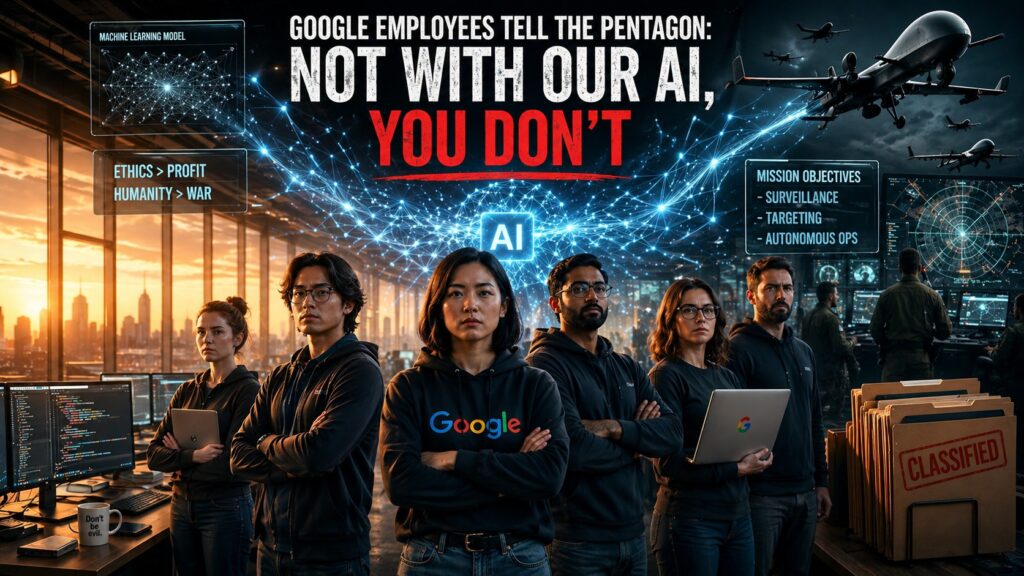
Over 600 Googlers just drew a line in the sand — and it points straight at the Department of Defense.
The Letter That Shook Silicon Valley
Picture this. You show up to work one Monday morning, coffee in hand, ready to push code or train models. Then you find out your employer, one of the most powerful tech companies on the planet, might be handing your work over to the Pentagon for classified military use. Without your knowledge. Without your consent. And possibly without any way for you to stop it.
That’s exactly the situation hundreds of Google employees found themselves in. And they didn’t stay quiet about it.
On April 27, 2026, more than 600 Google workers signed an open letter addressed directly to CEO Sundar Pichai. The message? Block the Pentagon from using Google’s AI for classified work. Full stop. No exceptions. No workarounds.
This wasn’t a casual Slack message or a passive-aggressive comment in a team meeting. This was a formal, organized, coordinated push from people who build the very technology in question. And it landed like a bomb.
Who Signed It — and Why That Matters
Let’s be clear: this wasn’t just a bunch of junior engineers venting frustration. According to Yahoo News, the signatories include over 18 senior-level staff, principals, directors, and even vice presidents. Many of them work inside Google’s DeepMind AI lab and Google Cloud division.
That’s not a protest. That’s a revolt from the inside.
The letter pulls no punches. “We want to see AI benefit humanity; not to see it being used in inhumane or extremely harmful ways,” the employees wrote. They specifically called out lethal autonomous weapons and mass surveillance as the kinds of applications they refuse to support.
But here’s the part that really stings: they’re not just worried about what the Pentagon might do with Google’s AI. They’re worried about what could happen without them ever knowing. Classified work, by definition, is secret. If Google’s Gemini AI gets deployed in a classified military setting, the engineers who built it may never find out how it’s being used. That’s a terrifying thought for anyone who cares about responsible AI development.
“The only way to guarantee that Google does not become associated with such harms,” the letter states, “is to reject any classified workloads. Otherwise, such uses may occur without our knowledge or the power to stop them.”
That’s not paranoia. That’s a legitimate concern.
What’s Actually on the Table
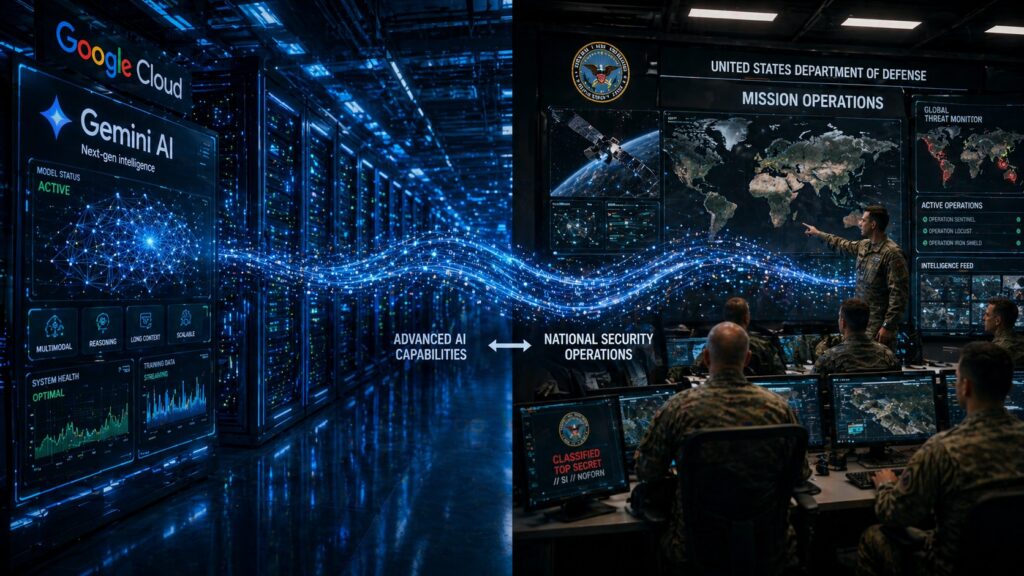
So what triggered all of this? It starts with a report from The Information that revealed Google and the Pentagon have been in active discussions. The deal on the table? Deploying Google’s Gemini AI models in classified military environments.
According to Newsmax, the two parties are discussing an agreement that would allow the Pentagon to use Google’s AI for “all lawful uses.” Google has reportedly proposed contract language to prevent its AI from being used for domestic mass surveillance or autonomous weapons without appropriate human control. But the employees aren’t buying it. Classified means classified and once that door opens, there’s no guarantee those guardrails hold.
A Pentagon official confirmed the military’s broader ambitions without directly addressing the Google talks: “The Pentagon will continue to deploy frontier AI capabilities through strong industry partnerships across all classification levels.” Translation: they want AI everywhere, at every security level, and they’re not slowing down.
For Alphabet, Google’s parent company, a Pentagon deal makes obvious business sense. It expands government ties, opens new revenue streams, and positions Google alongside Microsoft and OpenAI, both of which already have classified AI contracts with the Defense Department. OpenAI, in fact, renegotiated its Pentagon agreement back in February 2026.
But business sense and ethical sense don’t always point in the same direction.
The Ghost of Project Maven
If you want to understand why Google employees are so fired up, you have to go back to 2018. That year, Google got involved in Project Maven, a Pentagon program that used AI to analyze drone footage. Thousands of employees protested. Loudly. Persistently. And it worked. Google walked away from the contract.
After that, Google codified a set of AI principles that explicitly ruled out weapons systems and surveillance applications. It felt like a win. A real one.
Then, quietly, those guardrails disappeared. According to Yahoo News, Google stripped those restrictions from its AI principles the following year. And by March 2026, Google had already committed to furnishing Defense Department operations with AI agents, in an unclassified context, for now. Staff at DeepMind were reportedly told in a January internal meeting that similar agreements were coming.
So the employees signing this letter aren’t being dramatic. They’ve seen this movie before. They know how it ends.
The Anthropic Precedent — A Cautionary Tale
Here’s where things get really interesting. Google’s employees aren’t operating in a vacuum. They’re watching what happened to Anthropic, and it’s not pretty.
Anthropic, the AI safety company behind the Claude models, tried to do exactly what Google’s employees are asking for. They inserted contract language into their Pentagon deal that prohibited their AI from being used for mass surveillance or fully autonomous weapons. Reasonable stuff, right?
Wrong, at least according to the Pentagon. The Defense Department dropped Anthropic entirely in February 2026 after the company refused to remove those restrictions. The Defense Secretary then designated Anthropic a “supply chain risk.” Federal agencies were ordered to phase out its tools. A federal judge temporarily blocked the ban in March, but the legal battle is still ongoing.
The message from the Pentagon was loud and clear: play by our rules, or don’t play at all.
And yet, Google’s employees are still asking their CEO to take that same stand. That takes guts. Real guts.
Meanwhile, the situation gets stranger. Despite the U.S. government’s very public dispute with Anthropic, the NSA has reportedly been granted access to Mythos Preview, an Anthropic AI model restricted to a small group of researchers and cybersecurity organizations. President Trump recently suggested tensions may be easing, describing Anthropic as “shaping up.” Make of that what you will.
What the Employees Actually Want
The letter isn’t just a “no.” It comes with a concrete list of demands. According to Bitcoin Ethereum News, the employees are asking for three specific things:
- An immediate moratorium on deploying Google’s AI for military purposes.
- Full transparency on existing Pentagon contracts — what’s already been signed, what’s already in use.
- A permanent ethics board with actual employee representation to review any future military partnerships before they happen.
That third demand is particularly significant. The employees aren’t just asking to be heard once. They want a seat at the table going forward. They want institutional power to push back on decisions they find ethically problematic.
Google has not publicly responded to the letter. A request for comment went unanswered, according to Business Insider.
Silence, in this case, speaks volumes.
The Bigger Picture: Big Tech Goes to War
Zoom out for a second. What’s happening at Google isn’t an isolated incident. It’s part of a massive, industry-wide shift.
Since President Trump’s election victory, tech companies have been rapidly expanding their military partnerships, abandoning years of policies that restricted defense work. Microsoft already has deals to provide AI services in classified environments. OpenAI has its Pentagon agreement. Meta is reportedly in similar conversations.
The Chairman of the Joint Chiefs of Staff, General Dan Caine, has described autonomous weapons as a “key and essential part of everything we do” going forward. Senior Defense Department officials argue that the military should be allowed to use commercial AI in any situation that is legal. They say this approach keeps options open while staying within U.S. law and military rules.
That’s a reasonable-sounding argument. But it glosses over a critical question: legal according to whom? And ethical by whose standards?
The employees at Google, the people who actually build these systems, are raising exactly that question. They understand better than anyone what AI can and can’t do. They know where the guardrails are. And they know what happens when those guardrails get removed.
Why This Moment Feels Different
Employee activism at tech companies isn’t new. We’ve seen it at Amazon, Microsoft, and Google itself. But something about this moment feels different. More urgent. More consequential.
AI is no longer a research curiosity. It’s a weapon. Literally. The Pentagon is betting its future on it. Autonomous drones, battlefield decision-making systems, surveillance networks, these aren’t science fiction anymore. They’re procurement line items.
And the people building the underlying technology are starting to realize that their work has stakes they never signed up for. When you join a company to build a smarter search engine or a better language model, you don’t necessarily expect to find yourself contributing to classified military operations.
The Google employees who signed this letter are drawing a line. They’re saying: we built this, we care about how it’s used, and we’re not going to stay silent while it gets handed over to the military without our knowledge or consent.
Whether Sundar Pichai listens is another question entirely.
What Happens Next?

Nobody knows. Google hasn’t responded. The Pentagon negotiations are ongoing. The legal battle over Anthropic’s designation as a supply chain risk is still playing out in federal court.
But one thing is certain: the era of tech companies quietly signing defense contracts without internal pushback is over. Employees are paying attention. They’re organized. And they’re willing to go public.
The question isn’t whether this tension will continue. It will. The question is whether company leadership will treat employee concerns as a genuine ethical obligation, or just another PR problem to manage.
For the 600-plus Google employees who signed that letter, the answer matters enormously. For the rest of us, it should too.
Sources
- The Verge — Google employees ask Sundar Pichai to say no to classified military AI use
- Yahoo News — Google employees urge CEO to block Pentagon AI contracts
- The Washington Post — Google workers petition CEO to refuse classified AI work with Pentagon
- Newsmax — Google Employees Urge CEO to Reject Pentagon AI Deal
- Bitcoin Ethereum News — Google Employees Demand CEO Block Military AI Contracts in Open Letter
Military AI and Big Tech
Google, Gemini, and Defense Policy
- Google Gemini weapons and surveillance policy
- Google-Pentagon AI deal controversy
- Gemini-powered military AI network
AI Ethics and Defense Contractors
The Kingy Brief
Get the next Kingy Brief.
Source-checked AI changes, original tests and one practical thing to try.
Free · Choose your subjects · Double opt-in · Unsubscribe anytime