How OpenAI’s newest enterprise release turns ChatGPT into a shared, Codex-powered teammate that plans, acts, and keeps working while you’re away.
On April 22, 2026, OpenAI quietly reshaped what “using ChatGPT at work” means. With the launch of workspace agents, the company is no longer pitching ChatGPT as a clever conversational assistant. It’s pitching it as a teammate — one that can pick up a Slack thread, pull context from your documents, update your CRM, file a Linear ticket, draft the follow-up email, and then keep working on the next thing while you’re in a meeting or asleep.
This isn’t a minor product update. It’s the clearest signal yet that the enterprise AI race has moved past “impressive chat” and into what many are now calling the agent era — a phase in which the winners are the platforms that can actually do the work, not just talk about it.
Here’s everything worth knowing about workspace agents: what they are, how they work, why they matter, how to deploy them safely, and where OpenAI is taking them next.
Updated October 8, 2026: OpenAI now describes workspace agents as generally available in ChatGPT Business, Enterprise and Edu. Enterprise administrators must enable access for eligible workspaces. The April 22 launch details below remain historical: the May 6 free period has ended, and that announcement does not establish today’s credit rates or Teachers-plan entitlement. Check your workspace’s access and billing terms before committing a workflow.
The current workspace-agent guide describes creating an agent from the Agents sidebar, refining its draft, previewing it with a sample task, and publishing it when ready. Connected apps must be enabled and authenticated; instructions alone do not grant access. App write actions default to Always ask. Slack deployment requires shared app connections, so use a suitably restricted service account and review who can invoke the agent.
You can configure schedules and an API channel. API triggers queue a run and return 202 Accepted with no response body or run ID; the response cannot currently be retrieved through that API. The Workspace Agents plugin in Codex is in beta and can build, inspect, configure and publish agents. Running or previewing an agent still requires ChatGPT or Agent Studio. Changes to schedules and API triggers become live after publishing the draft.
From Custom GPTs to Shared Agents: A Quiet Evolution with Loud Implications
When OpenAI launched Custom GPTs, the vision was personal customization — anyone could build a tailored assistant for a specific purpose. But as 9to5Mac noted, Custom GPTs never quite became the core feature OpenAI hoped they would. They were useful, but they lived on the edges of most workflows.
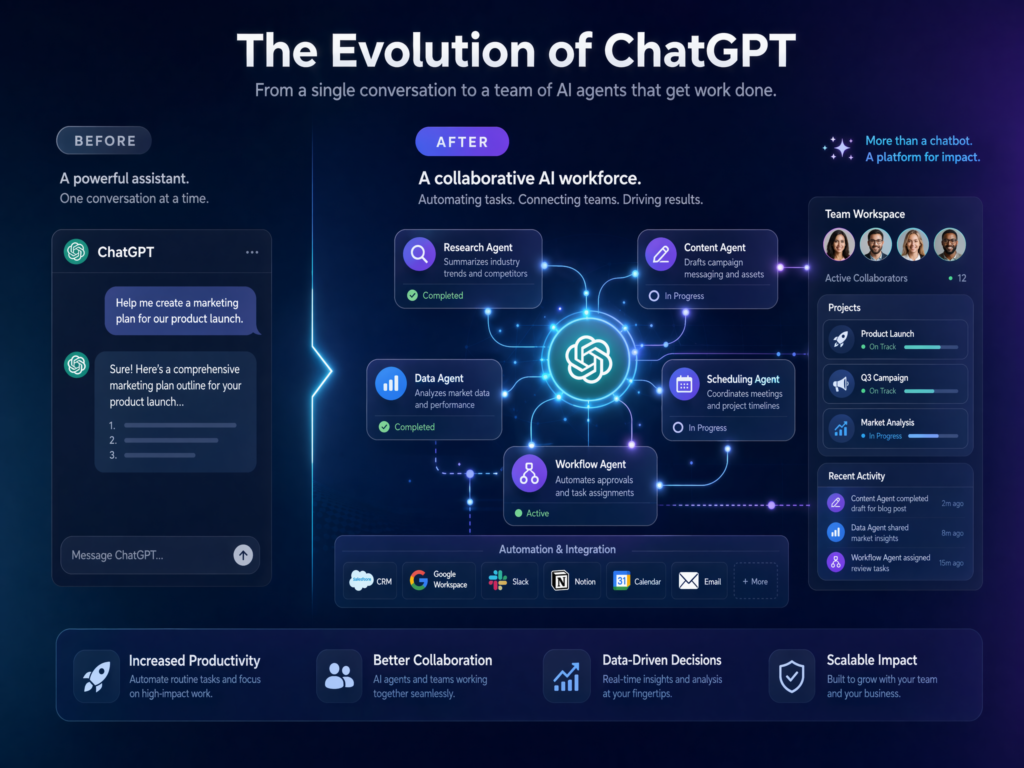
Workspace agents are OpenAI’s answer to what was missing. In the company’s own words, they are “an evolution of GPTs” — but the shift is more fundamental than the word “evolution” suggests. Workspace agents add shared cloud workflows to OpenAI’s customization tools. Workspace agents are shared, persistent, multi-step, and action-oriented. They’re designed for the way real work happens inside organizations: across people, across tools, across time.
OpenAI describes it plainly: “AI has already helped people work faster on their own, but many of the most important workflows inside an organization depend on shared context, handoffs, and decisions across teams. Workspace agents are designed for that kind of work.”
At the April 22 launch, OpenAI said GPTs would remain available while teams tested workspace agents, and described a future conversion tool. That launch statement does not confirm whether a conversion tool is available today.
What Exactly Is a Workspace Agent?
At the simplest level, a workspace agent is a shared AI worker you build once and deploy across your team. But underneath that simplicity is a meaningful technical stack.
Each workspace agent:
- Runs in the cloud on OpenAI’s infrastructure — so it keeps working even when you close your laptop.
- Has its own workspace, complete with files, code execution, connected tools, and memory that persists across sessions.
- Can plan and execute multi-step tasks rather than responding to a single prompt and stopping.
- Can be shared across an organization, surfaced inside ChatGPT or embedded directly into Slack.
- Operates under permissions set by administrators and the person who built it.
As Digital Trends put it, “ChatGPT is no longer just something that helps you think. It is slowly becoming something that works alongside you.” That framing captures the core shift: workspace agents don’t just accelerate your thinking — they own entire slices of execution.
The Technology Under the Hood: Codex, Everywhere
Workspace agents are powered by Codex, a cloud service. OpenAI has open-sourced on GitHub a separate Codex CLI agent that runs locally; its repository points users to Codex Web for the cloud service. The repository does not establish that the complete hosted workspace-agent runtime is open source. Codex is a reasoning-and-action engine built to write and run code, manipulate files, call tools, and reason over long contexts. By making Codex the backbone of workspace agents, OpenAI is essentially saying: the same engine that can autonomously complete complex engineering tasks is now powering your sales follow-ups, your weekly metrics reports, and your month-end close.
Each agent operates inside a dedicated cloud workspace that includes:
- File storage for reference documents, SOPs, templates, and outputs.
- A code interpreter for running scripts, manipulating data, and producing charts.
- Connectors to integrate with your team’s tools.
- Persistent memory, which can retain context across work. Memory configuration and file limits still matter; it does not guarantee that every earlier detail will be recalled.
That last piece — memory — is what makes workspace agents feel less like bots and more like colleagues. Because they remember, they can be corrected mid-conversation and continue to improve. As The Decoder observed, this turns scattered team knowledge into reusable workflows that follow the right process and use the right tools.
How to Build a Workspace Agent in Minutes
OpenAI has gone to significant lengths to make agent creation non-technical. You do not need to write code. You do not need an engineering team. You describe what you want done.
The flow looks like this:
- Click the Agents tab in the ChatGPT sidebar.
- Describe a workflow your team does often, or drop in a file — an SOP, a playbook, a checklist, a spec.
- ChatGPT guides you through the build step by step: defining the task steps, connecting the relevant tools, adding skills, and testing the agent against example inputs until it behaves the way you expect.
- Publish the agent. Share it with a team, a group, or the whole organization.
- Improve it over time using conversation-based corrections and usage analytics.
For teams who want to move even faster, OpenAI ships templates for common use cases — finance, sales, marketing, and more. Each template comes pre-wired with suggested tools and built-in skills so you can stand up a working agent in minutes and then customize from there.
The story being told by Rippling’s AI Engineering lead, Ankur Bhatt, captures how radically this lowers the barrier. As quoted in OpenAI’s launch post:
“The hard part of building an agent is not the model. It’s the integrations, memory, the user experience. Workspace agents collapsed that work, so one of our Sales Consultants built, evaluated, and iterated a Sales Opportunity agent end to end without an engineering team. It researches accounts, summarizes Gong calls, and posts deal briefs directly into the team’s Slack room. What used to take reps 5–6 hours a week now runs automatically in the background on every deal.”
Rippling’s launch testimonial reported 5–6 hours of weekly work saved for reps while the agent handled deals in the background. It did not report a separate 5–6-hour saving for each deal.
Five Flagship Agents OpenAI Showcased
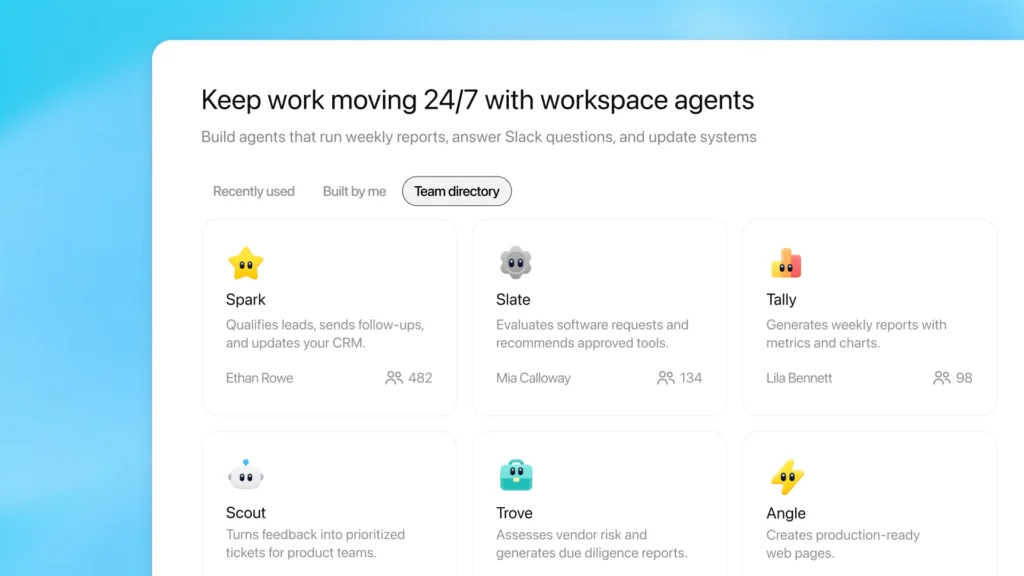
OpenAI unveiled workspace agents with five demo agents that illustrate the breadth of what’s possible:
1. Software Reviewer. Reviews employee software requests, checks them against approved tools and company policies, recommends next steps, and files IT tickets when needed. This is the kind of work that normally eats manager and IT time in slow, back-and-forth threads.
2. Product Feedback Router. Monitors Slack, support channels, and public forums. Turns raw feedback into prioritized tickets and delivers a weekly product summary. The agent captures signals, classifies them, and drives them into action.
3. Weekly Metrics Reporter. Every Friday, the agent auto-pulls the underlying data, generates charts, writes the narrative explaining what changed and why, and delivers a complete business report.
4. Lead Outreach Agent. Qualifies inbound leads against your rubric, researches accounts, drafts personalized follow-up emails, and updates the CRM. This is one of the highest-leverage applications because sales pipelines are notorious for context loss between reps, tools, and handoffs.
5. Third-Party Risk Manager. Screens vendors by researching sanctions exposure, financial health signals, and reputational risk. Produces a structured diligence report. What typically takes procurement teams days gets collapsed into minutes.
These aren’t hypothetical demos. Many of them are running inside OpenAI right now.
How OpenAI Uses Workspace Agents Internally
OpenAI used its own launch to show a few of the agents its teams depend on:
- The sales team uses an agent that pulls details from call notes and account research, qualifies new leads, and drafts follow-up emails directly into reps’ inboxes. Account executives spend less time stitching details together and more time in front of customers.
- The accounting team built an agent that prepares key parts of the month-end close — journal entries, balance sheet reconciliations, and variance analysis. It completes the work in minutes, produces workpapers with the underlying inputs and control totals needed for review, and enforces internal policies. Team members can access it in ChatGPT or in Slack channels where they collaborate around outputs.
- The product team built an agent that proactively answers employee questions in Slack. It responds with clear answers, links relevant documentation, and files tickets when it detects new issues — preventing the common failure mode where important follow-ups slip through the cracks.
If you squint, you can see the future: every operational function in a modern company — finance, legal, IT, HR, sales, marketing, support — has repetitive, multi-system workflows that workspace agents are designed to eat.
Where Agents Live: ChatGPT, Slack, and Beyond
Workspace agents are accessible today in two primary surfaces:
- ChatGPT, where they live in the sidebar under a dedicated Agents tab. Team members can discover, use, and collaborate with agents their colleagues have built.
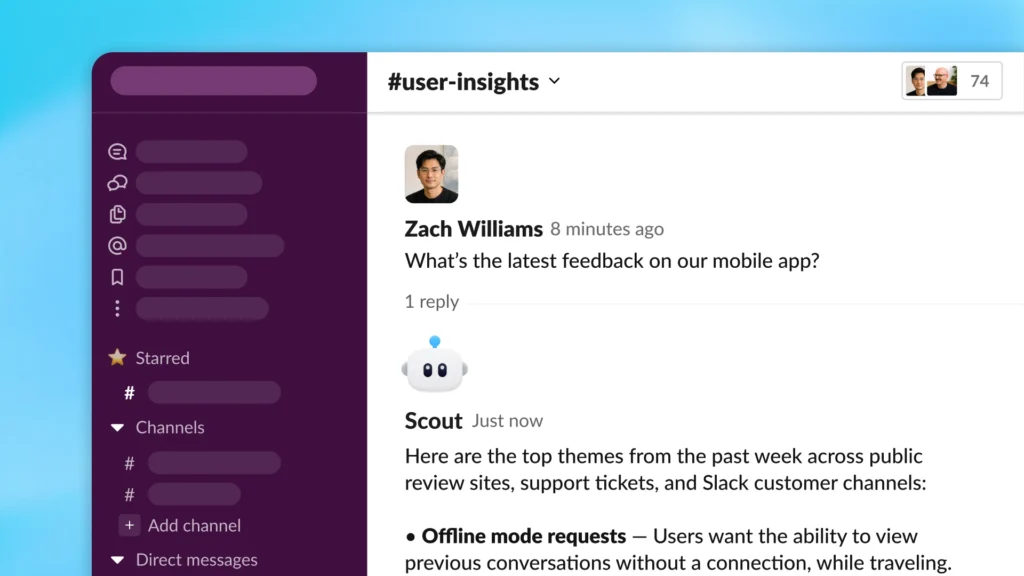
- Slack, where agents can be dropped directly into channels and threads. In Slack, an agent can jump into a conversation, understand what’s being asked, pull the right context from connected systems, help resolve the issue, and update the right tools — all without derailing the human conversation.
OpenAI’s April 22 announcement described more surfaces as future work. The current Help Center now documents a beta Workspace Agents plugin in Codex for building and configuring agents; it does not run the agent itself.
Triggers, Schedules, and Background Work
One of the most practical features of workspace agents — and one that makes them feel genuinely different from prior AI tools — is that they don’t require you to initiate every run.
Agents can be configured to:
- Run on a schedule (e.g., every Friday at 4pm, pull the metrics and publish the report).
- Run in the background while you’re offline.
- Pick up Slack requests as they come in, responding to threads without being prompted by a specific person.
The April 22 announcement described new triggers as future work. The current guide documents API triggers: an external system can queue an agent run through a configured API channel and a Workspace Agent access token. A queued request does not provide the finished response through the API.
Safety, Approvals, and Staying in Control
The power of agents comes with obvious risk. If an agent can send emails, edit spreadsheets, update CRM records, and file tickets, you had better be sure it only does so when you want it to. OpenAI’s design explicitly acknowledges this.
Every agent operates within a permission scope defined by:
- The person who built it.
- The administrator of the workspace.
- Role-based controls that determine who can use, build, and share agents.
For sensitive actions — sending emails, adding calendar events, editing spreadsheets, creating external documents — the agent can be required to ask for approval before proceeding. You stay in control of the consequential moves; the agent handles the grinding context-gathering and drafting in between.
After sharing an agent, builders get an analytics panel showing how many runs it has completed and how many people are using it — helping teams identify agents that are working well and those that aren’t getting traction.
Built-in safeguards also protect agents from prompt injection attacks, where malicious content embedded in external data tries to trick an agent into unintended actions. OpenAI has published a dedicated overview of its prompt injection safeguards, and the workspace agents stack builds on that foundation.
Enterprise Governance: Compliance, Visibility, Control
For IT leaders and CISOs, the interesting story lives in the enterprise controls. OpenAI is clearly positioning workspace agents not just as a productivity upgrade but as governable enterprise infrastructure.
ChatGPT Enterprise and Edu admins can:
- Control which connected tools and actions each user group can access.
- Manage who has permission to use, build, and share agents.
- Monitor every agent’s configuration, updates, and runs via the Compliance API.
- Suspend agents if anomalies appear.
OpenAI has also previewed an upcoming admin console view that will show every agent built across the organization, including usage patterns and the data sources each agent is connected to. For security teams who have been worried about “shadow AI” proliferating inside their orgs, this kind of top-down visibility is exactly what they’ve been asking for.
Pricing, Availability, and the Fine Print
Workspace agents launched in research preview on April 22, 2026. The announcement listed these plans at launch; this list should not be read as current eligibility:
- ChatGPT Business
- ChatGPT Enterprise
- ChatGPT Edu
- ChatGPT Teachers
On Enterprise and Edu plans, admins can enable agents through role-based controls before users see the feature.
The April 22 announcement offered free use until May 6, 2026 and said credit-based pricing would start then. That introductory period is over. The linked ChatGPT agent mode is a different product; its usage limits do not establish workspace-agent credit rates. Confirm your own workspace’s current billing terms.
Notably, The Tech Buzz observed that by restricting workspace agents to premium business tiers, OpenAI is pursuing a different strategy than Google — which is bundling its agent capabilities into existing Workspace subscriptions — and Microsoft — which is using Office 365 as a distribution vehicle for Copilot.
Why This Matters: The Bigger Competitive Picture
Workspace agents didn’t land in a vacuum. They arrived during a stretch of enterprise AI moves that’s been impossible to miss:
- Google launched its Gemini Enterprise Agent Platform on the same day, deepening its push to embed agents across Workspace.
- Microsoft has been steadily extending Copilot’s autonomous capabilities across Office, Teams, and Windows.
- Anthropic has been pressing forward with Claude’s tool-using capabilities in enterprise contexts.
- Newer entrants like OpenClaw (previously Clawdbot and Moltbot) went viral earlier this year with a platform marketed explicitly as “the AI that actually does things,” and OpenAI subsequently hired its founder, Peter Steinberger.
OpenAI’s advantage has historically been model quality. Workspace agents are its answer to the obvious follow-up question: can those models actually ship into real business workflows at scale? By combining Codex’s execution power, a clean team-centric surface, enterprise-grade governance, and deep Slack integration out of the gate, workspace agents are a serious attempt to prove that the answer is yes.
As The Verge put it, workspace agents can be shared within organizations “so teams can build an agent once, use it together in ChatGPT or Slack, and improve it over time.” That one-line description may end up being the most consequential user-facing change in ChatGPT’s enterprise journey so far.
Strengths and Weaknesses: An Honest Assessment
Workspace agents look strong on paper. But there are real open questions.
What’s genuinely impressive:
- The build experience is radically simpler than prior agent platforms. Describing a workflow and getting a functional agent in minutes is a step-change in accessibility.
- Slack-native deployment means agents can participate in the places where teams already coordinate — not in a separate AI surface users must remember to visit.
- The governance story includes Compliance API visibility, admin controls, suspension and analytics. Each organization still needs to assess whether the available controls meet its procurement requirements.
- Codex as the engine gives agents real action capabilities: code execution, file manipulation, multi-step reasoning. This is not a glorified prompt template.
What deserves healthy skepticism:
- The launch preview did not establish reliability at scale. General availability also does not substitute for testing your own workflow and failure cases.
- Messy, incomplete, or contradictory data is the norm in enterprise systems. How gracefully do agents degrade when reality doesn’t match the builder’s assumptions?
- The launch announcement said credit-based pricing would start on May 6, 2026. Budget using current workspace terms and measured workflow consumption.
- Prompt injection defenses are improving but not solved. Any agent that consumes external content — Slack messages, emails, web pages — inherits some injection surface area.
- Tool coverage matters. Agents are only as useful as the systems they’re connected to. Slack, Gmail, Linear, and a handful of common tools are in scope today; broad coverage is still being built out.
None of these concerns invalidate the launch. They’re simply the honest gap between “impressive product” and “load-bearing infrastructure.”
What’s Coming Next on OpenAI’s Roadmap
OpenAI’s April 22 launch roadmap included the following priorities. These were plans at that date; the current API-trigger and Codex-plugin details are described above.
- New triggers that start agent work automatically based on events (a form submission, a new CRM entry, a new Slack message matching a filter).
- Better dashboards for understanding agent performance and improving it over time.
- More integrations so agents can take action across a broader set of business tools.
- Workspace agents in the Codex app, extending the surface beyond ChatGPT and Slack.
- A conversion tool for existing Custom GPTs, so organizations with meaningful GPT investments can migrate without starting over.
Taken together, this roadmap sketches a recognizable trajectory: agents as an always-on substrate that spans your tools, starts on its own when needed, and gets incrementally smarter from team feedback.
A Practical Playbook: How to Roll Out Workspace Agents Well
If you’re an IT leader, product manager, or ops lead thinking about how to introduce workspace agents into your organization, here’s a rollout sequence worth considering:
1. Start with one repetitive, high-annoyance workflow. Weekly reporting and inbound lead qualification are great candidates because they’re already well-defined and the outputs are easy to evaluate.
2. Identify a single-owner agent. At the beginning, one human should own the agent, curate corrections, and triage its mistakes. Committee-owned agents tend to drift.
3. Require approvals for any outbound or irreversible action. Sending emails, editing records, and posting in external channels should all gate behind human confirmation in the first weeks.
4. Connect the minimum viable toolset. Every new connector adds both capability and risk. Start small, extend deliberately.
5. Instrument usage from day one. Use the built-in analytics to identify agents people actually depend on versus agents that exist but go unused.
6. Plan for the pricing transition. The May 6, 2026 introductory window has ended. Confirm the current billing terms and measure expected consumption before expanding agent use.
7. Make sharing a deliberate decision. Just because you can share an agent across the org doesn’t mean you should. Agents that encode real institutional processes deserve thoughtful ownership and governance.
8. Build feedback loops. Encourage users to correct agents in-conversation. That’s where the compounding quality gains come from.
The Deeper Shift: AI as Shared Infrastructure
Zoom out and the significance of workspace agents becomes clearer. For the last two years, AI at work has been mostly an individual productivity story: a person prompting a chatbot to help them write, code, or summarize. Workspace agents reframe AI as shared organizational infrastructure — reusable, governable, observable, and embedded in the tools where real work actually happens.
That’s a meaningfully different product category. It competes less with “chat” and more with:
- Low-code automation platforms (Zapier, Workato, n8n).
- RPA tools (UiPath, Automation Anywhere).
- Internal tooling platforms (Retool).
- Custom engineering-built workflow software.
The twist is that workspace agents are conversation-first, memory-equipped, and reason-capable in ways those legacy categories aren’t. They don’t just execute rigid flowcharts; they can read a Slack thread, figure out what’s needed, and act. That’s why OpenAI’s decision to put Codex underneath matters so much — it’s the difference between a chatbot with integrations and an actual autonomous worker.
Final Thoughts: The Real Test Is Production, Not Demos
Workspace agents are the most convincing “AI teammate” product OpenAI has shipped. The build experience is fast. The governance is credible. The Codex backbone gives them real capabilities. And the early testimony from customers like Rippling suggests the productivity gains are genuine, not theoretical.
But the real verdict will come from production. Can a Weekly Metrics Reporter agent survive the day the data pipeline breaks? Can a Lead Outreach Agent be trusted to draft emails that don’t embarrass the brand? Can a Third-Party Risk Manager agent catch the edge case that actually matters? The launch demos and present general-availability status do not answer those questions. Test the actual data, permissions, approval steps and failure cases before relying on an agent in production.
If workspace agents pass those tests, they’re going to change the shape of knowledge work. Teams will increasingly build, share, and refine agents the way they currently build, share, and refine documentation — as durable institutional assets rather than personal hacks. The org chart will quietly expand to include non-human contributors. And the phrase “AI copilot” will start to feel dated.
If they don’t, workspace agents will still be remembered as the moment OpenAI drew a clear line between consumer AI and enterprise AI — and started competing in earnest for the multi-trillion-dollar market of actual work getting done.
Either way, the direction is clear. The chatbot era is ending. The agent era is here. And the question for every team is no longer should we try this? but what’s the first workflow we hand over?
The Kingy Brief
Get The Kingy Brief.
AI changes, original tests and one practical thing to try. Fridays at 09:00 Vancouver time.
Free · Double opt-in · Unsubscribe anytime
Sign up for The Kingy Brief on Beehiiv.
Signup help and newsletter schedule
Signup form provided by Beehiiv. After submitting, check your inbox for "Confirm your subscription to The Kingy Brief" and open its confirmation link. Check Spam or Promotions if you cannot find it.
Fridays at 09:00 Vancouver time: source-checked AI changes, original tests and one practical thing to try. We skip a week when there is not enough verified material. Free. Unsubscribe anytime.