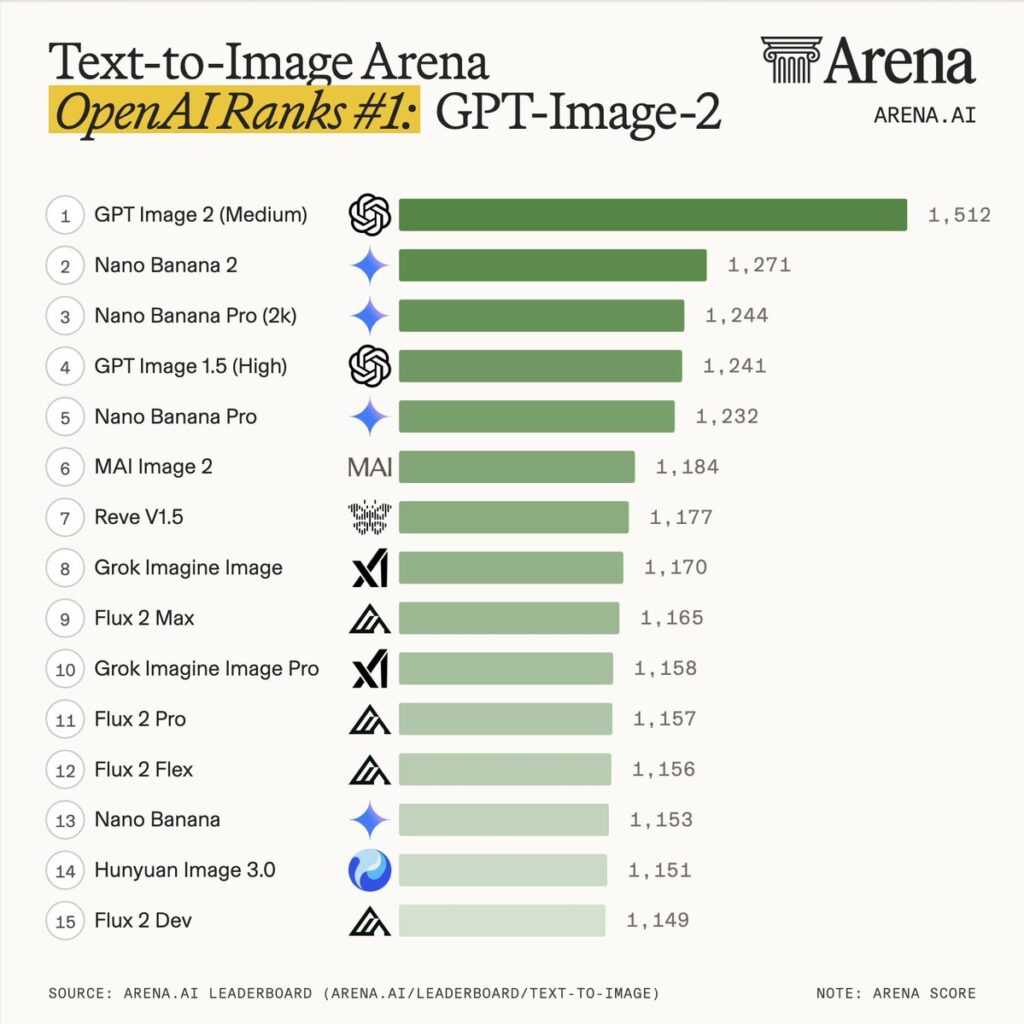
On April 21, 2026, OpenAI shipped the first AI image model that can actually lay out a magazine. The economic aftershock is going to land hardest on the people who just finished art school.
The Menu Test
Two years ago, if you wanted to prove that AI couldn’t really do design, you asked it to generate a menu for a Mexican restaurant.
You’d get back something that looked, at first glance, like food. Then your eye would catch the prices, and then the dish names, and then you’d realize you were staring at an imaginary cuisine of “enchuita,” “churiros,” “burrto,” and “margartas.” The image was gorgeous. The text was nonsense. And for about thirty months, that gap — between a model that could dream a composition and a model that could actually write on it — was the single load-bearing wall keeping generative AI out of real production design work.
On April 21, 2026, TechCrunch’s Amanda Silberling ran the same menu test on ChatGPT Images 2.0 and got back a menu that, in her words, “could immediately be used in a restaurant without customers noticing that something’s off.” The ceviche is priced a little aggressively at $13.50, but the words are real words, the kerning is clean, the hierarchy is correct, and a print shop could send it to a table tonight.
The wall fell. The question now isn’t whether AI can do production graphic design. It’s who still gets paid for it.
What Actually Shipped
Let’s start with the facts, because a lot of the commentary about Images 2.0 has been vibes and screenshots, and the details matter if you’re trying to figure out whether your job survives the quarter.
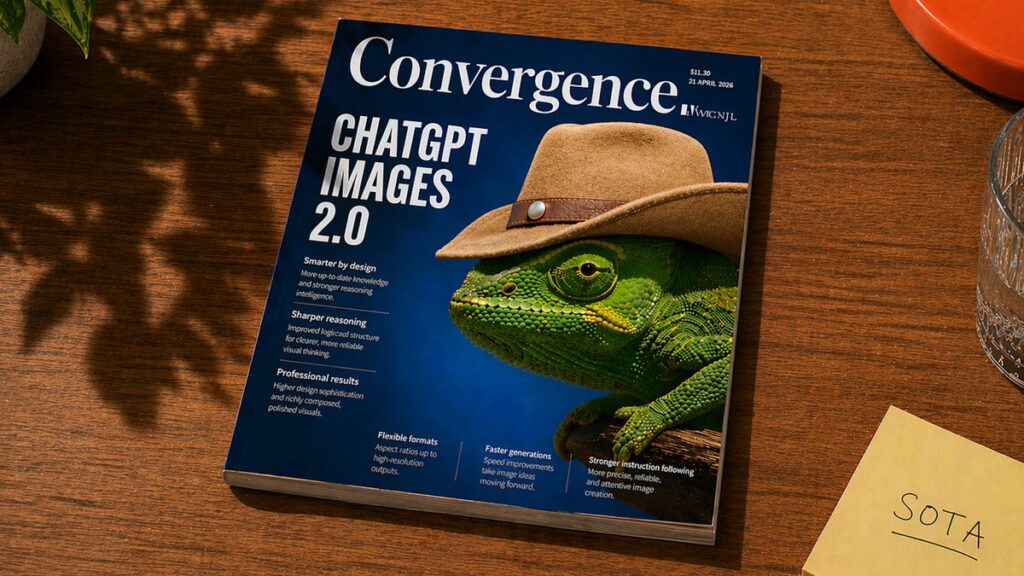
OpenAI’s announcement and the subsequent press coverage describe a model with a very specific profile. According to 9to5Mac’s rundown of the launch livestream, Images 2.0 can output at up to 2K resolution across flexible aspect ratios, supports non-Latin languages as first-class text-rendering targets, and — in OpenAI’s own framing — can be used to “create whole magazines.” Two variants are available on day one: an “Instant” mode and a “Thinking” mode. Paid ChatGPT and Codex users get the advanced outputs; the gpt-image-2 API is live with pricing tied to quality and resolution.
Interesting Engineering’s coverage fills in the technical envelope. Aspect ratios span from 3:1 to 1:3. A single prompt can produce up to eight outputs. Thinking mode, as demonstrated on stage, reasons through a task before rendering — which is how it manages multi-frame character consistency, the thing that has tortured every comic artist and storyboard team that has tried to use diffusion models for narrative work. Instant mode, which OpenAI tested quietly on LMArena under the codename “duct tape,” trades some of that deliberation for speed without visibly sacrificing quality.
The most interesting capability, though, is the one The Verge reported: Images 2.0 can pull information from the live web before it generates. Ask it for a one-pager about a current event and it will research, summarize, and lay out in a single loop. The knowledge cutoff for the underlying intelligence is December 2025, but the browsing capability extends past it. In the official OpenAI framing quoted in 9to5Mac, the pitch is that Images 2.0 “can expertly handle tasks end-to-end, from copywriting to analysis to design composition.”
End-to-end. Remember that phrase.
The long-standing weak point of AI image models — text — has been the headline of almost every review. Tom’s Guide called it “the first one designers might actually use”, specifically because the text finally stops warping. OpenAI’s own press release, quoted by TechCrunch, claims the model can “render the fine-grained elements that often break image models: small text, iconography, UI elements, dense compositions, and subtle stylistic constraints, all at up to 2K resolution.”
Small text. Iconography. UI elements. Dense compositions. That sentence is a list of every billable task a junior designer does before lunch.
Why This One Is Different From Every Previous “AI Killed Design” Moment
Designers have been here before. Midjourney v5 was supposed to end illustration. DALL-E 3 was supposed to end stock photography. Adobe Firefly was supposed to fold the production pipeline into a single button. And yet, as of early 2026, the profession is still standing — if a little bruised.
So why is this release different?
Three reasons, and they compound.
First, the text problem really was the last real moat. Every previous AI image model failed the same production test: it couldn’t reliably put legible, correctly-kerned, on-brand type on a deliverable. That single flaw made human designers a bottleneck in any agency pipeline, because someone had to take the AI output into Photoshop or Figma, mask out the nonsense text, and composite in real type. That bottleneck was billable hours. It was the thing that kept the lights on at small studios and the thing that kept juniors employed. PetaPixel’s analysis of the launch notes that OpenAI is explicitly pitching the model for “real-world creative workflows” — a subtle but important shift from “look what it made” toward “use this in your deliverables.”
Second, the iterative, conversational interface changes the unit economics. As the Interesting Engineering piece documents, OpenAI no longer treats image generation as a single prompt-response transaction. “It’s an AI that you interactively talk to, and it responds,” one of OpenAI’s researchers said during the demo. You can zoom into a layout, ask for a different headline weight, swap a hero image, change the grid, and keep going without restarting. In the demo, the system generated eight different summer outfits from a single uploaded reference photo, scanned social media reactions to earlier model tests, summarized the insights into a visual, and produced a QR code pointing back to ChatGPT — in a single thread.
That loop — research, draft, critique, revise, finalize — is what a junior designer does when handed a brief. The loop didn’t disappear. It moved.
Third, multi-frame consistency cracks storytelling open. Thinking mode’s ability to hold a character across a sequence of frames — which the Interesting Engineering piece notes is already being used for manga and storyboarding — means that editorial illustration, comic panels, pitch-deck narratives, onboarding flow mockups, and multi-asset marketing campaigns can now be generated coherently in one pass. Before April 21, you could get any one of those images. You couldn’t get a series that actually belonged to the same universe. Now you can.
Put those three together and what you get isn’t a better toy. You get a model that can do a small agency’s worth of production work in a single afternoon, conversationally, with legible text, at print resolution, across eight aspect ratios, in Japanese or Hindi, with the characters looking like themselves from panel one to panel twelve.
That is not an incremental release. That is a category change.
The Junior Designer Squeeze
Here is where the conversation gets uncomfortable, because the part of the design industry most exposed to this capability isn’t the famous art directors or the lead brand strategists. It’s the people who just graduated.
The World Economic Forum’s 2025 Future of Jobs Report already flagged graphic design as one of the professions most threatened by AI. As Design Week’s Rob Alderson summarized, the WEF’s 2025 survey — based on interviews with 1,000 employers representing more than 14 million workers across 55 countries — ranked graphic design as the 11th fastest-declining job over the next five years. That alone would be concerning.
What makes it alarming is the trajectory: in the previous WEF report two years earlier, graphic designers were “considered a moderately growing job.” The category flipped, in one survey cycle, from growth to decline, and the WEF explicitly linked the change to AI’s “increasing capacity to perform knowledge work.”
That report was published in early 2025. It was based on a world where AI image models still couldn’t spell. Images 2.0 is what comes next.
The production tasks that used to be the training ground for entry-level designers are precisely the tasks Images 2.0 automates best. Walk through them:
Social media asset resizing. Every junior designer has spent a Tuesday afternoon taking a single hero image and rebuilding it for Instagram square, Instagram story, LinkedIn banner, Twitter header, Pinterest pin, and a YouTube thumbnail. Images 2.0 does all eight in a single prompt, at correct aspect ratios, with the text readable on each. That task is not coming back.
Menu, flyer, and deck layout. The Mexican restaurant menu test is not a party trick. It is a proof that a small business owner can now generate a usable menu, a wedding invitation, a real estate flyer, or a sales deck without ever opening InDesign. The hundred-dollar gig on Fiverr — the gig that kept a lot of mid-career freelancers and a lot of design-school grads alive — is directly exposed.
Iconography and UI mockups. OpenAI’s press release specifically calls out iconography and UI elements as solved. That targets both the low-end end of UI design (wireframes, mockups, onboarding flows) and the icon-pack cottage industry that has lived on marketplaces like Noun Project and IconFinder.
Pitch-deck visuals and mood boards. With web-aware generation, the model can research a client’s current campaign, pull reference imagery, and assemble a mood board in one pass. That was a junior’s first week of work on a new account.
Editorial illustration, comics, and storyboards. Thinking mode’s character consistency makes this tractable in a way it wasn’t a week ago.
Localization. Non-Latin script support means the entire outsourcing chain that builds localized versions of Western marketing campaigns — Japanese game marketing, Korean beauty ad adaptation, Indian fintech collateral — has a new competitor that works for API pricing.
None of this means “graphic design” disappears as a field. It means that the bottom half of the skill pyramid — the production half, the resizing and layout and basic comp half — compresses toward zero marginal cost. And that bottom half is where juniors lived.
The Economic Pincer
The effect isn’t going to arrive uniformly. It’s going to arrive as a pincer, squeezing the market from both ends.
From above, agencies cut billable hours. Agency economics depend on leverage: a senior or a creative director wins the work, and an army of juniors and mids actually ships it. When the “ships it” part is a prompt, the leverage inverts. The agencies that thrived in the 2010s by stacking juniors billing at $75–$125 an hour against clients who didn’t know better are the agencies most exposed to this release. The conversation at an agency partner meeting next Tuesday is going to be about headcount.
From below, self-service reaches a tipping point. The research firm Robert Half’s 2026 graphic design outlook reports that 69% of marketing and creative leaders say advancements in AI and automation are reshaping the skills they need on their teams. Starting salaries for graphic designers, per the same Robert Half data, sit between $52,000 and $79,500 depending on market — which is the exact spend bracket a marketing manager might now reallocate once she realizes she can ship her monthly social calendar with a ChatGPT Teams seat and a good prompt library.
In the middle, the freelance marketplaces get repriced. The Tapflare 2025 market analysis — one of the more data-rich treatments of the space — estimated global graphic design services at $55.1 billion in 2025 and projected 8.1% CAGR through 2030, driven heavily by freelance marketplaces and subscription “design-as-a-service” models. Those marketplaces are the first to feel price compression from a model like Images 2.0, because they are the most directly substitutable. A $50 logo gig on Fiverr is competing with a free generation. A $300 social-post package is competing with a $20/month subscription plus ten minutes of a marketing coordinator’s time.
And underneath all of this is the apprenticeship problem, which is the thing almost nobody in the current AI-and-design debate is grappling with honestly. Juniors do not become seniors by thinking senior thoughts. They become seniors by doing three years of production work and absorbing, through their fingers, the ten thousand micro-decisions that make a layout feel right. When the production work goes away, the training path goes with it.
Patrick Franc, a veteran designer writing on Medium about his own experience job-hunting at 54, captured the sociological texture of this shift a year ago: a designer he quotes had been unemployed for a single business day and had already clocked the pattern of “jobs expecting creatives to quite literally do it all for low pay.” The comments on the post — dozens of designers listing Photoshop, Illustrator, InDesign, Figma, Premiere, After Effects, HTML, CSS, and now “prompt engineering” on top — read like a recession canary. What’s happening to juniors now isn’t that their jobs were taken by AI alone. It’s that the job description expanded to a mythical unicorn at the exact moment a model arrived that could do most of the unicorn’s work.
What Junior Designers Still Have (For Now)
I want to be careful here, because there is a genre of AI-disruption commentary that is basically just pessimism cosplay. The situation is not hopeless. There are real, defensible pockets of value that Images 2.0 does not touch, and they are the same pockets that Figma’s most recent hiring research flags as the places the market is still paying for.
That Figma study, published in February 2026 and based on a global survey of design managers, landed on a conclusion that should be counterintuitive to anyone doomscrolling design-Twitter: 82% of design hiring managers say their organization’s need for designers has either stayed steady or increased, and nearly half say demand has actually gone up. Design-focused VC firm Designer Fund, cited in the same Figma piece, estimates that design job postings across its portfolio were up roughly 60% in 2025 versus the prior year.
But — and this is the important but — the Figma data also shows 56% of hiring managers report increasing demand for senior design hires, compared to just 25% for junior ones. The market is real. It’s just concentrated above the line where Images 2.0 operates.
So what does the junior retain?
Taste and art direction. When the model gives you eight variants, someone still has to know which one is on-brand, which one won’t get the legal team nervous, and which one will land with a 42-year-old mortgage customer in Ohio versus a 22-year-old gamer in Seoul. That’s a human skill, and it’s the skill Figma’s respondents ranked as the most important: 58% named visual polish as a top-five skill, and more than 45% cited collaboration, systems thinking, and product strategy.
Client translation. Briefs are vague on purpose. Clients lie to themselves about what they want. Translating that fog into prompts that produce approvable work — and then defending the work back up the chain — is going to become a discipline, and it’s a discipline that rewards exactly the soft skills Robert Half’s 2026 guide lists as decisive: communication, flexibility, the ability to stay calm under last-minute change requests.
Systems thinking. Design systems, component libraries, token management, motion specifications, cross-surface consistency — these are things Images 2.0 can produce instances of, but can’t govern. A design system is a decision about what the next thousand instances should look like. That decision is strategic. It’s senior work. And it’s one of the few areas where the Figma data shows consistent, rising demand.
The last 10%. Accessibility compliance. Trademark clearance. Print production with real CMYK separations and bleed. Packaging dielines that have to survive a folding machine. Motion-sensitive animation. The edge cases that aren’t in the training distribution. This is unglamorous, but it’s a real floor.
Designing for AI. Per the Figma research, 73% of hiring managers now see an increasing need for designers proficient in AI tools, and 79% say the same of designing AI products. One UK-based tech hiring manager quoted in the Figma piece said bluntly: “we fully prioritize positions that combine technical capacity, strategy, and out-of-the-box thinking — which includes the use of AI, human-in-the-loop, and human-augmented AI.” If Images 2.0 represents the commoditization of production, then designing the interfaces, prompt structures, review workflows, and governance layers around tools like Images 2.0 is the new senior work.
None of that is comfort for someone who just handed in a thesis. But it is a map.
How Junior Designers Should Actually Respond
I am skeptical of most “here’s how to survive the AI apocalypse” listicles, so I want to make this section as concrete as I can. If I were 22 and about to walk out of design school into the post-Images-2.0 job market, here is what I would do, in priority order.
1. Shift to a creative-director posture immediately, even at the junior level. Stop thinking of yourself as the person who makes the thing. Start thinking of yourself as the person who decides which of the eight things is correct, and why. Write those decisions down. That document — a critique log, basically — is what a portfolio will look like in 2027.
2. Specialize narrow and deep in a place Images 2.0 cannot follow. The WEF Future of Jobs Report’s fastest-growing design category isn’t graphic design; it’s UI/UX, which was the 8th fastest-growing job overall in the 2025 survey. Motion design, 3D, AR/VR, accessibility specialization, brand strategy, and UX research all sit on the growth side of the pincer. The Tapflare report projects AR/VR and 3D visual design as the fastest-growing service-type subsector, at roughly 15% CAGR through 2030. Pick one. Go deep for three years.
3. Build an AI-native portfolio. Stop showing finished pixels. Show the brief, the prompts, the rejected variants, the critique notes, the revisions, and the final. Show the judgment. A portfolio in 2026 that is just pretty outputs is telling a hiring manager you haven’t figured out what your actual job is yet. A portfolio that documents art direction over ten iterations tells them you have.
4. Learn the prompt-and-critique loop as a core skill — it is the new Figma. Every three years, a new tool becomes table stakes. In 2013 it was responsive design. In 2018 it was Sketch, then Figma. In 2023 it was Figma plus a working knowledge of Midjourney. In 2026 it’s the ability to structure a conversation with a model like Images 2.0 well enough to produce on-brand, production-ready work in under ten iterations. That skill is teachable. It is also currently underpriced.
5. Take the internship even if it feels beneath you. This one is blunt. Daniel Wert, the executive-search CEO quoted in the Figma study, said flatly: “It just boggles my mind how few internship programs there are these days. I think it seems shortsighted… The best teams, the best organizations, have a lot of diversity [of] years of experience.” Internships are the one pipeline into the seats that aren’t being automated, and they are shrinking. If one is offered, take it. The alternative is trying to break in from the outside after two years of AI-augmented freelance work, which is a much harder sell to a senior hiring manager who wants continuity, not resilience.
The Counter-Argument (Steelman)
I owe the counter-argument an honest run, because the pessimistic case is seductive and mostly wrong on the ten-year timeline.
Every prior moment that was supposed to kill graphic design turned out to expand the market. When Photoshop arrived, the field grew. When desktop publishing democratized layout, the field grew. When Canva put templates in front of every small-business owner, the field grew. When Midjourney launched in 2022, everyone said the bottom was falling out — and in 2025, Upwork’s own data showed graphic design remained the #1 most-demanded skill in its Design & Creative category, per the Tapflare analysis.
The underlying reason is worth stating plainly: when you make a thing cheaper to produce, people produce more of it, and the bottleneck shifts from production to curation. More menus get designed, not fewer. More decks get made, not fewer. More brand refreshes get attempted. The market for “someone who can tell me which one of these is good” expands, because the supply of “things that could be good” just exploded.
Figma’s research finds exactly this: 46% of fast-growing companies plan to increase design hiring in the next six months; 40% of hiring managers plan to open more headcount; and AI fluency, rather than replacing the designer, has become the criterion by which designers are hired. The Design Council’s Minnie Moll, quoted in the Design Week coverage of the WEF report, framed it as a moment that “reinforces the irreplaceable value of human creativity” even as routine tasks are automated away.
The counter-argument is not that designers are safe. The counter-argument is that the function of design — making meaning visible — remains human, and that the market for humans who can do that function at a high level may actually expand, because the volume of visible meaning being produced is exploding.
What’s changing is where in the pipeline the humans sit. And that is the part that’s genuinely bad for juniors in the short run, because the middle of the pipeline — the part that used to train seniors into existence — is the part getting eaten.
The Two-Year Window
OpenAI’s own framing, in the Interesting Engineering interview with their researchers, is that image generation is no longer a feature — it is “becoming a core interface for interacting with AI.” Read that sentence carefully. OpenAI is not pitching Images 2.0 as a better Midjourney. They are pitching it as the interface layer through which a lot of knowledge work gets done, full stop. Copywriting plus analysis plus design composition, end-to-end, in one loop.
If that framing holds, then the graphic design job title in its 2024 shape — a mid-sized role that blends production, strategy, and a bit of art direction — is likely to bifurcate within 18 to 24 months. On one side: Creative Director roles that are almost entirely about taste, strategy, and client translation, with production happening through AI loops. On the other side: Design Engineer roles that sit at the seam between design systems, code, and AI governance, operating the tooling and building the guardrails.
The casualty is the middle. The traditional junior-to-mid production designer, the person who made a living by being pretty good at Photoshop and Figma and turning out clean work on deadline — that archetype doesn’t have a good seat in the 2028 org chart of a typical marketing team. The work they did has been absorbed by the model. The strategic work above them requires experience the apprenticeship path used to provide and no longer reliably does. The systems work below them requires a different kind of technical depth most graphic design programs don’t teach.
This is the part of the story where I want to be careful to stay honest about the evidence. The WEF report says 41% of employers plan to cut jobs due to AI’s improving capabilities, but 77% plan to reskill and upskill workers, and 47% plan to transition employees from AI-disrupted roles to other positions. That is a real, active redistribution, not a cliff. The juniors who end up fine will be the ones who catch one of those transitions early. The juniors who get hurt will be the ones who are still presenting portfolios full of Instagram grids in the spring of 2027.
Is This the End of Graphic Design?
No. It’s the end of graphic design as a reliable entry-level job.
Those are very different claims, and keeping them separate matters for any honest conversation about this moment. The field is in good shape. Figma’s numbers say the field is actually in its best shape in a decade at the senior level. The industry is going to keep growing, per the Tapflare and Mordor forecasts, into a $81+ billion global market by 2030.
What’s ending is the version of the profession where an art-school graduate could walk into a small agency, spend three years resizing hero images and laying out product pages, and emerge as a mid-level designer ready for harder work. That path is closing. The reason it’s closing is that on April 21, 2026, OpenAI released a model that can do those three years of work in an afternoon, with legible text, at print resolution, in any aspect ratio, in Japanese and Hindi, with character consistency across frames, while researching the client’s current campaign on the live web.
The honest pitch to anyone considering graphic design as a career in late April 2026 is not “run.” It’s “go narrower and go deeper, faster than you were planning to.” The Creative Director seats and the Design Engineer seats are going to be in demand for a long time. The production seats are not coming back. And the ladder between them — the thing the industry used to build through sheer volume of junior grunt work — is the thing that, as of this week, has to be rebuilt on purpose, by someone, before the next cohort of designers comes of age in a market that has no idea how to train them.
That someone is probably going to be us.
The Kingy Brief
Follow The Kingy Brief.
One consequential launch, one pricing, limit, or shutdown change, one hands-on test, one exact prompt or Test Pack, and one try / watch / skip verdict.
Free · Choose your subjects · Double opt-in · Unsubscribe anytime