AI Content Detector
AI Content Detection Tool
Analyze any text for signs of AI generation using 10+ linguistic heuristics — entirely client-side, private, and instant.
Analyzing your text…
Running multi-signal heuristic analysis
Why AI Content Detection Matters More Than Ever — And How to Check Any Text in Seconds
The internet is changing fast. By some estimates, the majority of what you read online was never written by a human. Here’s why that matters — and what you can do about it.
Over half of the content published online is now written by artificial intelligence. That’s not a prediction — it’s already happening. According to Stanford’s AI Index Report 2026, more than 50% of newly created internet content has been AI-generated since early 2025, a staggering rise from near zero when ChatGPT launched in November 2022.
An Ahrefs study of 900,000 newly created webpages found that 74.2% contained AI-generated content. Only 25.8% were purely human-written. The rest? A sliding scale of human-AI blends — from lightly assisted drafts to content that was almost entirely machine-produced.
And it’s only accelerating. Europol estimates that as much as 90% of online content could be synthetically generated by 2026.
The question isn’t whether AI is writing the internet. It already is. The question is: can you tell?

The Problem With Undetected AI Content
Why should anyone care whether a blog post, product review, or news article was written by a person or a machine?
Because trust is built on authenticity — and AI-generated content has a well-documented problem with accuracy, originality, and depth.
AI models are trained to produce plausible text, not truthful text. They hallucinate statistics, fabricate citations, and confidently present outdated information as fact. When this content floods the web unchecked, it degrades the quality of information that everyone — readers, students, professionals, and even other AI systems — depends on.
This matters to businesses, too. Google’s own guidelines make clear that while AI-generated content isn’t automatically penalized, content that is low-quality, unhelpful, or produced primarily to manipulate search rankings will be. Google’s E-E-A-T framework — Experience, Expertise, Authoritativeness, and Trustworthiness — applies equally to AI and human content. Generic, thin AI output that lacks genuine expertise or original insight is exactly the kind of content that gets filtered out.
For publishers, marketers, and business owners, the risk is real. As Zero Gravity Marketing notes, a 2024 survey found that 71% of marketers saw improved engagement and SEO performance when AI content was human-edited — implying that raw, unreviewed AI output consistently underperforms.
A Booming Industry for a Reason
The market for AI content detection tools is exploding. MarketsandMarkets projects the AI detector market will grow from $0.58 billion in 2025 to $2.06 billion by 2030 — a compound annual growth rate of 28.8%.
The demand is coming from everywhere:
- Over 65% of universities now use AI detection tools to uphold academic integrity (TextShift)
- 78% of content marketing teams use AI detection in their editorial workflows (TextShift)
- 97% of content marketers plan to use AI for content creation in 2026 — which makes detection the necessary counterbalance (The Stacc)
The pattern is clear: the more AI content is produced, the more critical it becomes to verify what’s human and what isn’t.
How AI Content Detection Actually Works
AI detectors don’t read text the way you do. They analyze statistical patterns — the mathematical fingerprints that distinguish human writing from machine output. The core signals include:
Perplexity — a measure of how predictable the text is. Human writing surprises. It detours, recovers, and makes unexpected word choices. AI text tends to be statistically “smooth” — each word is the most probable next word given what came before. Low perplexity often signals machine generation.
Burstiness — the variation in sentence length and structure. Humans write in bursts: a long, complex sentence followed by a short, punchy one. AI tends toward uniformity — paragraphs of similar length, sentences of similar rhythm, a flatness that trained eyes (and algorithms) can spot.
Vocabulary Diversity — measured through metrics like the Type-Token Ratio. Human writers draw from a wider, more unpredictable vocabulary. AI tends to favor a narrower set of “safe” words, repeating the same terms and constructions.
Transition Word Overuse — words like “Moreover,” “Furthermore,” “Additionally,” and “In conclusion” appear at rates in AI text that would make a high school English teacher wince. These mechanical connectors are one of the most reliable tells.
Sentence Starter Repetition — AI frequently begins consecutive sentences with similar structures. “The” this, “The” that, “It is” here, “It is” there. Human writing is naturally more varied in how sentences open.
Structural Uniformity — AI paragraphs tend to be suspiciously similar in length, and writing follows a formulaic structure: setup, explanation, conclusion, repeat. Human writers are messier — and that mess is the signal.
These signals are combined and weighted to produce a composite score: the likelihood that a given piece of text was generated by AI.
The Limitations You Should Know About
No AI detector is perfect — and anyone who claims otherwise is selling something.
According to independent testing by Digital Applied, even the best single-model detectors achieve around 80–90% accuracy, with false positive rates averaging 5–15% across the industry. That means human-written content gets incorrectly flagged more often than most people realize — particularly content from non-native English writers or highly technical fields.
Perhaps more importantly, detection accuracy drops 20–30% with light editing of AI text, and falls below 50% with heavy rewriting (Digital Applied). A skilled editor can make AI text largely undetectable — which is exactly why detection should be seen as one tool in a broader quality strategy, not an infallible oracle.
The best approach? Use detection as a signal, not a verdict. A high AI score doesn’t prove the text was machine-generated — but it does suggest the writing may lack the variation, depth, and originality that readers and search engines reward.
Where This Is All Headed
The conversation around AI content is shifting. Google isn’t trying to ban AI writing — they’re trying to ensure the internet remains useful. Their Helpful Content System, permanently integrated into core ranking infrastructure since 2024, targets content created primarily for search engines rather than people. If a large portion of a site is deemed unhelpful, the entire domain can see ranking suppression.
Meanwhile, AI detection is expanding beyond text. Reality Defender now offers browser extensions for deepfake scanning. Google DeepMind’s SynthID embeds invisible watermarks into AI-generated images, video, audio, and text at creation. The EU AI Act is pushing for mandatory labeling of AI-generated content.
The future isn’t about AI vs. human. It’s about transparency — knowing what you’re reading, who (or what) wrote it, and whether it deserves your trust.
Try It Yourself
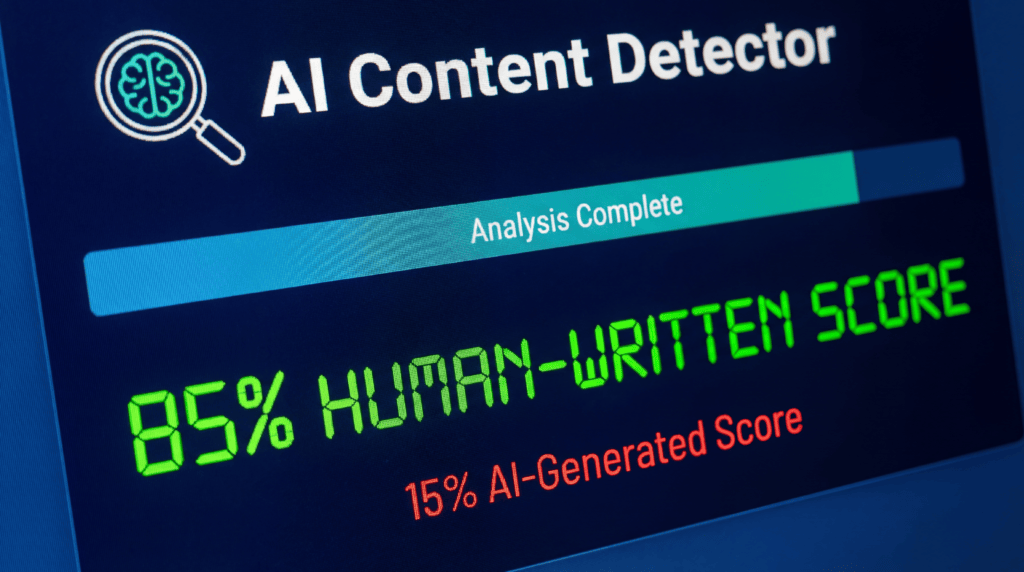
The tool above lets you paste any text and get an instant analysis — a composite AI likelihood score, a detailed breakdown across eight linguistic dimensions, and sentence-level highlighting showing which parts of the text triggered detection signals.
It runs entirely in your browser. No data is sent anywhere. No account required.
Paste in a blog post you’re reviewing. Check a freelancer’s deliverable. Test your own writing. In a world where most of the internet is no longer written by humans, a little skepticism goes a long way.
The AI Content Detection Tool uses client-side heuristic analysis to estimate the likelihood of AI-generated text. It is not a substitute for professional editorial review. No detection method is 100% accurate — use results as one input among many when evaluating content quality.
The Kingy Brief
Get The Kingy Brief.
AI changes, original tests and one practical thing to try. Fridays at 09:00 Vancouver time.
Free · Double opt-in · Unsubscribe anytime
Signup help and newsletter schedule
Signup form provided by Beehiiv. After submitting, check your inbox for "Confirm your subscription to The Kingy Brief" and open its confirmation link. Check Spam or Promotions if you cannot find it.
Fridays at 09:00 Vancouver time: source-checked AI changes, original tests and one practical thing to try. The weekly restart begins October 9, 2026. We skip a week when there is not enough verified material. Free. Unsubscribe anytime.