
You know that friend who shows up to every party, blends in perfectly, and somehow ends up running the whole thing by the end of the night? That’s Canva right now. The Australian design darling — the one that made your cousin’s birthday invitations look like they were made by a professional — just walked into the AI arena and said, “We live here now.”
On April 16, 2026, at its flagship Canva Create event in Los Angeles, Canva officially launched Canva AI 2.0. And this isn’t just a shiny new feature drop. This is a full-on identity shift. Canva is no longer just “a design platform with AI tools.” It’s now, in its own words, “an AI platform with design tools.”
That’s not just a word swap. That’s a whole new worldview.
From Magic Wands to AI Agents: How We Got Here
Let’s rewind a little. Canva launched back in 2012 with a simple but powerful idea: make design accessible to everyone. No Photoshop degree required. No design school tuition. Just drag, drop, and done.
Then ChatGPT exploded onto the scene in late 2022, and the whole tech world scrambled to figure out what AI meant for their business. Canva moved fast. By early 2023, it had already integrated generative AI features into its platform. Interestingly, Fortune noted that Canva was initially shy about using the word “AI” — preferring the softer, friendlier term “magic” instead.
Well, the magic wand is gone. The AI agent has arrived.
Canva CEO Mel Perkins revealed something fascinating during the launch. She pulled up a concept from 2011 called Canvas Chef — a rough prototype that looked like a Google Search page dressed up in kitchen decor. The idea? You type what you want, and you get a design. Just like that.
“From the very early stages, we always believed that you could just be able to type in whatever you want and kind of get kickstarted straight away,” Perkins told Fast Company. “Obviously, it has been a very long journey to get to this point in time, but really, that is actually what we’re launching today.”
Fifteen years later, that sketch is now a product. And it’s a big one.
So, What Exactly Is Canva AI 2.0?
Here’s where it gets genuinely exciting. Canva AI 2.0 isn’t just a smarter search bar. It’s a full rearchitecting of the entire Canva platform — from the ground up.
“We had to rearchitect the whole Canva platform,” said Cliff Obrecht, Canva’s cofounder and COO, in an interview with Fortune.
The new platform lets users create and edit designs using natural language prompts. You talk to it. It builds. You tweak. Done. But it goes way beyond just making pretty slides.
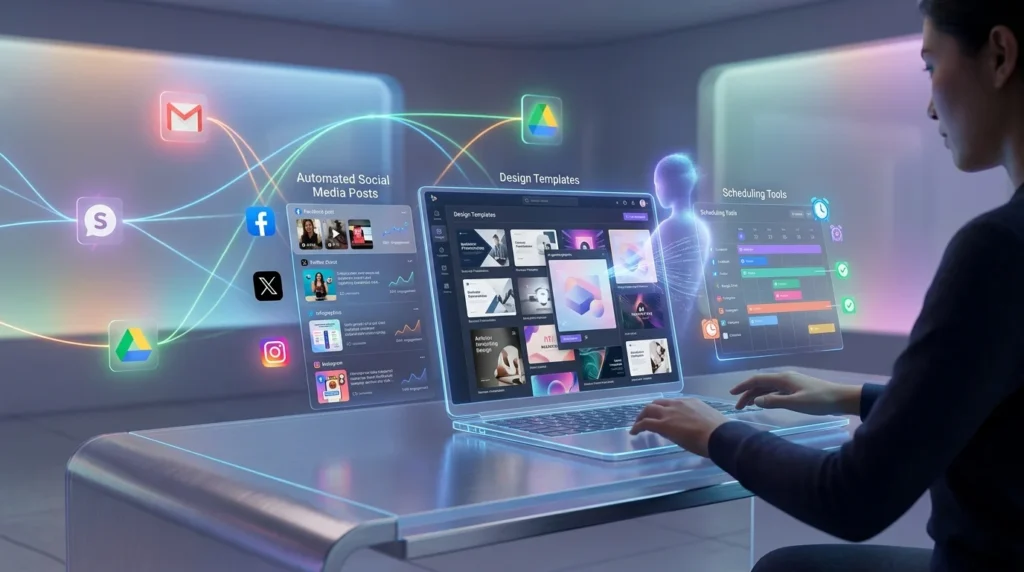
Canva AI 2.0 connects to external services like Gmail, Slack, Zoom, Google Drive, Google Calendar, and Notion — all through MCP (Model Context Protocol), an open standard developed by Anthropic. These integrations give Canva’s AI the rich context it needs to actually understand your work life, not just your design preferences.
And then there’s persistent memory. Canva now learns how you work. It remembers your brand colors, your tone, your preferences. It can automatically update designs when your brand imagery changes. It’s like having a design assistant who actually pays attention.
The platform also introduces conversation-based editable designs — meaning the outputs Canva generates aren’t static images. They’re fully editable. You can keep the conversation going, refine the design, and iterate — all without starting from scratch, as The Hindu reported.
Meet the Star Feature: Scheduling

If there’s one feature that really captures what Canva AI 2.0 is all about, it’s Scheduling.
This isn’t your average “post at 9am on Tuesday” kind of scheduling. This is autonomous, agentic scheduling. Canva can now crawl the web for breaking news overnight, figure out what’s trending, create social media posts around it, and schedule them — all on its own. No human required until it’s time to hit approve.
Think about what that means for a small business owner, a solo content creator, or a marketing team of two. Tasks that used to eat up entire days — researching trends, writing copy, designing graphics, scheduling posts — can now run in the background while you focus on the stuff that actually needs your brain.
“It can help you complete your whole job,” Obrecht told Fortune.
TechRadar caught up with Canva co-founders Obrecht and Cameron Adams, who acknowledged that autonomous agentic tools are still at an “absolute early adopter stage.” But that’s exactly the point. Canva wants to democratize that early-adopter power and put it in the hands of everyday users — not just enterprise tech teams with six-figure AI budgets.
Other recurring task examples include weekly social content batches, daily meeting briefings, and internal company newsletters. Canva handles the busywork. You handle the final call.
Scheduling is currently available as a research preview to the first million users who can crack a hidden easter egg in the platform. Yes, really. Canva hid an easter egg. Because of course they did.
The Numbers Behind the Glow-Up
Let’s talk about scale, because Canva’s numbers are genuinely jaw-dropping.
Canva has 265 million users worldwide. That’s not a niche design tool. That’s a global platform. And according to an analysis by VC firm a16z, Canva is now the world’s third most used generative AI web product by monthly active users — sitting right behind Google Gemini and ahead of China’s DeepSeek chatbot.
Let that sink in. Canva — the app people use to make birthday cards and Instagram stories — is beating DeepSeek in AI usage.
The company reported $3.5 billion in revenue in 2025. It’s still privately held, valued at $42 billion — a valuation that has held steady even as the broader SaaS market has taken a beating. Adobe’s shares are down more than 30% over the past year. Figma lost nearly 85% of its value since its IPO. Meanwhile, Canva is sitting pretty.
“We’ve fortunately avoided being hit by that SaaS apocalypse,” Obrecht told Fortune.
An IPO, Obrecht has hinted, is “probably imminent in the next couple of years.”
Building the Engine: Acquisitions and Own Models
Here’s something that doesn’t get talked about enough: Canva isn’t just plugging in someone else’s AI. It’s building its own.
The company has been on an acquisition spree. In 2024, it acquired Leonardo AI, an image-generating platform. Just last week, it snapped up Simtheory, a platform for building AI agents, and Ortto, a marketing automation company.
These moves aren’t random. They’re strategic. Canva is assembling the pieces it needs to own its AI stack — models, infrastructure, and agent-building capabilities — rather than depending on third-party providers.
The result? Canva claims its AI services are sevenfold faster and 30-fold cheaper than comparable frontier models. Obrecht also mentioned that Canva is exploring ways to tap into device processing power for AI, rather than routing everything through the cloud. That’s a bold move — and a smart one for a platform with 265 million users hammering its servers every month.
“There’s only so long you can fund your user base with VC-funded dollars,” Obrecht said. “With 265 million users on a monthly basis hammering our services, we have to own our models and we have to own infrastructure that serves our models.”
What This Means for the Design World
Let’s be real for a second. The design industry is nervous. AI can now generate images, videos, presentations, and social posts in seconds. Tools like ChatGPT and Claude are getting better at visual content every month. Adobe — the longtime king of creative software — is scrambling to keep up.
But Canva is playing a different game. It’s not trying to replace designers. It’s trying to make everyone a designer. And now, it’s trying to make everyone a content operations team, too.
The shift from “design platform with AI” to “AI platform with design” is more than marketing language. It signals that Canva sees its future not just in helping people make things look good — but in helping people get things done. Fully. Autonomously. Intelligently.
Obrecht put it bluntly: “If we’re not going to disrupt ourselves, then we’re going to be disrupted.”
That’s the kind of self-awareness that separates companies that survive AI from companies that get swallowed by it.
Pricing: Something for Everyone
Canva AI 2.0 rolls out across multiple pricing tiers, so it’s not just for enterprise teams with deep pockets.
Free users get access to Canva’s basic AI, along with a small number of credits for premium model features. From there, pricing scales up through several tiers, all the way to $100 per month — which Obrecht describes as “almost all-you-can-eat,” even if the most powerful models still have some limits.
That’s a smart move. Keep the door open for casual users. Give power users a reason to pay. And make sure the platform stays accessible to the small business owner, the freelancer, the student — the people Canva was built for in the first place.
The Road Ahead: Hundreds of Integrations and Beyond
Right now, Canva AI 2.0 launches with integrations for Slack, Gmail, Google Drive, Google Calendar, Notion, and Zoom. But Obrecht called this just the “start of a huge wave.”
Potentially hundreds of MCP connectors could be on the way, giving Canva’s autonomous scheduling and agentic tools even richer context to work with. The more data Canva can pull in — from your calendar, your inbox, your brand guidelines, your past content — the smarter and more useful it becomes.
This is the flywheel Canva is building. More integrations mean more context. More context means better outputs. Better outputs mean more users. More users mean more data. And around it goes.
The agentic AI era is here. And Canva just showed up to it — not as a guest, but as a host.
Final Thoughts: The Quiet Giant Gets Loud

Canva has always been a quiet giant. It grew to 265 million users without making the kind of noise that OpenAI or Google make, It built a $42 billion business without the drama of a public market debut. It integrated AI without screaming about it from the rooftops.
But with Canva AI 2.0, the quiet phase is over. This is Canva planting its flag in the AI landscape and saying: we’re not just a design tool anymore. We’re the platform where work gets done.
Whether you’re a solo creator trying to keep up with your content calendar, a marketing team drowning in deliverables, or a business owner who just wants things to run smoother — Canva AI 2.0 is coming for your to-do list.
And honestly? It’s about time.
Sources
- Fortune — Canva debuts a new suite of agentic tools
- Fast Company — Canva is officially ‘an AI platform with design tools’
- TechRadar — Autonomous agentic assistants are at an ‘absolute early adopter stage’: Scheduling in Canva AI 2.0 is about to “democratize” that
- The Hindu — Canva AI 2.0 launched, bringing agentic features and conversation-based editable designs to users
- a16z — 100 Gen AI Apps
The Kingy Brief
Get The Kingy Brief.
AI changes, original tests and one practical thing to try. Fridays at 09:00 Vancouver time.
Free · Double opt-in · Unsubscribe anytime
Sign up for The Kingy Brief on Beehiiv.
Signup help and newsletter schedule
Signup form provided by Beehiiv. After submitting, check your inbox for "Confirm your subscription to The Kingy Brief" and open its confirmation link. Check Spam or Promotions if you cannot find it.
Fridays at 09:00 Vancouver time: source-checked AI changes, original tests and one practical thing to try. We skip a week when there is not enough verified material. Free. Unsubscribe anytime.