
There is a paradox sitting at the very heart of the generative AI revolution, and almost nobody is talking about it honestly.
OpenAI — the company that ignited the modern AI era with ChatGPT — is projected to generate $12 billion in annual sales in 2025, according to data compiled by Backlinko from reporting by The Information. That number is staggering. It is the kind of revenue figure that redefines an industry, reshuffles investor portfolios, and sends competitors scrambling.
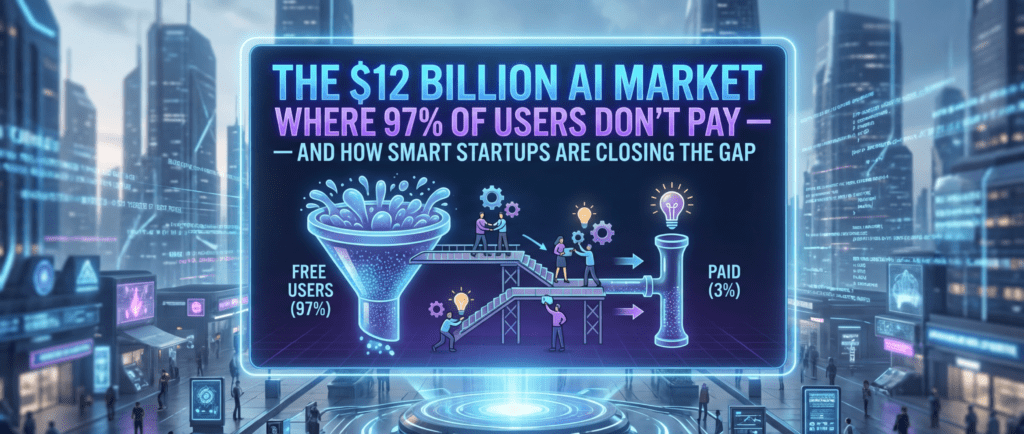
And yet, sitting directly underneath that headline number is a stat that should give every founder, operator, and investor pause: at its peak, ChatGPT had roughly 900 million weekly active users and approximately 50 million paying subscribers across all tiers. Do the math. That means somewhere between 94% and 96% of every person who opens ChatGPT in a given week is paying absolutely nothing.
Zoom out to the broader generative AI ecosystem — beyond OpenAI, beyond any single tool — and the picture becomes even more striking. Across SaaS and AI-native products, 95% to 98% of free users will never convert to paying customers, according to research from Pathmonk.
The average freemium-to-paid conversion rate across B2B SaaS is just 3%, per Userpilot. Freemium models convert around 2.6% of organic users to paid, according to Amra and Elma. Round it all up — or rather, round it down — and you arrive at a single, uncomfortable truth: approximately 97% of people using AI tools today are not paying for them.
This is not a failure. This is a structural feature of how the generative AI market has been built — and it is simultaneously the industry’s biggest opportunity and its most dangerous blind spot. Understanding why 97% of users don’t pay, and what the smartest startups are doing to close the gap, is the defining commercial challenge of the AI era.
At Kingy AI, we track the generative AI landscape daily — the tools, the monetization models, the conversion tactics, and the startups rewriting the rules. This piece is our most comprehensive market overview yet: a ground-level look at where the money actually flows, who is winning the conversion war, and what the next wave of smart AI companies is doing differently.
The Market Is Enormous — And Growing Faster Than Almost Any Projection
Before we interrogate the monetization problem, let’s contextualize the scale of what we are talking about.
Depending on who you ask and how they define the boundaries, the global generative AI market is already generating tens of billions of dollars annually — and the trajectory is almost vertical. Grand View Research estimates the global generative AI market at $22.21 billion in 2025, projected to reach $324.68 billion by 2033 at a CAGR of 40.8%. MarketsandMarkets puts the 2025 figure higher — at $71.36 billion — and forecasts an expansion to $890.59 billion by 2032 at a CAGR of 43.4%. Statista’s market outlook pegs the 2025 market at $59.01 billion, projecting $86.70 billion in 2026 alone.
The variance in these numbers reflects genuine methodological disagreement about what “counts” — API revenues, enterprise licenses, consumer subscriptions, infrastructure embedded in AI workflows. But even the most conservative estimate points to a market growing at nearly 40% annually, driven by the seamless embedding of generative AI into enterprise workflows and a consumer adoption curve that has been historically unprecedented.
ChatGPT’s growth story alone belongs in a different category from any consumer technology that came before it. It reached 1 million users in 5 days and 100 million users in 2 months. TikTok — widely understood to be one of the fastest-growing apps in history — took 9 months to hit 100 million users. Instagram took 2.5 years. The generative AI wave didn’t just move quickly; it obliterated the existing frame of reference for what “fast” means in technology adoption.
And yet, velocity of adoption and velocity of monetization are two very different things. The AI market has proven extraordinarily good at the former and still remarkably challenged by the latter.
The 97% Problem: Why Almost Nobody Pays
To understand why the vast majority of AI users don’t pay, you have to understand the specific psychology and market mechanics of the freemium model — which has become the de facto go-to-market strategy for virtually every consumer and prosumer AI tool.
The freemium model is seductive in its logic. You attract massive user bases at low cost, build network effects and brand recognition, collect behavioral data, and then gradually convert the most engaged users into paying customers. Companies like Spotify, Slack, Dropbox, and Zoom all rode this model to enormous valuations.
The problem is that generative AI has stress-tested freemium in ways those earlier companies never had to contend with — because running an AI model is genuinely, structurally expensive in a way that hosting a file or streaming a song is not.
According to a 2026 survey of 200 B2B software products conducted by Kyle Poyar at Growth Unhinged in partnership with ChartMogul and ProductLed, the median free-to-paid conversion rate across all products is 8%. But that median is misleading. The distribution is wildly bimodal: one in five products sees a conversion rate below 2.5%, and roughly one in four sees conversion above 25%. Very few products actually land at 8%. In the freemium-specific data, one in four products see a free-to-paid conversion rate below 2.5%, and it is rare to see freemium conversion above 15%.
For AI-native and AI-SaaS hybrid products, the conversion benchmarks are slightly better — “good” is defined as 6-8% and “great” as 15-20% — but the baseline truth remains: the overwhelming majority of people who use any given AI tool will never open their wallets.
There are structural reasons for this beyond just user psychology.

First, the free tier is genuinely useful. Unlike legacy software where the free version was deliberately crippled into near-uselessness, modern AI tools tend to provide genuine value for free. ChatGPT’s free tier powered by GPT-4o mini can write code, draft essays, answer complex questions, and generate images.
For casual users, this is often more than enough. As the Pathmonk analysis of SaaS conversion rates notes, “users often sign up for free trials or freemium plans out of curiosity but never make the leap to paid” because the free tier adequately meets their needs.
Second, the switching cost is nearly zero. If ChatGPT imposes a usage limit, a user can switch to Claude, Gemini, Perplexity, or any of dozens of other capable tools in under 30 seconds — most of which also have generous free tiers. This competitive dynamic depresses willingness to pay across the board. Differentiation is hard when capability parity improves monthly.
Third, the aha moment is often immediate but shallow. Generative AI tools tend to deliver an impressive first experience — the “wow, it wrote that so fast” moment — but struggle to build the kind of deep workflow dependency that creates strong upgrade motivation over time. A user who is genuinely astonished by a tool’s capabilities is not automatically a user who will pay for it.
Fourth, there is genuine uncertainty about long-term value. Many users worry that AI capabilities will continue to improve rapidly, that prices will fall, or that a better free alternative will emerge. Paying $20/month for something that might be free — or superseded — in six months feels like a risk.
The Economics Are Brutal at Scale
Here’s where the freemium-AI tension becomes genuinely acute: the cost of serving a free user in the generative AI space is orders of magnitude higher than in traditional SaaS.
When Dropbox gives away free storage, the marginal cost of an additional free gigabyte trends toward zero over time. When an AI tool gives away free queries, it is burning GPU compute — the most expensive commodity in the current technology economy — every single time someone hits “generate.” OpenAI CEO Sam Altman has publicly stated that ChatGPT Pro subscriptions at $200/month are still unprofitable due to high usage. If $200/month is unprofitable, the math at $20/month, let alone $0, becomes structurally terrifying.
As Kinde’s analysis of AI tool billing noted: “The freemium model is a powerful engine for growth, especially for AI-powered tools. You attract a wide user base, let them experience your product’s magic, and build a community. But growth alone doesn’t pay the bills — or the GPU costs.”
This is the existential tension that every AI startup is navigating right now: the model that most effectively drives adoption is also the model that most effectively burns capital. And with GPU costs remaining high, as the Growth Unhinged 2026 report specifically calls out, “supporting free users has gotten much more expensive as AI token costs have remained high.”
The companies that survive and scale are not those that ignore this tension — they are the ones that have found genuinely creative ways to resolve it.

The Conversion Arsenal: What Smart Startups Are Actually Doing
The good news — and the real story that gets lost in the doom-and-gloom narrative about AI monetization — is that a new generation of AI-native startups is developing increasingly sophisticated approaches to closing the conversion gap. Not all of them are working. But the ones that are working are working remarkably well. Here is what the data and the emerging playbook actually look like.
1. Ruthless Feature Gating at the Point of Maximum Desire
The single most effective conversion lever in the freemium AI toolkit is not the paywall — it is where the paywall appears. The difference between a crude paywall and a smart one is timing. Smart startups are learning to gate not just features, but specific feature-moments: the exact instant when a user’s desire for a capability is at its peak.
Userpilot’s analysis of successful freemium models cites Loom as a clean example: the video tool shows a prompt to upgrade precisely when users have finished recording and realize they need to edit out verbal tics. That is not an arbitrary gate — it is a psychologically precise intervention at the moment of maximum motivation.
For AI tools, the analogues are obvious: the moment a user hits a generation limit on a long-form document they desperately need, the moment they want to produce a higher-resolution output, the moment they try to connect an AI to their calendar or CRM. These are not friction points — they are conversion opportunities, if executed with empathy rather than aggression.
The key principle is what Userpilot calls the “free-to-paid value gap”: the free version should provide enough value to hook users while clearly demonstrating the additional benefits of paid plans. The optimal distribution, per research from Price Intelligently, is providing roughly 80% of functionality to free users while reserving the 20% of highest-value features for paid tiers. This is harder to calibrate than it sounds — too generous and you eliminate upgrade motivation, too restrictive and you eliminate free adoption.
2. The Ungated Experience Strategy
One of the most counterintuitive findings from the Growth Unhinged 2026 conversion report is the power of removing the signup gate entirely. Among freemium products, 38% now let users interact with the product before creating an account — a model popularized by vibe-coding tools like Lovable and Replit, and large language models like ChatGPT itself (which allows limited queries before requiring login).
The data on this is striking. For ungated freemium experiences, “good” conversion is defined as 7-9%, meaningfully above the 3-5% that gated freemium products achieve. The reason is straightforward: users who experience genuine value before ever providing their email address have already made an implicit commitment. They’ve invested time, received something useful, and have a tangible reason to create an account to preserve their progress. The conversion happens from a position of demonstrated value, not theoretical promise.
Smart AI startups are leaning into this hard. Rather than asking users to register before they’ve seen what the product can do, they’re leading with capability and collecting authentication only when users want to save, share, or extend their work.
3. Credit Card Trials: The Nuclear Option
At the extreme end of the conversion spectrum sits the credit card-required trial model. According to the Growth Unhinged data, free trial products that require a credit card see 30% free-to-paid conversion — more than five times the rate of those that don’t require one. “Good” conversion with a credit card requirement is 25-35%, and “great” is 50-60%.
The trade-off is stark: credit card requirements typically cut the number of trial signups roughly in half, as many users balk at providing payment information before they’ve fully committed. But the users who do sign up with a credit card on file are dramatically more likely to convert — and more likely to be retained. Canva’s approach of offering a 30-day Canva Pro trial with a credit card, while prominently promising a reminder 7 days before the trial ends, is cited as a best-practice template: reducing perceived risk while maximizing commitment signals.
For AI startups targeting professional or enterprise users rather than casual consumers, this model is increasingly viable. Users who are deploying AI for serious workflows — content production, code generation, data analysis — tend to have higher purchase intent and lower resistance to providing payment credentials.
4. Usage-Based Pricing: Aligning Cost With Value
One of the most structurally elegant solutions to the freemium conversion problem is usage-based pricing — a model where users pay proportionally to how much value they actually extract, rather than committing to a fixed monthly subscription.
This model removes one of the biggest barriers to paid conversion: the risk of overpaying for a subscription during months of lower usage. A user who only needs 50,000 AI-generated words per month doesn’t want to pay the same as a heavy user generating 500,000. Usage-based pricing lets them start small and scale up naturally, without the psychological friction of a fixed commitment.
Several AI startups have built their entire monetization architecture around this model, offering generous free tiers (often measured in “credits” or “tokens”) and then making it frictionless to purchase more. The genius of credits as a unit is that they abstract away the underlying compute cost and replace it with a simple, understandable quantity that users can intuitively gauge their consumption of.
5. Behavioral Triggers and In-App Intelligence
The Kinde analysis of AI tool billing conversions articulates what is becoming a core competency for monetization-focused AI startups: the smart billing trigger. Rather than relying on users to proactively decide to upgrade, smart startups build systems that detect high-value behavioral signals and respond with precisely timed conversion prompts.
These triggers include: a user approaching their monthly usage limit, a user attempting to access a premium feature for the third time (indicating sustained interest rather than casual curiosity), a user inviting collaborators (signaling that the tool has become embedded in a workflow), and time-based triggers that catch users at the moment of peak engagement within a session.
Research from Mixpanel, cited by Userpilot, found that timing upgrade prompts to coincide with moments of high product value realization increased conversion rates by 32%. For AI tools that can observe rich behavioral signals — what the user asked for, how they reacted to the output, what they tried to do with it — the opportunity for intelligent behavioral triggering is substantial.

6. The Enterprise Land-and-Expand Play
Across the generative AI startup landscape, one of the most reliable paths from free to paid is not converting individual users at all — it is converting organizations through the individual user as a beachhead.
This is the classic “land and expand” model: a single developer, marketer, or analyst starts using a free AI tool for personal productivity. They get value. They tell a colleague. The tool spreads virally through the organization. And then the organization hits a wall — collaboration features, administrative controls, data security guarantees, API access — that requires an enterprise license.
The Growth Unhinged report notes that 70% of freemium products have human touchpoints when an enterprise user self-serves. This is not an accident. It reflects the understanding that individual-to-enterprise conversion is often a human-assisted motion, not a self-serve one.
Smart AI startups are building both tracks simultaneously: a frictionless consumer freemium experience that generates organic organizational adoption, and a ready sales team to catch and close when organizations reach critical mass.
7. The Reverse Trial: Creating Withdrawal
Among the more psychologically sophisticated conversion tactics is what growth practitioners call the “reverse trial” — giving users full access to premium features from day one, then reverting them to a free tier after a set period.
Where a standard free trial shows users what they could have, a reverse trial shows users what they already have and then takes it away. The asymmetric pain of loss is a far more powerful motivator than the anticipated pleasure of gain — which is why Asana’s approach of offering full feature free trials within a freemium model generates meaningful conversion lift.
For AI tools, this is particularly potent because the productivity gains from AI assistance can be felt immediately and viscerally. A user who has spent two weeks generating reports in seconds, summarizing documents instantly, and automating repetitive writing tasks knows exactly what they are giving up when the countdown expires. That knowing is the conversion engine.
The Canva Benchmark: What Exceptional Conversion Actually Looks Like
In a market where 2-5% freemium conversion is considered average and 5-10% is considered strong, Canva stands out as a case study in what is possible when conversion optimization is treated as a core product discipline rather than a marketing afterthought.
Canva converts approximately 6% of its free users to paid — roughly double the industry average — through a combination of strategic feature gating, contextual upgrade prompts, and a two-step upgrade flow that minimizes friction at the moment of purchase decision. The company integrates premium features (specific templates, background removal, brand kits) naturally into the free user experience, making them visible and desirable without being inaccessible to the point of frustration.
This balance — what Userpilot frames as the optimal “free-to-paid value gap” — is the hardest thing to get right in freemium monetization. Too much generosity in the free tier and there is no upgrade motivation. Too much restriction and adoption suffers. Canva’s solution has been to make the free tier genuinely excellent for casual users while ensuring that anyone with serious professional needs will consistently encounter premium features that justify the $120/year investment.
The analogous AI opportunity is enormous. The tools that will win the conversion war in the generative AI space are not those that impose the bluntest paywalls or the most aggressive limits. They are those that understand their users’ workflows deeply enough to know which features will be genuinely transformative for which users, and surface those features at the moments of highest purchase intent.
What This Means for the Market: A $12 Billion Ceiling With a $324 Billion Floor
The combination of explosive user adoption and structurally low conversion rates creates a fascinating market dynamic. On one hand, the generative AI market is generating real, significant revenue — OpenAI’s $12 billion annual sales projection is not speculative; it is grounded in credit card data and subscription analytics reported by The Information and cited by Backlinko. ChatGPT made $8 billion for OpenAI in 2025 alone, a 128% increase on the previous year.
On the other hand, the ceiling implied by current conversion rates is vastly lower than the floor implied by the size of the engaged free user base. If even 5% of the 900 million weekly ChatGPT users converted to paid at $20/month, that would represent $1.08 billion in monthly recurring revenue — more than $12 billion annually from ChatGPT alone. At the current 5-6% approximate conversion rate, the reality is somewhat below that theoretical maximum — and enormous amounts of value are walking out the door every day in the form of engaged, capable, active users who have simply never been given the right reason to pay.
Grand View Research’s projection of the generative AI market reaching $324.68 billion by 2033 assumes continued rapid growth in both adoption and monetization. But that monetization projection is not guaranteed — it requires that the industry solves the conversion problem at scale, building products and pricing architectures that can finally convince the 97% to open their wallets.
The startups that crack this — the ones that move the needle from 3% to 8%, or from 8% to 15% — will not just be doing themselves a commercial favor. They will be reshaping the economics of the entire sector.
The Kingy AI Perspective: What We’re Watching
From our position tracking the generative AI tool landscape at Kingy AI, several developments are particularly worth watching as the conversion gap becomes the industry’s central commercial challenge.
The AI-native freemium model is still adolescent. The conversion playbook for AI tools is being written in real time. The Growth Unhinged 2026 report explicitly notes that “AI reshaped how products are built, priced, and sold. Self-serve funnels now include AI-driven onboarding and in-product copilots.” This is an industry still discovering what works. The companies that invest in rigorous conversion experimentation now — A/B testing pricing structures, trigger timing, feature gating configurations — will have compound advantages as the market matures.
North America remains the dominant monetization market. North America accounted for the largest share — 40-43% — of global generative AI market revenue in 2025, driven by high investment levels and enterprise AI adoption across healthcare, finance, and media. For AI startups seeking to maximize conversion rates, US-first go-to-market strategies remain the highest-leverage approach, given both higher willingness to pay and deeper penetration of AI workflows in American professional life.
Enterprise is where the money actually is. Consumer freemium generates brand awareness and data. Enterprise contracts generate revenue. ChatGPT Enterprise had 5 million paying users across Enterprise, Team, and Edu offerings by H2 2025, growing from 600,000 in April 2024 — a nearly 10x increase in 18 months. The AI startups that build consumer-grade UX with enterprise-grade security, compliance, and administrative controls will capture the lion’s share of the monetizable market.
Multimodal tools will drive the next conversion wave. MarketsandMarkets projects that the multimodal AI segment will register the highest CAGR of 56.6% through the forecast period. Tools that can seamlessly combine text, image, audio, and video generation create more deeply embedded workflows — and more deeply embedded workflows create stronger upgrade motivation. A user who has built their entire content production pipeline around a multimodal AI tool has a far higher switching cost than one who uses an LLM for occasional text queries.
AI SaaS conversion rates are beating traditional SaaS. The Growth Unhinged data shows that AI-native and AI-SaaS hybrid products see slightly higher conversion compared to traditional SaaS — “good” is 6-8% and “great” is 15-20%. This is a meaningful data point: it suggests that AI tools, when they demonstrate genuine productivity value, can actually command stronger monetization than legacy software. The challenge is demonstrating that value quickly and consistently enough to translate it into upgrade decisions.
The Opportunity Is the Gap
The generative AI market is simultaneously the most exciting market in the world and the most systematically underleveraged one.
Precedence Research values the global generative AI market at $37.89 billion in 2025 and projects approximately $1.2 trillion by 2035. That trajectory assumes that the industry figures out how to monetize the massive engaged user bases it has already built. If conversion rates remain stuck at 3-5%, much of that projected value will never materialize.
The 97% of users who don’t pay are not lost causes. They are free users who have already opted in, already experienced value, and already demonstrated that they find AI tools useful enough to use repeatedly. The gap between their current willingness to pay ($0) and the value they are extracting from AI tools (significant and growing) is the market opportunity that every smart AI startup is racing to close.
What separates the winners from the losers in this race is not feature parity. In a market where GPT-5, Claude Sonnet, Gemini Ultra, and a dozen other frontier models are all capable of extraordinary things, pure capability is increasingly table stakes.
The winners will be the companies that understand conversion science as deeply as they understand AI science — that instrument their products for behavioral intelligence, design their pricing with psychological sophistication, time their upgrade prompts with precision, and build enterprise paths that leverage the viral adoption of their free tiers.
The $12 billion that OpenAI is capturing in 2025 was built on the back of a billion users, the vast majority of whom pay nothing. The next $12 billion — and the $100 billion after that — will be built by the companies that figure out how to make a meaningful fraction of those users open their wallets.
That is the challenge. That is the opportunity. And it is playing out right now, in real time, across every AI tool in the market.
At Kingy AI, we are watching it unfold — and in our next deep-dives, we will be profiling the specific tools and startups that are doing it best. Because in a market this large and this early, the founders who understand the conversion gap are the ones who will define what the AI industry looks like in 2030.
This article was produced by the Kingy AI market intelligence team. Data points cited throughout reflect publicly available market research and industry reporting. Where projections are referenced, sources are linked inline. Kingy AI tracks the generative AI tool landscape to identify emerging leaders in product design, monetization, and enterprise adoption.
The Kingy Brief
Get The Kingy Brief.
AI changes, original tests and one practical thing to try. Fridays at 09:00 Vancouver time.
Free · Double opt-in · Unsubscribe anytime
Signup help and newsletter schedule
Signup form provided by Beehiiv. After submitting, check your inbox for "Confirm your subscription to The Kingy Brief" and open its confirmation link. Check Spam or Promotions if you cannot find it.
Fridays at 09:00 Vancouver time: source-checked AI changes, original tests and one practical thing to try. The weekly restart begins October 9, 2026. We skip a week when there is not enough verified material. Free. Unsubscribe anytime.