
Every generation believes it has finally discovered the fixed limits of human work. Every generation is wrong.
On March 28, 2026, Marc Andreessen — co-founder of Andreessen Horowitz and perhaps the most influential technology investor alive — weighed in on one of the most consequential debates of our time: whether artificial intelligence will permanently destroy the jobs of the people it displaces. His answer was blunt, and rooted not in optimism or tech-boosterism, but in economics. He pointed to a concept that has been debunked so many times it has its own name: the Lump of Labor Fallacy.
The fallacy, as Andreessen described it, is the belief that there is a fixed, finite amount of work in an economy — a lump — and that if machines or immigrants or foreign workers take a piece of it, less remains for everyone else. It is the economic equivalent of believing that a pie cannot grow. It is also, as we shall see, one of the foundational errors of socialist economic thinking, a ghost that refuses to die no matter how many times the evidence banishes it.
Understanding this fallacy — where it came from, why it keeps returning, why it is wrong, and why it is genuinely dangerous when governments act on it — is not merely an academic exercise. In the age of AGI, it may be the most important economic concept of our time.
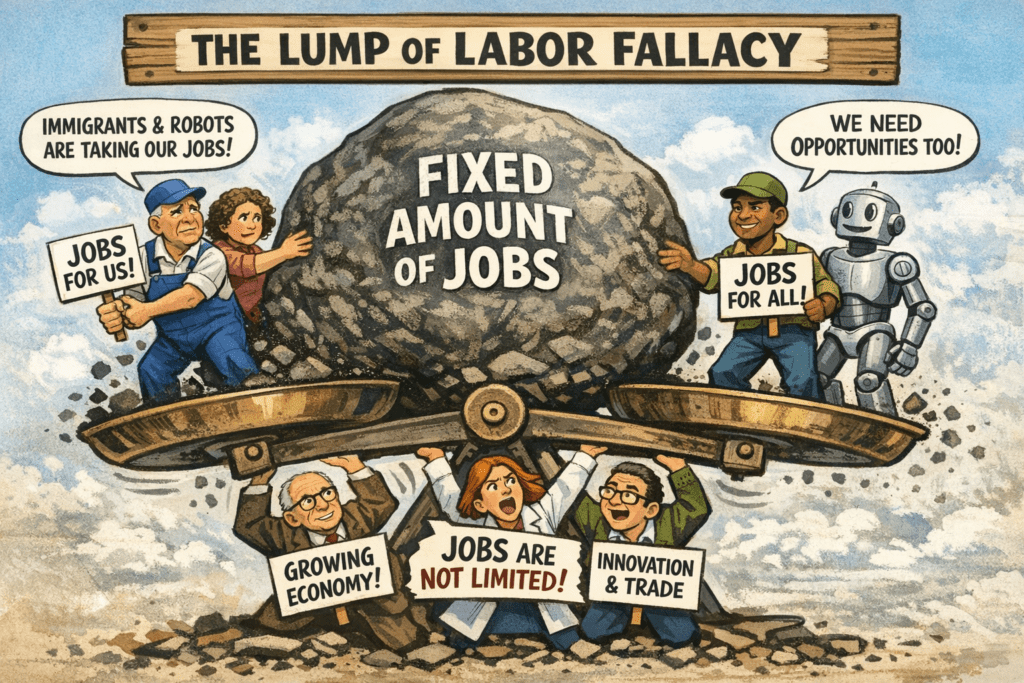
A 134-Year-Old Mistake
The Lump of Labor Fallacy is not a new critique. It has a precise origin. As economist and writer Zombor Varnagy-Toth notes on Medium, the fallacy was first formally identified and named by economist David Schloss in 1892. Schloss was responding to the labor movements of the industrial era — specifically to workers and unions who argued that the total amount of work available was fixed, and that any task performed by a machine was a task permanently lost to a human being.
This was not an unreasonable fear at the time, or at least not an emotionally unreasonable one. The industrial revolution was dismantling centuries-old trades. Weavers who had practiced their craft for generations watched mechanical looms do in hours what had taken them days. Blacksmiths, millers, and farmhands saw their livelihoods reshaped by forces they did not choose and could not fully understand. The Luddites — that famous English movement of textile workers who smashed machinery in the early 1800s — were not stupid people. They were frightened people who had drawn a logical-sounding but ultimately wrong conclusion: that there was only so much work to go around, and the machines were eating their share.
Schloss named the fallacy. But naming it did not kill it. It has surfaced, in almost identical form, at every major technological transition since: during the mechanization of agriculture, during the spread of electricity, during the rise of the automobile, during the computing revolution of the 1970s and 1980s, and now, with breathtaking persistence, during the emergence of artificial intelligence.
The reason it keeps returning is not stupidity. It is human psychology. When people witness their specific job being automated, it feels like a fixed pie is shrinking. What they cannot see — because it has not yet happened — is the new demand, the new industries, and the new categories of work that the freed-up productivity will create. We see the destruction. We cannot yet see the creation.
This is a failure of imagination, not evidence.
The Socialist DNA of the Fallacy
To understand why the Lump of Labor Fallacy is best understood as a socialist error — rather than simply a general human cognitive bias — we need to examine what the fallacy assumes about how economies work.
The fallacy is, at its core, a zero-sum claim. It assumes that wealth and work are distributed, not created. It treats the economy as a bucket with a fixed amount of water in it, where your gain is necessarily my loss. This is precisely the framework that underpins socialist economic thinking: that capital owners extract value from workers rather than create it, that profit is a form of theft from a fixed pool of social wealth, that the gains of the efficient come at the expense of the displaced.
This zero-sum worldview makes the Lump of Labor Fallacy feel intuitive to those on the political left. If you already believe that the economy is a redistribution problem rather than a growth problem, then of course you will believe that automation displaces workers permanently — because in a zero-sum world, it must. There is nowhere for the displaced workers to go except into unemployment or poverty, because new wealth and new demand are not part of the model.
Socialist-adjacent policy proposals flow naturally from this error. France’s 35-hour workweek, introduced in 2000 by the Socialist Party government of Lionel Jospin, was explicitly designed on lump-of-labor logic: if we reduce the hours worked by each employee, the thinking went, companies will be forced to hire more people to cover the same output. Work-sharing as a political program is pure Lump of Labor Fallacy in legislative form. The same logic drives calls to ban AI-generated content, impose robot taxes, mandate AI impact assessments before deployment, or slow the rollout of automation in industries from logistics to law.
The results of these policies, when implemented, are instructive. The IMF studied France’s 35-hour workweek and concluded in a working paper that it failed to achieve its stated goals: “The 35-hour workweek appears to have had a mainly negative impact. It failed to create more jobs and generated a significant — and mostly negative — reaction both from companies and workers as they tried to neutralize the law’s effect.” The Brookings Institution reached a similar verdict, noting that “strong economic growth had created most of the jobs in that period. Even the Jospin government attributes only about one fifth of the new jobs directly to the 35-hour work week, and most economists believe the impact has been far less.”
In other words, you cannot redistribute a lump of labor that does not exist.
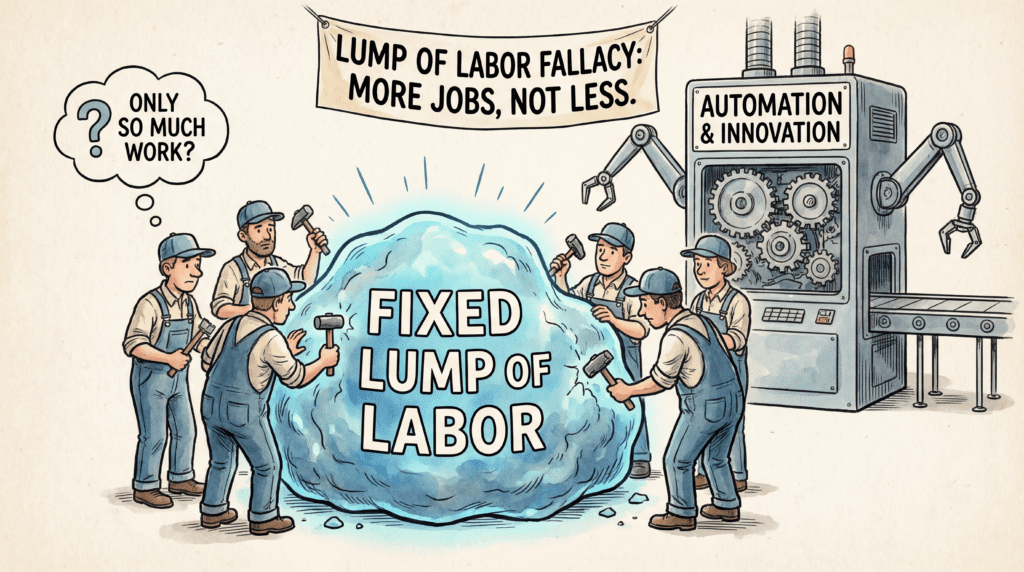
How the Economy Actually Works
The classical rebuttal to the Lump of Labor Fallacy involves three interlocking mechanisms, each of which the fallacy ignores entirely.
First: productivity gains lower prices, which increases demand. When a machine takes over a task previously done by human labor, it does not simply eliminate that task. It makes the output of that task cheaper. Cheaper goods and services mean that consumers have more money left over — money that flows into demand for other goods and services. Henry Ford’s assembly line didn’t just eliminate the horse-and-buggy carriage maker; it made automobiles affordable to ordinary workers, created an enormous new consumer market, and generated millions of jobs in manufacturing, road-building, fuel distribution, roadside hospitality, and eventually the entire suburban economy.
Second: productivity gains create new capital, which seeds new industries. Technological efficiency doesn’t just produce cheaper things. It frees up resources — labor, capital, time — that can be redirected into activities that didn’t previously exist. The agricultural revolution didn’t just idle farm hands. It freed a massive portion of the human population from subsistence farming and made it available for manufacturing, science, trade, education, and the arts. The industrial revolution didn’t just displace artisans. It built the infrastructure — railroads, factories, cities, communication networks — that created the modern economy from which all of us benefit today.
Third: innovation creates genuinely new categories of demand. Some of the most important jobs of the last thirty years did not exist before the technologies that created them. Social media manager, cloud architect, UX designer, cybersecurity analyst, YouTube creator, podcast producer, app developer, prompt engineer — none of these existed in 1990. They were not redistributions of existing work. They were new categories of human activity enabled by new technology. The Lump of Labor Fallacy, by assuming that the total amount of work is fixed, cannot account for the creation of entirely new forms of value.
As Andreessen put it directly: “Sectors that are easily mechanised see dramatic productivity increases; sectors that resist mechanisation do not. As mechanised sectors get cheaper, the relative price of labor-intensive sectors rises, and society allocates more of its spending toward them — not less.”
This is not a theoretical claim. It is an observable pattern that has held across every major technological transition in the historical record.
The Historical Record Is Undefeated
If we want to evaluate the Lump of Labor Fallacy empirically, we can simply ask: has it ever been correct? Has there ever been a major labor-saving technology that resulted in permanent, structural mass unemployment?
The answer, surveying all of recorded economic history, is no.
When mechanical agriculture displaced farm laborers in the 18th and 19th centuries, the workers did not simply starve. They moved — often painfully, often through a difficult transitional period — into manufacturing. When manufacturing automation began displacing factory workers through the 20th century, the workers moved into services. The services sector in advanced economies now employs the vast majority of the workforce, in jobs — healthcare, education, entertainment, finance, hospitality, design, software — that would have been unrecognizable to a 19th-century industrial worker.
Each transition involved genuine hardship for those caught in the middle. We should not dismiss that. Workers in declining industries face real suffering: lost income, disrupted communities, skills made suddenly obsolete. These are human costs that deserve serious policy responses. But the correct policy response is not to prevent the technology. It is to invest in the retraining, mobility, and social support systems that ease the transition.
What Andreessen states about this record is worth quoting in full: “The argument against AGI-driven unemployment is not that we can predict exactly what the new jobs will be. The argument is that the historical base rate of technology creating new job categories at least as fast as it destroys old ones is 100% across every major technological transition in recorded economic history.”
That is not optimism. That is the most rigorously supported empirical pattern in all of economic history.
The AI-Specific Panic
And yet here we are again. The year is 2026, and the most sophisticated version of the Lump of Labor Fallacy is being deployed by educated, well-meaning people to argue that this time is different — that AI will, at last, finally, permanently eliminate human employment.
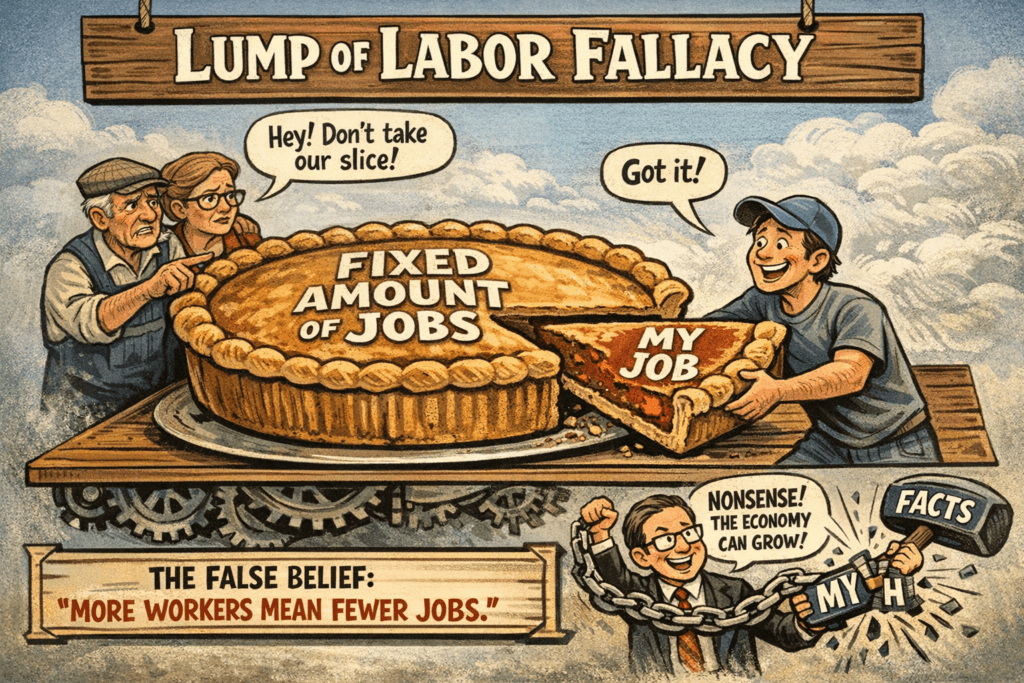
The specific version of the argument goes like this: previous technological revolutions displaced workers from one sector, but those workers could escape into new sectors because those new sectors still required human labor. A displaced factory worker could become a software tester. A displaced travel agent could become a digital marketing coordinator. But artificial intelligence, the argument goes, is different in kind, not just degree. It is a general cognitive technology, capable of performing not just one narrow task but virtually any cognitive task. There is no new sector to escape into, because AI can follow workers into any sector they might flee to.
This argument is made thoughtfully by some economists, including Daniel Susskind of Oxford and King’s College London, whose work is summarized by Varnagy-Toth: “[The Lump of Labor Fallacy] only suggests that there will always be more work. It doesn’t suggest that humans would do the work — a significant detail.” The concern is not that new jobs won’t be created. It is that machines will fill those new jobs too, leaving humans structurally redundant.
It is a serious argument, and it deserves a serious response. But it ultimately fails for two reasons.
First, it assumes AGI capability that does not yet exist. The concern requires us to believe that AI will become not merely very good at many cognitive tasks, but comprehensively better than humans at all cognitive tasks in all economic contexts at a lower cost — and to do so across every domain simultaneously. This is an enormous and unsupported assumption. We do not currently have AI systems that replicate human judgment in complex social, legal, physical, and relational contexts. We have AI systems that perform impressively on narrow, well-defined tasks with rich training data. The generalization from “GPT is good at writing code” to “AI will make all human economic activity obsolete” is not a small inferential step; it is a leap of extraordinary magnitude.
Second, even in the theoretical scenario where AGI exceeds humans at everything, comparative advantage still applies. This is the most underappreciated point in the entire debate, and Andreessen makes it precisely: “Even if AGI becomes absolutely better than humans at every cognitive task — faster, cheaper, more accurate, more creative — it does not follow that humans have no economic role. What can humans produce at the lowest opportunity cost relative to AGI?”
Comparative advantage — the principle that even the less efficient party benefits from specializing in the tasks at which it is relatively most productive — is one of the most rigorously established principles in all of economics. It is why trade between countries of vastly different productivity is mutually beneficial. It is why a brilliant surgeon’s time is better spent operating than filing their own tax returns, even if they are also a better accountant than their accountant. The logic does not break down just because AI is very good. As Andreessen notes: “As long as human time has any value to humans themselves (which it trivially does), and as long as there is any production that requires human presence, consent, or subjective experience, comparative advantage exists.”
That last phrase deserves emphasis. There are enormous categories of economic activity that require human presence: medical care, education, therapy, personal training, live performance, childcare, legal advocacy, physical construction, skilled trades, and the vast domain of human experience goods — travel, hospitality, food, culture — where what is being consumed is the human element. No one pays top dollar for a concert because they want to hear the most technically accurate rendering of music. They pay because they want to be in the presence of a human being creating something in real time.
The Policy Danger
The intellectual errors of the Lump of Labor Fallacy would be merely academic if they stayed in seminar rooms. They do not. They shape legislation, regulation, and policy in ways that impose real costs on real people.
Consider what it looks like when governments act as though the lump of labor is real:
Work-sharing mandates reduce the hours available to skilled workers and raise the cost of employment, typically resulting in reduced investment in training and capital — the very things that drive productivity and wage growth. France’s experiment, as documented by the IMF, did not create the jobs its architects promised; it created rigidity, added cost, and ultimately required its own rollback.
Robot taxes — periodically proposed by politicians from Bernie Sanders to European Parliament members — would directly penalize the productivity gains that create new wealth and new work, effectively taxing the mechanism that has driven human economic progress for three centuries.
AI moratoria and regulatory delay are perhaps the most damaging expressions of lump-of-labor thinking in the current environment. Every month that AI-driven productivity is delayed in healthcare is a month in which diseases go undiagnosed. Every month it is delayed in logistics is a month in which supply chains remain inefficient and goods remain more expensive. Every month it is delayed in scientific research is a month in which solutions to energy, climate, and disease problems are not found. The economic costs of not automating are not neutral. They are enormous, and they fall disproportionately on ordinary people who cannot afford to pay for inefficiency.
Immigration restrictions justified by labor competition are perhaps the oldest policy application of the fallacy. The argument that immigrants “take jobs” from native workers assumes a fixed amount of available work — precisely the lump-of-labor error. The economic literature on immigration is nearly uniform: immigrants expand the economic pie, they do not merely redistribute an existing slice of it. The countries and cities that have historically welcomed large immigrant populations have not seen the native unemployment rates that lump-of-labor thinking predicts; they have seen economic dynamism, entrepreneurship, and new industries.
The pattern is consistent: when policy is designed around the assumption that work is a zero-sum resource to be divided rather than a dynamic outcome to be expanded, the policies fail. They do not prevent technological displacement. They merely add friction, reduce efficiency, and slow the emergence of the new economic activity that would otherwise absorb displaced workers.
What Legitimate Concern Looks Like
It would be intellectually dishonest — and ultimately counterproductive — to dismiss all concern about AI and labor as lump-of-labor thinking. There are legitimate worries that deserve serious engagement, and conflating them with the fallacy does no one any favors.
The real concern is not permanent unemployment. It is transitional pain at scale, at speed, concentrated in specific communities and demographics.
Historical technological transitions, however ultimately beneficial, did impose genuine suffering on workers caught in the middle. The textile workers displaced by mechanized looms in the early 19th century did not all smoothly transition into new manufacturing jobs. Many experienced years of poverty, community disruption, and social dislocation. The coal miners displaced by natural gas and automation in the late 20th century did not all retrain as software developers. Many experienced a loss not just of income but of identity, community, and purpose.
The concern with AI is not that these transitional dynamics will happen — they certainly will — but that they may happen faster, across more sectors simultaneously, and with less time for social adaptation than previous transitions allowed. This is a legitimate concern about policy and social infrastructure, not about the fundamental economics.
The appropriate response is investment in:
- Education systems that develop the judgment, creativity, and interpersonal skills that are hardest to automate
- Portable benefits and retraining programs that reduce the cost to workers of moving between industries
- Community investment in regions whose dominant industries face disruption
- Strong safety nets that buffer the income shock of displacement without penalizing the technology that is creating new opportunity
What the appropriate response is not is restricting the technology itself. As Andreessen has argued since at least 2016: “If you are concerned about job growth you should want more technology, not less.”
The distinction between the legitimate concern and the fallacy is this: the legitimate concern acknowledges that technology will create more and better work overall, but worries about who bears the transitional cost and how society manages the disruption. The fallacy denies that the new work will be created at all. One leads to sensible policy; the other leads to protectionism, stagnation, and ultimately greater human suffering.
The Deeper Error
Underlying the Lump of Labor Fallacy is something more profound than a misunderstanding of labor economics. It is a failure to believe in human desire.
The reason the lump of labor never exists is not a quirk of how markets work. It is a reflection of the fact that human wants are, for all practical purposes, unlimited. There will never come a day when every human on earth says, “I have enough. I want nothing more.” There will always be diseases we want cured, beauty we want created, knowledge we want discovered, places we want to go, experiences we want to have, problems we want solved, connections we want made.
Every one of those wants is a potential job. Every efficiency gain that frees up human time and resources creates the capacity to pursue new wants that previously went unmet. The lump-of-labor fallacy, at its root, assumes that human desire is finite and exhaustible — that once we have enough food and shelter and basic manufactured goods, there is nothing left to want. History reveals this assumption to be spectacularly, extravagantly wrong.
The Fortune analysis of the AI-driven “SaaSpocalypse” captures the scale of what is happening: AI is now doing to software what software did to manufacturing, retail, and media. It is eating work itself — not to destroy it, but to transform it. Morgan Stanley analysts estimate that generative AI can now process the unstructured data — emails, conversations, documents — that represents over 80% of information in organizations. This is genuinely new territory.
But new territory has always preceded new opportunity. The concern that “AI will replace software jobs” neglects that software created the internet economy, the app economy, the cloud economy, and is now, through AI, creating a new layer of economic activity whose full dimensions we cannot yet see. We are in the creative destruction phase. The destruction is visible. The creation has not yet arrived.
That is precisely where every generation has made the same mistake. They saw the destruction. They wrote pamphlets about it. They named it. They legislated against it. And then the creation arrived anyway, and the next generation inherited a world more prosperous than anything their grandparents imagined.
Conclusion: The Fallacy That Will Not Die
Marc Andreessen’s March 2026 intervention on the Lump of Labor Fallacy was not, in the end, about AI. It was about economic literacy. It was a reminder, delivered in the midst of understandable panic about a genuinely powerful technology, that the fundamental question — “will automation leave humans with nothing to do?” — has been asked and answered. The answer has been the same every time: no.
WIRED, in its critique of Andreessen’s broader AI optimism, noted that he defines the fallacy as “the incorrect notion that there is a fixed amount of labor to be done in the economy at any given time, and either machines do it or people do it — and if machines do it, there will be no work for people to do.” Even critics who dispute Andreessen’s more expansive claims about AI’s benefits largely concede this core point. The fallacy is a fallacy. The debate is not about whether new work will be created. It is about who creates it, who benefits from it, and how the transition is managed.
The Lump of Labor Fallacy keeps returning because it speaks to a genuine human experience: the experience of watching your specific, familiar form of work disappear. That experience is real. The pain is real. But the conclusion — that the disappearance of your job means the disappearance of all jobs — is a category error, a leap from the particular to the universal that the evidence does not support.
The socialist attraction to the fallacy is understandable. If work is zero-sum, redistribution makes sense. If the economic pie is fixed, fairness means slicing it more equally rather than growing it larger. But the evidence of three centuries of technological progress is unambiguous: the pie grows. It grows because of technology, not despite it. And the right policy response to growth is to ensure that the benefits of that growth are broadly shared — not to prevent the growth in the first place.
We have been here before. We will be here again. The names change — the Luddites, the anti-automators, the AI moratoria advocates — but the error is the same. There is no lump of labor. There never was. And the greatest risk we face is not that AI will take all our jobs. It is that, frightened by a 134-year-old fallacy, we will slow down the technology that has made every previous generation richer, healthier, and freer than the one that came before it.
Related Guides
- AI and post-labor economics
- AI jobs evidence from studies and CEOs
- AI surpassing screen-based work
- AI transforming entry-level jobs guide
Compare
Latest News
The Kingy Brief
Get The Kingy Brief.
AI changes, original tests and one practical thing to try. Fridays at 09:00 Vancouver time.
Free · Double opt-in · Unsubscribe anytime
Sign up for The Kingy Brief on Beehiiv.
Signup help and newsletter schedule
Signup form provided by Beehiiv. After submitting, check your inbox for "Confirm your subscription to The Kingy Brief" and open its confirmation link. Check Spam or Promotions if you cannot find it.
Fridays at 09:00 Vancouver time: source-checked AI changes, original tests and one practical thing to try. We skip a week when there is not enough verified material. Free. Unsubscribe anytime.