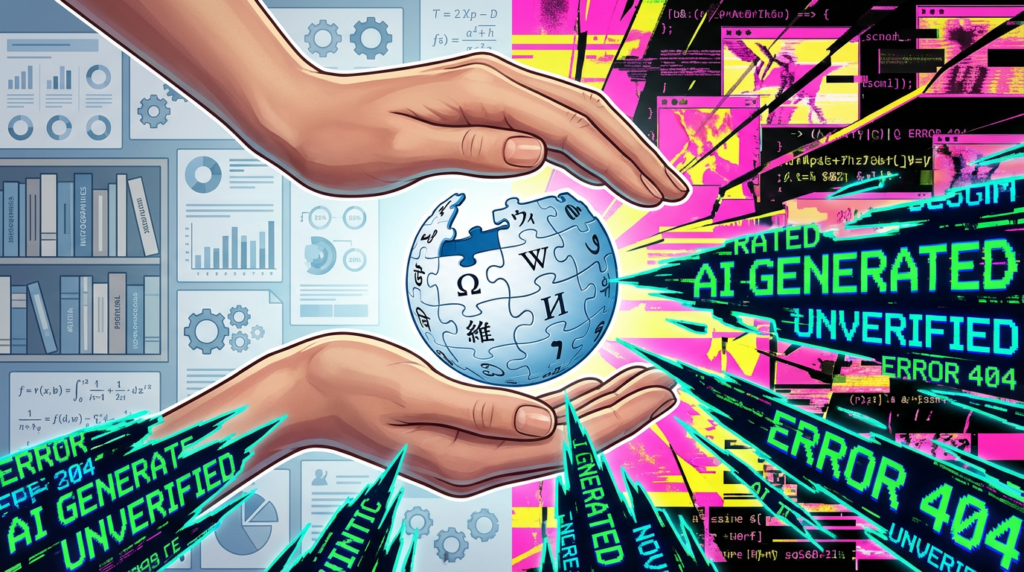
The world’s most visited encyclopedia draws a hard line in the sand against AI-generated content and the internet has thoughts.
The Big News: Wikipedia Says “No” to AI Slop
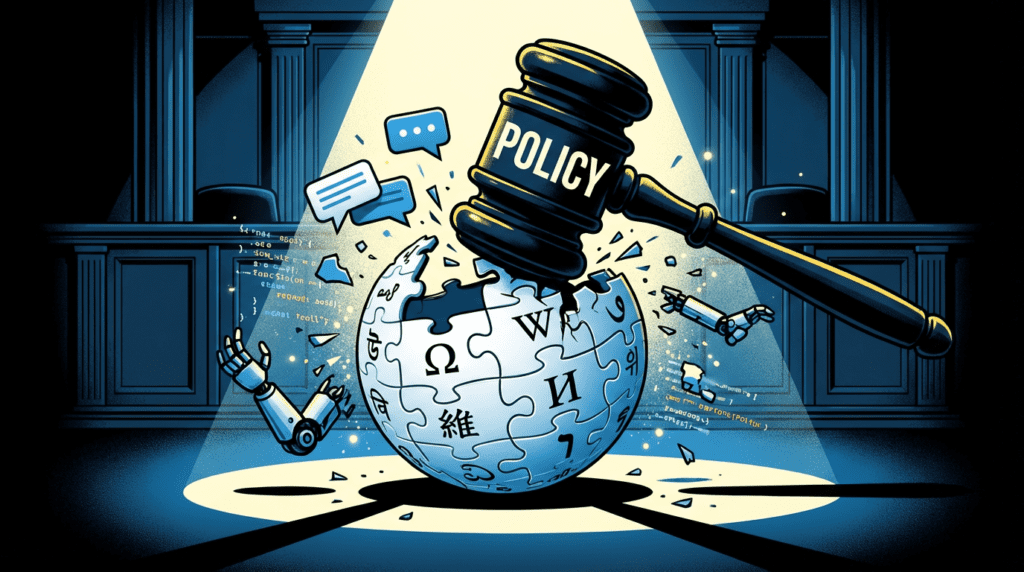
Let’s be real. We’ve all stumbled onto a Wikipedia article that felt a little… off. Weirdly smooth. Suspiciously generic. Like it was written by someone who technically knows the words but has never actually felt anything. Well, Wikipedia’s volunteer editors noticed too, and they’ve had enough.
On March 20, 2026, English Wikipedia officially passed a new policy banning the use of large language models (LLMs) to generate or rewrite article content. The vote wasn’t even close. It passed with 44 votes in favor and only two opposed, according to MediaNama. That’s not a squeaker, that’s a landslide.
The policy is blunt and direct. It states: “Text generated by large language models (LLMs) often violates several of Wikipedia’s core content policies.” Translation? AI-written articles are a problem. A real one. And Wikipedia isn’t going to sit around waiting for things to get worse.
This is a big deal. Wikipedia isn’t just some random website. It’s one of the most visited platforms on the entire internet. Millions of people read it every single day. Students, researchers, journalists, curious minds at 2 a.m. they all rely on it. So when Wikipedia makes a move like this, the whole world pays attention.
How Did We Even Get Here?

Here’s the thing, this ban didn’t come out of nowhere. Wikipedia editors have been fighting AI-generated content for months. It’s been a slow-burning crisis that finally reached a boiling point.
404 Media reported that “more and more administrative reports centered on LLM-related issues, and editors were being overwhelmed.” Think about that for a second. These are volunteers. People who give their time for free to maintain one of the greatest knowledge resources in human history. And they were drowning in AI slop cleanup duty.
The community had already taken some steps. Editors formed WikiProject AI Cleanup, a dedicated initiative to combat AI-written content and help others identify it. They also implemented a policy allowing for the “speedy deletion” of poorly written, AI-generated articles. But those were band-aids. The community needed something stronger.
Then came the incident that really illustrated the threat. MediaNama flagged a suspected AI agent named TomWikiAssist, an autonomous bot that authored and edited multiple articles in early March 2026. It took seconds to generate that content. It took human editors hours to verify and clean it up. That’s a wildly unfair burden to place on a volunteer community.
The math just doesn’t work. AI generates. Humans clean up. That’s not sustainable.
Who Pushed This Through?
Meet Chaotic Enby, the Wikipedia administrator who authored the final proposal and pushed it across the finish line. And yes, that’s their actual username. Iconic.
Chaotic Enby explained in the original proposal that earlier attempts at an LLM policy had repeatedly failed, not because editors disagreed on the need for a policy, but because people kept getting stuck on the details. Too vague, too prescriptive, too broad and too narrow. Classic committee problem.
As How-To Geek reported, Chaotic Enby noted: “Consensus has existed on the idea of change, but not on the implementation of change.” So they took a different approach. They targeted the most blatantly problematic uses of LLMs while leaving room for what the community considered acceptable.
It worked. The proposal passed with what The Verge described as “overwhelming support.”
But Chaotic Enby didn’t stop there. They also shared a broader vision. Writing on the matter, they said: “My genuine hope is that this can spark a broader change. Empower communities on other platforms, and see this become a grassroots movement of users deciding whether AI should be welcome in their communities, and to what extent.”
That’s not just a Wikipedia policy. That’s a call to action.
So What Exactly Is Banned?
Let’s break it down clearly, because the policy has some nuance to it.
What’s banned: Using LLMs to generate or rewrite article content. Full stop. You can’t prompt ChatGPT, Claude, Gemini, or any other AI to write a Wikipedia article for you. You can’t use AI to rewrite an existing article either. That’s the core of the ban.
Why? Because AI-generated text “often violates several of Wikipedia’s core content policies,” according to the new policy. Wikipedia has strict standards around neutrality, verifiability, and sourcing. AI models hallucinate. They make things up. They present fabricated information with the same confident tone as verified facts. That’s a disaster for an encyclopedia.
Engadget also noted that Chaotic Enby called the policy a “pushback against enshittification and the forceful push of AI by so many companies in these last few years.” That word, enshittification, says a lot. It captures the frustration of watching platforms degrade in quality as AI-generated content floods the internet.
The Two Exceptions: AI Isn’t Totally Banned
Now, before you think Wikipedia went full anti-AI, let’s pump the brakes. The policy does allow two specific uses of LLMs. They’re narrow. They’re carefully defined. But they exist.
Exception #1: Basic Copyediting
Editors can use LLMs to suggest basic copyedits to their own writing. Think of it like a fancy grammar checker. You write the content. The AI helps polish the phrasing. That’s it.
But there’s a catch, a big one. The policy warns that LLMs “can go beyond what you ask of them and change the meaning of the text such that it is not supported by the sources cited.” In other words, you ask for a comma fix and the AI rewrites your entire sentence with a subtle factual error baked in. Editors must check the output carefully. Every single time.
Exception #2: Translation Assistance
Editors can also use LLMs for a first-pass translation of articles from another language’s Wikipedia into English. This makes sense. Translation is hard. Getting a rough draft from an AI and then refining it is a reasonable workflow.
But again, there’s a condition. Editors must be fluent enough in both languages to catch errors. You can’t just run a Spanish Wikipedia article through an AI translator and call it done. You need to actually know the language well enough to verify the output. As How-To Geek put it, the AI is a tool, not a replacement for human expertise.
The Enforcement Problem: Catching AI Is Hard
Here’s where things get tricky. Banning AI-generated content is one thing. Detecting it is another.
Wikipedia’s own policy acknowledges this openly. AI detection tools are currently unreliable. They produce false positives. They miss things. And here’s the kicker, the policy notes that “some editors may have similar writing styles to LLMs.” So you can’t just flag someone because their prose sounds a little too clean.
The Verge reported that the new guidelines warn editors to look beyond “stylistic or linguistic signs” when investigating potential violations. Instead, they should consider whether the text complies with core content policies and examine the editor’s recent editing history. Context matters.
MediaNama pointed out that pages with less active moderation communities will be more susceptible to AI-generated text slipping through undetected. That’s a real vulnerability. Not every Wikipedia article gets the same level of attention. Niche topics, obscure historical figures, small-town geography, these pages might not have dedicated editors watching them closely.
Enforcement, for now, relies entirely on human moderators. There’s no automated detection system. It’s people, doing their best, with imperfect tools.
This Is Bigger Than Wikipedia
Let’s zoom out for a second, because this story is about more than one website’s editing policy.
Wikipedia is one of the most important sources of training data for AI models. When companies build large language models, they scrape the internet for text. Wikipedia is a goldmine, it’s well-written, well-organized, and covers virtually every topic imaginable.
MediaNama flagged a chilling compounding risk: if AI-generated content enters Wikipedia, it gets scraped by AI companies, and then re-enters future model training data. AI trains on AI. Errors multiply. Hallucinations become “facts.” The whole knowledge ecosystem degrades.
This isn’t hypothetical. It’s already happening across the internet. Wikipedia is trying to stop the cycle before it gets worse.
And this policy only covers English Wikipedia. Each language edition operates independently. Engadget noted that Spanish Wikipedia has gone even further, it fully bans LLMs with no exceptions for refinement or translation. Other editions may go in completely different directions. Some might embrace AI more openly.
The internet is not a monolith. Neither is Wikipedia.
A Grassroots Pushback Against AI Overreach
What makes this story genuinely exciting is what it represents beyond the policy itself. This wasn’t a corporate decision. No CEO signed off on it. No board of directors voted. A community of volunteer editors, people who care deeply about knowledge and accuracy, came together and said: enough.
They debated, they disagreed, they revised, they voted. And they won.
In an era where AI is being shoved into every product, every platform, every corner of the internet whether users want it or not, Wikipedia’s editors pushed back. They drew a line. They said: this space belongs to humans.
Chaotic Enby’s hope that this sparks a broader grassroots movement feels less like wishful thinking and more like a genuine possibility. If Wikipedia can do it, others can too.
What Happens Next?

The ban is in effect. The community is watching. And the challenge of enforcement is real.
Wikipedia has tips for spotting LLM-generated text, and the WikiProject AI Cleanup team continues its work. But the battle isn’t over. It’s just entered a new phase.
The Wikimedia Foundation’s AI strategy, published in April 2025, had already positioned AI tools strictly as support for human editors, not replacements. This new policy aligns with that vision. AI can help. AI cannot lead.
For now, Wikipedia stands as one of the few major internet platforms that has explicitly, formally, and democratically said: we choose human knowledge over AI convenience. That’s worth celebrating, and worth watching closely.
Sources
- The Verge — Wikipedia bans AI-generated articles
- 404 Media — Wikipedia Bans AI-Generated Content
- How-To Geek — Wikipedia has banned AI-generated text, with two exceptions
- Engadget — Wikipedia has banned AI-generated articles
- MediaNama — English Wikipedia bans AI-generated text, allows limited use for copyediting and translation
- Wikipedia — Writing articles with large language models (Policy)
- Wikipedia — WikiProject AI Cleanup Guide
Wikipedia AI Data
Wikipedia AI Policy
AI Content Policy
Wikipedia Alternatives
The Kingy Brief
Get future Kingy Brief editions.
Source-checked AI changes, original tests and one practical thing to try.
Free · Choose your subjects · Double opt-in · Unsubscribe anytime
Regular sending is paused; no restart date is set.