Introduction: A New Kind of Creative Claim
Every few months, a new AI tool arrives promising to democratise some historically expensive creative domain. We’ve seen it with music, with written content, with image generation, and with short-form video. But animation — real, narrative-driven, character-consistent, cinematically composed animation — has always been the white whale. It demands not just raw generative capability, but orchestration: a scriptwriter, a character artist, a storyboard artist, a motion director, and a sound designer, all working in coherent sequence toward a unified creative vision.
OiiOii (pronounced “oyi-oyi”) is making a bold claim: that it has solved that orchestration problem. The platform’s homepage greets you with the slogan “Make Animation Great Again” and positions itself not as a video generator, but as an “AI animation agent team” — a complete, collaborative pipeline of specialised artificial intelligence agents that takes your idea from prompt to polished short film. No timeline. No keyframes. No technical skills required.
After running a full animation pipeline inside the platform, analysing the multi-agent workflow in real-time, and comparing the outputs against what has been promised in the company’s documentation and external reviews, this is the comprehensive verdict on OiiOii in 2026: what it does brilliantly, where it still stumbles, and whether it deserves a place in a serious creator’s toolkit.
Company Background: Mysterious Origins, Serious Backing
OiiOii.ai is a startup operating at the intersection of generative AI and creative production. Its founding team, headquartered location, and precise launch timeline are not publicly disclosed — a notable opacity for a company generating this level of interest. What is known is significant: OiiOii has reportedly received backing from ByteDance, the parent company of TikTok and one of the world’s most powerful technology conglomerates. ByteDance’s involvement is not cosmetic. The company has deep proprietary AI research, including the DreamActor-M1 model that underpins OiiOii’s character consistency engine — one of the product’s most technically impressive features.
The platform is currently operating in invite-only beta. A 20,000-person waitlist has been reported by reviewers, and access requires an invite code, which circulates primarily through OiiOii’s official Discord server and community channels. Pricing has not been publicly disclosed, though Pollo AI’s partner page (which offers limited access to OiiOii through its portal) suggests a free tier with limited credits, transitioning to a paid subscription model. The absence of public pricing, a named CEO, or a transparent founding story gives OiiOii a slightly mysterious quality — it feels more like a research project that escaped the lab than a product that has been intentionally marketed. But what it has built more than justifies the intrigue.
The Concept: From Prompt to Cinematic Short Film
The core thesis of OiiOii is straightforward: animation production is a multi-stage, multi-discipline process, and AI should handle each stage through a dedicated specialist agent rather than attempting to compress everything into a single monolithic model. This modular, pipeline-oriented approach is what separates OiiOii from competitors like Runway, Kling, or Sora, which essentially ask a single model to do everything at once.
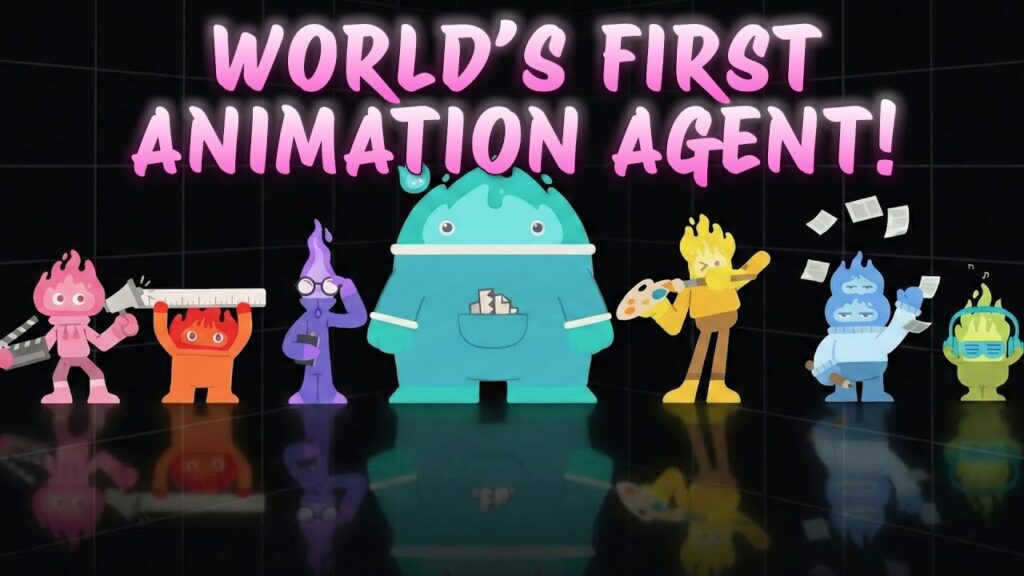
On the OiiOii platform, when you initiate a project, you are not talking to “the AI” — you are directing a team. The team currently comprises seven agents:
- Art Director — holds the overall creative vision, interprets your prompt for aesthetic and emotional direction.
- Scene Designer — builds the environment and spatial context of each shot.
- Scriptwriter — develops the narrative, generates scene descriptions, character dialogue, and emotional beats.
- IP Designer — translates conceptual ideas into visual intellectual property (characters, mascots, original creations).
- Character Designer — generates character sheets, poses, and visual turnarounds.
- Storyboard Artist — translates the script and director’s vision into sequential visual panels and shot plans.
- Sound Director — creates or selects the background music and soundscape for the final film.
The language OiiOii uses throughout the interface is theatrical: you are the Director. The agents are your crew. They introduce themselves, take briefs, produce work for your approval, and invite you to give notes before moving to the next stage. Whether this framing is clever UX design or a genuinely novel approach to human-AI collaboration is a question worth exploring — but from a user experience standpoint, it is surprisingly effective at making a technically complex AI pipeline feel intuitive and creative rather than mechanical.
The Technical Architecture: Why the Pipeline Matters
To appreciate what OiiOii is doing, it helps to understand why single-model video generation tends to fail at narrative animation. Tools like Runway Gen-3 or Sora 2 in isolation are extraordinary at producing visually compelling short clips — but they are stateless. They do not remember what your character looked like in the last shot. They do not maintain consistent facial geometry, clothing details, or emotional continuity across a sequence of scenes. The result is what the industry calls “character drift”: your protagonist looks subtly different in every shot, a problem that is tolerable in abstract art videos but fatal in narrative animation.
OiiOii’s solution is architectural. The character is designed once, in full, by the Character Designer agent using the DreamActor-M1 model — a ByteDance proprietary system specifically engineered to lock in a character’s appearance at the vector level. Once the character sheet exists (multiple poses, expressions, a defined colour palette), that reference is passed to every subsequent stage in the pipeline. The Storyboard Artist works from it. The Animation Renderer receives it as a constraint. Even the Sound Director’s emotional brief is informed by the character’s established visual personality.
For the actual motion and rendering, OiiOii does something clever: it functions as an intelligent orchestrator across multiple best-in-class video models rather than relying on a single engine. Depending on the requirements of a given shot, it may call upon Google’s Sora 2, Veo 3.1, Seedance, or Vidu. If one model fails — which does happen, particularly when shots trigger IP filters or encounter edge cases — OiiOii’s auto-patching system detects the failure and reroutes the shot to a capable alternative engine, maintaining character consistency throughout because the character reference is model-agnostic.
This engine-switching capability is genuinely novel. It means OiiOii is not tethered to the limitations of any single video model. When Sora 2 produces an artefact or fails on a complex prompt, the pipeline doesn’t break — it adapts. Reviewers who have observed this behaviour in testing describe it as the platform essentially acting as a smart production supervisor, delegating rendering tasks to whichever subcontractor can best handle each specific shot.
A particularly interesting technique observed in testing: OiiOii has been documented generating character sheets via NanoBanana (an image model) before feeding that visual reference into Veo 3.1 for motion generation. This cross-model handoff is not something a typical user would configure manually; it happens invisibly within the pipeline. The result is that you receive animation quality that draws on multiple state-of-the-art systems simultaneously, filtered through a character consistency layer that prevents the standard chaos that multi-model pipelines normally produce.

Platform Walkthrough: What Actually Happens When You Use It
The homepage of oiioii.ai is clean and confident. A reel of cinematic animations — girls by the sea, warriors in motion, urban dreamscapes — cycles through as the platform introduces its agent team with individual role cards. The tone is professional without being corporate. You feel immediately like this is a product made by people who care deeply about animation as an art form, not just as a content generation category.
After logging in with a Google account, you arrive at the main dashboard. The interface offers several distinct creation modes: Quick Video, Oii Image, Anime Music Video, Story Video, and IP Creation. This tiered structure is thoughtful — it acknowledges that not every user wants a full six-shot narrative every time. If you need a 15-second creative clip for social media, you don’t need to engage the full pipeline. If you’re building out a character IP for a series, the dedicated IP Creation mode gives you the depth you need.
The Style Library is one of the platform’s most immediately impressive features. Scrolling through it reveals over 200 preset art styles spanning an extraordinary range: Ghibli-inspired watercolour, Naruto-style anime, Minecraft block art, One Piece cell shading, stylised 3D cartoon, ink wash, neon synthwave, and dozens more. These aren’t superficial filters applied over a single underlying aesthetic — each style genuinely shapes how the AI agents interpret your prompt, from the line weight and colour saturation to the camera movement conventions associated with each genre. A scene described as “a girl walking through a market at dusk” will look fundamentally different in Ghibli mode versus neon synthwave mode, and both will feel native to their respective aesthetics rather than derivative.
The character creation workflow is where OiiOii really begins to distinguish itself. In a live demonstration, the process begins by dragging a reference image — in this case, an anime girl sitting on a beach — into the chat interface. The Art Director agent immediately activates, analyses the image, and then calls in the Character Designer. What follows is a genuine conversation: the agents describe what they see (“hair in a loose ponytail, sitting by the sea, surrounded by blue sky and clear water”), propose a character name, and generate a full character sheet including multiple poses, expressions, and a defined colour palette. The whole process takes roughly ninety seconds.
The character sheet that emerges is genuinely impressive in its fidelity to the reference. The proportions are maintained. The clothing and hair details are consistent across the different posed views. The colour palette is extracted and displayed as a standalone reference. You can see immediately how this character sheet functions as the foundation the rest of the pipeline will build from — it’s not just a pretty image, it’s a production document.
From there, the Scriptwriter agent takes over. When prompted to produce a narrative short film of the character at the beach, the agent doesn’t just spit out a plot summary. It generates a full script structure including a cast list, emotional tone keywords (Ocean, Healing, Serenity, Purity, Radiance), and six distinct storyboard shots with specific dialogue lines, camera instructions, and audio descriptions. The level of detail is striking. Shot three, for example, is labelled “Morning Glow” and includes not just a visual description but specific dialogue (“The world is so still before the light comes”), an audio cue (gentle ocean waves and ambient music), and a camera instruction (slow push-in to a medium close-up).
A cost breakdown is shown before confirmation — a transparency feature that lets you see how much of your credit allocation will be consumed by the agents’ services. Then the Storyboard Artist takes the script and generates six visual panels, each corresponding to a shot in the sequence. These are not rough thumbnails — they are fully rendered, stylistically consistent frames that show exactly what the final animation will look like compositionally. You can hover over each to review the specific prompts and instructions, and — crucially — you can edit or regenerate individual shots before the final render.
The final animated film is played back in sequence, with smooth transitions between shots, synchronised dialogue, and a cinematic music score that genuinely fits the emotional arc of the piece. The “Seaside Girl” character is visually identical across all six shots. The pacing has been thought about — there is a real sense of rhythm and emotional build across the sequence. For something generated from a single reference image and a prompt saying “short film of our character at the beach,” the result is remarkable.

Output Quality: Honest Assessment
The emotional vibrancy of OiiOii’s output is its most distinguishing quality. Where many AI video tools produce technically competent but emotionally flat content, OiiOii animations have a pacing and intentionality that feels genuinely directed rather than randomly generated. The music fits the mood. The camera movements reinforce the emotional beats. The dialogue, while generated, has a poetic quality that suits animated shorts.
That said, it would be dishonest to describe the output as equivalent to professional studio animation. The visual quality is excellent for stylised, stylistic short-form content — it genuinely holds up as social media animation, as YouTube short content, as a visualiser for music, or as a personal creative project. But it is not photorealistic, and it is not the kind of fluid, precise character animation that a trained animator would produce for a commercial release. The 60-second runtime of a full short film is also a meaningful constraint for creators with more ambitious narrative goals.
The character consistency story is strong but not perfect. DreamActor-M1 keeps the core character design stable across shots with impressive reliability — this is genuinely OiiOii’s most technically differentiated feature. However, in shots requiring precise physical continuity (specific hand positions, exact outfit details across multiple angles) or tight action choreography, the system shows its limits. Reviewers with animation backgrounds note that very detailed motion sequences — a character throwing a punch with specific footwork, for instance — are currently outside OiiOii’s reliable range.
The music generation, handled by the Sound Director agent, is consistently good. The platform appears to draw on a curated bank of compositionally coherent music that is matched to the emotional keywords extracted by the Scriptwriter. The result is rarely jarring or inappropriate, which is more than can be said for many AI music generation tools in their current state.
Strengths: What OiiOii Does Better Than Anyone Else
End-to-End Automation with Narrative Coherence
The most fundamental strength of OiiOii is that it doesn’t just generate a video — it generates a story. The pipeline starts with intent (your prompt, your reference image, your emotion keyword) and traces that intent through script, character, storyboard, animation, and music. The final output has a beginning, middle, and end, not because you engineered it, but because the Scriptwriter agent structured it that way. For creators who want to make content with narrative depth but lack the skills to build it manually, this is genuinely transformative.
Character Consistency Across Shots
This is the technical feature that most clearly separates OiiOii from the competition. The DreamActor-M1 character locking mechanism addresses the single biggest failure mode of AI animation tools. When OiiOii works as intended, your character looks like themselves in every shot — same face structure, same hair, same clothing, same colour palette. This is not a trivial achievement; it is the result of a sophisticated multi-stage pipeline specifically engineered to solve a hard problem.
Multi-Agent Clarification Process
Rather than generating a result and presenting it as a fait accompli, OiiOii’s agents actively seek clarification at key decision points. When the Art Director asks you to choose between Healing, Serenity, or Radiance as your emotional keyword, it is not a meaningless formality — that choice genuinely shapes how every subsequent agent interprets the brief. This active dialogue gives creators a real sense of authorship over the final product without requiring them to understand the technical workings of the models beneath.
Style Diversity
Two hundred-plus preset art styles is not a marketing number — it is a genuine creative resource. The ability to run the exact same narrative prompt through multiple aesthetic frameworks and compare results gives creators an extraordinary range of output options. The styles are not surface-level either; they inform the compositional choices, the colour grading, the line weight, and the camera conventions of the final animation.
Modular Pipeline Architecture
The ability to review and regenerate individual shots before final render is a major usability advantage. If the third shot in your six-shot sequence doesn’t land the way you hoped, you can rebuild just that shot without restarting the entire project. This kind of incremental refinement workflow brings OiiOii meaningfully closer to how real animation production actually operates — iterative, collaborative, checkpoint-based.
Engine-Switching and Auto-Patching
The invisible intelligence of OiiOii’s backend — routing rendering tasks to the best available model for each shot, automatically patching failures — is exactly the kind of reliability infrastructure that professional tools need. It means the platform’s output quality is not dependent on any single model having a good day. It also means OiiOii can leverage improvements to third-party models (Sora, Veo, Seedance) without the user needing to change anything.
Limitations: Where OiiOii Falls Short
Fixed Pipeline Architecture
OiiOii’s pipeline is linear, and that linearity is a double-edged sword. The same structure that makes it accessible to beginners makes it frustrating for experienced creators who want to deviate from the standard workflow. If you want to use a specific animation engine for a particular shot, or skip the Scriptwriter’s interpretation and provide your own dialogue, or integrate a custom character model that isn’t DreamActor-M1 — you can’t, at least not in the current beta. The system gives you dialogue with the agents but not direct access to their underlying configurations.
Limited Manual Control and Precision
OiiOii is built for the “good enough in one pass” use case. For creators who need precise control over specific motions, camera angles, or character interactions, the current toolset is insufficient. You can ask for adjustments through the Boss Mode dialogue, but the responsiveness and fidelity of those adjustments is inconsistent. Reviewers with animation backgrounds describe the platform as “opaque” in its response to detailed technical direction.
Tight Continuity Challenges
As noted above, very specific physical continuity — exact outfit configurations, precise body positioning relative to objects in the scene, tight action choreography — remains a weakness. The DreamActor-M1 locking is effective for character appearance but not for moment-to-moment physical continuity in the way that hand-drawn or 3D-modelled animation would provide.
Beta Availability and Access Restrictions
OiiOii is currently invite-only. The 20,000-person waitlist signals strong demand, but it also means that the vast majority of interested creators cannot access the platform today. For a product that positions itself as a revolution in democratised animation, the closed beta status is a meaningful barrier. Until a public launch happens — with no confirmed timeline as of writing — OiiOii remains more of a proof of concept for most people than a usable tool.
Undisclosed Pricing
The absence of public pricing information is frustrating for anyone trying to evaluate OiiOii seriously as a business or production tool. The free trial through Pollo AI’s portal offers limited credits, but what a full subscription costs, what the credit consumption looks like for a full narrative short film, and whether there are commercial licensing tiers for professional use — all of this is unknown. Creators cannot make informed decisions about building workflows around OiiOii without this information.
Output Duration
Sixty seconds is a meaningful creative constraint. For social media shorts, YouTube clips, and music video-style content, it is perfectly adequate. But for creators interested in longer-form animated storytelling — short films of five to ten minutes, multi-episode content, or episodic series — OiiOii’s current output ceiling creates a significant gap between what the platform promises (a personal animation studio) and what it can currently deliver.
Target Audience: Who Should Be Paying Attention
OiiOii is not for everyone, and the platform doesn’t pretend to be. Its ideal user is a creator who has compelling stories to tell and a strong instinct for visual aesthetics, but who lacks either the technical skills or the budget to execute those ideas through traditional animation pipelines.
Social media content creators are the most obvious fit. The ability to produce a visually polished 60-second animated short in under five minutes, in any of 200+ art styles, is extraordinary for anyone operating on a daily or weekly publishing cadence. The emotional quality of OiiOii’s output — the pacing, the music, the narrative structure — elevates it well above the typical AI video content flooding social feeds.
Independent story and animation channel operators are another key segment. If your goal is to run an animation or narrative storytelling channel — a YouTube channel telling original stories, a serialised fantasy saga, a character-driven anthology series — OiiOii’s ability to maintain character consistency and generate episodic content from a library of established characters is genuinely compelling.
Musicians and artists seeking animated music video content will find the Anime Music Video mode particularly useful. The platform’s music-matching capabilities and its ability to generate emotionally coherent visual narratives around a sonic aesthetic make it a powerful tool for artists who want high-quality visual accompaniment for their releases without the expense of commissioning an animation studio.
Educators and explainer content creators can leverage OiiOii’s storytelling pipeline to produce engaging animated educational content without requiring animation software skills. The quality is high enough for professional educational platforms, and the workflow is fast enough to be operationally viable for regular content production.
Marketers and brand teams, particularly in gaming, entertainment, and consumer lifestyle categories, represent a significant commercial opportunity. OiiOii’s ability to generate branded animated content at scale — campaigns, character mascots, animated social ads — at a fraction of the cost of traditional animation could be transformative for teams that currently rely on expensive external production.
OiiOii is less well-suited for creators who need photorealistic animation, precise technical control, very long-form content, or the ability to integrate with existing production pipelines and asset libraries. For those use cases, the platform’s current constraints make it an interesting experiment rather than a practical solution.
Competitive Landscape: Where OiiOii Stands
The AI video and animation space is moving at extraordinary speed, and OiiOii operates in a field with well-resourced competitors. Runway ML’s Gen-3 offers sophisticated video generation with growing character control capabilities. Sora 2 (which OiiOii itself uses as one of its rendering backends) is becoming more accessible as a direct consumer product. Pika Labs, Kling, Veo 3, and Seedance all compete for the short-form AI video market.
What distinguishes OiiOii from all of these is not raw generation quality — in isolation, Sora 2 and Veo 3.1 are as good or better at producing individual clips. The differentiation is the narrative architecture. No other platform in the current market orchestrates a complete story pipeline the way OiiOii does, from script to character to storyboard to final edit to music, with a consistent character threading through every shot. The multi-agent approach is genuinely novel, and the character consistency result it produces is meaningfully better than anything available through single-model alternatives.
The closest conceptual competitor is probably something like an integrated workflow combining Midjourney for character design, a video model for animation, and a human editor for assembly and music sync — the “manual OiiOii.” What OiiOii provides is that entire workflow, automated and orchestrated, at a speed that the manual version cannot match. The tradeoff is control, and for many use cases, it is a tradeoff worth making.
ByteDance’s backing gives OiiOii a structural advantage that should not be underestimated. Access to DreamActor-M1, to the research talent that produced it, and to the distribution infrastructure of a company that owns the world’s most-watched short-video platform represents a competitive moat that most animation AI startups cannot replicate. If OiiOii executes well on its roadmap and navigates the opacity concerns around data and pricing, it is positioned to become the dominant platform in its category.
Open Questions and Risks
Several significant uncertainties cloud the picture for OiiOii.
Roadmap and Timeline: The company has not published any information about when the platform will transition from private beta to public access. The absence of a public roadmap makes it impossible to evaluate OiiOii as a long-term tool. Creators considering building workflows around it are doing so on speculation.
Third-Party Model Dependency: OiiOii’s value proposition relies in part on integrating the best available third-party video models. Licensing changes, API restrictions, or competitive dynamics could reduce OiiOii’s access to Sora 2, Veo, or other engines it currently leverages. If those access points narrow, the quality of OiiOii’s output is directly affected.
Intellectual Property Exposure: The platform’s approach to user-submitted content raises genuine IP questions. What happens when a user submits a character reference image that includes copyrighted character designs? How does OiiOii navigate the IP filters already present in some of its rendering engines? What liability does the user carry for AI-generated content that inadvertently reproduces protected material? These questions have no clear public answers.
Data and Privacy: The broad content license in OiiOii’s Terms of Service requires serious scrutiny before any professional or commercial use. Creators should assume that submitted images and prompts are retained and potentially used to improve the platform’s models until the company publishes a clear, audited privacy policy stating otherwise.
Ethical Content Considerations: Like all generative AI platforms, OiiOii could be misused to produce misleading, inappropriate, or harmful animated content. There is no public information about content moderation policies, usage limits, or safeguards against misuse. As the platform scales, these issues will require transparent answers.
The Verdict: Genuinely Groundbreaking, But Not Yet Complete
OiiOii is one of the most genuinely interesting AI products to emerge in the animation space, and it is not interesting in the way that many AI tools are interesting — as impressive technology demos that don’t survive contact with real creative work. The multi-agent pipeline, the character consistency engine, the narrative architecture, and the emotional intelligence of the output all represent real, substantive advances over what was available even a year ago.
The platform’s core claim — that one person can become an entire animation studio — is not marketing hyperbole. After running a full pipeline from a single reference image to a six-shot cinematic short with dialogue, score, and consistent character design in under ten minutes, the claim holds. It is not the same as being a professional animation studio. But for the target audience, it doesn’t need to be. It needs to be fast, emotionally compelling, visually distinctive, and accessible — and on all four counts, OiiOii currently delivers.
The limitations are real and should not be minimised. The fixed pipeline frustrates experienced creators. The beta access wall shuts out most of the people who need it. The pricing opacity makes budgeting impossible. The data and privacy questions need urgent answers. And the 60-second output ceiling means the “personal animation studio” framing oversells the platform’s current scope.
But the foundation is extraordinary. The technical architecture — modular agents, DreamActor-M1 character locking, multi-engine orchestration with auto-patching, narrative-first pipeline design — is more sophisticated than almost anything else in the market. ByteDance’s backing gives it resources to scale. The emotional quality of the outputs already surpasses the stilted, emotionally flat aesthetic that characterises most AI video content today.
OiiOii is not finished. It is a beta product that is very aware of what it is trying to become. If the team can execute on a public launch with transparent pricing, resolve the privacy and data questions, extend the output duration ceiling, and gradually open the pipeline to more creator control — the platform has the architecture and the backing to define a new category.
Watch this one closely. “Make Animation Great Again” is a bold slogan. At this stage of development, OiiOii is doing something credible toward making it true.


