The Audition Nobody Expected

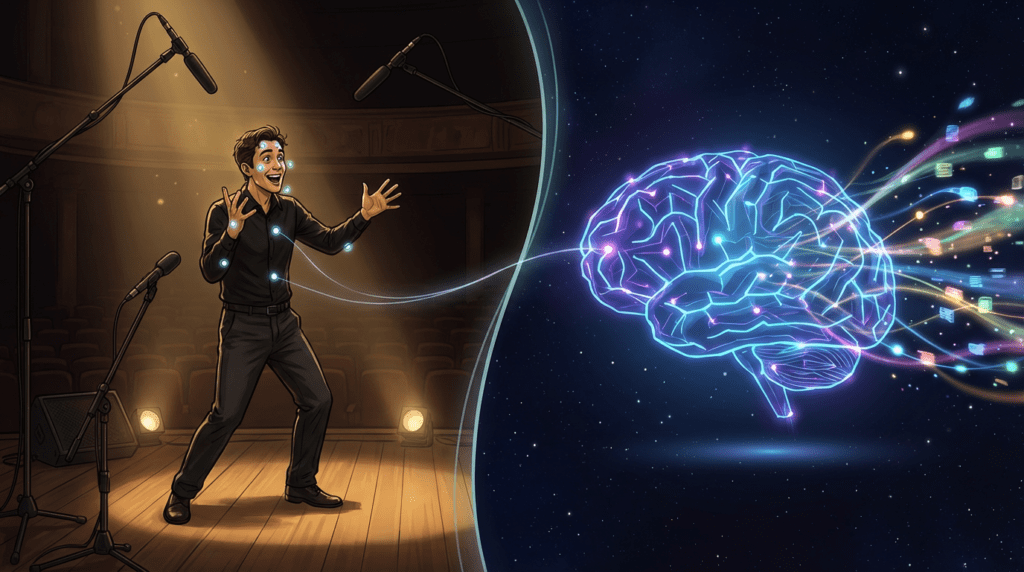
Picture this. You walk into an audition, except there’s no casting director, no stage, and no script. Instead, you log onto a video call, get handed a loose prompt, and start improvising with a stranger. The twist? Your performance isn’t going to land you a role in a film or a spot in a theater company. It’s going to train an artificial intelligence.
That’s exactly what’s happening right now. AI companies are actively recruiting improv actors, sketch comedians, and stage performers to help teach their models how to understand and replicate human emotion. It sounds like the premise of a quirky indie film. But it’s real, it’s happening fast, and it’s raising some very big questions about the future of both AI and the performing arts.
The job listing comes from Handshake AI, a company that supplies training data to OpenAI and other leading AI labs. And it’s just one signal of a much larger shift happening across the tech industry.
What Handshake AI Is Actually Asking For
Let’s break down what this job actually involves. Handshake AI posted an open role inviting “actors, improvisers, and performers” to join a paid, collaborative improv project. Participants get matched with other performers over video. They receive a light prompt or scenario. Then they improvise, freely, openly, and without a script.
The role calls for people with a background in acting, improv, sketch, or theater. But it goes further than just performance chops. The listing specifically asks for “emotional awareness” defined as the “ability to recognize, express, and shift between emotions in a way that feels authentic and human.” It also asks for “interactions that feel grounded, human, and fun to play.”
Sessions are described as “unscripted and open-ended.” Participants improvise scenes, explore characters, and respond naturally in the moment. The role promises creative freedom. It also promises flexibility, easy to fit alongside auditions, classes, or rehearsals. And it pays an average of $74 per hour.
That’s not a bad rate. But as The Verge has reported, the starting pay on these projects often dwindles quickly once a participant signs up. The flexible schedule also isn’t as flexible as it sounds when workers are competing for a limited number of tasks that can appear, or disappear, at any moment.
Why AI Needs Actors in the First Place
Here’s the thing about AI models. They’re often described as “jagged.” That means they can be brilliant at surprisingly complex tasks, writing legal briefs, solving math problems, generating code, but they stumble badly at things that feel simple to humans. Like reading the room. Like knowing when someone is frustrated, excited, or just being sarcastic.
That’s the gap AI companies are trying to close. And they’ve realized that closing it requires something they can’t just scrape from the internet: authentic, nuanced, emotionally layered human interaction.
According to NewsBytesApp, these improv sessions are specifically designed to produce examples of human tone and emotion that can help voice AIs sound less robotic. The goal is to train models to actually get human emotions, not just repeat data patterns, but understand the texture of real conversation.
This matters more than ever because AI has gone fully multimodal. Models don’t just generate text anymore. They speak, listen and respond in real time with realistic inflections. OpenAI debuted an Advanced Voice Mode in 2024, complete with a suite of different voices. Elon Musk’s xAI offers voice chat within Grok. Anthropic’s Claude has offered a voice feature since last May. These systems need to do more than talk, they need to connect.
The Booming Business of Specialized Training Data
Handshake AI isn’t operating in a vacuum. It’s part of a fast-growing ecosystem of companies that supply specialized training data to AI labs. Think of them as the behind-the-scenes suppliers feeding the AI machine.
Handshake’s demand for training data tripled last summer. By November, the company had surpassed a $150 million run rate. It’s scrambling to keep up. Competitors like Mercor and Scale AI are doing the same, building networks of tens of thousands of professionals across white-collar industries. Chemists. Doctors. Lawyers. Screenwriters. And now, improv actors.
The logic is straightforward. AI models are only as good as the data they’re trained on. If you want a model that can navigate a tense negotiation, you train it on data from lawyers. If you want a model that can diagnose a rare condition, you train it on data from doctors. And if you want a model that can hold a warm, emotionally intelligent conversation, you train it on data from performers.
TechDeals.net notes that this role sits squarely at the intersection of creative industries and technology. It underscores a growing acknowledgment from AI companies that human input isn’t optional, it’s essential for emotional authenticity. You can’t fake genuine human feeling with synthetic data alone.
The Performers Caught in the Middle
Not everyone in the performing arts community is thrilled about this development. And honestly, that’s understandable.
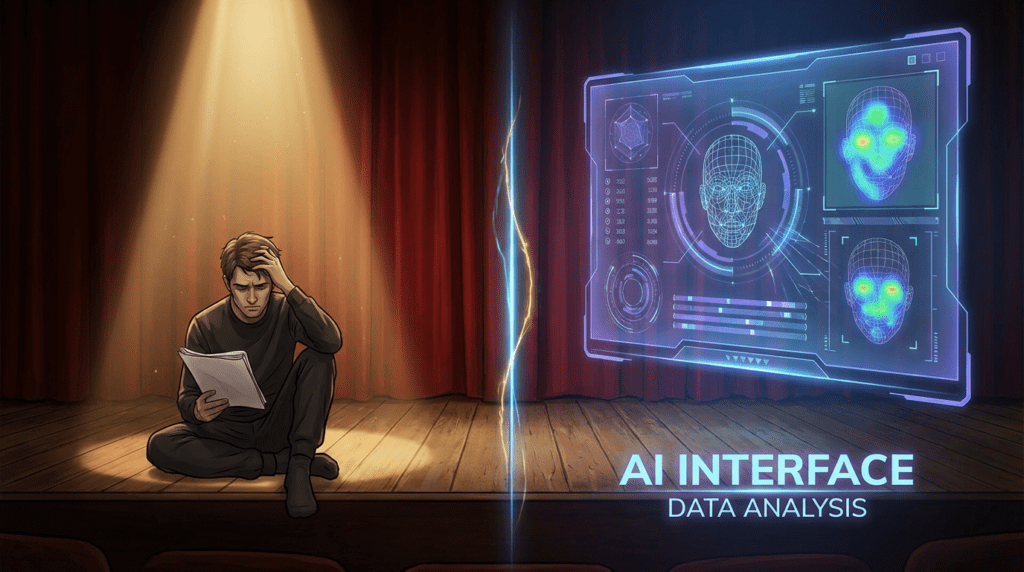
Members of the r/improv community on Reddit have been discussing the Handshake AI listing at length. The reactions range from skeptical to outright hostile. One user called it “dystopian.” Another wrote bluntly: “It’s clearly just an attempt to get people to train AI models to create AI generated videos.” A third said they planned to “sabotage the inputs.”
One user joked, “Now AI is coming for our lucrative improv comedy jobs.” It got laughs. But underneath the humor, there’s a real anxiety.
Many of these professionals worry they’re training AI models in a way that will make their own careers obsolete faster than they otherwise would have been. It’s a genuine dilemma. Take the money now, help build the thing that might replace you later. Or refuse, and watch someone else take the gig.
The Verge has reported on this tension across multiple industries. Doctors, lawyers, and screenwriters have all faced the same uncomfortable question: am I accelerating my own displacement?
The Case for Participating — and the Case Against
Let’s be fair. There are real arguments on both sides.
For performers who are between gigs, the $74-per-hour rate is genuinely attractive. The work is flexible. It draws on real skills. And it doesn’t require relocating, auditioning, or navigating the brutal economics of the traditional entertainment industry. For someone juggling acting classes, side gigs, and auditions, this kind of work can fill gaps in a meaningful way.
TechDeals.net points out that performers with strong improvisational skillsets and flexible schedules are the ideal candidates for this kind of work. For them, the opportunity might genuinely make sense, at least in the short term.
But the risks are real too. The pay can drop. The tasks can dry up. And the long-term implications are murky at best. Classical theater roles, film and television projects, and other traditional acting opportunities may offer more stability — even if the hourly rate looks lower on paper. More importantly, they don’t carry the existential weight of potentially training your own replacement.
What This Means for the Future of AI Interaction
Step back from the individual dilemma for a moment. Look at the bigger picture. What does it mean that AI companies are now hiring performers to teach their models how to feel?
It means we’re entering a new phase of AI development. The race isn’t just about raw intelligence anymore. It’s about emotional intelligence. It’s about building systems that don’t just answer questions, they understand the person asking them.
NewsBytesApp frames it well: these efforts could, over time, make everyday chatbots feel more relatable. Think assistants that can accurately detect and respond to user mood, voice interfaces that respond naturally to emotional signals, and AI that doesn’t just process your words, it reads your tone.
That’s a profound shift. And it changes how we interact with technology in daily life. Your AI assistant might soon know when you’re stressed before you say a word. It might adjust its tone when you’re grieving. It might match your energy when you’re excited. That’s not science fiction. That’s the direction this is heading.
The Irony Nobody Is Talking About
Here’s the irony at the heart of all this. The very qualities that make human performers irreplaceable, spontaneity, emotional depth, authentic presence, are exactly what AI companies are trying to bottle and replicate.
They’re not hiring actors because they think actors are obsolete. They’re hiring actors because they know they can’t do this without them. Not yet. Maybe not ever, in the truest sense.
One Reddit user put it beautifully: “I predict a resurgence of live comedy from people being sick of online services and wanting some rough around the edges, real, face-to-face entertainment. I think that could be a great marketing angle for improv teams: come see real, unpolished, laugh out loud comedy, NOT made by a computer.”
There’s something to that. The more AI polishes its emotional performance, the more people might crave the raw, unfiltered version. The version that stumbles, and surprises itself. The version that’s genuinely, messily human.
A New Kind of Collaboration — Whether We Like It or Not
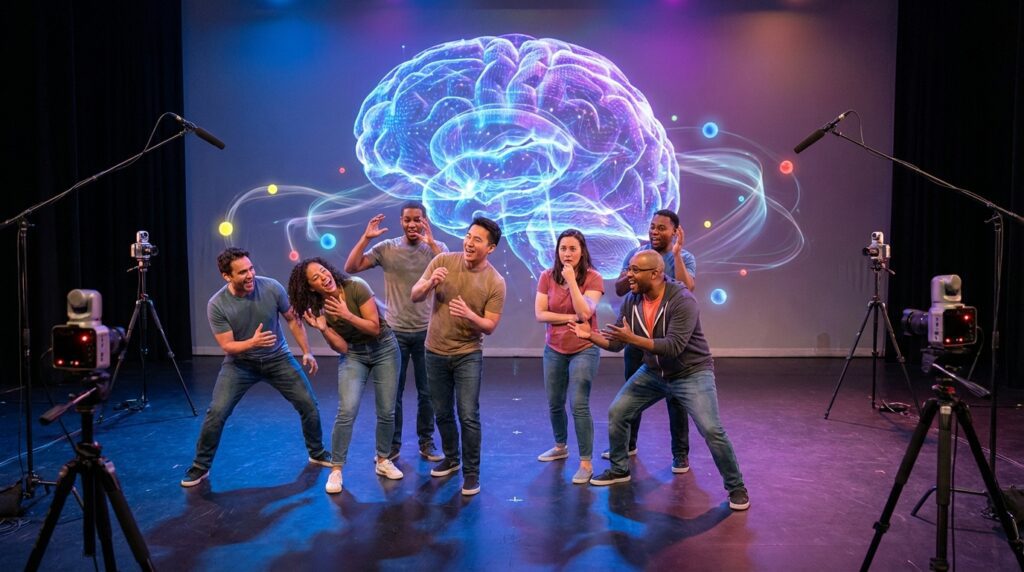
The relationship between AI and the performing arts is no longer hypothetical. It’s here. It’s paying $74 an hour. And it’s asking you to improvise.
Whether that’s an opportunity or a threat depends on who you ask. But one thing is clear: AI companies have decided that emotional authenticity matters. They’ve decided that the best way to get it is to go straight to the source, the people who have spent their lives learning how to feel out loud.
That’s a strange kind of compliment. And a complicated one.
The stage has changed. The audience has changed. But the need for genuine human expression? That hasn’t changed at all. If anything, it’s more valuable than ever.
Sources
- The Verge — AI companies want to harvest improv actors’ skills to train AI on human emotion — Hayden Field, March 15, 2026
- TechDeals.net — AI Firms Hire Improv Actors for Emotion Training — March 15, 2026
- NewsBytesApp — AI companies are hiring actors to improve emotional responses — March 16, 2026
AI Emotional Safety
AI Work and Labor
AI Data Exhaustion
AI Company Evolution
The Kingy Brief
Get the next Kingy Brief.
Source-checked AI changes, original tests and one practical thing to try.
Free · Choose your subjects · Double opt-in · Unsubscribe anytime