The AI music platform’s biggest update yet isn’t about better beats. It’s about making those beats unmistakably, undeniably you.
The Drop Nobody Saw Coming (But Everyone Needed)

Let’s be honest. Most AI music updates follow the same script. Better audio. Cleaner vocals. Fewer weird glitches where the singer sounds like they’re gargling underwater. Rinse. Repeat.
Suno just tore up that script entirely.
On March 26, 2026, Suno quietly dropped version 5.5 of its AI music model, and it’s not what anyone expected. This isn’t just a quality bump. It’s a full-on identity shift. The company calls it “our best and most expressive model yet,” and for once, that’s not just marketing fluff.
V5.5 introduces three brand-new features: Voices, Custom Models, and My Taste. Each one does something different. But together? They’re pointing toward a future where AI music isn’t just generated, it’s personalized. Deeply, specifically, almost uncomfortably personalized.
So buckle up. We’re breaking it all down.
Voices: The Feature Everyone Was Screaming For
Here’s the thing about Suno’s community. They’ve been asking for this one for a long time.
Voices is exactly what it sounds like. It lets you train Suno’s vocal model on your own voice. Your actual, real, human voice. Then it uses that voice to sing on AI-generated tracks.
Think about that for a second. You hum a melody into your phone. You type a prompt. And suddenly, you’re the one singing a fully produced pop banger, even if you can’t carry a tune to save your life.
According to The Verge, the feature is flexible in how you feed it data. You can upload clean a cappella recordings for the best results. You can submit finished tracks with backing music if that’s all you’ve got. Or you can just sing directly into your phone or laptop microphone. The cleaner the recording, the less data the model needs. Simple as that.
But here’s where it gets interesting, and a little bit legally spicy.
The Voice Verification Problem (And How Suno Tackled It)
Voice cloning is powerful. It’s also terrifying. The second you let people clone voices, someone’s going to try to clone someone else’s voice. A celebrity. A musician. An ex. You name it.
Suno knows this. And they built in a safeguard.
To use the Voices feature, you don’t just upload audio and call it a day. Suno requires you to record a randomly generated verification phrase. The system then matches the singing voice in your uploaded audio against that spoken phrase. If they don’t match, no dice.
As The Decoder explains, this verification step is designed to make sure only your voice gets used. Voice profiles are private by default. Only the person who uploaded the voice can use it to create new songs.
Is it foolproof? Probably not. The Verge notes that existing AI voice models of celebrities could potentially be used to fool the system. That’s a real concern. But the fact that Suno built in any safeguard at all signals that they’re at least thinking about the ethical minefield they’re walking through.
And for what it’s worth, Suno says it plans to add a voice-sharing option down the road, with users keeping full control over their voice data. That’s a promising sign.
Custom Models: Build Your Own Musical DNA
Okay, so you’ve got your voice in the system. Now what?
Now you build your sound.
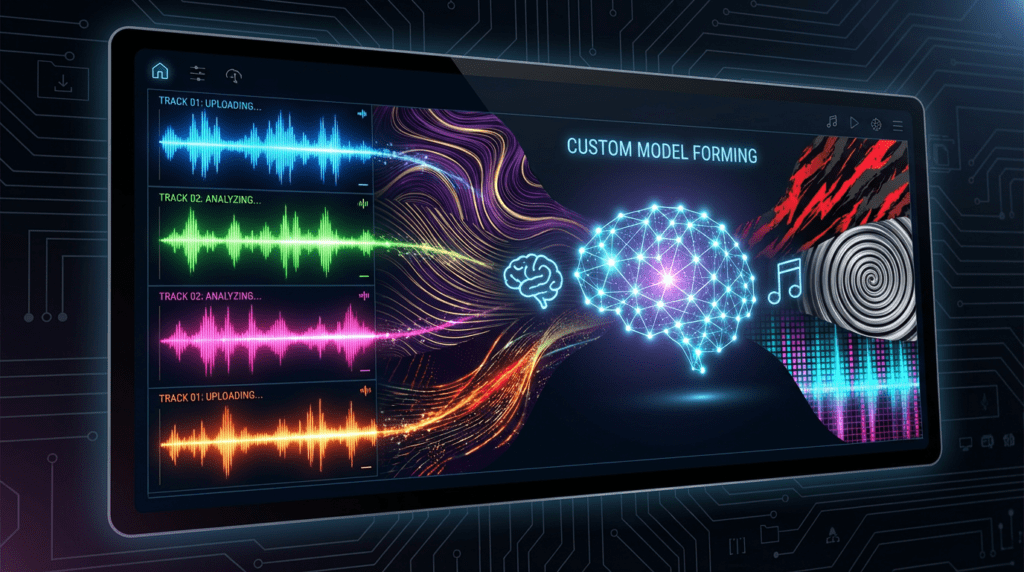
Custom Models is the second major feature in v5.5, and it’s aimed squarely at creators who have a catalog to work with. The idea is simple: upload at least six tracks from your own music, give the custom model a name, and Suno builds a personalized version of v5.5 that knows your style.
Not just your genre. Your style. The way you structure a verse. The chord progressions you gravitate toward. The mood you always seem to land in. Suno absorbs all of it and bakes it into a model that’s uniquely yours.
Digital Music News reports that Pro and Premier subscribers can create up to three custom models for now. That’s a meaningful limit, it keeps things manageable while still giving serious creators room to experiment.
Think of it like this. If you’re a lo-fi hip-hop producer, you can train a model on your existing beats. Then every new prompt you run through that model comes out sounding like you, not like generic AI output. That’s a game-changer for artists who’ve been frustrated by how homogenized AI music can feel.
TechBuzz.ai frames it well: “Once you’ve spent time training a custom voice model, switching to a competitor becomes less appealing.” That’s not just a product feature. That’s a retention strategy. And it’s a smart one.
My Taste: The Algorithm That Works For You
Here’s the feature that everyone gets access to, not just the paying subscribers.
My Taste is Suno’s answer to the recommendation algorithm. But instead of surfacing content you might like, it shapes the content it creates for you.
Over time, Suno pays attention. It notices which genres you keep coming back to. Which moods you gravitate toward. Which artists you reference in your prompts. And it starts applying those preferences automatically, especially when you use the magic wand to autogenerate styles.
The Verge describes it as learning “tastes and preferences over time” and applying them to outputs. It’s subtle. It’s passive. And it’s genuinely useful for casual users who don’t want to write a detailed prompt every single time.
Think of it as Spotify’s Discover Weekly, but instead of finding music you’ll love, it makes music you’ll love. Based on you. For you.
It’s the most accessible of the three new features, and probably the one that’ll have the widest impact. Not everyone has a vocal catalog to upload. Not everyone wants to build a custom model. But everyone has taste. And now Suno can learn it.
The Bigger Picture: A Strategic Pivot in Real Time
Let’s zoom out for a second.
Suno’s previous updates were all about fidelity. Better sound. More natural vocals. Fewer artifacts. That’s the standard playbook for any AI model in its early stages, chase quality first, then worry about everything else.
V5.5 marks a clear departure from that playbook.
TechBuzz.ai puts it bluntly: “Where previous versions focused on creating more natural-sounding vocals and improving overall audio fidelity, v5.5 puts customization front and center.” This is a company that’s decided baseline quality is no longer the differentiator. Everyone can make decent AI music now. The question is: who can make your AI music?
Suno’s answer is clear. They can.
And they’re not alone in making this pivot. OpenAI has been adding fine-tuning and customization options to its GPT models. Image generators like Midjourney and Stable Diffusion have embraced style training. The pattern is consistent across the entire generative AI industry: first you chase quality, then you chase control.
Suno is right on schedule.
The Competition Is Heating Up
Here’s something worth noting. Suno didn’t drop v5.5 in a vacuum.
Digital Music News points out that the release came right as Google rolled out its latest AI music system, Lyria 3 Pro. That’s Google DeepMind’s offering, promising more detailed instrumental rendering and dynamic control tailored for artists and producers.
Two major AI music drops in the same week. That’s not a coincidence. That’s a war.
The AI music space is getting crowded fast. And the companies that survive won’t just be the ones with the best models. They’ll be the ones with the most loyal users. The ones who’ve built ecosystems that are hard to leave.
Suno’s v5.5 is a direct play for that kind of loyalty. Your voice is in there, your taste is in there and your custom model is in there. Why would you go anywhere else?
The Legal Elephant in the Room
We’d be doing you a disservice if we didn’t mention this.
Suno is currently fighting lawsuits from major record labels over its training data. It’s a messy, ongoing battle that hasn’t been resolved. And it’s not the only one, The Decoder notes that competitor Udio has already been more or less absorbed by Universal Music Group.
But here’s the interesting wrinkle. Suno dropped a hint in its v5.5 release notes that these features “lay the foundation for the next generation of music models we’re launching with the music industry later this year.”
With the music industry. Not against it.
That’s a significant shift in tone. It suggests that Suno’s legal battles might be moving toward resolution, or at least toward some kind of détente. Partnering with the industry rather than fighting it would be a massive strategic win. And it would give v5.5’s features a whole new context: not just tools for individual creators, but building blocks for a broader music ecosystem.
Watch this space.
Who Gets What — And What It’ll Cost You
Let’s break down the access tiers quickly, because not everything in v5.5 is available to everyone.
My Taste — Available to all users, free and paid. No barriers. Just use Suno and it learns your preferences over time.
Voices — Pro and Premier subscribers only. You’ll need to pay to clone your own voice and use it on tracks.
Custom Models — Also Pro and Premier only. Up to three custom models per user, trained on your own music catalog.
If you’re a casual user, My Taste is a nice perk. But the real power features, the ones that make v5.5 genuinely exciting, are locked behind a paywall. That’s a reasonable business decision. These features require significant compute. They’re not cheap to run.
Whether the price is worth it depends on how serious you are about making music. For hobbyists, probably not. For working creators? This could be transformative.
The Bottom Line: AI Music Just Got Personal

Here’s what Suno v5.5 really is, stripped of all the tech jargon.
It’s a bet. A big one.
Suno is betting that the future of AI music isn’t about the machine making better music. It’s about the machine making your music. Music that sounds like you. Music that reflects your taste, your voice, your creative DNA.
That’s a fundamentally different vision than what most AI music tools have been selling. And it’s a compelling one.
Will it work, will casual users bother training custom models? And will voice cloning become mainstream or stay niche? Those are real questions without clear answers yet.
But the direction is right. The features are genuinely innovative. And for the first time, AI music feels less like a novelty and more like a real creative tool.
Suno v5.5 isn’t just an update. It’s a statement. And the music industry, all of it, human and artificial, is listening.
Sources
- The Verge — “Suno leans into customization with v5.5”
- The Decoder — “Suno 5.5 lets users sing their own AI-generated songs with a personalized voice feature”
- Digital Music News — “Suno Launches Version 5.5 With New ‘Voices’ Feature”
- TechBuzz.ai — “Suno’s v5.5 AI Music Model Adds Voice Cloning Features”
- Suno Official Blog — v5.5 Release Notes