Microsoft dropped three new AI models, restructured its entire AI division, and quietly told the world it doesn’t need OpenAI to win. Here’s what’s actually going on.
The Big Move Nobody Saw Coming
Let’s be honest. Most people weren’t paying attention.
On April 2, 2026, Microsoft quietly launched three in-house AI models, and the tech world hasn’t been the same since. No fanfare. No flashy keynote. Just a blog post from Mustafa Suleyman and a trio of models that signal something massive: Microsoft is building its own AI empire, and it’s doing it fast.
This isn’t just a product launch. It’s a declaration of independence.
Until October 2025, Microsoft was contractually restricted from independently pursuing AGI or superintelligence. That was part of the original 2019 deal with OpenAI, Microsoft got the models, OpenAI got the cloud compute. Everyone was happy. Then OpenAI started shopping for compute deals elsewhere, and Microsoft renegotiated. Buried in that new contract? A clause that freed Microsoft to chase superintelligence on its own terms.
Suleyman told The Verge he’d been planning this move for nine months before the ink was even dry. That’s not reactive. That’s chess.
Meet the MAI Model Family
So what exactly did Microsoft ship? Three models. All built in-house. All impressive.
MAI-Transcribe-1, MAI-Voice-1, and MAI-Image-2 are now live on Microsoft Foundry and the MAI Playground. They’re available for commercial use. Developers can start building today.
Together, they form a first-party AI stack covering speech recognition, voice synthesis, and image generation, all under one roof. That’s a big deal. It means developers building on Azure no longer have to stitch together third-party APIs for these core capabilities. Microsoft just handed them a complete multimodal toolkit.
And yes, these models are already running inside products you use every day, Copilot, Bing, Teams, and PowerPoint.
MAI-Transcribe-1: The Headliner

This one is turning heads. And for good reason.
MAI-Transcribe-1 is a speech-to-text model that supports 25 languages. It beats OpenAI’s Whisper-large-v3 across all 25 tested languages. It also outperforms Google’s Gemini 3.1 Flash-Lite on 22 of those 25. The average word error rate sits at 3.8% on the FLEURS benchmark. That’s genuinely best-in-class.
Speed? It runs 2.5 times faster than Microsoft’s previous Azure Fast offering. Cost? Just $0.36 per audio hour. And Suleyman claims it runs at half the GPU cost of competing state-of-the-art models.
If that holds up under real-world conditions, it’s a massive win for anyone running transcription at scale.
The model handles the messy stuff too. Background noise. Low-quality audio. Overlapping speech. It was trained on a mix of controlled studio recordings and real-world audio, contractors recording themselves on busy streets, in noisy homes, with kids running around in the background. That’s the kind of training data that actually matters for enterprise use.
It supports MP3, WAV, and FLAC formats. It’s already rolling out inside Copilot Voice and Microsoft Teams. And it’s ready for call center analytics, real-time captioning, and voice input pipelines.
MAI-Voice-1: Speed Meets Naturalness
Next up is MAI-Voice-1, Microsoft’s text-to-speech model.
Here’s the stat that makes developers stop scrolling: it generates 60 seconds of audio in under one second on a single GPU. That’s not a typo. One second. Sixty seconds of output.
It also lets you create a custom voice from just a few seconds of sample audio. That opens up a wild range of use cases, branded voice assistants, personalized podcast narration, conversational agents that actually sound human.
Pricing starts at $22 per one million characters. Combined with MAI-Transcribe-1 and a language model, Microsoft says it can power full voice agents end-to-end. That’s a complete voice pipeline, all from one vendor.
MAI-Image-2: Already Winning on the Leaderboard
Then there’s MAI-Image-2. Microsoft’s text-to-image model debuted at #3 on the Arena.ai leaderboard for image model families. It delivers at least twice the generation speed compared to earlier versions, based on production data.
It focuses on photorealistic outputs, better text rendering inside images, and improved handling of complex layouts. The model was trained with input from designers, photographers, and visual storytellers, which shows in the results.
WPP, one of the world’s largest advertising companies, is already building on it at scale. It’s also live inside Bing Image Creator and PowerPoint. Pricing starts at $5 per million text tokens and $33 per million image tokens.
The Small Team Behind the Big Win
Here’s the part that should make every startup founder sit up straight.
Suleyman built MAI-Transcribe-1 with a team of just 10 people. Ten. He told The Verge the team was “liberated from any of the bureaucracy,” with a surrounding support team handling vendor management, data sourcing, and logistics. The core team just built.
This mirrors what Meta, Amazon, Google, and Anthropic are all experimenting with, small, focused teams with big compute budgets and minimal red tape. It turns out that when you strip away the meetings and the approval chains, smart people build incredible things fast.
Microsoft applied the same strategy to MAI-Voice-1 and MAI-Image-2. The results speak for themselves.
What This Means for the Microsoft-OpenAI Relationship
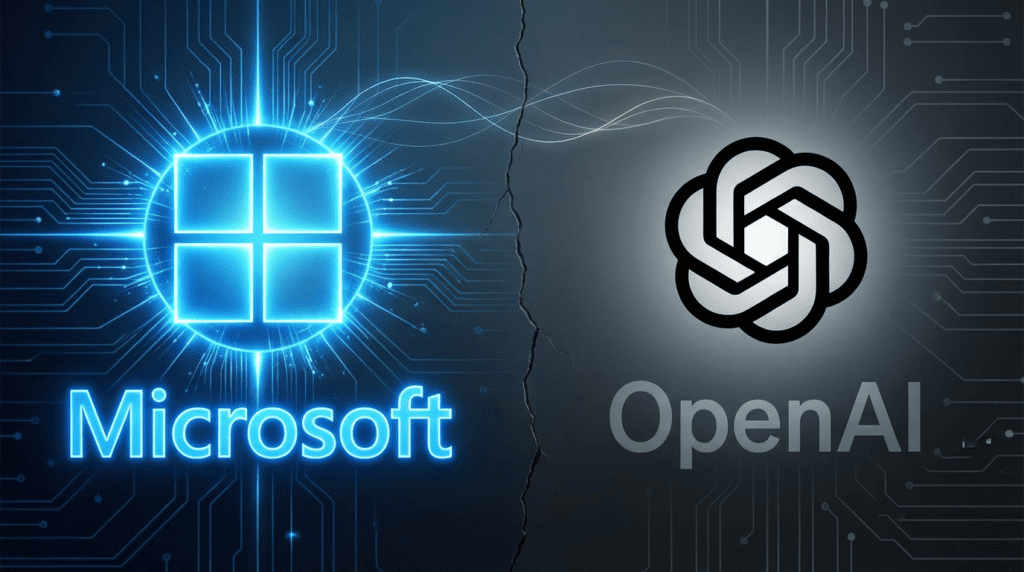
Let’s not dance around it. This is awkward.
Microsoft still holds license rights to everything OpenAI builds through 2032. So they’re not losing anything from the partnership. But OpenAI is losing something significant, the guarantee that Microsoft would always ship OpenAI models because they had no alternative. Now they do.
As Dev.to writer Bejie Paulo Aclao put it, “The partnership language coming from both sides right now is the corporate equivalent of a couple telling friends ‘we’re fine, everything’s great’ while one of them is already apartment hunting.”
Both sides are saying the right things publicly. Suleyman says they’ll be partners until at least 2032. But actions tell a different story. Microsoft just shipped three competing models, reorganized its entire AI division around building more of them, and its CEO of AI is using words like “self-sufficiency” in every interview.
Suleyman’s Superintelligence Vision
So what’s the endgame here?
After Microsoft’s mid-March restructuring, Suleyman handed off day-to-day Copilot oversight to Jacob Andreou, who now leads engineering, growth, product, and design for the newly combined enterprise and consumer teams under the Copilot banner. That freed Suleyman to focus entirely on what he calls “humanist superintelligence.”
It’s a very Microsoft way of defining the term. For Suleyman, superintelligence isn’t about robots taking over the world. It’s about business value. “Superintelligence is really about, ‘Are these models capable of delivering product value for the millions of enterprises that depend on us?'” he told The Verge.
His vision is practical. Grounded. “Everyone is going to have an AI assistant in their pocket that is truly world-class, accountable to them, on their side, aligned to their interests, working on their behalf.”
That’s not science fiction. That’s a product roadmap.
Why Developers Should Care Right Now
If you’re building on Azure, pay attention. MAI models are already showing up alongside GPT models in Azure AI Foundry. The transcription model alone could save serious money for anyone running speech processing pipelines at scale.
More competition means cheaper inference for everyone. Microsoft has the distribution, Azure, Office, Windows, Teams, VS Code — and now it’s building the models to match. OpenAI has to stay sharp. Google has to stay sharp. And developers building on these APIs get more options at better price points.
That’s a win. Full stop.
Suleyman promised “more models soon.” If Microsoft keeps this pace, and the early results suggest it will, we might be looking at a world where the best models for specific enterprise tasks come from Microsoft, not OpenAI.
The superintelligence game plan is no longer theoretical. It just shipped.
Sources
- The Verge — Microsoft’s new ‘superintelligence’ game plan is all about business
- The Decoder — Microsoft’s MAI-Transcribe-1 runs 2.5x faster than its predecessor at $0.36 per audio hour
- Economic Times — Microsoft launches 3 AI models for transcription, image, and speech generation
- Dev.to — Microsoft Just Told OpenAI It Doesn’t Need Them Anymore
- FoneArena — Microsoft rolls out MAI-Transcribe-1, MAI-Voice-1 and MAI-Image-2 in Foundry public preview