
The Job Posting That Says More Than It Looks
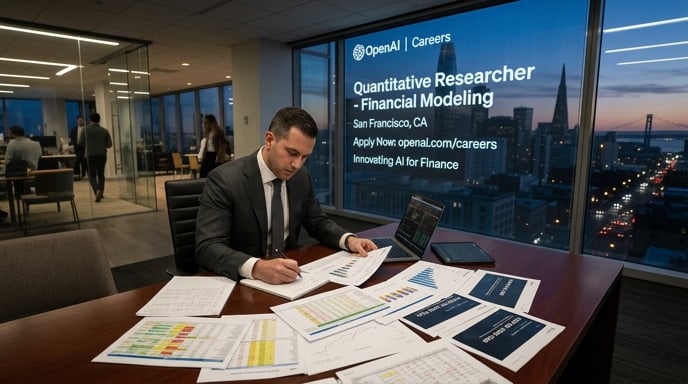
OpenAI is hiring an investment banking expert in San Francisco, and no, this is not some quirky résumé experiment from Silicon Valley’s “let’s automate everything” laboratory.
The company has posted a role for a Subject Matter Expert, Investment Banking on its Applied AI team. The listed pay: $185,000 to $205,000 in base salary, plus equity. The setup: hybrid work in San Francisco, three days a week in the office, with relocation assistance available for new employees.
At first glance, this sounds like OpenAI simply wants a former banker to help polish finance workflows. Nice. Sensible. Very spreadsheet-adjacent.
But the job description tells a bigger story.
OpenAI says investment banking is one of the most demanding environments for knowledge work. Bankers must synthesize scattered information, make judgment calls under pressure, and produce accurate models, analyses, and client materials. That is not casual ChatGPT territory. That is “one bad cell reference and the managing director starts breathing fire” territory.
The company wants someone who can help define what “excellent AI-assisted banking work” actually looks like. In plain English: OpenAI does not just want AI that sounds like a banker. It wants AI that can survive a banker’s red pen.
And that is where things get interesting.
Why OpenAI Needs a Banker in the Room
OpenAI’s listing is unusually specific. The company wants someone with current investment banking knowledge across company research, industry research, financial analysis, valuation, diligence, transaction execution, and client materials.
That matters because banking is not just “make me a chart.” It is judgment layered on top of numbers, wrapped in a PowerPoint deck, then stress-tested by senior people who have seen every trick in the book.
OpenAI says the new hire will design realistic tasks and evaluations, create banker-grade reference work, diagnose model failures, and help technical teams improve model behavior. The person will move between Excel models, slide decks, source documents, evaluation rubrics, product prototypes, and conversations with researchers or customers.
That is a mouthful. But the core idea is simple.
AI models can already produce confident-looking answers. The problem is that in finance, “confident-looking” is not enough. A model can write a clean paragraph about a merger and still misunderstand the debt structure. It can build a valuation table and still use the wrong denominator. It can produce a beautiful chart that is, financially speaking, wearing clown shoes.
OpenAI wants help separating impressive-looking output from work that is accurate, traceable, internally consistent, and useful in real financial workflows.
That is not cosmetic. That is product development.
The Pay Is Good, But the Signal Is Better
Business Insider reported that OpenAI is offering up to $205,000 plus equity for the role, noting that the company is making a bigger push into investment banking.
That salary may look attractive to plenty of professionals, especially because it comes with equity. But Wall Street compensation is its own strange beast. Top investment banking roles can pay more, especially after bonuses. So this is not necessarily OpenAI outbidding every bank on cash.
The real lure is different.
This job sits at the intersection of finance, AI, and enterprise software. Whoever gets it will not just review pitch decks. They may help shape how AI tools work inside one of the most lucrative, high-pressure corners of the global economy.
The listing asks for 2+ years of investment banking experience, including live transaction execution and the production of high-quality analyses, financial models, and client materials. OpenAI says demonstrated judgment matters more than title or tenure.
That line is important. OpenAI is not necessarily looking for a rainmaking managing director with a Rolex and a calendar full of steak dinners. It wants someone who understands the machinery of banking work. The grueling stuff. The analyst-to-associate trenches. The version-control chaos. The “why does this EBITDA number not match page 47?” nightmare.
In other words, OpenAI wants someone who knows where the bodies are buried in the spreadsheet.
This Is About Evals, Not Just Automation
The most revealing word in the job listing is not “banking.” It is evaluations.
OpenAI says the hire will translate real banking workflows into representative evaluation tasks with realistic inputs, constraints, deliverables, and success criteria. The person will also develop grading methods that assess financial correctness, analytical judgment, source quality, traceability, internal consistency, presentation quality, and practical usefulness.
That is the boring-sounding part that may matter most.
AI companies do not improve models by magic. They need tests. They need benchmarks. They need examples of good work and bad work. They need humans who can say, “This answer is not merely wrong; it is wrong in the exact way a junior banker gets roasted at 1:17 a.m.”
Investment banking is full of edge cases. Comparable company analysis can look easy until the peer set is questionable. Discounted cash flow models can look polished while hiding fragile assumptions. Diligence summaries can sound persuasive while leaning on weak sources.
OpenAI appears to be building the machinery to test models against those realities.
That is a serious move. It suggests the company does not merely want ChatGPT to help bankers write emails faster. It wants AI systems that can participate in deeper financial workflows, where accuracy and judgment carry real consequences.
Wall Street Is a Huge Prize
The financial sector is not a side quest for AI companies. It is one of the main levels.
Traders Union framed OpenAI’s banking hire as part of a broader fight for enterprise spending from financial institutions. The outlet also noted that major banks are already spending heavily on technology, citing figures from Business Insider that JPMorgan Chase budgets $18 billion a year for technology and Goldman Sachs is spending $6 billion this year, with AI as a central focus.
Those numbers explain the frenzy.
Banks have money. Banks have repetitive workflows. Banks have armies of people producing research, analysis, models, memos, decks, compliance documentation, and client materials. Banks also have enormous pressure to move faster without breaking the rules or embarrassing themselves in front of clients.
That combination is catnip for enterprise AI.
But finance is also hard to crack. The tolerance for error is low. Confidentiality matters. Data entitlements matter. Regulatory scrutiny matters. Reputational risk matters. OpenAI’s own listing mentions governance, regulation, confidentiality, data entitlements, and reputational risk as areas where candidates need sound judgment.
That is the catch.
A chatbot that drafts a vacation itinerary can be charming even when it makes a goofy suggestion. A banking assistant that misstates a valuation multiple is not charming. It is a liability with a login screen.
The AI Banker Will Not Start as the Boss

OpenAI’s job listing includes a subtle but important line: the candidate should understand where AI should automate execution, support decision-making, or remain subject to human review.
That is the entire AI-in-finance debate in one sentence.
Some banking work is ripe for automation. Think formatting, first-pass company research, data extraction, market summaries, comparable company screening, and draft materials. Nobody should romanticize copying numbers from one document into another until midnight. That is not “craft.” That is punishment with fonts.
Other work is different.
Judgment-heavy tasks still need experienced humans. Deciding whether a company belongs in a peer set, whether an assumption is defensible, whether a transaction narrative actually makes sense, or whether a client should take a strategic path cannot be reduced to autocomplete with a bonus target.
OpenAI appears to recognize that distinction.
The company is not advertising for someone to remove bankers from the loop. It is advertising for someone who can help determine where the loop should tighten, where it can loosen, and where it must stay firmly human.
That is smart. It is also necessary.
The winners in finance AI will not be the tools that shout “full automation!” the loudest. They will be the tools that know when not to touch the steering wheel.
The Role Could Shape Future Finance Products
OpenAI says the new hire will work with product teams to identify high-value opportunities for AI in investment banking, prototype new workflows using OpenAI tools, and evaluate whether early experiences meet the needs of real users.
That sounds like a product strategy role wearing a banker costume.
The person may help answer questions like: Which banking tasks are painful enough that firms will pay for AI help? Which workflows are safe enough to automate? Which outputs require citation trails? How should AI handle source documents? How should it flag uncertainty? How should it behave when it sees conflicting numbers?
These are not abstract questions. They determine whether AI becomes a novelty, a productivity layer, or a core operating system for financial work.
Investment banking has always been a strange mix of elite judgment and manual grind. AI companies see the grind and smell opportunity. But they also need to respect the judgment part. That is harder.
A good finance AI tool must know the difference between “here is a draft” and “here is a defensible answer.” Those are not the same thing. Not even close.
OpenAI’s hiring push suggests it wants domain experts to teach its systems that difference.
Anthropic, Banks, and the Enterprise Race
OpenAI is not operating in a vacuum. The enterprise AI race is crowded, expensive, and increasingly vertical.
Business Insider noted that Anthropic announced new agents in May aimed at streamlining Wall Street-style work, while financial services remains a major enterprise opportunity. Traders Union also reported that JPMorgan was an early partner in Anthropic’s Project Glasswing and that the project expanded to more than 150 organizations across more than 15 countries.
This is the larger backdrop.
AI labs no longer win simply by releasing a dazzling general model. Enterprise customers want tools that understand their actual workflows. A law firm wants legal reasoning. A hospital wants clinical discipline. A bank wants financial precision, controls, auditability, and workflow fit.
Generic intelligence is useful. Specialized intelligence sells.
That is why OpenAI hiring a banker is not random. It is part of a broader shift from “look what this model can do” to “look what this model can do inside your business, with your standards, your constraints, and your very expensive mistakes.”
The future of AI competition may depend less on who has the flashiest demo and more on who can package intelligence into specific professional environments.
Finance is one of the biggest tests.
The Spreadsheet Is the Battlefield
The most important software in investment banking is not glamorous. It is Excel. The second is PowerPoint. The third is probably email, followed closely by whatever internal system makes everyone quietly miserable.
OpenAI knows this. The job listing explicitly says candidates should be able to build and review financial analyses in Excel and produce polished PowerPoint materials, while spotting errors, weak assumptions, unsupported claims, inconsistent numbers, and poor presentation.
That sentence is practically a map of banking pain.
AI tools that cannot handle spreadsheets properly will hit a wall in finance. A banker does not just need a summary. A banker needs numbers that tie. Assumptions that make sense. Outputs that match source documents. Formatting that does not look like it was assembled during a small earthquake.
This is where many AI systems still struggle. They are good at language. They are getting better at structured reasoning. But financial work demands both, plus accountability.
An AI-generated model must be inspectable. A valuation output must show its logic. A diligence summary must cite its sources. A pitch deck must be polished, but polish without correctness is just expensive decoration.
So yes, the spreadsheet is the battlefield.
And OpenAI seems to be recruiting accordingly.
What This Means for Junior Bankers
The obvious question is whether this kind of AI will replace junior bankers.
The blunt answer: some junior-banker tasks are absolutely vulnerable. Confidence level: high.
First drafts of company profiles, market maps, initial valuation screens, diligence summaries, formatting checks, and repetitive deck-building are exactly the kinds of tasks AI companies want to compress. That does not mean every analyst disappears. It means the job changes.
The more useful question is what happens to the training ladder.
Investment banking has traditionally trained people through repetition. You learn by building models, fixing footnotes, revising decks, checking numbers, and absorbing feedback through pain, caffeine, and mild existential collapse.
If AI removes too much of the junior grind, banks may need new ways to train judgment. That is not a small issue. Senior bankers do not emerge from nowhere. They are built through years of doing the work.
OpenAI’s listing shows awareness of this hierarchy. The company wants someone who understands how work and judgment evolve from junior analyst through director.
That phrase matters because AI adoption could reshape not just productivity, but apprenticeship itself.
The boring tasks are often where beginners learn the details. Remove the tasks, and you must replace the learning.
Otherwise, Wall Street gets faster and dumber. Nobody wants that. Well, almost nobody.
The Real Product Is Trust
OpenAI’s role is really about one thing: trust.
Not vibes. Not slick demos. Trust.
In banking, trust means the model used the right sources. It means the numbers tie across pages. It means the analysis can withstand review. It means the output is not just plausible, but defensible. OpenAI says it wants the new hire to help distinguish outputs that merely look plausible from work that is accurate, traceable, internally consistent, and ready for serious professional use.
That is the heart of the story.
AI has already conquered the “wow” phase. People know it can write, summarize, brainstorm, code, and explain. The next phase is the “prove it” phase.
Finance will demand proof.
Where did this number come from? Why did the model choose this peer group? What source supports that claim? Why did it exclude that transaction? Does the model know when it is uncertain? Can it show its work without inventing a confident fairy tale?
The companies that answer those questions well will win serious enterprise money.
The ones that cannot will remain impressive toys in expensive suits.
OpenAI’s Banking Hire Is a Small Posting With Big Implications

OpenAI’s investment banking job listing is just one role. But it points to a larger shift in AI.
The frontier is moving from general chatbots toward expert workflows. From broad capability toward domain reliability. From “AI can answer anything” toward “AI can do this specific job under real-world pressure.”
That is a much harder game.
It requires subject matter experts. It requires rubrics. It requires evaluation data. It requires brutal honesty about model failures. It requires knowing when automation helps and when it creates risk.
OpenAI’s banking hire will not instantly transform Wall Street. One job posting does not rewrite an industry. But it does reveal where the company thinks the money, the difficulty, and the opportunity are.
Investment banking is a perfect test case. The work is valuable. The workflows are painful. The standards are high. The budgets are enormous. The mistakes are expensive.
In other words, it is exactly the kind of environment where AI either grows up or gets laughed out of the conference room.
OpenAI seems to want its models ready for that room.
And somewhere in San Francisco, a banker may soon be paid very well to teach an AI the sacred art of making the numbers tie.
Sources
- OpenAI Careers — Subject Matter Expert, Investment Banking
- Business Insider — OpenAI Is Hiring an Investment Banker, Paying Up to $205K Plus Equity
- Traders Union — OpenAI Expands Investment Banking Hiring Push in San Francisco
- eFinancialCareers — OpenAI Job Banker
The Kingy Brief
Get The Kingy Brief.
AI changes, original tests and one practical thing to try. Fridays at 09:00 Vancouver time.
Free · Double opt-in · Unsubscribe anytime
Signup help and newsletter schedule
Signup form provided by Beehiiv. After submitting, check your inbox for "Confirm your subscription to The Kingy Brief" and open its confirmation link. Check Spam or Promotions if you cannot find it.
Fridays at 09:00 Vancouver time: source-checked AI changes, original tests and one practical thing to try. The weekly restart begins October 9, 2026. We skip a week when there is not enough verified material. Free. Unsubscribe anytime.