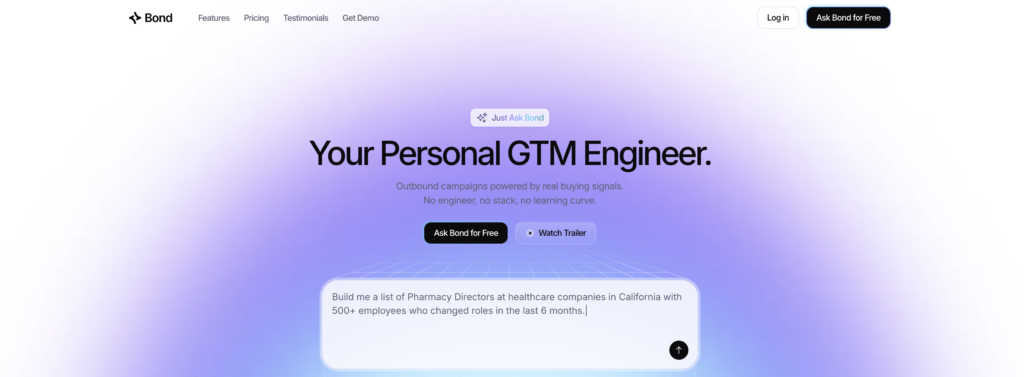
Outbound is not dead. Bad outbound is.
That distinction matters because most B2B teams still need a reliable way to identify the right accounts, understand why now might be the right time to reach out, and start conversations with people who actually fit the product.
The problem is that modern outbound has become operationally heavy.
A team might use one tool for lists, another for enrichment, another for intent data, another for research, another for AI copy, another for sequencing, and then still need someone to check whether the campaign makes sense before it goes live.
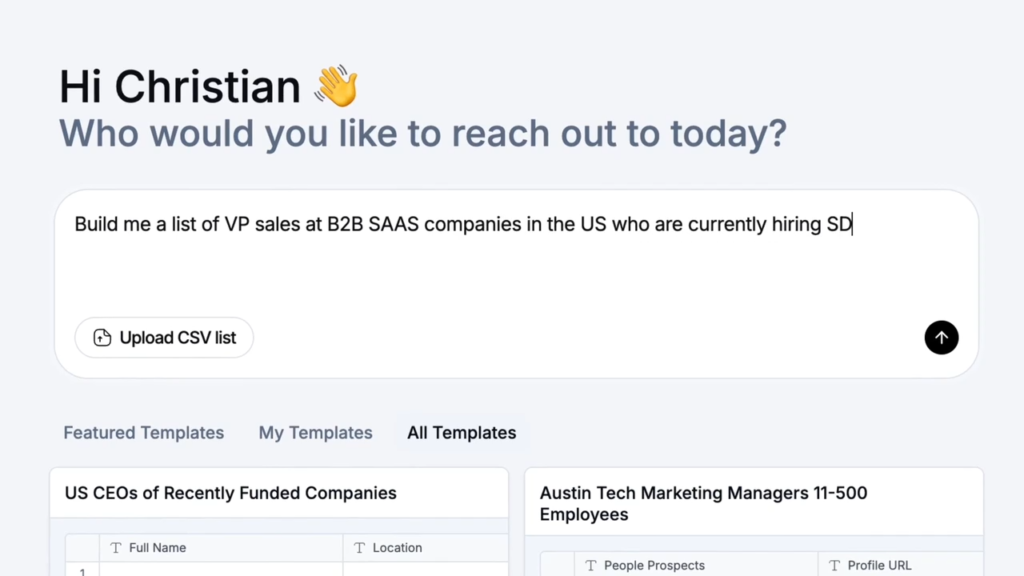
Bond is built around a simple idea: what if that messy middle layer could be compressed into one conversational GTM workflow?
Bond describes itself as a personal GTM engineer. In practical terms, it helps sales and growth teams describe an ideal customer profile, choose buying signals, build lists, verify contacts, research prospects, and create outbound messaging from one place.
That is the core appeal.
Not “AI replaces sales.” Not “pipeline on autopilot.” The better way to understand Bond is this:
Bond helps teams move from “we should go after this segment” to “this campaign is ready to review” faster.
What Bond Actually Does
Bond is an outbound campaign tool built around real buying signals.
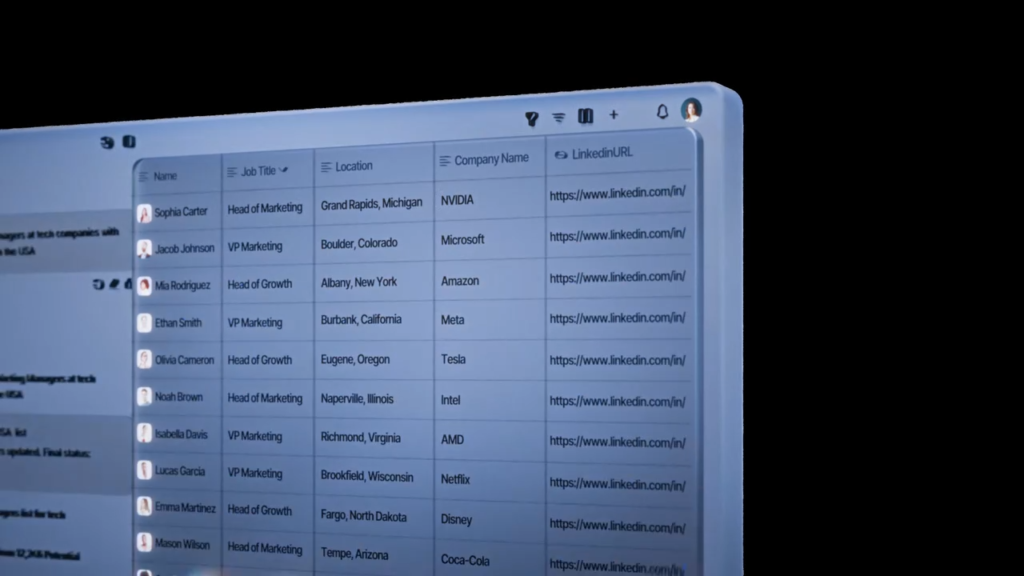
On its site, Bond explains the workflow in three steps: describe the ICP, let Bond build and research the list, then send personalized emails, LinkedIn messages, and call scripts through your sequencer.
The useful part is not just the AI writing. Many tools can draft copy. The more interesting part is the workflow compression.
A typical outbound motion includes:
- Finding accounts
- Identifying relevant contacts
- Checking whether those contacts match the ICP
- Enriching emails and phone numbers
- Researching company context
- Looking for timing signals
- Writing messaging
- Pushing contacts into a sequencer
- Reviewing everything before launch
Bond tries to bring those jobs closer together.
That matters because outbound performance is rarely just a copywriting issue. A good email to the wrong person at the wrong company is still bad outbound. A clever LinkedIn message based on weak research still feels generic. A beautiful sequence sent to stale contacts still wastes time.
Bond’s positioning is strongest when viewed as a GTM operations layer, not merely an AI copywriter.
Why This Is Useful Now
The outbound stack has become powerful but fragmented.
Tools like Clay helped make GTM engineering more accessible by giving teams flexible ways to enrich data, build workflows, and automate research. For technical growth teams, that flexibility is valuable.
But not every sales team wants to become a GTM engineering team.
Some teams do not have the time, skill, or patience to wire together providers, debug workflows, maintain enrichment logic, and constantly adjust the system. They want the outcome without managing the machinery.
That is where Bond’s value proposition becomes clear.
It is for teams that want signal-based outbound, but do not want to operate five tools and a fragile workflow to get there.
The best buyer for Bond is probably not someone who wants total control over every technical step. It is the founder, SDR manager, sales leader, RevOps person, or lean growth team that wants outbound campaigns built from better data and clearer signals, without turning every campaign into an internal systems project.
The Real Problem Bond Solves
Most outbound teams do not suffer from a lack of tools. They suffer from workflow drag.
The work gets stuck between idea and execution.
A founder says, “We should target recently funded cybersecurity startups hiring sales leaders.”
That sounds simple.
But then someone has to find the companies, verify the funding, check the hiring signal, find the right decision-makers, enrich contacts, research the business context, write a message that does not sound robotic, and get everything into the outbound system.
That is a lot of small work.
Bond’s promise is that you can describe that campaign in plain English and let the system assemble the pieces.
This is why the “personal GTM engineer” framing works. Bond is not just selling more automation. It is selling less operational friction between strategy and outreach.
Why Buying Signals Matter
Outbound used to rely heavily on firmographics: company size, industry, geography, title, seniority.
Those still matter, but they are not enough.
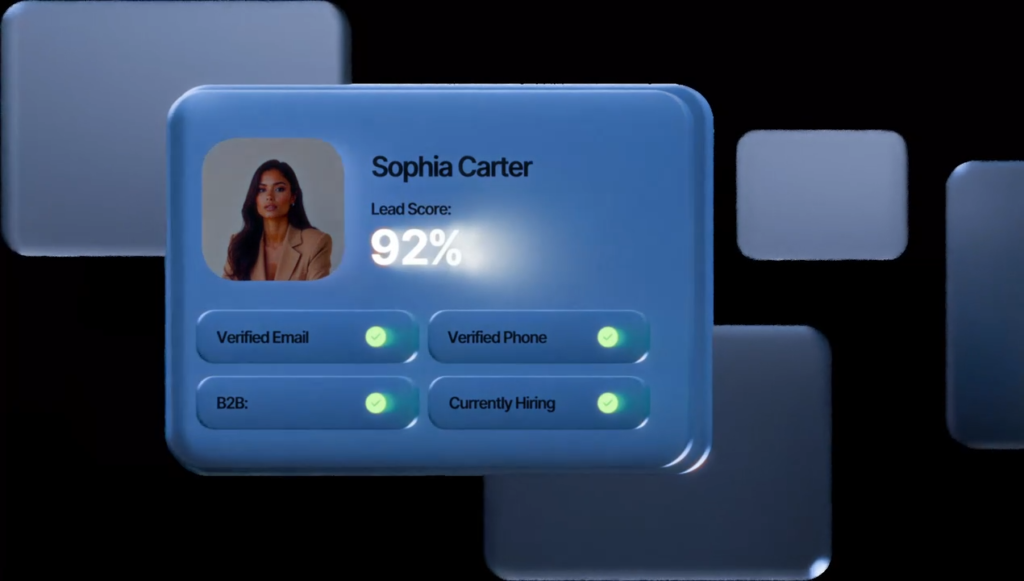
Modern outbound works better when it is tied to timing. A company that just raised money, hired a new executive, opened several relevant roles, changed tools, expanded into a new market, or started showing category intent may be more likely to care about a specific problem.
Bond emphasizes signals like funding, job changes, hiring, and intent. That is the right direction.
Signal-based outbound does not guarantee results. Nothing does. But it gives the seller a more reasonable reason to reach out.
The difference between “I saw you are VP Sales at a SaaS company” and “I noticed your team is hiring SDRs while expanding into a new segment” is meaningful.
One is a label. The other is context.
Why Bond Fits The Creator-Led GTM Moment
Tools like Bond need to be seen.
A landing page can explain the promise, but buyers often need to watch the workflow before they believe it. They want to see the interface. They want to see the input. They want to see what Bond produces. They want to know whether the output feels useful or just polished.
That is why creator demos matter.
In the Kingy AI creator-led GTM playbook, the core idea is that AI buyers often watch before they try. This is especially true for tools that replace multi-step workflows.
Bond is a perfect fit for that kind of education.
A good Bond demo should not be a feature tour. It should be a real campaign build.
For example:
“Let’s build an outbound campaign for B2B SaaS companies that recently raised a seed round and are hiring their first sales team.”
That gives the viewer something concrete. They can judge the list quality, the signal logic, the contact selection, the research, and the message quality.
That kind of demo is much more useful than a generic claim about AI-powered outbound.
Why LinkedIn Matters For Bond
Bond’s buyer is already on LinkedIn.
Founders, sales leaders, RevOps operators, SDR managers, GTM engineers, and B2B marketers use LinkedIn to talk about pipeline, outbound, AI tools, sales workflows, and go-to-market experiments.
So Bond should not treat LinkedIn as just another ad platform. It is the category’s public conversation layer.
LinkedIn can help Bond in three ways.
First, it can make the pain visible. Posts can show the messy outbound workflow that teams are currently stitching together manually.
Second, it can make the product understandable. Short clips can show Bond turning an ICP and buying signal into a campaign-ready workflow.
Third, it can create repeated exposure. LinkedIn offers products like Thought Leader Ads and retargeting, which can help a company stay in front of people who have already engaged with content.
For Bond, the smart LinkedIn strategy is not “post more AI content.”
It is to own a specific point of view:
Better outbound comes from better signal selection, better research, and less workflow drag.
Why Newsletters And SaaS Influencers Make Sense
Newsletter sponsorships can also work well for a tool like Bond, but only if the audience is focused.
Broad reach is less useful than concentrated trust.
Bond belongs in front of people who care about outbound, sales systems, growth, RevOps, founder-led sales, and B2B marketing. Communities and media ecosystems like Exit Five and Pavilion are good examples of where serious GTM operators spend attention.
The same applies to SaaS influencers.
The best influencer for Bond is not necessarily the biggest creator. It is someone whose audience trusts them on sales workflows, GTM systems, or B2B software evaluation.
The strongest sponsored content would not simply say, “Bond is great.”
It would explain a problem the audience already feels:
“Here is why your outbound workflow takes too long.”
“Here is how to build a signal-based campaign without managing five tools.”
“Here is what a good AI-assisted outbound process should still require a human to review.”
That last point matters. The human review angle makes Bond more credible. Buyers do not want reckless automation. They want leverage with control.
What Makes Bond Good
Bond is good because it aims at the actual bottleneck.
The bottleneck is not that sales teams cannot write one more email. The bottleneck is that good outbound requires a chain of decisions and data steps before the email is even worth writing.
Who should we target?
Why now?
Which signal matters?
Who is the right person?
Is the contact data valid?
What context should the message use?
Is this campaign ready to send?
Bond’s value is in reducing the distance between those questions and a usable campaign.
It is also good because the interface appears to be built around natural language. That lowers the barrier for teams that know their market but do not want to build technical workflows.
The best tools in this category do not make the buyer feel like they are operating software. They make the buyer feel like they are expressing a GTM idea clearly and watching the system assemble it.
That is the premium version of AI in outbound: not louder automation, but cleaner execution.
Where Teams Should Be Careful
Bond is still an outbound tool. It will not fix weak positioning, a bad offer, unclear ICP, poor deliverability, or a sales team that cannot handle replies.
That is important.
No GTM tool should be treated as a substitute for strategy. Bond can help execute a campaign, but the team still needs to know who they serve, what pain they solve, and why the timing matters.
Teams should also review the outputs carefully. AI-assisted research and messaging can be useful, but outbound still touches real people and real brands. Human approval should remain part of the process.
The best use of Bond is not “set it and forget it.”
It is “brief it clearly, review the campaign, improve the logic, then send with confidence.”
The Bottom Line
Bond is worth paying attention to because it reflects where outbound is going.
The future of outbound is probably not more brute-force volume. It is better targeting, clearer signals, faster research, and more useful human review.
Bond packages that idea into a product that sales and GTM teams can actually understand: describe the campaign you want, let Bond assemble the list and research, then review the outreach before it goes live.
That is practical. That is useful. And for lean teams trying to build pipeline without hiring a full GTM engineering function, it solves a very real problem.
Bond is not interesting because it says “AI outbound.”
Bond is interesting because it tries to make good outbound easier to operationalize.
The Kingy Brief
Get The Kingy Brief.
AI changes, original tests and one practical thing to try. Fridays at 09:00 Vancouver time.
Free · Double opt-in · Unsubscribe anytime
Signup help and newsletter schedule
Signup form provided by Beehiiv. After submitting, check your inbox for "Confirm your subscription to The Kingy Brief" and open its confirmation link. Check Spam or Promotions if you cannot find it.
Fridays at 09:00 Vancouver time: source-checked AI changes, original tests and one practical thing to try. The weekly restart begins October 9, 2026. We skip a week when there is not enough verified material. Free. Unsubscribe anytime.