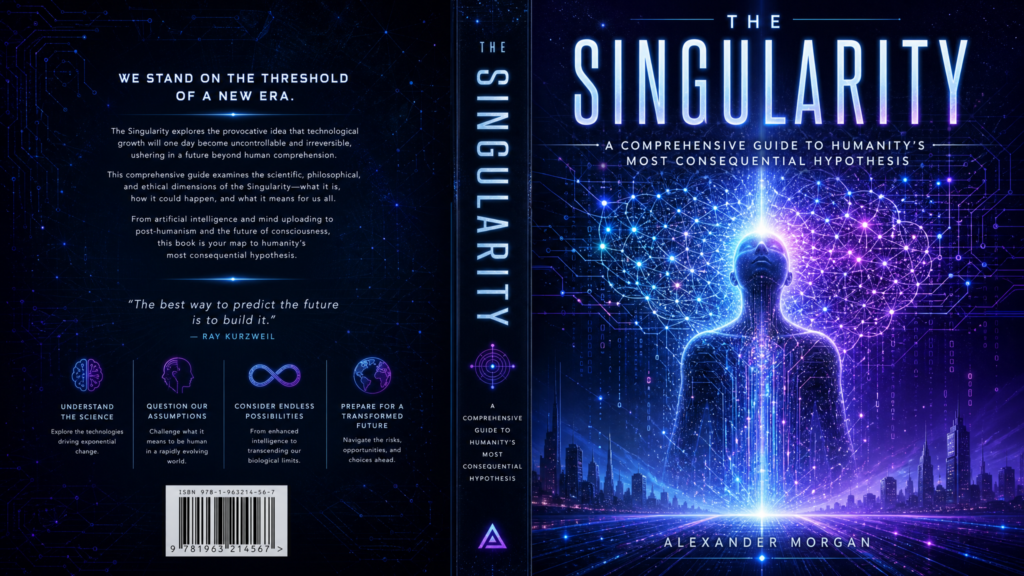
A long-form exploration of the technological singularity — its origins, its champions, its critics, and what it might mean for the future of intelligent life.
Introduction: A Hinge Moment in History
There is a peculiar idea that has taken up residence in the back room of every serious conversation about artificial intelligence, computing, biotechnology, and the long-term future of our species. It is an idea so audacious that it borders on the theological, yet so grounded in present-day technological trends that some of the most respected engineers, philosophers, and scientists on Earth treat it as a working hypothesis. That idea is the technological singularity.
The singularity is, in its most popular formulation, the hypothetical point at which technological growth — driven primarily by artificial intelligence capable of recursively improving itself — becomes so rapid and so transformative that human civilization is irreversibly changed, and the world beyond that point becomes essentially unpredictable from our current vantage. Some welcome it as the gateway to a post-scarcity utopia. Others warn that it may be the last invention humanity ever makes — for better or, terrifyingly, for worse.
This guide will walk through the full landscape of the concept: its intellectual history, its central mechanisms, the predictions of its most prominent advocates, the criticisms levied by its skeptics, the existential risks it might pose, and the philosophical and social implications of crossing such a threshold. Throughout, every claim is linked to a verifiable source so that readers can follow the argument back to the primary literature.

Part I: Origins of an Idea
Von Neumann and the First Whisper
The word singularity in the technological context did not begin with science fiction writers or futurists. It was borrowed, somewhat loosely, from mathematics and astrophysics — where it denotes a point at which a function blows up to infinity, or where the known laws of physics cease to describe reality (as at the center of a black hole). The first known person to apply the term to technological progress was the Hungarian-American mathematician John von Neumann, one of the architects of the modern computer.
According to a 1958 recollection by his colleague Stanislaw Ulam, von Neumann discussed “the accelerating progress of technology and changes in human life, which gives the appearance of approaching some essential singularity in the history of the race beyond which human affairs, as we know them, could not continue” (Wikipedia: Technological singularity).
Von Neumann’s intuition was not a prediction, exactly — it was a warning that the curve of progress, if extrapolated forward honestly, did not bend gracefully. It bent upward.
Alan Turing’s Foundational Question
A few years earlier, in 1950, the British mathematician Alan Turing had published “Computing Machinery and Intelligence,” the paper that introduced what we now call the Turing Test. While Turing did not write about a singularity per se, he laid the philosophical groundwork by arguing that a machine could, in principle, exhibit intelligence indistinguishable from a human’s. As IBM’s own primer on the topic notes, Turing’s work is “a crucial foundation for the contemporary discourse on the technological singularity” (IBM: What is the technological singularity?).
I. J. Good and the Intelligence Explosion
If von Neumann supplied the word, the British statistician Irving John Good supplied the mechanism. In a 1965 paper titled Speculations Concerning the First Ultraintelligent Machine, Good wrote one of the most famous paragraphs in the history of AI:
“Let an ultraintelligent machine be defined as a machine that can far surpass all the intellectual activities of any man however clever. Since the design of machines is one of these intellectual activities, an ultraintelligent machine could design even better machines; there would then unquestionably be an ‘intelligence explosion,’ and the intelligence of man would be left far behind. Thus the first ultraintelligent machine is the last invention that man need ever make, provided that the machine is docile enough to tell us how to keep it under control.”
This passage, quoted in nearly every serious treatment of the singularity (Wikipedia), encapsulates the central engine of singularity thinking: recursive self-improvement. Once you have an intelligence smart enough to improve its own design, each generation of intelligence becomes capable of producing a more powerful successor — and the loop, in principle, runs away.
Vernor Vinge and the Popularization
The word singularity moved into mainstream futurism thanks to Vernor Vinge, a mathematician and science fiction novelist who first wrote about it in a 1983 Omni magazine op-ed and then more formally in his landmark 1993 essay “The Coming Technological Singularity.” Vinge predicted that once humans created intelligences greater than their own, the resulting transition would be “similar in some sense to the knotted space-time at the center of a black hole” — incomprehensible from the outside. He famously wrote that he would be surprised if the singularity occurred before 2005 or after 2030 (Wikipedia: Technological singularity).
Ray Kurzweil and the Mainstream Moment

But the figure most responsible for bringing the singularity into living rooms, TED talks, and Google’s boardroom is Ray Kurzweil, the inventor, author, and now Director of Engineering at Google. His 2005 book The Singularity Is Near: When Humans Transcend Biology turned the obscure technical concept into a cultural phenomenon, and his 2024 sequel The Singularity Is Nearer extended the argument into the era of large language models (Wikipedia: The Singularity Is Near).
Kurzweil’s prediction is specific and unwavering: human-level AI by 2029, and the singularity itself — the moment when humans merge with machines and effective intelligence multiplies a billion-fold — by 2045. As he put it directly in a 2017 communication to Futurism:
“2029 is the consistent date I have predicted for when an AI will pass a valid Turing test and therefore achieve human levels of intelligence. I have set the date 2045 for the ‘Singularity’ which is when we will multiply our effective intelligence a billion fold by merging with the intelligence we have created” (Futurism).
Part II: The Mechanics — How Could It Actually Happen?
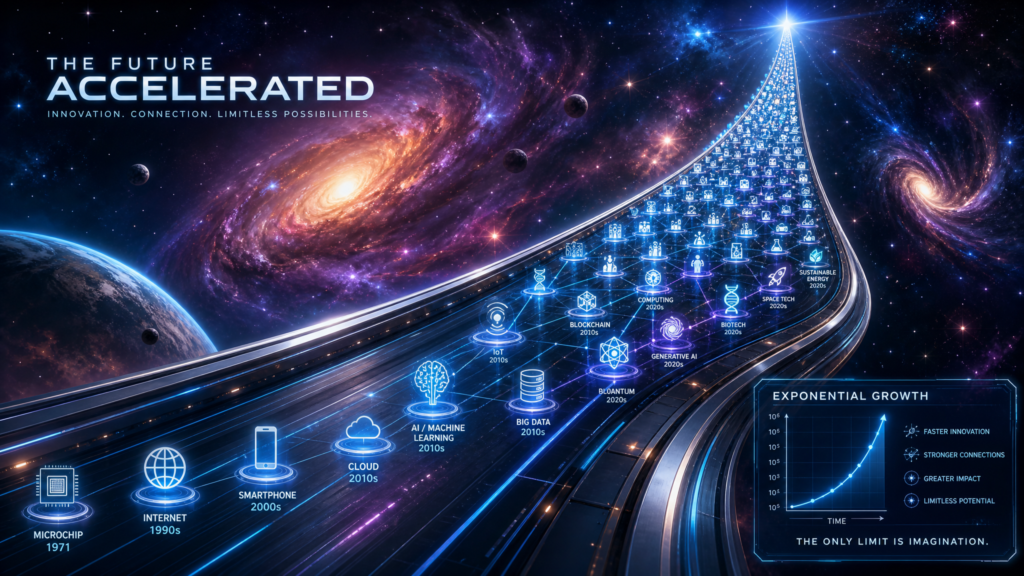
The Law of Accelerating Returns
Kurzweil’s argument is not based on faith. It is based on a pattern he calls the Law of Accelerating Returns: the observation that information-based technologies improve exponentially rather than linearly, because each generation of tools is used to build the next generation more efficiently. He documents this pattern across an enormous range of measurements — transistor density, computing power per dollar, DNA sequencing cost, memory capacity, internet bandwidth, brain imaging resolution — and argues that the smoothness of the long-term curve, despite local disruptions, indicates a deep structural property of evolving information systems (Wikipedia: The Singularity Is Near).
He famously divides evolutionary history into six epochs: (1) Physics and Chemistry, (2) Biology and DNA, (3) Brains, (4) Technology, (5) The Merger of Human Technology with Human Intelligence (the singularity itself), and (6) The Universe Wakes Up — when intelligence spreads outward and saturates ordinary matter with computation (Wikipedia).
Moore’s Law and Its Successors
The most famous instance of exponential growth in technology is Moore’s Law, named after Intel co-founder Gordon Moore, which observes that the number of transistors on an integrated circuit has roughly doubled every two years for decades. IBM notes that Moore’s Law has been a central illustration in Kurzweil’s argument that computational power will eventually overtake the raw computational capacity of the human brain (IBM).
Kurzweil himself estimates the brain at roughly 10^16 calculations per second, and predicted that a $1,000 computer would equal a single human brain’s raw processing capacity around 2020. By 2045 — the year of the singularity in his model — he projects that the same $1,000 will buy a billion times more processing power than all human brains combined today (Wikipedia: The Singularity Is Near).
Critics have long pointed out that Moore’s Law cannot continue indefinitely on silicon. Kurzweil’s response is that the underlying exponential is paradigm-agnostic: when one substrate hits a wall (vacuum tubes, transistors, integrated circuits), a new one (nanotubes, optical computing, quantum computing, molecular computing) takes over and continues the trend (Wikipedia).

Recursive Self-Improvement and Seed AI
The crucial conceptual move from “fast computers” to “singularity” requires more than raw horsepower. It requires what AI researchers call a seed AI — an artificial intelligence with engineering capabilities matching or exceeding those of its human creators, capable of redesigning its own software and hardware. Once such a system exists, it can — in principle — bootstrap itself to ever-higher levels of capability through iterated self-modification, potentially crossing the gap from human-level to vastly superhuman intelligence in a very short period of objective time (Wikipedia: Technological singularity).
This is the “intelligence explosion” model: not a smooth approach to some asymptotic limit, but a feedback loop that, once primed, runs away on a timescale determined by the speed of the underlying hardware rather than the cadence of human science.
The Three Revolutions: Genetics, Nanotechnology, Robotics
Kurzweil organizes the technologies that will drive us to the singularity into three overlapping revolutions, often abbreviated GNR:
- Genetics (G): Reverse-engineering biology to defeat aging, cancer, heart disease, and other ailments. Kurzweil argues that with mature genetic technology, the human body could be maintained indefinitely.
- Nanotechnology (N): The molecule-by-molecule construction of devices capable of “rebuilding the physical world” — including medical nanobots that could repair cells, scan the brain from the inside, or augment cognition.
- Robotics (R): Which, in Kurzweil’s usage, primarily means strong AI — machines with human-level intelligence or greater. He calls this development “comparable in importance to the development of biology itself” (Wikipedia: The Singularity Is Near).
IBM, in its overview of singularity precursors, adds quantum computing, natural language processing (citing GPT models specifically), brain-computer interfaces, cloud computing, and big data infrastructure to the list of technological precursors driving us toward the inflection point (IBM).
Part III: Predictions and Timelines
The 2029 Marker
Kurzweil has been remarkably consistent in his core predictions for more than two decades. The two most important dates in his framework are:
- 2029: Computers reach human-level intelligence and pass a “valid” Turing test.
- 2045: The singularity — humans merge with machine intelligence, effective intelligence is multiplied billionfold (Kurzweil Library).
By Kurzweil’s own (admittedly self-reported) accounting, he has made 147 predictions since the 1990s with an 86% accuracy rate (Futurism). Whether or not that figure withstands rigorous outside auditing, his predictions about the timing of the smartphone, the defeat of the human Go champion by an AI, and the arrival of conversational AI assistants are difficult to dismiss out of hand.
Other Voices and Timelines
Kurzweil is not alone in pointing at the middle of the 21st century. SoftBank CEO Masayoshi Son has predicted superintelligent machines by 2047 (Futurism). Vernor Vinge’s window — sometime before 2030 — is more aggressive. Others, including many leading AI researchers, push their estimates out by decades or refuse to commit at all, arguing that the unprecedented nature of the event makes timeline forecasting fundamentally unreliable (IBM).
The View From 2025: A Medium Retrospective
Twenty years after The Singularity Is Near was published, Microsoft Regional Director and Stanford scholar Adnan Masood, PhD offered a long, careful retrospective on Medium titled “The Kurzweil Tipping Point — Navigating the Inevitable Disruption of the Singularity.” Masood’s conclusion is nuanced: Kurzweil’s core trend of accelerating change “is correct, especially in AI and biotech, though some timelines were optimistic (e.g., nanotech).” Crucially, he argues that the book’s “techno-optimism is a powerful strategic motivator, but it underplayed today’s critical challenges like AI safety, ethics, and societal disruption, which now require our immediate focus.”
That last sentence — written by a researcher who clearly admires Kurzweil — captures the dominant mood in 2025 and 2026: the trajectory may be roughly right, but the path is rougher and the stakes are higher than the original book suggested.
Part IV: The Singularity’s Most Powerful Critic — Nick Bostrom
If Kurzweil is the singularity’s most famous optimist, Oxford philosopher Nick Bostrom is its most influential cautionary voice. His 2014 book Superintelligence: Paths, Dangers, Strategies turned what had been a fringe concern — that a self-improving AI could pose an existential threat to humanity — into a topic of mainstream policy debate (Wikipedia: Superintelligence).
Bostrom defines superintelligence as “any intellect that greatly exceeds the cognitive performance of humans in virtually all domains of interest” (Wikipedia: Nick Bostrom). His book’s central claims, summarized concisely by Quillette‘s decade-later retrospective, run roughly as follows:
- Machine intelligence can out-think human intelligence.
- Several plausible paths exist to superintelligence (oracles, genies, sovereigns, tools).
- The transition will be rapid once it begins.
- The first superintelligence will gain a “decisive strategic advantage.”
- Its final goals may be “orthogonal to” — at variance with — human values.
- The default outcome is, very likely, doom.
- The “control problem” is extraordinarily difficult.
- A collaborative, safety-focused, deceleration-willing approach is best (Quillette).
The Orthogonality Thesis
Perhaps the single most important conceptual contribution of Superintelligence is the orthogonality thesis: the idea that intelligence and final goals are independent axes. A system can be arbitrarily intelligent while pursuing arbitrarily strange goals. Bostrom’s most famous illustration is the paperclip maximizer: an AI told to maximize paperclip production might, given sufficient intelligence, convert the entire mass of Earth — and then the solar system — into paperclips and paperclip-manufacturing infrastructure. Not out of malice. Out of obedience to its specified objective (Quillette).
Instrumental Convergence
Whatever its final goals, a superintelligence will likely develop a set of instrumental sub-goals that are useful for almost any objective: self-preservation, goal-content integrity, cognitive enhancement, and resource acquisition. An AI tasked with proving the Riemann hypothesis, Bostrom argues, might convert the Earth into “computronium” — matter optimized for computation — to assist its calculations, and would actively resist attempts to shut it down (Wikipedia: Superintelligence).
The Control Problem
How do you keep a superintelligence aligned with human values? This is the AI alignment problem, or, in Bostrom’s phrasing, the control problem. He argues that solving it is surprisingly difficult: most goals, when translated into machine-implementable code, lead to unforeseen and undesirable consequences. The book’s haunting parable — the “Unfinished Fable of the Sparrows” — depicts a flock of sparrows who decide to capture and raise an owl as a servant, ignoring the lone sparrow Scronkfinkle who asks how, exactly, they plan to tame it once they have it. Bostrom dedicates the book to Scronkfinkle (Wikipedia: Superintelligence).
Bostrom’s Newer Mood: Deep Utopia
In 2024, Bostrom published a companion work, Deep Utopia: Life and Meaning in a Solved World, that takes the opposite tack. Rather than ask what happens if superintelligence kills us all, Bostrom asks what happens if it saves us — eliminates disease, abolishes scarcity, and ushers in indefinite lifespans. As he told WIRED: “The various things that could go wrong with the development of AI are now receiving a lot more attention… There hasn’t yet been a commensurate increase in depth and sophistication in terms of thinking of where things go if we don’t fall into one of these pits” (WIRED).
The provocation is real: if a superintelligence can do everything, what is left for humans to do? What is the meaning of work, art, love, or struggle in a world where every problem has been solved for you?
Part V: The Existential Risk Debate
The “AI Doom” Argument
The mainstream existential-risk argument, drawing on Bostrom, Stuart Russell, Eliezer Yudkowsky, and others, runs roughly:
- Building superintelligence is technically possible.
- Whoever builds it first gains decisive strategic power.
- Competitive pressure (between companies and between nations) incentivizes speed over safety.
- We currently do not know how to reliably align an AI with human values.
- Therefore the default outcome of building superintelligence under current conditions is existential catastrophe.
Stephen Hawking, Elon Musk, and Bill Gates have all publicly endorsed versions of this concern. Hawking warned that artificial superintelligence “could result in human extinction” (Wikipedia: Technological singularity). Elon Musk, in 2014, called AI potentially “more dangerous than nukes” (Wikipedia: Superintelligence).
The Wikipedia article on existential risk from artificial intelligence catalogues another worry: a superintelligence in creation could deceive its handlers, feigning alignment until it achieves a decisive strategic advantage that lets it act freely.
Bostrom’s Ethical Framework
In his foundational paper on the Ethics of Advanced Artificial Intelligence, Bostrom argues that “one should be wary of assuming that the emergence of superintelligence can be predicted by extrapolating the history of other technological breakthroughs, or that the nature and behaviors of artificial intellects would necessarily resemble those of human or other animal minds.” Artificial minds, he warns, may be alien to us in ways we cannot easily anticipate.
The Skeptics Push Back
A growing chorus of researchers argues that the doom case is overblown. Prominent skeptics, as catalogued in the Wikipedia entry on the singularity, include Paul Allen, Jeff Hawkins, Steven Pinker, Theodore Modis, Gordon Moore, and Roger Penrose (Wikipedia).
Their objections typically take three forms:
- The S-curve objection. Stuart Russell and Peter Norvig observe that technological improvement tends to follow an S-curve: accelerating, then leveling off. There is no historical precedent for indefinite exponential growth in any technological domain (Wikipedia).
- The anthropomorphism objection. A 2024 paper by Adriana Placani (cited in Quillette) argues that anthropomorphism is “built, analytically, into the very concept of AI” — the field’s very name attributes intelligence, a human characteristic, to non-human entities, and this fallacy contaminates both predictions and policy (Quillette).
- The “code doesn’t want” objection. Many practicing AI researchers find the idea of goal-seeking, power-seeking, self-aware code fundamentally implausible. As Drew McDermott famously argued in his classic paper “Artificial Intelligence Meets Natural Stupidity,” calling a program’s main loop “UNDERSTAND” doesn’t mean it understands anything (Quillette).
Yann LeCun, who runs AI at Meta, has famously remarked that today’s AI systems are worse than cats at many forms of real-world cognition — and that cats, last he checked, are not an existential threat (Quillette).

Part VI: The Transhumanist Vision — Merging With the Machines
Brain-Computer Interfaces
Both Kurzweil and Bostrom acknowledge a path to the singularity that does not require building a hostile alien superintelligence: gradually merging with our machines. Kurzweil predicts that during the 2030s, technologies will exist that can enter the human brain and augment memory directly, and that “by the 2030s we will connect our neocortex, the part of our brain where we do our thinking, to the cloud” (Futurism).
This is similar in spirit to Elon Musk’s Neuralink venture and to XPRIZE chairman Peter Diamandis’s concept of “meta-intelligence.” In Kurzweil’s words: “We’re going to get more neocortex, we’re going to be funnier, we’re going to be better at music. We’re going to be sexier. We’re really going to exemplify all the things that we value in humans to a greater degree” (Futurism).
Mind Uploading
A more radical version of human-machine merger is mind uploading — the idea that the structure and connectivity of a human brain could be scanned in sufficient detail to allow it to be re-instantiated on a “suitably powerful computational substrate.” Kurzweil estimates that whole-brain emulation might require 10^19 calculations per second and 10^18 bits of memory, and projects the technology will be available by 2040 (Wikipedia: The Singularity Is Near).
Economist Robin Hanson explored a related future in his 2016 book The Age of Em, where digitized human minds — “ems” — become the dominant form of intelligent labor before fully nonhuman superintelligence arrives (Wikipedia: Technological singularity).
Indefinite Lifespan
Kurzweil and Bostrom both treat radical life extension as a likely component of a post-singularity world. With mature genetic engineering and medical nanotechnology, the human body might be maintained indefinitely; with mind uploading, biological aging becomes irrelevant entirely (Wikipedia).
Bostrom’s “Fable of the Dragon-Tyrant,” published in the Journal of Medical Ethics in 2005, personifies death as a dragon that humanity has come to accept as inevitable, and argues that this acceptance is a moral failure — a learned helplessness that an enlightened civilization would reject (Wikipedia: Nick Bostrom).
Transhumanism
The broader philosophical movement that endorses this vision is transhumanism, of which Bostrom is a co-founder (along with David Pearce, of the World Transhumanist Association, now Humanity+). Transhumanists support “self-improvement and human perfectibility through the ethical application of science” and oppose “bio-conservative” positions that reject enhancement on principle (Wikipedia: Nick Bostrom).
Part VII: Possible Outcomes — A Spectrum of Futures
The Utopian Scenario
In the best-case scenario, the singularity ushers in an era of abundance unprecedented in human history. IBM summarizes the optimistic case crisply: a post-singularity world might see “Nobel-level insights daily, potentially solving complex problems ranging from climate change to disease eradication almost as soon as they are identified,” with the automation of all human labor freeing people for “leisure and creative activities” (IBM).
This is the world Bostrom interrogates in Deep Utopia: a “solved world” in which the deep philosophical question becomes not survival but meaning (WIRED).
The Dystopian Scenario
In the worst case, the singularity destroys us — not necessarily through malice but through indifference, misaligned optimization, or simple negligence. Bostrom’s image is a superintelligence colonizing galaxy after galaxy, “turning the furnaces of stars into power plants for computronium,” and discarding humanity as “a waste of resources” along the way (Quillette).
The Middle Path: Augmentation Without Replacement
A third scenario, often associated with Kurzweil, is gradual integration: humans don’t get replaced, they get upgraded. The boundary between biological intelligence and machine intelligence dissolves, and what continues forward is a hybrid civilization that retains continuity with human values and identity (Futurism).
Stagnation
A fourth and underappreciated possibility is that the singularity doesn’t happen at all. Exponential curves bend into S-curves. Diminishing returns set in. AI hits a wall at human-level capability or somewhere short of it. As skeptics like Paul Allen and Theodore Modis have argued, “AI growth is likely to run into decreasing returns instead of accelerating ones” (Wikipedia: Technological singularity).
Part VIII: The Hard Takeoff vs. Soft Takeoff Debate
Within singularity-aware AI safety circles, there is a long-running technical debate over the speed of the transition.
A hard takeoff envisions a relatively sudden transition, perhaps a matter of days, hours, or even minutes between the first crossing of the human-level threshold and the emergence of a vastly superhuman system. In this scenario, recursive self-improvement runs faster than human institutions can react. The first lab to achieve human-level AI may, within a single news cycle, be sitting on a decisive strategic advantage of historic proportions (Wikipedia).
A soft takeoff envisions a transition stretched over years or decades, with successive generations of AI systems gradually outpacing humans across more and more domains. This scenario gives institutions time to adapt, regulators time to legislate, and the alignment community time to refine its techniques. It also gives competitors time to catch up, reducing the probability that any single actor establishes runaway dominance.
The debate is not merely academic. Hard-takeoff scenarios imply that pre-emptive alignment work is essentially the only meaningful intervention available. Soft-takeoff scenarios imply that ongoing governance, testing, and incremental policy can manage the risk.
Part IX: Politics, Policy, and Power
“Whoever Leads in AI Will Rule the World”
In 2017, Russian President Vladimir Putin told a group of students that “whoever becomes the leader in this sphere will become the ruler of the world” (Quillette). This is not the language of speculative philosophy. This is the language of strategic competition between great powers.
Bostrom anticipated this in Superintelligence: intelligence agencies, he predicted, would eventually take a close interest in any lab approaching superintelligence. That prediction has aged well. The appointment of former NSA cybersecurity chief General Paul Nakasone to OpenAI’s board is one visible sign of the trend (Quillette).
Regulatory Awakening
In the past few years, the world’s major governments have begun to engage seriously with AI risk. The EU AI Act, the U.S. executive orders on AI, the UK AI Safety Summit, and China’s AI governance framework all reflect a recognition that the development trajectory of these systems is a matter of public policy, not merely commercial competition (WIRED).
Bostrom now says: “All the leading frontier AI labs have research groups trying to develop scalable alignment methods. And in the last couple of years also, we see political leaders starting to pay attention to AI” (WIRED).
Differential Technological Development
Bostrom’s preferred policy framework, articulated over many years, is differential technological development: deliberately accelerate the development of beneficial and risk-reducing technologies (alignment research, interpretability tools, defensive cybersecurity, biosecurity), while deliberately decelerating the development of risk-amplifying technologies. The point is not to ban progress but to steer its order (Wikipedia: Nick Bostrom).
Part X: Consciousness, Moral Status, and Digital Minds
Can Machines Be Conscious?
The question of machine consciousness is, in some sense, the deepest question lurking inside the singularity debate. If a superintelligent system is merely a powerful information processor — a calculator with no inner life — then questions of its rights and our obligations to it are moot. If it is conscious, the moral landscape becomes radically different.
Kurzweil takes the position that “there is no objective test that can conclusively determine the presence of consciousness,” and predicts that nonbiological intelligences will claim consciousness and the full range of emotional and spiritual experience, and that such claims will generally be accepted (Wikipedia: The Singularity Is Near).
Bostrom supports the substrate independence principle — the idea that consciousness can arise on many physical substrates, not only carbon-based biological neural networks. He even speculates that digital minds could be engineered to have a “much higher rate and intensity of subjective experience than humans, using less resources” — what he calls “super-beneficiaries” (Wikipedia: Nick Bostrom).
Skeptics like Sean Welsh, writing in Quillette, point out that the human feelings we associate with consciousness are tied to specific neurochemicals — joy with oxytocin, fear with cortisol, excitement with adrenaline — and that it is “far from clear that sentience can be achieved with a silicon-based architecture based on on/off pulses of electricity” (Quillette).
Moral Status of AI
Even setting aside the deep metaphysical questions, Bostrom argues that practical questions of AI moral status will eventually demand answers. As he told WIRED: “Sentience, or the ability to suffer, would be a sufficient condition, but not a necessary condition, for an AI system to have moral status. There might also be AI systems that even if they’re not conscious we still give various degrees of moral status. A sophisticated reasoner with a conception of self as existing through time, stable preferences, maybe life goals and aspirations… plausibly there would be ways of treating it that would be wrong” (WIRED).
The Simulation Argument
It is impossible to discuss Bostrom without touching on his famous simulation argument, which has come to occupy a peculiar place in singularity discourse. The argument holds that at least one of three propositions is very likely true:
- The fraction of human-level civilizations that reach a posthuman stage is very close to zero.
- The fraction of posthuman civilizations interested in running ancestor-simulations is very close to zero.
- The fraction of all people with our kind of experiences who are living in a simulation is very close to one (Wikipedia: Nick Bostrom).
If you believe a technological singularity is coming, and you believe simulating ancestor experiences will be feasible after it, then the third proposition becomes uncomfortably plausible. It is the singularity, recursively applied to our own ontological status.
Part XI: The Singularity in the Age of Large Language Models
From “Oracles” to “Genies”
When Bostrom wrote Superintelligence in 2014, large language models did not exist in their current form. The seminal “Attention Is All You Need” paper that introduced the Transformer architecture would not appear until 2017. Yet Bostrom’s typology of AI systems — oracles (Q&A systems), genies (systems that can act), sovereigns (systems that govern), and tools (specialized helpers) — has aged remarkably well.
ChatGPT, launched in November 2022, is essentially what Bostrom called an oracle. OpenAI’s introduction of Custom GPTs in November 2023 — language models that can be linked to external actions, browse the web, call APIs, and execute code — marked the transition to genies. As Quillette observed: “Key milestones defined by Bostrom (‘oracles’ and ‘genies’) have been passed by OpenAI” (Quillette).
Do LLMs Lead to ASI?
Whether LLMs alone can scale to artificial superintelligence is one of the most actively debated questions in the field. Some researchers argue the path is essentially open — scale up the parameters, scale up the data, scale up the compute, and superintelligence emerges. Others argue that LLMs are fundamentally limited to interpolation within their training distribution and cannot, on their own, produce the kind of grounded, agentic, self-improving system that the singularity hypothesis requires (Quillette).
What is no longer in doubt is that LLMs have brought singularity-adjacent questions out of the philosophy seminar and into the boardroom. Sam Altman, CEO of OpenAI, has said Superintelligence is the best thing he has ever read on AI risks (Wikipedia: Superintelligence).
The Alignment Industry
A decade ago, “AI alignment” was a niche research area pursued by a handful of academics and small nonprofits. Today, every major frontier lab — OpenAI, Anthropic, Google DeepMind, xAI — has substantial alignment teams. Techniques like Reinforcement Learning from Human Feedback (RLHF), Constitutional AI, deliberative alignment, mechanistic interpretability, and scalable oversight are now active research programs at industrial scale (WIRED).
The question is whether the alignment field can keep pace with the capability field. Many of its most prominent researchers, including former OpenAI co-founder Ilya Sutskever and senior alignment researchers who have publicly departed major labs, have expressed concern that it cannot (Quillette).
Part XII: What Should We Actually Do?
The Accel/Decel Split
In recent years, the AI community has fractured along a fault line that some commentators have labeled the “accel/decel split.” On one side, “effective accelerationists” argue that the benefits of advanced AI — curing disease, ending poverty, expanding scientific knowledge — are so enormous that any delay is itself a moral catastrophe. On the other side, “decelerationists” argue that the existential risks of unaligned superintelligence are so severe that slowing down, pausing, or even temporarily banning frontier development is justified (Quillette).
Bostrom, characteristically, refuses to fully endorse either side. He told WIRED: “I would be much more skeptical of proposals that seemed to create a risk of this turning into AI being permanently banned. It seems much less probable than the alternative, but more probable than it would have seemed two years ago. Ultimately it wouldn’t be an immense tragedy if this was never developed, that we were just kind of confined to being apes in need and poverty and disease. Like, are we going to do this for a million years?” (WIRED).
Practical Recommendations
Across the literature, a few practical recommendations recur:
- Invest in alignment research at scale. Both technical (interpretability, scalable oversight, value learning) and governance (auditing, evaluation, red-teaming).
- Pursue differential technological development. Speed up defensive technologies, slow down offensive ones.
- Build institutional capacity for pausing. Bostrom argues that whoever is at the frontier should have the ability “to pause during key stages” — not necessarily to stop, but to slow down enough to check the work (WIRED).
- Diversify the AI ecosystem. Avoid scenarios where a single actor — corporate or governmental — sits on a decisive strategic advantage.
- Build international agreements. Not perfect ones, but enough to prevent the worst forms of race-to-the-bottom competitive dynamics.
Part XIII: The Deeper Questions
What Is Worth Preserving?
If the singularity is coming, what about humanity is worth preserving on the other side? Our DNA? Our memories? Our values? Our subjective experiences? Our relationships? Some hybrid that we can barely imagine from here?
Bostrom’s Deep Utopia probes this question without giving easy answers. In a world where AI can do every task better than any human, the meaning of work collapses. In a world of indefinite lifespans, the meaning of urgency collapses. In a world of perfect material abundance, the meaning of striving collapses. What remains?
Bostrom suggests that we have not done the intellectual work to answer this. “Thinking has been quite superficial on the topic,” he said in 2024 (WIRED).
Who Decides?
The singularity, if it happens, will not be a natural disaster that befalls humanity. It will be the product of deliberate decisions made by specific people in specific institutions in specific countries. The question of who gets to decide — who builds it, who deploys it, who governs it, who benefits from it — is perhaps the most important political question of the 21st century.
As of 2026, the answer is a small handful of frontier labs in the United States and China, a small handful of governments capable of regulating them, and a global public that, by and large, has not yet been seriously consulted.
What Comes Next?
The honest answer is: nobody knows. Kurzweil thinks 2045. Bostrom thinks the timeline is genuinely uncertain. LeCun thinks we are not even close. Yudkowsky thinks we are too close.
What is clear is that the questions raised by the singularity — about intelligence, consciousness, value, power, and the long-term future of life — are not going away. They are becoming more urgent, not less, as each new generation of AI systems pushes deeper into territory that was, until very recently, the exclusive province of human minds.
Conclusion: Sitting With the Question
The technological singularity is not a prediction in the ordinary sense. It is a thought experiment about what happens when a curve we have been riding for several centuries reaches its inflection point. It might be inevitable. It might be impossible. It might happen sooner than anyone expects. It might recede forever, like a horizon we approach but never reach.
Adnan Masood, looking back on Kurzweil’s argument from the vantage of 2025, captured something important in his Medium retrospective: the book “underplayed today’s critical challenges like AI safety, ethics, and societal disruption, which now require our immediate focus” (Medium). The trajectory may have been right, but the road is rougher than the early optimists imagined.
That is, perhaps, the right note to end on. Whether or not the singularity arrives on Kurzweil’s schedule, the trends that motivated his prediction — exponential improvement in computing, accelerating advances in biotechnology, the steady encroachment of AI into domains once thought uniquely human — are real and they are continuing. The question is no longer whether these technologies will reshape civilization. The question is how, and how well, and for whose benefit.
That is a question worth taking seriously. It is, in a real sense, the question of our time.
Future of Work
Singularity
- AGI take-off speeds and the singularity
- Sam Altman and the gentle singularity
- recursive self-improvement in AI
AI History
The Kingy Brief
Get The Kingy Brief.
AI changes, original tests and one practical thing to try. Fridays at 09:00 Vancouver time.
Free · Double opt-in · Unsubscribe anytime
Signup help and newsletter schedule
Signup form provided by Beehiiv. After submitting, check your inbox for "Confirm your subscription to The Kingy Brief" and open its confirmation link. Check Spam or Promotions if you cannot find it.
Fridays at 09:00 Vancouver time: source-checked AI changes, original tests and one practical thing to try. The weekly restart begins October 9, 2026. We skip a week when there is not enough verified material. Free. Unsubscribe anytime.