
TL;DR: Today’s Radar covers a 975B-parameter open-weight multimodal model, a physical Codex controller, cross-device ChatGPT desktop continuity, and two GitHub Copilot updates aimed at measuring and governing agent work.
Launch Snapshot
The July 18 snapshot ranks five launches for editorial follow-up, including desktop continuity, Copilot controls, a physical Codex controller, and an open multimodal model. The values are Kingy coverage scores, not product benchmarks.
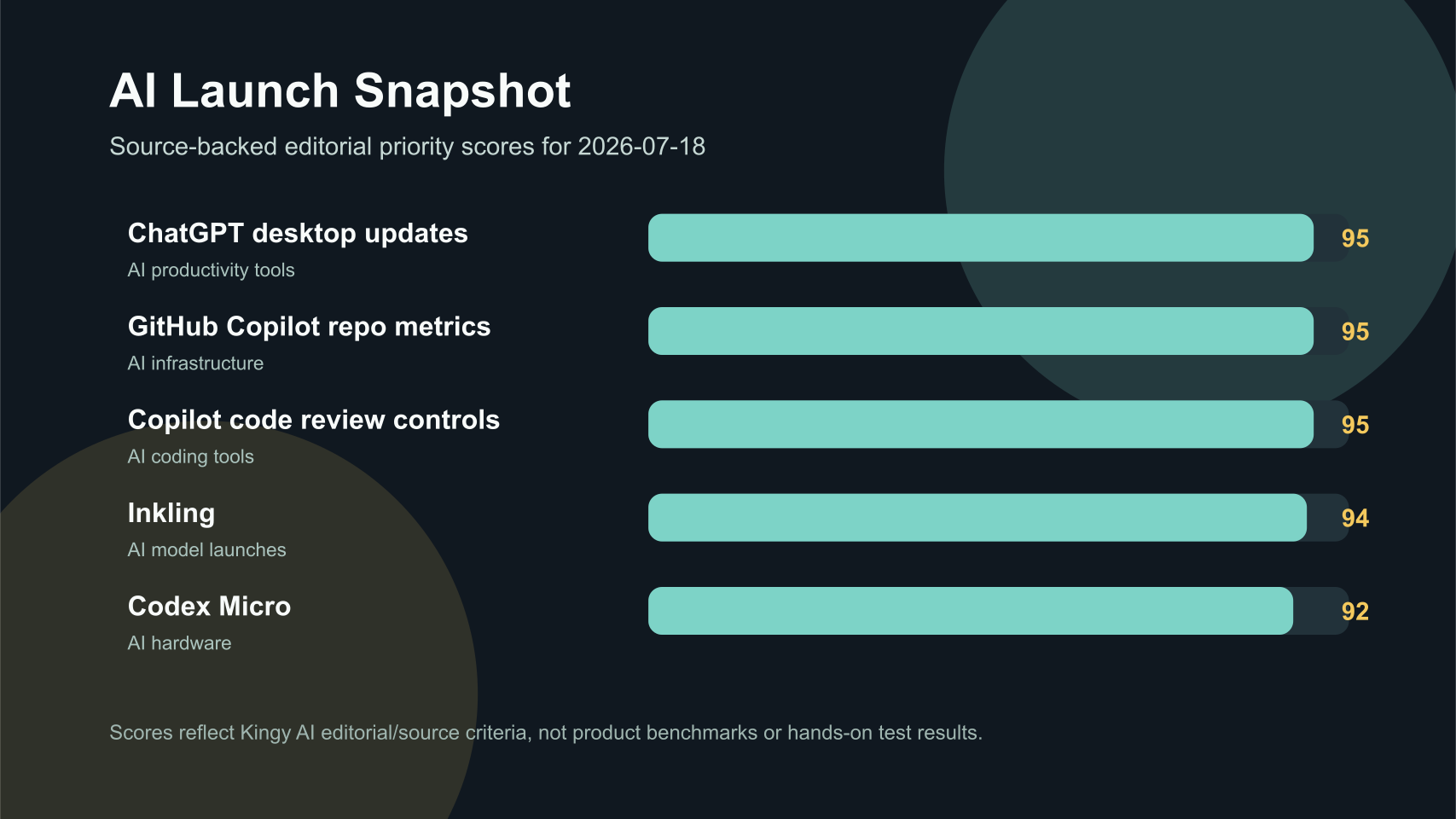
Strongest Launches
ChatGPT desktop app experience updates
OpenAI updated the ChatGPT desktop app with a clearer ChatGPT/Codex switcher, unified Recents, Projects access, and Work continuity across devices.
Sources checked: launch source, docs.
Why it matters: As ChatGPT Work and Codex become longer-running agent surfaces, desktop navigation and cross-device continuity affect whether users can supervise real work without losing context.
Who should care: AI Product Teams, Developers, Founders, Operators
Pricing: The release notes say the update is live for all plans on macOS and Windows; broader ChatGPT plan pricing should be verified on the ChatGPT pricing page. Confirm current pricing on the official pricing/source page.
What remains unproven: Feature availability can vary by plan, region, workspace type, and local versus cloud conversation mode.
Repository-level GitHub Copilot usage metrics
GitHub made repository-level Copilot usage metrics generally available through new REST API endpoints for daily repository activity.
Sources checked: launch source, docs.
Why it matters: Repository-level AI usage data helps engineering leaders see where coding agents and AI review are actually changing pull request activity, rather than relying only on organization-level adoption totals.
Who should care: AI Platform Teams, Developers, Enterprises, Operators
Pricing: Access depends on GitHub Copilot and organization or enterprise permissions; current plan pricing should be verified on GitHub Copilot pricing pages. Confirm current pricing on the official pricing/source page.
What remains unproven: Metrics require correct permissions and enabled policies; usage activity is adoption signal, not automatic proof of quality or productivity.
Copilot code review customization and configurability improvements
GitHub expanded Copilot code review controls with head-branch custom instructions, more instruction file support, custom setup steps, firewall support, and separate runner settings.
Sources checked: launch source, docs.
Why it matters: The update gives teams more control over AI code review behavior, context boundaries, runtime setup, and network access, which matters as code-review agents move into production repositories.
Who should care: AI Platform Teams, AI Engineers, Developers, Enterprises
Pricing: Feature access depends on GitHub Copilot plan and organization policies; current plan pricing should be verified on GitHub Copilot pricing pages. Confirm current pricing on the official pricing/source page.
What remains unproven: Self-hosted runners do not currently support the firewall according to the changelog; teams should validate review quality and permission boundaries before relying on the agent.
Inkling
Thinking Machines Lab released Inkling, a 975B-parameter open-weight multimodal Mixture-of-Experts model with text, image, and audio inputs.
Sources checked: launch source, docs, Hugging Face page.
Why it matters: It is a major open-weight model release from a high-profile AI lab and gives developers another path to customize large multimodal models outside closed frontier APIs.
Who should care: AI Platform Teams, AI Engineers, Developers, Researchers
Pricing: The launch says Inkling Playground is free for a limited time and lists third-party API availability, but current public per-token pricing was not verified from a stable official pricing page.
What remains unproven: Hardware requirements are high; third-party inference availability and costs vary; open-weight deployment needs additional safety, monitoring, and evaluation before production use.
Codex Micro
OpenAI and Work Louder launched Codex Micro, a compact hardware controller for managing Codex agent workflows with status keys, shortcuts, a joystick, and a dial.
Sources checked: launch source, docs.
Why it matters: It is a concrete attempt to turn supervising multiple AI coding agents into a physical desktop workflow, which is useful signal for developers and AI product teams evaluating agent-control interfaces.
Who should care: AI Product Teams, AI Engineers, Developers, Operators
Pricing: OpenAI lists Codex Micro at $230 with warranty and support included. Confirm current pricing on the official pricing/source page.
Availability and open questions: OpenAI’s official product page listed Codex Micro as out of stock when this Radar was rechecked on July 18. The product is highly specialized, and teams should still test whether tactile shortcuts improve supervision or create accidental-action risk.
Related Kingy AI Links
Compare the July 18 releases in AI Launches and AI Tools, then check the AI News archive for later plan or documentation changes. Creator teams can use the AI Sponsored Video ROI Calculator separately.
Sponsor path
Sponsor Kingy AI launch coverage
Launching an AI product that needs clear demos, creator education, and buyer trust? Sponsor a Kingy AI video or launch feature.
The Kingy Brief
Get The Kingy Brief.
AI changes, original tests and one practical thing to try. Fridays at 09:00 Vancouver time.
Free · Double opt-in · Unsubscribe anytime
Sign up for The Kingy Brief on Beehiiv.
Signup help and newsletter schedule
Signup form provided by Beehiiv. After submitting, check your inbox for "Confirm your subscription to The Kingy Brief" and open its confirmation link. Check Spam or Promotions if you cannot find it.
Fridays at 09:00 Vancouver time: source-checked AI changes, original tests and one practical thing to try. We skip a week when there is not enough verified material. Free. Unsubscribe anytime.