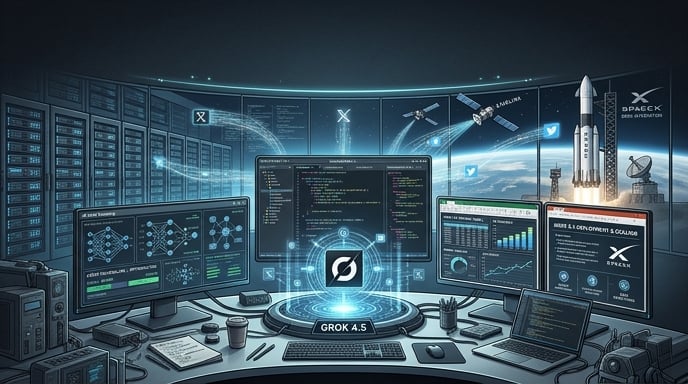
xAI Enters Its Next Phase

Elon Musk’s artificial-intelligence operation has launched Grok 4.5, a model aimed squarely at coding, autonomous tasks, and professional knowledge work.
The July 2026 release carries more significance than its version number suggests. It is one of the first major model launches since xAI became part of SpaceX and began operating under the SpaceXAI identity. It also arrives as OpenAI and Anthropic intensify their own efforts to place AI agents inside everyday business workflows.
Grok first attracted attention as a conversational assistant tied closely to X. Its personality and access to real-time social discussion helped distinguish it from more cautious competitors. Grok 4.5 seeks a different kind of credibility.
SpaceXAI wants developers and businesses to see the model as an efficient engine for serious work.
The company says Grok 4.5 can write and repair software, operate tools, carry out long-running assignments, create applications, perform research, and produce office materials. It is available through Grok Build, Cursor, and SpaceXAI’s developer platform.
That puts the model into direct competition with OpenAI’s GPT‑5.6 family and Anthropic’s Claude models. The contest has moved beyond chat. Each company now wants its AI to become the system that completes the assignment.
A Model Designed Around Engineering
SpaceXAI describes Grok 4.5 as its smartest model for coding, agentic tasks, and knowledge work.
The company says it trained the model on data spanning software development, science, engineering, and mathematics. It placed particular emphasis on multistep engineering assignments rather than isolated code-completion questions.
That focus matters because real software work rarely consists of writing one perfect function from scratch.
An engineering agent must inspect a repository, understand unfamiliar code, identify the source of a failure, modify several files, run tests, interpret errors, and try again. It may need to use documentation, issue trackers, command-line tools, or a browser. Sometimes it must work for hours.
SpaceXAI says its reinforcement-learning process covered hundreds of thousands of tasks. It also designed the training system to support highly asynchronous agent runs that can continue for long periods while learning proceeds across many processors.
The ambition is clear. Grok 4.5 should not merely suggest code. It should participate in the broader loop of software engineering.
That same loop plan, act, inspect, correct also powers agents for research, finance, presentations, and other professional tasks.
Training at Enormous Scale
SpaceXAI says it trained Grok 4.5 across tens of thousands of NVIDIA GB300 graphics processors.
Raw computing power tells only part of the story. The company emphasizes filtering, deduplication, quality scoring, and domain-focused selection in its training data. It says those steps helped keep the information mixture broad while reducing low-value repetition.
That claim addresses an industry-wide problem.
Adding more data does not automatically create a better model. Duplicate, contradictory, poorly labeled, or low-quality examples can waste computing resources. Stronger curation may improve what the model learns from each training token.
SpaceXAI also says it focused on “per-token intelligence.” In plain language, it wants the model to achieve more while generating less.
That objective has become commercially important. Long-running agents can produce enormous amounts of intermediate reasoning and tool output. If a model needs fewer tokens to solve the same problem, customers may receive answers more quickly and pay less.
Of course, training claims come from the developer. Independent users will need to test whether the efficiency survives contact with messy codebases, incomplete documentation, and production constraints.
Still, the scale of the training run signals SpaceXAI’s determination to compete at the frontier.
Cursor Played a Notable Role
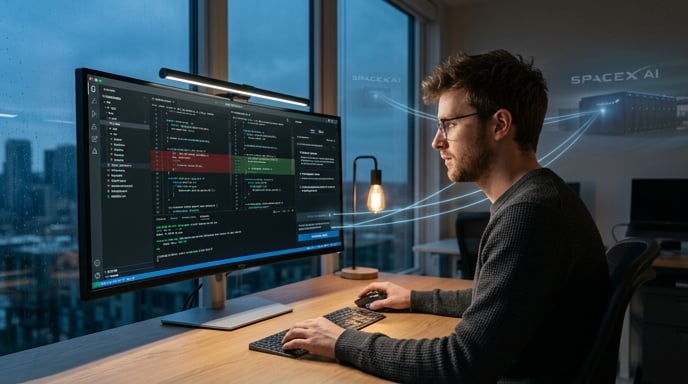
SpaceXAI says it trained Grok 4.5 alongside Cursor, the popular AI coding environment created by Anysphere.
Reuters reported that SpaceX had agreed to acquire Anysphere in an all-stock deal valued at $60 billion. That relationship gives SpaceXAI a potentially valuable bridge between model development and daily developer behavior.
A model laboratory can evaluate coding performance through benchmarks. A widely used coding product sees what programmers actually attempt, where agents fail, which edits users accept, and how long tasks take.
The combination could create a powerful feedback loop.
Cursor can provide a practical environment for Grok 4.5. Grok can give Cursor a model designed with its workflows in mind. SpaceXAI can then learn from real engineering tasks and use those lessons in later training.
This kind of vertical integration is becoming common in AI. Companies do not want to supply only the underlying model. They want to control the application, the agent interface, the tools, and sometimes the infrastructure.
That approach can accelerate improvements. It may also make it harder for customers to separate one layer from another or switch providers without changing their working environment.
Benchmarks Show Strengths and Limits
SpaceXAI published several coding benchmarks for Grok 4.5.
The company reports a 62% score on DeepSWE 1.0, placing the model below Fable at 66.1% and GPT‑5.5 at 64.31% in the comparison it presented. On DeepSWE 1.1, Grok scored 53%, behind Fable, GPT‑5.5, and Opus 4.8 in the published chart.
Grok performed more strongly on SWE Marathon, where SpaceXAI reported a 29% resolution rate. That exceeded the comparison scores it listed for Opus 4.8 and Fable.
On Terminal Bench 2.1, the company reported 83.3%. Its SWE Bench Pro result reached 64.7%.
The mixed results are instructive.
Grok 4.5 does not dominate every test. SpaceXAI’s own charts show rivals ahead in several areas. That makes the company’s positioning more credible than a simple claim of universal superiority.
It also highlights why businesses should resist reducing model selection to one leaderboard. Different evaluations test different tasks, tools, and time limits. A model that performs best in a long software-maintenance challenge may not lead on short debugging assignments.
The relevant question is not “Which model wins?” It is “Which model wins at the work this team actually does?”
Speed Becomes Part of the Pitch
SpaceXAI says Grok 4.5 runs at about 80 tokens per second.
It also claims the model can use substantially fewer output tokens than some competing frontier systems. On SWE Bench Pro, the company reports an average of 15,954 output tokens for Grok 4.5, compared with 67,020 for Claude Opus 4.8 at its maximum setting.
That represents about 4.2 times fewer output tokens in SpaceXAI’s comparison.
If those figures hold across practical assignments, the impact could be meaningful. Developers would wait less. Agents could attempt more tasks within the same budget. Businesses might use a capable model in workflows that would otherwise be too expensive.
However, token count is not the same as total efficiency.
A model that generates fewer tokens but makes more unsuccessful attempts may still cost more. A fast model that produces a subtle bug can consume hours of human review. Tool charges, retries, caching, and external services can also affect the final bill.
Customers should measure completed, accepted work not merely tokens or response speed.
SpaceXAI’s emphasis on efficiency nevertheless identifies a real competitive opening. Many organizations want frontier-level ability without frontier-level operating costs.
Aggressive Pricing Sharpens the Contest
Grok 4.5 costs $2 per million input tokens and $6 per million output tokens, according to SpaceXAI.
That places it in an aggressive position.
Reuters noted that Anthropic priced Claude Opus 4.8 at $5 per million input tokens and $25 per million output tokens. OpenAI’s GPT‑5.6 Luna costs $1 for input and $6 for output, while OpenAI charges more for its Terra and Sol tiers.
Straight price comparisons need caution. The models differ in ability, speed, context handling, tool use, and the number of tokens needed to finish a task.
Even so, SpaceXAI is sending an unmistakable message: Grok 4.5 should be considered not only capable but economical.
Lower prices can reshape the market quickly. Developers may test a new model for secondary tasks, then expand its role if performance holds up. Companies that use billions of tokens have a strong incentive to avoid paying premium rates when a cheaper model produces acceptable results.
This pressure will force competitors to improve efficiency or explain why their higher-priced systems deliver greater value.
The AI model business is starting to resemble cloud computing. Reliability, unit economics, integration, and service quality matter alongside raw technical performance.
Grok Build Extends Beyond Coding
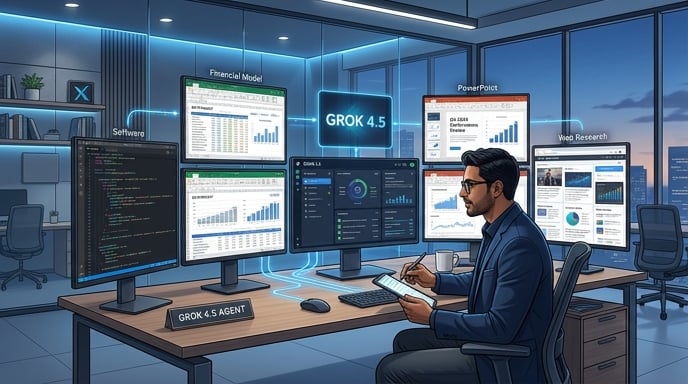
Grok 4.5 serves as the default model in Grok Build, SpaceXAI’s agentic work environment.
Despite the name, SpaceXAI is pushing Build beyond software development. The company says it can research information, construct complex Excel models, use formulas across multiple sheets, and leave notes for future reference.
It also promotes Grok integrations for Microsoft Word and PowerPoint. SpaceXAI says the model can create diagrams with native PowerPoint shapes, design slides, and write prose inside Word.
This expansion closely mirrors the strategies of OpenAI and Anthropic.
OpenAI’s ChatGPT Work aims to produce documents, spreadsheets, presentations, reports, and websites. Anthropic’s Claude Cowork targets multistep office assignments. SpaceXAI now wants Grok Build to operate across code and business materials.
All three companies are following a lesson learned from coding agents: AI becomes more valuable when it can manipulate the actual artifact.
Writing advice has value. Editing the document has more. Explaining a formula helps. Building and checking the workbook helps more.
The companies still need to prove that their agents preserve formatting, source accuracy, and organizational rules. Office files may look simple, but businesses rely on them for consequential decisions.
From xAI to SpaceXAI
The corporate setting around Grok has changed dramatically.
SpaceX announced its acquisition of xAI in February 2026. Musk later said xAI would stop operating as a separate company and become part of SpaceXAI.
The combination brings together rockets, satellites, social-media data, massive computing infrastructure, and an AI developer under one corporate structure.
Supporters see a compelling industrial strategy. SpaceX can provide capital, engineering expertise, energy projects, communications infrastructure, and potentially space-based computing. X gives Grok access to a large platform built around real-time public conversation. The AI division can serve products across the group.
Critics see concentration and complexity.
Transactions among companies controlled by the same person can raise questions about valuation, governance, data access, and which shareholders bear which risks. Integrating X, xAI, and SpaceX also joins businesses with very different regulatory and financial profiles.
Grok 4.5 will therefore be judged as both a technical product and part of a much larger Musk-controlled ecosystem.
Its success could strengthen the argument that the combination creates unique advantages. Its problems could spread across more than one business.
Infrastructure Is a Strategic Weapon
Frontier AI requires enormous computing capacity. SpaceXAI’s corporate structure gives infrastructure an unusually prominent role in its strategy.
xAI became known for building the Colossus computing cluster at high speed. After joining SpaceX, the AI operation gained a closer relationship with a company experienced in large-scale hardware, energy, telecommunications, and capital-intensive engineering.
SpaceX has also discussed the long-term idea of placing computing infrastructure in orbit. Supporters argue that space-based systems could gain access to abundant solar power and reduce some constraints faced by terrestrial data centers.
That vision remains technically and economically demanding. Launch costs, radiation, cooling, maintenance, networking, and hardware replacement all create serious challenges.
The near-term advantage is more straightforward: SpaceXAI can coordinate investment in chips, data centers, networks, and AI products within one organization.
Compute shortages have shaped model releases across the industry. A company that controls more infrastructure can train larger systems, serve more users, and lower latency.
Yet enormous infrastructure also creates pressure to generate revenue. Grok 4.5’s workplace focus may help turn that computing investment into recurring business demand.
Real-Time Information Remains a Grok Advantage
Grok’s connection with X has always differentiated it from many competitors.
The platform provides a continuous stream of public posts, reactions, breaking developments, and cultural conversation. For questions about what people are discussing right now, that access can be useful.
It can also be treacherous.
Social-media information moves quickly, but speed does not guarantee truth. Coordinated campaigns, jokes, impersonation, recycled footage, and confident speculation can flood a platform during a developing event.
A knowledge-work agent must therefore do more than retrieve real-time posts. It must distinguish firsthand evidence from repetition, identify credible sources, and communicate uncertainty.
That becomes especially important when Grok creates reports or business materials. A false claim copied into a polished presentation may appear more authoritative than the original post.
SpaceXAI can turn real-time access into a powerful advantage if it builds strong verification and sourcing around it. Without those controls, the same access becomes a channel for contamination.
The future of AI research agents depends not only on how much information they can reach but on how responsibly they rank and explain it.
Safety Questions Follow Grok Into the Workplace
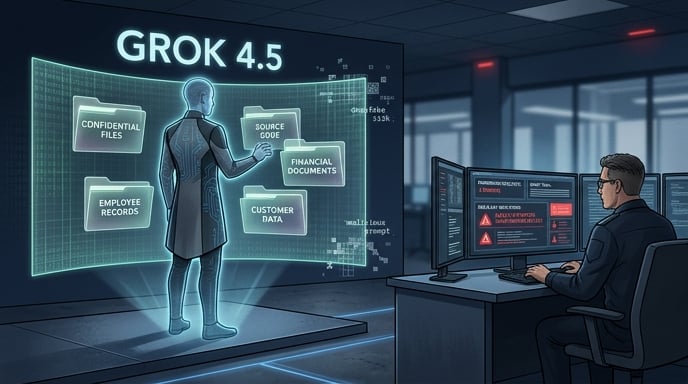
Grok has faced persistent scrutiny over generated content and safety controls.
In June 2026, a British member of Parliament filed a legal claim alleging that people used Grok to create nonconsensual fake images of her. The case followed broader concern about sexualized deepfakes and the responsibilities of AI providers.
Grok’s move into professional work does not erase those questions. It adds new ones.
A coding agent may encounter security credentials, proprietary software, and customer information. An office agent may access financial records, internal messages, or employment data. A research system may encounter misleading content and repeat it in a report.
SpaceXAI needs controls appropriate to each environment. Consumer safeguards alone are not enough.
The company must show how it limits data exposure, prevents destructive actions, isolates customer information, records tool use, and handles malicious instructions hidden in websites or files.
Businesses will also want clear explanations of where their data goes and whether it contributes to model training.
Grok 4.5’s price and speed may attract experiments. Long-term enterprise adoption will depend on governance, reliability, and trust.
Availability Still Has Boundaries
SpaceXAI made Grok 4.5 available through Grok Build, Cursor, and its developer console. Reuters reported that European Union availability was expected in mid-July.
Regional differences matter because AI providers operate under a growing collection of privacy, consumer-protection, safety, and competition rules.
A company may launch a model globally while withholding certain features. It may offer the API in one region before a consumer product. Business customers may receive contractual protections that individual users do not.
Developers should therefore check the conditions that apply to their own location and product rather than assume a general announcement guarantees identical access.
They should also plan for model changes.
AI companies frequently update, replace, or retire models. An application that depends heavily on Grok 4.5’s exact behavior may need adjustment when SpaceXAI changes the underlying system.
Good engineering practices can reduce that risk. Teams can evaluate outputs automatically, preserve version information, separate model-specific instructions, and maintain alternatives.
The frontier moves quickly. Production systems must expect motion.
A Different Competitive Position
OpenAI enters the workplace race with the ChatGPT brand and a broad user base. Anthropic brings a strong reputation in coding, enterprise use, and safety. SpaceXAI brings Musk’s integrated technology empire, aggressive infrastructure investment, real-time access through X, and an increasingly serious coding strategy.
Grok 4.5 does not need to defeat every rival on every benchmark to matter.
It can gain ground by offering a strong combination of cost, speed, and adequate performance. Also, it can win developers through Cursor and Grok Build. It can use X to strengthen real-time tasks. It can use SpaceXAI’s infrastructure to scale.
The company also carries distinctive risks. Grok’s controversial history may make some organizations cautious. Corporate integration may invite governance questions. Enterprise buyers may demand more transparency than consumer audiences.
That tension gives the Grok story its energy.
SpaceXAI wants to preserve the product’s outsider identity while convincing conservative businesses that it can handle important work. Those goals do not always align.
A provocative consumer assistant can tolerate unpredictability. A system modifying production code or financial models cannot.
The Model Must Prove Itself in Production
The strongest evidence for Grok 4.5 will not come from a benchmark chart.
It will come from programmers who accept its changes, companies that keep it in production, and teams that can show measurable savings without a rise in defects.
Buyers should test the model on representative assignments. They should record completion rates, correction time, token use, latency, security behavior, and the quality of cited sources. Aside from that, they should compare total workflow cost, not just API prices.
They should also examine failure.
Does Grok admit uncertainty? Does it preserve a repository’s conventions? Can it recover when a tool fails? Does it make large changes when a small one would work? Can reviewers reconstruct what it did?
An agent’s most dangerous output may not be an obvious failure. It may be a plausible result that passes a quick inspection.
SpaceXAI’s claims about token efficiency and engineering performance make Grok 4.5 worthy of serious testing. They do not remove the need for supervision.
The companies that adopt agents thoughtfully will learn faster than those that either reject them completely or trust them without controls.
The Third Major Strategy in the AI Race
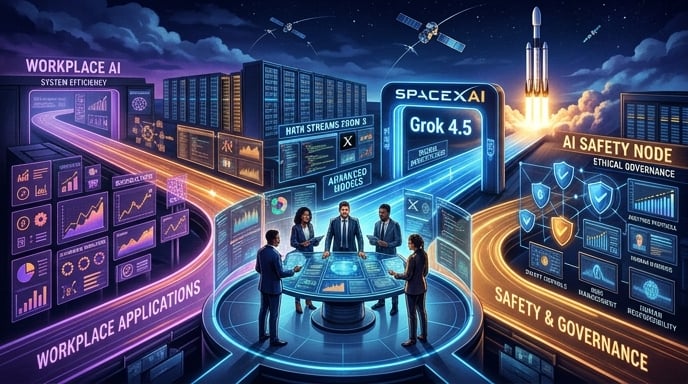
Grok 4.5 completes a revealing picture of the frontier-AI market.
OpenAI is turning ChatGPT into a general work platform. Anthropic is pairing high capability with an elaborate safety and government-review framework. SpaceXAI is combining an aggressively priced model with coding products, real-time information, and large-scale infrastructure.
All three strategies point toward the same destination: AI systems that perform sustained work instead of merely discussing it.
The competition will likely drive rapid improvements. Models will become faster. Prices will fall. Agents will connect to more applications. Finished documents, software, and analyses will arrive with less human preparation.
The hard problems will move upward.
People will need to decide which goals to delegate, which information an agent can see, which actions require approval, and who remains accountable when the system makes a mistake.
Grok 4.5 gives SpaceXAI a credible entry in that contest. Its low price and engineering focus could attract substantial use. Its corporate backing gives it resources few startups can match.
Now comes the less glamorous part: proving that speed, scale, and ambition can produce dependable work.
Sources
- SpaceXAI: Introducing Grok 4.5
- Reuters: SpaceXAI launches Grok 4.5 for coding and agentic tasks
- SpaceXAI: xAI joins SpaceX
- SpaceXAI: Introducing Grok Build
- SpaceXAI: Introducing /goal for long-running autonomous tasks
- Associated Press: UK lawmaker brings legal claim over fake Grok images
The Kingy Brief
Get The Kingy Brief.
AI changes, original tests and one practical thing to try. Fridays at 09:00 Vancouver time.
Free · Double opt-in · Unsubscribe anytime
Sign up for The Kingy Brief on Beehiiv.
Signup help and newsletter schedule
Signup form provided by Beehiiv. After submitting, check your inbox for "Confirm your subscription to The Kingy Brief" and open its confirmation link. Check Spam or Promotions if you cannot find it.
Fridays at 09:00 Vancouver time: source-checked AI changes, original tests and one practical thing to try. We skip a week when there is not enough verified material. Free. Unsubscribe anytime.