Bottom line: Muse Spark 1.1 is not just Meta’s new chatbot model. It is Meta’s first serious developer-facing push around a long-context, multimodal, agentic model that can use tools, coordinate subagents, operate computer interfaces, and run coding workflows through the new Meta Model API.
The short version: Muse Spark 1.1 appears strongest as an agent and workflow model, competitive but not dominant as a coding model, mixed on pure long-context retrieval, strong in tool-augmented reasoning, and useful but not clearly dominant in multimodal benchmarks.
Meta released Muse Spark 1.1 on July 9, 2026, alongside a public preview of the Meta Model API. The launch matters because Meta is no longer only talking about consumer assistants or open-weight Llama releases. With Muse Spark 1.1, Meta is putting a proprietary model into a developer API and aiming it at the workloads where AI builders spend real money: agents, tools, coding loops, browser work, multimodal workflows, and long-running tasks.
That makes this a bigger story than a normal model update. For AI founders, developer-tool companies, automation startups, and product teams building agents, the core question is not “Can Muse Spark chat well?” The better question is: can it complete useful work at a lower cost per finished task?
For broader context, see Kingy.ai’s coverage hubs for AI launches, AI models, AI tools, and the Kingy.ai blog.
What Is Muse Spark 1.1?
Muse Spark 1.1 is the latest model in the Muse Spark family from Meta Superintelligence Labs. Meta describes it as a significant upgrade from Muse Spark and says it is a multimodal reasoning model built for agentic tasks, with gains in tool use, computer use, coding, and multimodal understanding.
The official Muse Spark 1.1 Evaluation Report says the model updates the system powering Meta AI and extends availability to external developers through an API with agentic affordances, including tool calling, function calling, and user-specified developer prompts. Meta’s announcement also says the model is available in “Thinking” mode in the Meta AI app and on meta.ai.
The model’s intended shape is clear: Muse Spark 1.1 is not being positioned as a pure benchmark machine. It is being positioned as an agent foundation. That means it is supposed to gather context, call tools, operate browsers and desktops, plan across long sessions, delegate work to subagents, and keep enough state to finish multi-step tasks.
Muse Spark 1.1 Specifications
| Specification | Verified detail |
|---|---|
| Developer | Meta Superintelligence Labs. |
| Model family | Muse Spark. |
| Model type | Multimodal reasoning model for agentic tasks. |
| Main focus | Tool use, computer use, coding, multimodal workflows, long-running agents, and developer API workflows. |
| Context window | 1 million tokens, with active context management and compaction according to Meta’s announcement. |
| API availability | Available through the Meta Model API public preview, according to Meta. |
| Consumer availability | Available in “Thinking” mode in the Meta AI app and on meta.ai, according to Meta. |
| Pricing | Meta’s announcement and evaluation report do not publish a plain rate card. A Reuters-syndicated report cites $1.25 per million input tokens and $4.25 per million output tokens, plus $20 in free credits, but that rate was not independently visible in the official announcement or evaluation report reviewed here. |
| Modalities | Meta describes Muse Spark 1.1 as multimodal. The announcement discusses visual, audio, image, video, PDF, and multimodal workflow use cases through Meta text and launch-page partner quotes. |
| Agent and tool features | Tool calling, function calling, developer prompts, computer use, browser workflows, and agentic scaffolding are described in the report or announcement. |
| MCP/tool generalization | Meta says Muse Spark 1.1 zero-shot generalizes to new native tools, MCP servers, and custom skills. |
| Multi-agent orchestration | Meta says the model can act as a main agent, gather context, plan, and delegate work across parallel subagents. |
| Context compaction | Meta says the model actively manages and compacts its 1 million-token context window. |
Benchmark Summary
The benchmark story is nuanced. Muse Spark 1.1 looks especially strong on agent and tool-use benchmarks. It leads the compared set on MCP Atlas, JobBench, Humanity’s Last Exam with tools, Finance Agent v2, and HealthBench Professional. It is close to the top on Toolathlon-Verified, OSWorld-Verified, WebArena-Verified, and DeepSearchQA.
It is less clean as a coding king. On Terminal-Bench 2.1, GPT-5.5 leads. On SWE-Bench Pro, Claude Opus 4.8 leads. On DeepSWE 1.1, GPT-5.5 leads. Muse Spark 1.1 is absolutely competitive, and it is a large improvement over Muse Spark 1.0, but the official table does not support the claim that it is the best pure coding model.
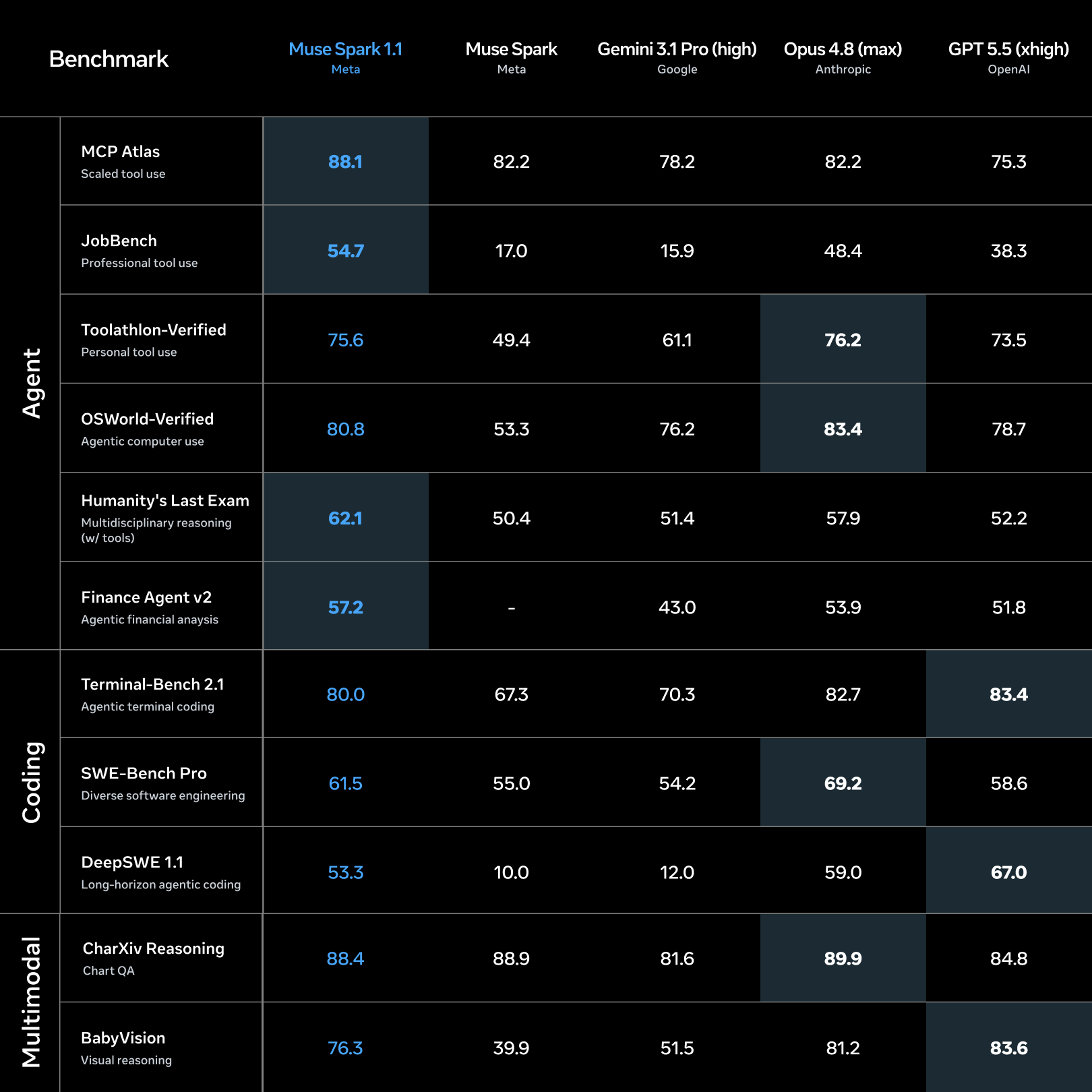
The most useful takeaway for builders is this: Muse Spark 1.1 may be more interesting as a cost-efficient orchestration model than as a single universal winner. Agents can burn tokens quickly. A model that is slightly behind the top coding score but cheaper and better at tool orchestration can still win on cost-per-completed-task.
Evaluation Methodology And Caveats
Meta’s evaluation report compares Muse Spark 1.1 against Muse Spark 1.0, Gemini 3.1 Pro, Claude Opus 4.8, and GPT-5.5. For those competitor models, Meta says it uses high or max reasoning modes where applicable: high reasoning effort for Gemini, max reasoning effort for Claude, and xhigh reasoning effort for GPT. Meta says all Muse Spark 1.1 general-capability results were run through the Meta Model API using xhigh reasoning effort.
There are important caveats. For coding and agentic benchmarks, Meta reports self-reported competitor results when available and runs internal evaluations when self-reported results are not available. For other benchmarks, Meta says it reports the most favorable result between self-reported scores and internal API reproductions unless otherwise specified.
Meta also warns that agentic evaluations for third-party models are best-effort evaluations in the same framework used for Meta’s internal models. The tools, prompts, and harnesses may not be specifically tuned for the proprietary competitor models. That means the numbers are useful, but they are not the final independent verdict.
That matters. Agent benchmarks are especially sensitive to scaffolds, tool schemas, browser setup, retry policy, timeouts, hidden instructions, and model-specific prompting. Independent testing is still needed before any company should move production workloads from Claude, GPT, Gemini, Grok, or open-weight models to Muse Spark 1.1.
Benchmark Comparison Table
The table below uses the official Muse Spark 1.1 Evaluation Report. The “best competing score” column excludes Muse Spark 1.1 and shows the highest listed competitor where available.
| Category | Benchmark | Muse Spark 1.1 | Best competing score | Apparent winner | Plain-English interpretation |
|---|---|---|---|---|---|
| Reasoning | Humanity’s Last Exam, with tools | 62.1 | 57.9, Claude Opus 4.8 | Muse Spark 1.1 | Strong tool-augmented reasoning result. |
| Reasoning | Humanity’s Last Exam, no tools | 52.2 | 49.8, Claude Opus 4.8 | Muse Spark 1.1 | Strong standalone reasoning in Meta’s table. |
| Long context | MRCR Long Context, 1M context window | 54.1 | 74.0, GPT-5.5 | GPT-5.5 | 1M context does not automatically mean best long-context retrieval. |
| Agents | MCP Atlas | 88.1 | 82.2, Muse Spark 1.0 / Claude Opus 4.8 | Muse Spark 1.1 | Strong scaled tool-use result. |
| Agents | Toolathlon-Verified | 75.6 | 76.2, Claude Opus 4.8 | Claude Opus 4.8 | Nearly tied with Opus, but not the winner. |
| Computer use | OSWorld-Verified | 80.8 | 83.4, Claude Opus 4.8 | Claude Opus 4.8 | Very strong computer-use result, slightly behind Opus. |
| Computer use | OSWorld 2.0, binary / partial, without exec | 14.2 / 47.3 | 20.6 / 54.8, Claude Opus 4.8 | Claude Opus 4.8 | Long-horizon computer use remains hard. |
| Agents | WebArena-Verified | 69.0 | 71.2, Claude Opus 4.8 | Claude Opus 4.8 | Competitive browser-agent score, but Opus leads. |
| Agents | DeepSearchQA | 84.9 | 87.8, GPT-5.5 | GPT-5.5 | Strong search-agent result, second in the table. |
| Professional work | GDPval-AA v2 Elo | 1381 | 1600, Claude Opus 4.8 | Claude Opus 4.8 | Useful but not top on this professional-task Elo. |
| Professional work | JobBench | 54.7 | 48.4, Claude Opus 4.8 | Muse Spark 1.1 | Best result in the table on professional tool use. |
| Finance | Finance Agent v2 | 57.2 | 53.9, Claude Opus 4.8 | Muse Spark 1.1 | Best reported score among listed models. |
| Coding | Terminal-Bench 2.1 | 80.0 | 83.4, GPT-5.5 | GPT-5.5 | Competitive, not best. |
| Coding | SWE-Bench Pro | 61.5 | 69.2, Claude Opus 4.8 | Claude Opus 4.8 | Good but behind Opus on diverse software engineering. |
| Coding | DeepSWE 1.1 | 53.3 | 67.0, GPT-5.5 | GPT-5.5 | Long-horizon coding is not Muse Spark’s clearest win. |
| Health | HealthBench Professional | 59.3 | 55.8, Claude Opus 4.8 | Muse Spark 1.1 | Strong health/professional result in Meta’s evaluation. |
| Multimodal | CharXiv Reasoning, with tools | 88.4 | 89.9, Claude Opus 4.8 | Claude Opus 4.8 | Strong chart reasoning, not best-in-table. |
| Multimodal | BabyVision, with tools | 76.3 | 83.6, GPT-5.5 | GPT-5.5 | Useful visual reasoning, but trails GPT and Opus. |
Reasoning And Long Context
Muse Spark 1.1’s cleanest reasoning win is Humanity’s Last Exam. In Meta’s table, it scores 62.1 with tools, ahead of Claude Opus 4.8 at 57.9, GPT-5.5 at 52.2, Gemini 3.1 Pro at 51.4, and Muse Spark 1.0 at 50.4. Without tools, Muse Spark 1.1 scores 52.2, also ahead of the listed competitors.
That matters because tool-augmented reasoning is closer to real product behavior than isolated answer generation. Useful AI agents do not just produce final text. They search, inspect files, run code, call APIs, compare intermediate results, retry failures, and decide whether to use a tool at all. The HLE with-tools result is a signal that Muse Spark 1.1 is built for that world.
The long-context story is more mixed. Meta says Muse Spark 1.1 has a 1 million-token context window and active context management. But on MRCR Long Context at the 1M context window, Meta’s table shows Muse Spark 1.1 at 54.1 while GPT-5.5 scores 74.0. That is exactly why teams should not treat “1M context” as a synonym for “best retrieval.” A giant context window helps only when the model can find and use the right information inside it.
Agent Benchmarks
This is the strongest part of the Muse Spark 1.1 story. MCP Atlas, Toolathlon-Verified, OSWorld-Verified, WebArena-Verified, DeepSearchQA, JobBench, Finance Agent v2, and GDPval-AA are all closer to real work than ordinary multiple-choice tests. They involve tool schemas, browser environments, desktop interfaces, professional deliverables, financial analysis, or long-running search.
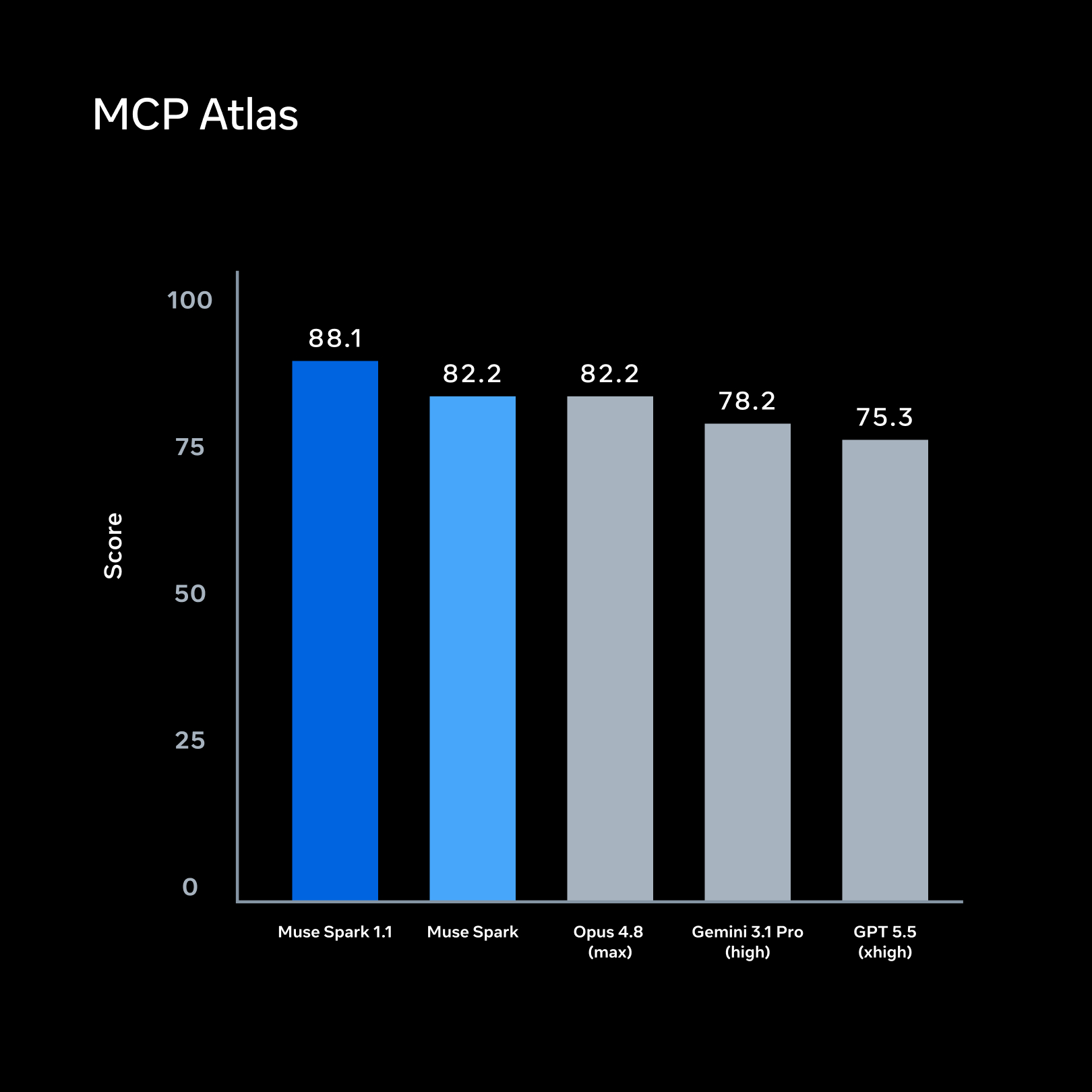
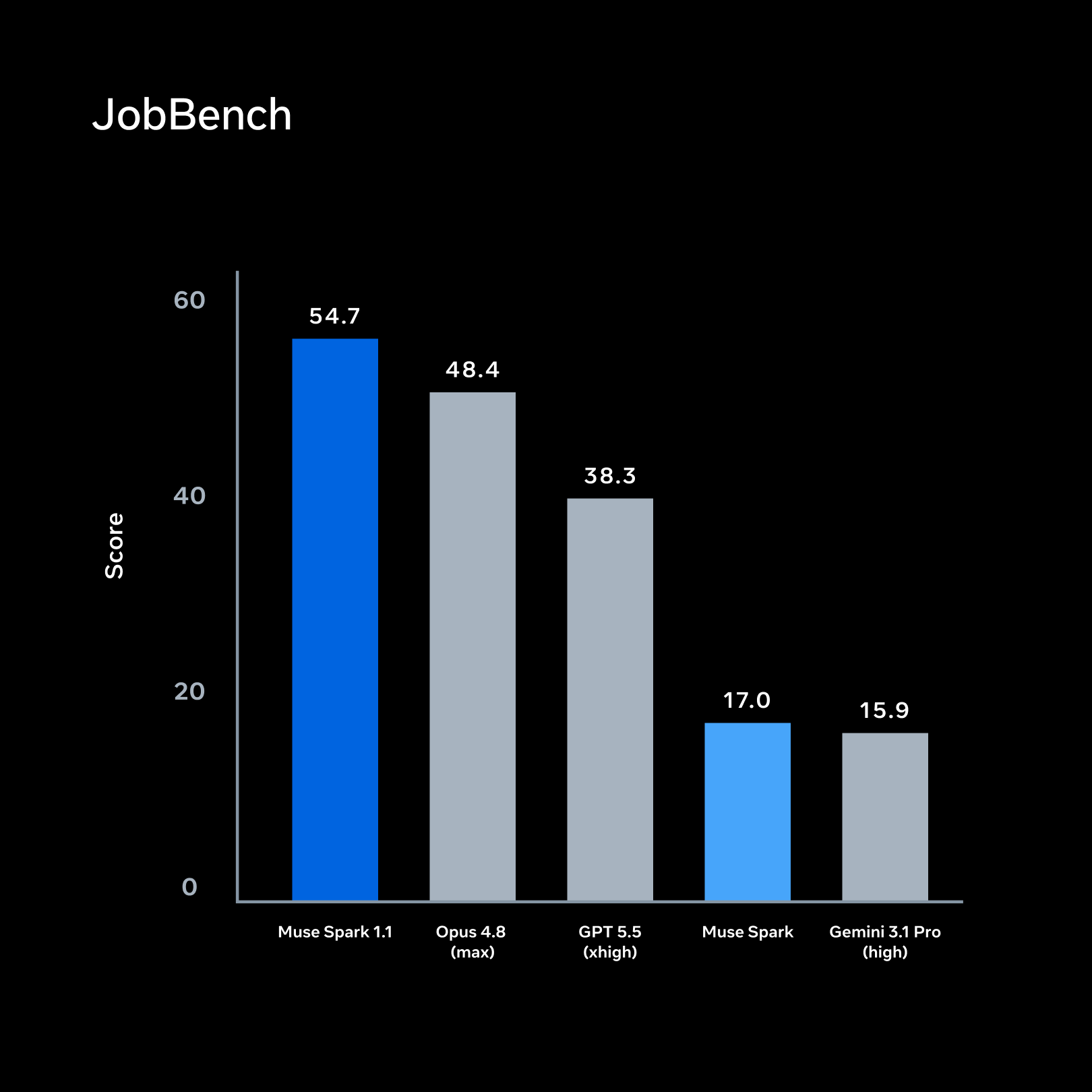
On MCP Atlas, Muse Spark 1.1 scores 88.1, ahead of Claude Opus 4.8 and Muse Spark 1.0 at 82.2, Gemini 3.1 Pro at 78.2, and GPT-5.5 at 75.3. On JobBench, it scores 54.7, ahead of Claude Opus 4.8 at 48.4 and GPT-5.5 at 38.3. On Finance Agent v2, it scores 57.2, ahead of Claude Opus 4.8 at 53.9, GPT-5.5 at 51.8, and Gemini 3.1 Pro at 43.0.
It is not all one-way. On WebArena-Verified, Muse Spark 1.1 scores 69.0, tied with Gemini 3.1 Pro and behind Claude Opus 4.8 at 71.2. On DeepSearchQA, Muse Spark 1.1 scores 84.9, behind GPT-5.5 at 87.8 but slightly ahead of Claude Opus 4.8 at 84.3. On GDPval-AA v2 Elo, it scores 1381, behind Claude Opus 4.8 at 1600 and GPT-5.5 at 1494.
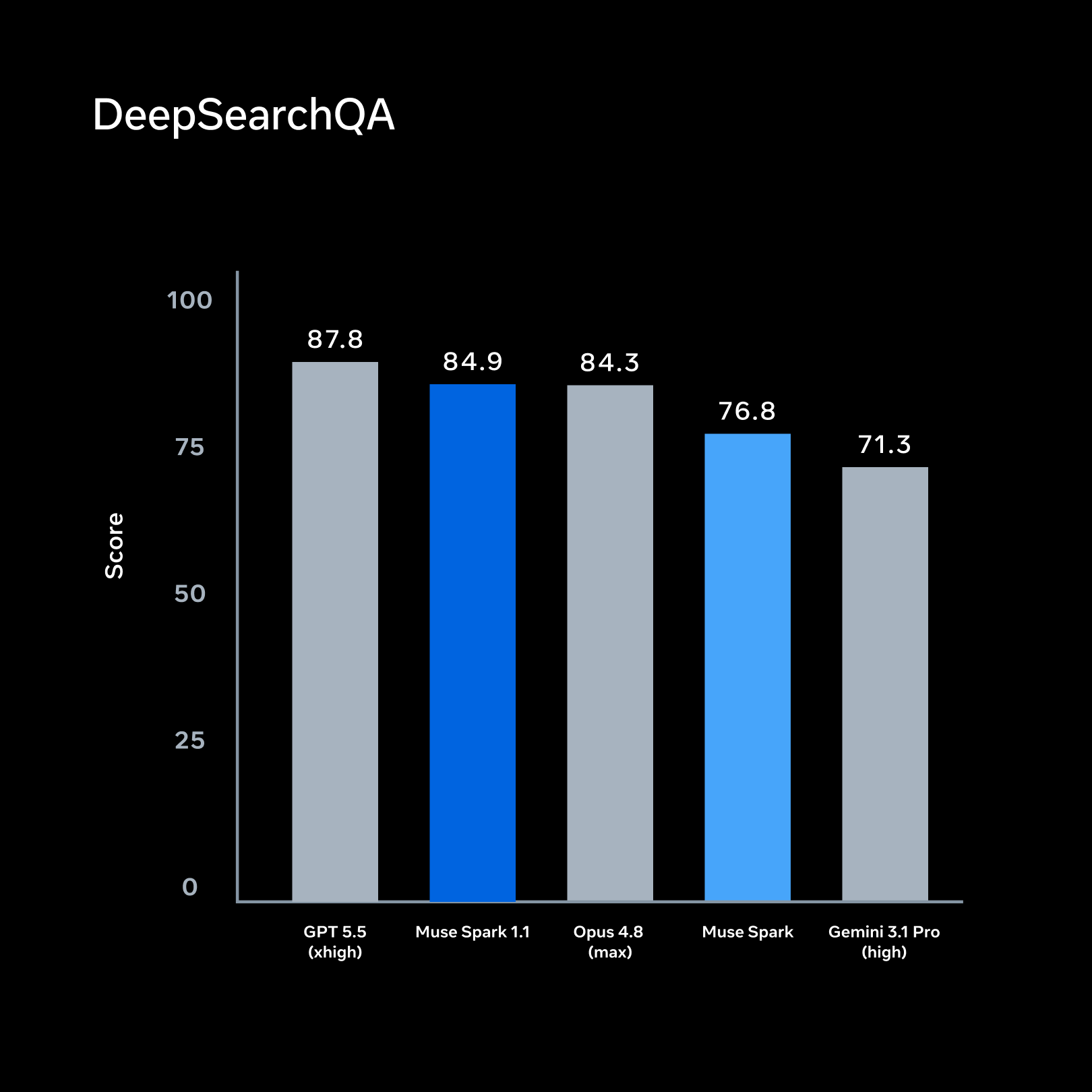
The pattern is useful: Muse Spark 1.1 is often in the top cluster, and it wins several agentic tasks outright. For startups building browser agents, research agents, financial-analysis agents, internal enterprise copilots, and workflow automation tools, that is more meaningful than a single leaderboard headline.
Computer Use
Meta’s computer-use claim is practical: Muse Spark 1.1 can work across multiple apps, deal with changing information, navigate unfamiliar interfaces, and decide when to write scripts versus when to click through an interface directly. This is a smart target. Real agents often fail not because they cannot reason in the abstract, but because they cannot operate messy software interfaces reliably.
On OSWorld-Verified, Muse Spark 1.1 scores 80.8. That is strong, but Claude Opus 4.8 leads at 83.4. On OSWorld 2.0, which Meta describes as a harder long-horizon benchmark of 108 real-world workflows on a full Ubuntu desktop VM, Muse Spark 1.1 scores 14.2 binary and 47.3 partial, while Claude Opus 4.8 scores 20.6 binary and 54.8 partial.
The interpretation is balanced: Muse Spark 1.1 is a serious computer-use model, but the official report does not make it the undisputed leader. The more interesting claim is economic. If Meta’s reported API pricing holds, a model that performs near the top at a lower token cost could become attractive for high-volume computer-use agents.
Coding Benchmarks
Muse Spark 1.1 is competitive at coding. It is not the obvious overall coding leader.
On Terminal-Bench 2.1, Muse Spark 1.1 scores 80.0. GPT-5.5 scores 83.4 and Claude Opus 4.8 scores 82.7. On SWE-Bench Pro, Muse Spark 1.1 scores 61.5, while Claude Opus 4.8 leads at 69.2 and GPT-5.5 scores 58.6. On DeepSWE 1.1, Muse Spark 1.1 scores 53.3, behind GPT-5.5 at 67.0 and Claude Opus 4.8 at 59.0.
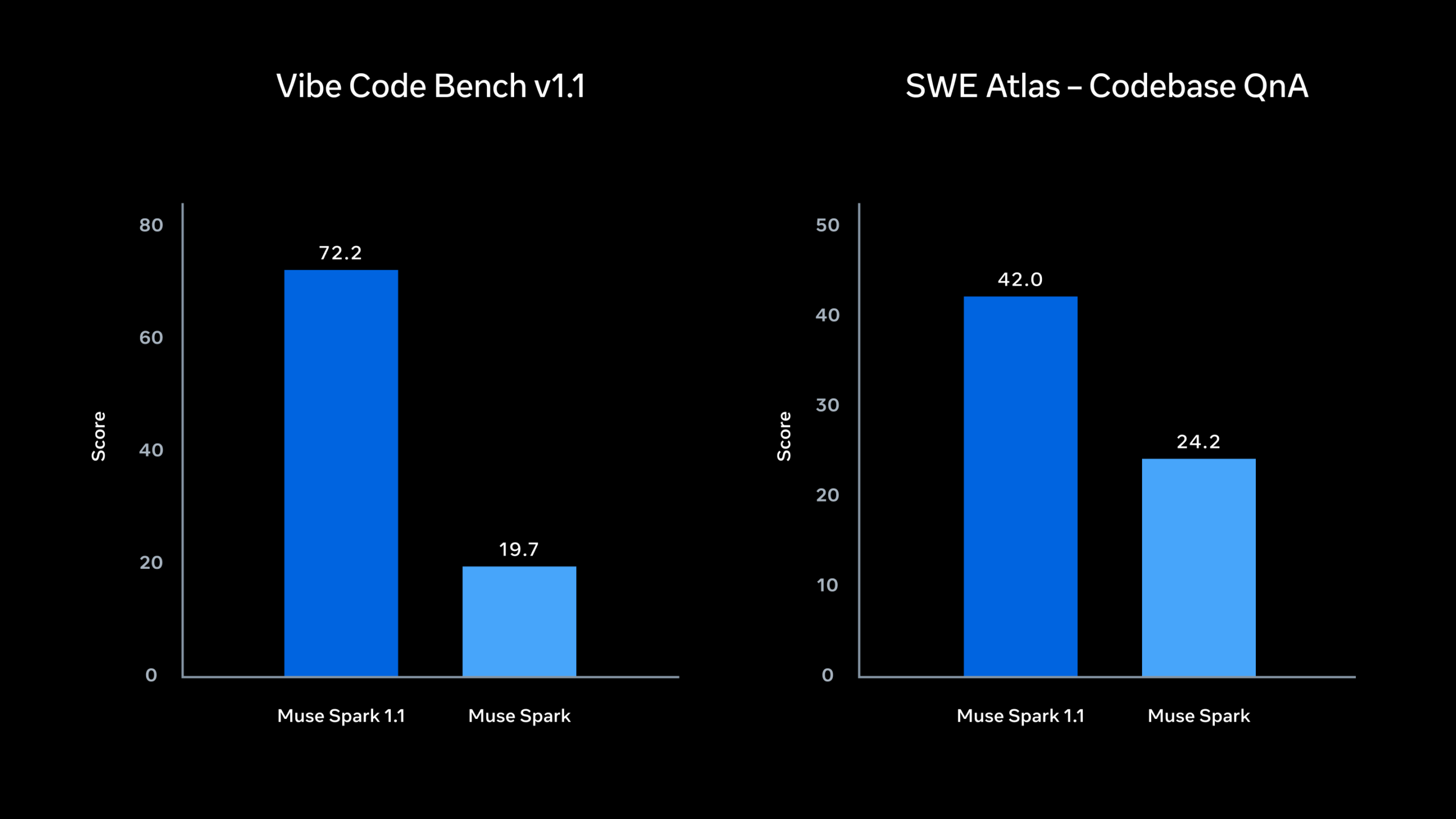
That does not make Muse Spark 1.1 uninteresting for developers. It may be more interesting as a coding-agent orchestration model than as the single best pure coding benchmark model. Meta says Muse Spark 1.1 supports planning mode, goal conditioning, subagent delegation, and context compaction. Those features matter in real coding tools because coding agents are systems, not just models.
The right test is not “Can it beat GPT-5.5 on every coding leaderboard?” The better test is whether it can complete a large codebase bug fix, keep screenshots and terminal logs in context, call tools reliably, generate a patch, run tests, recover from failures, and do all of that cheaply enough to run at scale.
Multimodal Benchmarks
Meta positions Muse Spark 1.1 as a multimodal reasoning model. The announcement highlights image and video understanding, visual-to-code artifact generation, descriptive image and video captioning, and multimodal workflows where perception and action happen together.
The benchmark table is strong but not dominant. On CharXiv Reasoning with tools, Muse Spark 1.1 scores 88.4. Claude Opus 4.8 leads at 89.9, while Muse Spark 1.0 is at 88.9, GPT-5.5 is at 84.8, and Gemini 3.1 Pro is at 81.6. On BabyVision with tools, Muse Spark 1.1 scores 76.3, behind GPT-5.5 at 83.6 and Claude Opus 4.8 at 81.2.
So the practical view is this: Muse Spark 1.1 looks useful for multimodal agent workflows, especially where visual perception connects to action. It is not, based on Meta’s own table, the clear winner across every multimodal benchmark.
Safety And Preparedness Evals
The safety report deserves careful reading. Meta evaluated Muse Spark 1.1 under its Advanced AI Scaling Framework across Chemical & Biological, Cybersecurity, and Loss of Control risk domains. The report states that, without mitigations applied, Meta could not rule out Muse Spark 1.1 meeting the “high risk” capability threshold in both Chemical & Biological and Cybersecurity domains. It says the Loss of Control domain remains within the “moderate or lower” threshold.
That is not a reason to sensationalize the model. It is a reason to describe the deployment honestly. Meta says it implemented and validated multi-layered mitigations that reduce residual risk across all domains to “moderate or lower” before release.
The report also includes refusal and robustness results. For example, Muse Spark 1.1 reports 97.7 on BioTIER refusals and 99.8 on Chemical Agents refusals. For adversarial robustness, it reports 0.5 attack success rate on StrongREJECT v2, matching GPT-5.5 in the table and ahead of Claude Opus 4.8 and Gemini 3.1 Pro. The report also discusses prompt injection, agent robustness, false refusals, sycophancy, honesty, calibration, and agentic misalignment.
The takeaway for developers is simple: safety mitigations are part of the product. If you are building agents with browser, code, file, or tool permissions, you still need your own permission model, logs, sandboxing, approval gates, and abuse monitoring.
Strengths And Weaknesses
Strengths of Muse Spark 1.1
- Strong agentic performance: wins or competes closely on MCP Atlas, JobBench, Finance Agent v2, WebArena-Verified, DeepSearchQA, and OSWorld-Verified.
- Competitive price-performance: external reports cite aggressive API pricing, and Meta’s launch materials repeatedly frame Muse Spark 1.1 around efficient agentic workloads.
- 1 million-token context window: useful for long projects, codebases, documents, and persistent agent workflows.
- Tool use and function calling: the evaluation report explicitly describes API affordances including tool and function calling.
- Multi-agent orchestration: Meta says it can plan as a main agent and delegate execution across parallel subagents.
- Good fit for coding agents: the model supports planning, goal conditioning, subagent delegation, and context compaction.
- Strong reasoning results: it leads the table on Humanity’s Last Exam with and without tools.
- Multimodal workflow usefulness: the model is built for workflows that combine perception, tools, and action.
Weaknesses of Muse Spark 1.1
- Not the clear winner on every coding benchmark: GPT-5.5 leads Terminal-Bench 2.1 and DeepSWE 1.1, while Claude Opus 4.8 leads SWE-Bench Pro.
- 1M context does not guarantee best retrieval: GPT-5.5 leads MRCR Long Context in Meta’s table.
- Multimodal results are not always best-in-class: Claude Opus 4.8 leads CharXiv Reasoning and GPT-5.5 leads BabyVision.
- Benchmark methodology needs independent verification: Meta’s report is useful, but independent harnesses will matter.
- API availability may be preview-limited: Meta calls the API a public preview, and real access details can change.
- Safety mitigations are part of the deployment story: the unmitigated model triggered high-risk-threshold concerns in specific domains.
- Developers still need real-world tests: the model should be evaluated on actual workflows before switching production traffic.
Who Should Try Muse Spark 1.1?
Muse Spark 1.1 is most interesting for teams building systems where agents do actual work. That includes AI coding-agent companies, browser-agent startups, workflow automation platforms, research agents, financial analysis agents, internal enterprise copilots, document-heavy agents, multimodal productivity tools, and teams trying to reduce the token cost of long-running tasks.
It may be less urgent for users who only need casual chat, teams already locked into another model stack, developers who need open weights or local deployment, and organizations that need the current best pure coding model regardless of cost.
For AI founders, the key question is not whether Muse Spark 1.1 wins every benchmark. It does not. The key question is whether it can finish your workflow with the right mix of reliability, latency, tool discipline, and price.
Kingy.ai Real-World Test Plan
Here is the test suite Kingy.ai would run before recommending Muse Spark 1.1 as a production agent model:
- Large codebase bug fix: give the model a failing test suite in a real repository and measure whether it finds the issue, patches it, and avoids unrelated edits.
- Frontend rebuild from screenshot: ask it to rebuild a product screen from an image, then evaluate layout fidelity on desktop and mobile.
- Browser workflow: run a multi-step web task with changing instructions, login state, forms, and error recovery.
- Long-context retrieval: place critical facts deep inside a large document set and test retrieval accuracy, not just context length.
- Agentic article production: have it research, draft, cite, format, upload images, and verify a CMS post without hallucinated details.
- Multimodal debugging: give it screenshots, logs, browser console output, and source files, then measure whether it links visual failure to code.
- Spreadsheet/report generation: ask it to create a financial or market report with calculations, charts, and a final executive summary.
- Tool-use reliability: measure invalid tool calls, repeated calls, unnecessary tool use, and recovery from tool failures.
- Cost-per-completed-task: compare total input tokens, output tokens, retries, tool calls, latency, and human interventions against Claude, GPT, Gemini, and open-weight baselines.
- Human preference ranking: have expert reviewers compare final deliverables blind, not just raw benchmark scores.
Final Verdict
Muse Spark 1.1 is not a simple “best model in the world” story. It is more specific and more interesting. Meta appears to have built a serious, aggressively priced agent model with strong tool-use, reasoning, professional-task, and workflow performance.
The weaknesses are also clear. It does not dominate pure coding. It does not win every multimodal benchmark. A 1 million-token context window does not automatically make it the best long-context retrieval model. And Meta’s own safety report shows why deployment mitigations matter.
But for agent workflows that plan, use tools, operate across apps, run code, inspect visual state, and burn a lot of tokens, Muse Spark 1.1 deserves serious testing. The first teams that should evaluate it are not casual chatbot users. They are the teams paying large inference bills for agents that need to finish real work.
FAQ
What is Muse Spark 1.1?
Muse Spark 1.1 is Meta’s latest Muse Spark model from Meta Superintelligence Labs. Meta describes it as a multimodal reasoning model built for agentic tasks, tool use, computer use, coding, and multimodal workflows.
Is Muse Spark 1.1 available through an API?
Yes. Meta says Muse Spark 1.1 is available through the Meta Model API public preview. The evaluation report says the API exposes agentic affordances such as tool calling, function calling, and developer prompts.
What is Muse Spark 1.1 best at?
Based on Meta’s evaluation report, Muse Spark 1.1 looks strongest on agentic and tool-use workflows, including MCP Atlas, JobBench, Finance Agent v2, Humanity’s Last Exam with tools, and HealthBench Professional.
Is Muse Spark 1.1 better than GPT-5.5 or Claude Opus?
Not universally. Muse Spark 1.1 leads some agent, reasoning, finance, and health benchmarks in Meta’s table. GPT-5.5 leads DeepSearchQA, Terminal-Bench 2.1, DeepSWE 1.1, BabyVision, and MRCR Long Context. Claude Opus 4.8 leads SWE-Bench Pro, WebArena-Verified, GDPval-AA v2 Elo, Toolathlon-Verified, OSWorld-Verified, OSWorld 2.0, and CharXiv Reasoning.
What is the context window for Muse Spark 1.1?
Meta says Muse Spark 1.1 has a 1 million-token context window and can actively manage and compact that context during long-running work.
Is Muse Spark 1.1 good for coding?
Yes, but it is not the clear leader on every coding benchmark. In Meta’s report it scores 80.0 on Terminal-Bench 2.1, 61.5 on SWE-Bench Pro, and 53.3 on DeepSWE 1.1. GPT-5.5 or Claude Opus 4.8 lead those specific coding rows.
What are Muse Spark 1.1’s biggest weaknesses?
The biggest weaknesses are mixed long-context retrieval, non-dominant pure coding scores, multimodal results that do not always lead the table, preview API uncertainty, and the need for independent benchmark verification.
Sources
- Meta AI: Introducing Muse Spark 1.1
- Meta AI: Muse Spark 1.1 Evaluation Report
- Alexandr Wang on X: Muse Spark 1.1 launch thread
- Meta for Developers: AI developer resources and Meta Model API
- Reuters-syndicated report: Meta debuts Muse Spark 1.1 with preview open to developers
The Kingy Brief
Get The Kingy Brief.
AI changes, original tests and one practical thing to try. Fridays at 09:00 Vancouver time.
Free · Double opt-in · Unsubscribe anytime
Signup help and newsletter schedule
Signup form provided by Beehiiv. After submitting, check your inbox for "Confirm your subscription to The Kingy Brief" and open its confirmation link. Check Spam or Promotions if you cannot find it.
Fridays at 09:00 Vancouver time: source-checked AI changes, original tests and one practical thing to try. The weekly restart begins October 9, 2026. We skip a week when there is not enough verified material. Free. Unsubscribe anytime.