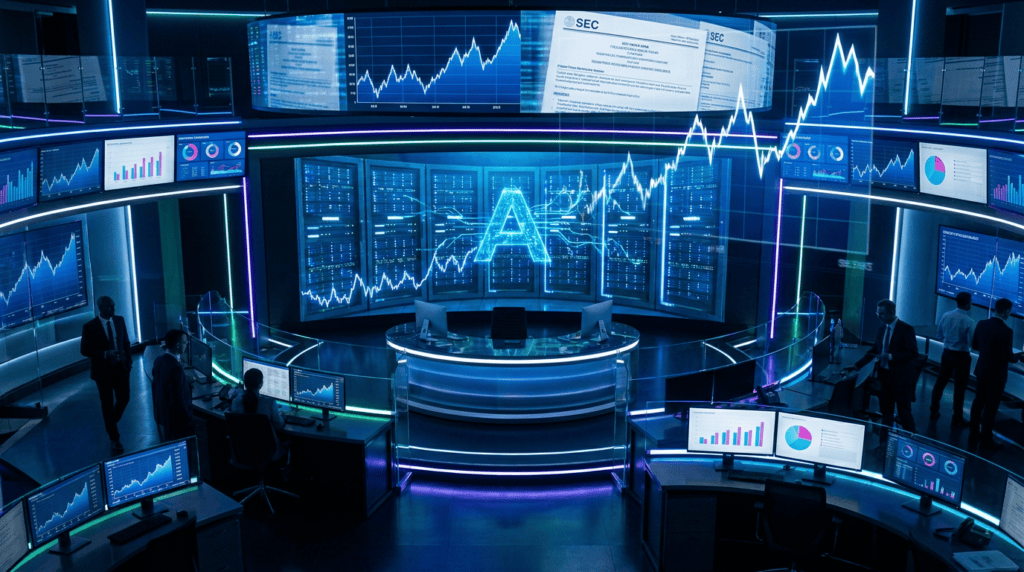
The Filing That Made Everyone Sit Up
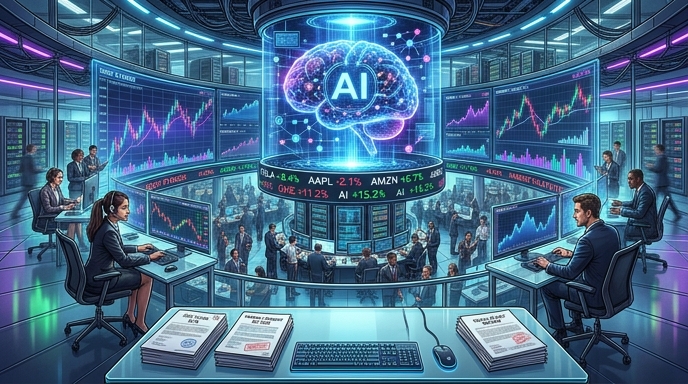
In its June 1, 2026 announcement, Anthropic said it had confidentially submitted a draft Form S-1 registration statement to the U.S. Securities and Exchange Commission for a proposed IPO. The announcement gave it the option to go public after SEC review, subject to market conditions and other factors; the number of shares and the price had not been set. This article examines that announcement, rather than establishing the company’s subsequent listing status.
Still, the filing lands like a cymbal crash in the AI market. Anthropic is not just another app company with a shiny logo and a founder in fleece. It builds Claude, one of the frontier AI systems now competing for serious enterprise work. So this is not only a finance story. It is a test of whether generative AI can grow up, put on shoes, and answer hard questions from public investors without hiding behind private-market enthusiasm.
From Research Lab to Utility Bill
The big idea running through the coverage is simple: AI is moving from science-fair spectacle to enterprise utility. AI News frames Anthropic’s filing as a sign that generative AI is maturing from research-heavy venture building into something more stable, structured, and procurement-friendly.
That sounds dry. It is not. Corporate buyers need predictable pricing, reliable service, clear contracts, and vendors that do not vanish into the startup fog. If Claude sits inside legal review, customer support, software development, or HR workflows, companies need more than “trust us, the model is smart.” They need governance. They need support. They need rate limits that do not ambush their budgets like raccoons in a pantry.
A public Anthropic would face a sharper version of that demand. Wall Street likes growth. It also likes margins. Those two desires do not always hold hands nicely.
The Near-Trillion-Dollar Question
The Decoder, HyperFRAME Research, and Futurum covered the same funding round. Anthropic’s May 28, 2026 announcement said it raised $65 billion in Series H funding at a $965 billion post-money valuation, led by Altimeter Capital, Dragoneer, Greenoaks, and Sequoia Capital. That is the announced private-round valuation, not an IPO price or a current public-market valuation.
That valuation changes the conversation. At small scale, investors can buy a dream. At nearly a trillion dollars, they want machinery. They want proof that revenue can grow without compute costs eating the house.
Training and serving frontier models requires vast infrastructure. Anthropic’s funding announcement says the new capital will help expand compute, support research, and scale products and partnerships. Translation: the company needs enormous horsepower. The servers do not run on vibes. They run on capital, chips, energy, cloud capacity, and operational discipline.
Why Enterprises Matter More Than Casual Users
Consumer chatbots make noise. Enterprises make budgets. That is the cold center of this story.
AI News notes that the consumer market alone may not support the cost structure of frontier AI. It cites Emarketer forecasts showing Claude trailing ChatGPT and Gemini among U.S. internet users in 2026. But work use could be the bigger prize. More than 60% of U.S. AI users reportedly use AI tools for work, according to the same AI News analysis.
That puts Anthropic’s enterprise strategy under bright lights. If Claude becomes a daily tool for developers, analysts, lawyers, support agents, and operations teams, Anthropic has a path to durable revenue. If Claude remains admired but optional, investors will notice. They will not clap politely forever.
In plain English: Anthropic does not need every teenager using Claude to write vampire poetry. It needs big organizations using Claude to finish real work.
Benchmarks Are Not Enough Anymore
HyperFRAME makes a useful point: the market is no longer asking only which model wins benchmarks. That question still matters, but it is not enough. Enterprise buyers care about developer adoption, governance, retention, cost per completed workflow, reliability, and whether AI tools survive contact with messy business systems.
That last part is the monster under the bed. Most large companies do not run clean, modern, perfectly organized tech stacks. They run old systems, new systems, half-integrated systems, multiple clouds, proprietary databases, legacy workflows, and security rules written after someone once had a very bad Tuesday.
Anthropic must therefore prove Claude can work inside complicated environments. It must show that Claude can become a platform, not merely a model endpoint. A clever model can impress a demo room. A platform must earn its keep Monday morning after procurement, security, legal, finance, and IT have all taken turns poking it with sticks.
The Multi-Model Reality Check
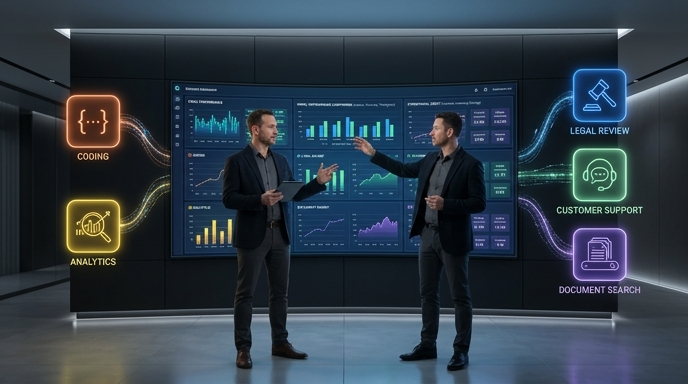
HyperFRAME also reports that 66% of organizations expect to deploy multiple foundation models at the same time. That is a big deal. It means Anthropic is not walking into most enterprises as the only game in town.
CIOs increasingly want choice. One model may work best for coding. Another may handle summarization. Another may plug neatly into an existing cloud deal. Another may win on cost. The future may look less like “one AI to rule them all” and more like a messy but useful tool belt.
That creates both pressure and opportunity for Anthropic. The company does not have to dominate every workflow. It does have to become trusted for high-value work. That means reliability, safety posture, integration, security, auditability, and cost discipline must matter as much as model flair.
The model race is becoming a platform race. The winner may not be the loudest engine. It may be the one enterprises can actually steer.
Transparency Cuts Both Ways
Futurum argues that Anthropic’s draft S-1 could raise the bar for enterprise trust. A public filing can reveal more about growth, risks, costs, and business durability. Buyers like that. Investors like that. Competitors hate it only when the numbers are good.
But transparency cuts both ways. A confidential filing begins the process, but it does not yet hand the market a full public prospectus. When more details arrive, investors will hunt for the unglamorous stuff: revenue concentration, gross margins, compute commitments, customer retention, legal risks, security posture, and whether growth depends on discounting.
That is where the fun ends and the spreadsheets begin. AI companies have sold the future with fireworks. Public markets will ask whether the fireworks factory makes money.
The Budget Gap Problem
Futurum highlights a tension that deserves attention. Vendors need huge capital to build and run advanced AI platforms, but many enterprise buyers still allocate modest slices of their technology budgets to AI. Its June 3 article reports that 63% of respondents to Futurum’s AI Platforms Decision Maker Survey (n=820, first half of 2026) allocated 10% or less of their tech budget to AI, while 78% planned to increase spending over the following year. Futurum labels that article AI-generated and not editor-reviewed; the underlying survey data and methodology are not independently assessed here.
That is bullish, but not magical. “We plan to spend more” does not automatically justify near-trillion-dollar valuations. Enterprises can be enthusiastic and cautious at the same time. In fact, they usually are. They test. They pilot. They negotiate. They demand proof.
Anthropic must bridge that gap. It must turn curiosity into contracts, contracts into renewals, and renewals into expanding usage. Otherwise, the market will ask a rude but fair question: where is the operating leverage?
Reliability Is the Real Product
Futurum’s survey also points to reliability and hallucination management as a top GenAI adoption challenge, with privacy and security close behind. That lands directly in Anthropic’s lane. The company has built much of its brand around safety, trust, and professional use.
That brand helps. It does not solve the problem by itself. Enterprises will ask whether Claude can reduce errors, protect sensitive data, support audits, and handle real workflows without creating fresh headaches. Nobody wants an AI assistant that drafts a contract clause confidently and incorrectly. That is not productivity. That is a lawsuit wearing a party hat.
Reliability turns AI from toy to infrastructure. Security turns it from risk to asset. Governance turns it from clever chaos to something a board can tolerate. Anthropic’s IPO story will depend heavily on whether buyers believe those promises at scale.
Competition Is Not Waiting Politely
Anthropic faces a brutal field. Futurum names OpenAI, Google, and Microsoft as major competitive forces in enterprise AI. HyperFRAME makes the same point and adds that Google and Microsoft bring deep advantages through cloud, productivity software, developer tools, and enterprise distribution.
That matters because distribution can beat elegance. A better product does not always win if a good-enough product already sits inside a customer’s existing stack. Microsoft has enterprise relationships. Google has cloud infrastructure and AI depth. OpenAI has broad consumer and developer recognition. Anthropic has credibility in safety-oriented, professional, high-value work.
So the company’s challenge is not just “make Claude smarter.” It must make Claude easier to buy, easier to govern, easier to integrate, and harder to replace.
That is less glamorous than a benchmark chart. It is also where enterprise markets are won.
What Public Investors Will Watch
The coming test will not revolve around one metric. It will be a bundle of questions.
Can Anthropic maintain research velocity while controlling costs? Can it expand capacity without wrecking margins? Can it win large customers and keep them? Can Claude become embedded in recurring workflows, rather than used for scattered experiments? Can the company price usage in a way that customers accept and investors respect?
AI News suggests an IPO could force commercial discipline across the sector. HyperFRAME calls this the industrialization of foundation models. Futurum frames it as a new phase in the AI platform race.
All three angles point to the same conclusion. Anthropic’s filing is not merely about Anthropic. It is a referendum on whether frontier AI companies can become durable public businesses.
What Customers Should Do Now
Enterprise customers should not treat the filing as a reason to panic. But they should treat it as a reason to get sharper.
First, buyers should map where Claude already touches important work. That includes code generation, internal search, support workflows, document review, and any agentic process that can take action across systems. Then they should ask boring questions. Who owns the budget? What happens if pricing changes? Can the company switch models if needed? Are prompts, outputs, logs, and sensitive data governed properly?
Second, buyers should negotiate while Anthropic still wants expansion. AI News notes that enterprise dependence may give boardrooms room to seek longer-term price locks and stronger data governance terms before public-market pressures intensify.
Third, customers should avoid building brittle systems around a single model. HyperFRAME’s multi-model data makes the direction clear. The smarter architecture is flexible. Use Claude where it performs best. Keep the exit door unlocked. Vendor love is fine. Vendor dependence is where the invoice starts doing push-ups.
The Bottom Line
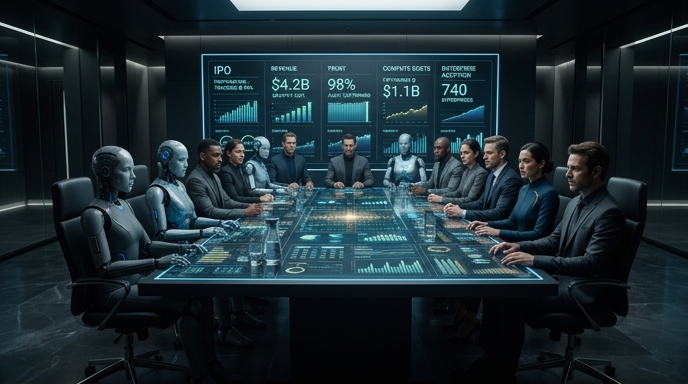
Anthropic’s draft S-1 does not guarantee an IPO. It does not set a share price. It does not answer every question. But it does draw a line in the sand.
The AI boom has spent years running on private capital, benchmark drama, product launches, and a thick fog of future promise. Anthropic is now edging toward a harsher arena. Public investors will want evidence. Enterprise buyers will want stability. Competitors will respond. Smaller AI vendors may feel the squeeze.
That makes this filing a market signal with teeth. If Anthropic succeeds, it could help define how public markets value frontier AI labs. If it stumbles, the entire sector may feel the wobble.
Either way, the grown-ups have entered the room. They brought calculators.
Sources
- AI News: “Anthropic IPO filing marks AI maturing into enterprise utility”
- The Decoder: “Claude maker Anthropic files for IPO with the SEC”
- HyperFRAME Research: “Anthropic IPO Filing Tests the Enterprise Value of AI Platforms”
- Futurum Group: “Will Anthropic’s Draft S-1 Ignite a New Phase in the AI Platform Race?”
- Anthropic: “Anthropic confidentially submits draft S-1 to the SEC”
- Anthropic: “Anthropic raises $65B in Series H funding at $965B post-money valuation”
The Kingy Brief
Get The Kingy Brief.
AI changes, original tests and one practical thing to try. Fridays at 09:00 Vancouver time.
Free · Double opt-in · Unsubscribe anytime
Sign up for The Kingy Brief on Beehiiv.
Signup help and newsletter schedule
Signup form provided by Beehiiv. After submitting, check your inbox for "Confirm your subscription to The Kingy Brief" and open its confirmation link. Check Spam or Promotions if you cannot find it.
Fridays at 09:00 Vancouver time: source-checked AI changes, original tests and one practical thing to try. We skip a week when there is not enough verified material. Free. Unsubscribe anytime.