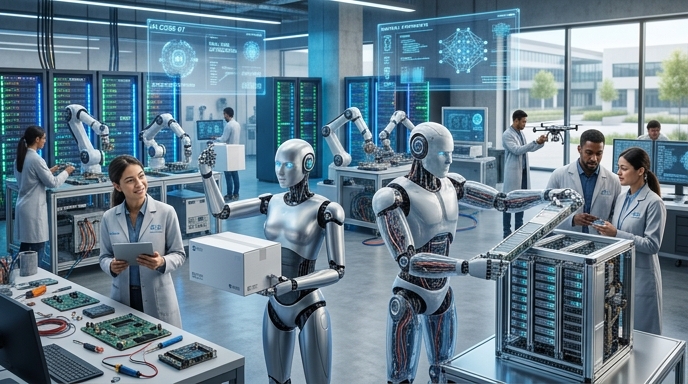
The Chatbot Era Just Grew Legs

For the last few years, Silicon Valley has been obsessed with making AI talk. Then it made AI write. Then code. Then draw. Then summarize your meeting so efficiently that you could almost forget the meeting happened.
Now the new mission is different.
AI is getting a body.
That is the big idea running through a fresh wave of reporting from Business Insider, The Decoder, The Economic Times, and DIGITIMES Asia. The shared message is blunt: the next AI race is not only about better apps, bigger models, or smarter chatbots. It is about machines that can move through the real world, handle tools, support workers, build infrastructure, and maybe one day tidy your kitchen without making the whole thing worse.
Silicon Valley has found its new slogan: let’s get physical.
That sounds like a gym poster. It is actually a strategy shift.
OpenAI Wants Back Into Robotics
OpenAI is now openly recruiting for its robotics ambitions. The company is looking for engineers across hardware, operations, systems, and machine learning, according to reports from The Decoder, The Economic Times, and DIGITIMES Asia.
That matters because OpenAI has been here before.
The company once worked on robotics, including its well-known robotic hand project that solved a Rubik’s Cube. But OpenAI shut down that robotics effort in 2020 as it focused more heavily on large language models. That pivot worked out rather well. You may have heard of ChatGPT. Tiny little product. Barely caused any commotion.
Now OpenAI appears to be returning to the physical world with a more practical opening move.
Sam Altman has framed the short-term goal as robots that help skilled workers build future infrastructure. The long-term vision is much bigger: personal robots that can help people with whatever they need.
That is an enormous jump. It is one thing to build a machine that helps in a controlled worksite. It is another to build Rosie from “The Jetsons,” minus the sitcom logic and plus a liability department sweating through its shirts.
Start With Infrastructure, Dream About the Home
The most interesting part of OpenAI’s robotics plan is the sequence.
It does not start with a cute home robot folding socks. It starts with infrastructure.
That is the sensible play. Homes are chaos machines. Every kitchen drawer is a philosophical insult to standardization. Factories, data centers, warehouses, and construction sites are still complicated, but they offer more structure. The tasks are clearer. The economics are easier to justify. The buyers are professional. The tolerance for expensive early versions is higher.
A robot that helps build infrastructure does not need to charm your grandmother. It needs to move parts, assist workers, collect data, avoid creating a disaster, and keep improving.
That is probably why OpenAI’s near-term pitch sounds industrial. Skilled workers are already stretched. AI infrastructure requires data centers, chips, power systems, cooling, networking, and physical buildouts. If robots can help assemble or maintain that world, they become part of the AI supply chain itself.
In plain English: AI may need robots to help build the physical world that future AI runs on.
That is a neat loop. Also a slightly ominous one. Silicon Valley does love a loop.
“Physical AI” Is the New Magic Phrase
The phrase now floating around the Valley is “physical AI.” It describes AI systems that do not just answer questions, but act in the physical world.
That distinction matters.
A chatbot can make a mistake and give you a bad restaurant recommendation. Annoying, but survivable. A robot can make a mistake and drop a box, break a tool, block a worker, or punt a coffee table into your shin. The stakes change when software gets arms.
That is why robotics is hard. It combines perception, planning, movement, hardware design, safety systems, real-time control, and a mountain of training data. Language models learned from the internet. Robots need to learn from reality, which is less searchable and far less forgiving.
Business Insider describes this as an arms race involving Nvidia, OpenAI, Meta, Tesla, and robotics startups. That sounds right. The AI world already knows how to compete on models. Now it wants bodies, sensors, hands, legs, and training environments.
The real question is not whether robots can perform impressive demos. They can. The harder question is whether they can work reliably when the demo table disappears and the real world starts throwing banana peels.
The real world is undefeated.
Nvidia Wants to Standardize the Robot Toolkit
Nvidia is one of the biggest players pushing this “physical AI” shift.
At Nvidia GTC Taipei, the company announced a standard humanoid robot blueprint for academic researchers, expected to become available in late 2026, according to Business Insider. The blueprint combines a robot body from Unitree, five-fingered hands, Nvidia onboard computing, and software tools.
That is not a small detail. Robotics has long suffered from fragmentation. Different labs and startups stitch together bodies, sensors, chips, software, simulation tools, and control systems. Everyone builds their own Frankenstein. Some are brilliant. Some look like they were assembled during a fire drill.
A more standardized platform could help researchers move faster. Instead of spending half the project wiring the creature together, they can focus on behavior, learning, safety, and useful tasks.
Nvidia CEO Jensen Huang has described humanoid robots as a major economic opportunity. That fits Nvidia’s broader position. The company already powers much of the AI boom through chips and software. If AI moves into machines, Nvidia wants to be the nervous system supplier.
The company sold shovels in the AI gold rush. Now it wants to sell the muscles too.
The Startup Race Is Getting Loud

Big Tech is not alone here. Startups are turning robotics into a spectacle.
Figure AI has drawn major attention with humanoid robots sorting packages. Business Insider reported that the company’s package-sorting videos attracted millions of viewers in May. It also reported that Figure signed a commercial agreement with Catalyst Brands, the parent company of JCPenney, Aéropostale, and Brooks Brothers, to deploy humanoids in distribution and logistics.
That is the kind of milestone robotics companies need.
A viral demo is nice. A commercial deployment is better. Robots have spent decades looking impressive on stage and less impressive in the messy middle of operations. Warehouses, distribution centers, and logistics networks are natural proving grounds because the tasks can be repeated, measured, and tied to business value.
Other players are also pushing forward. Business Insider notes that Agility Robotics has already deployed its Digit humanoid with customers including Amazon, GXO, Schaeffler, and Mercado Libre. Hyundai-owned Boston Dynamics is moving toward industrial use for Atlas, with Hyundai reportedly planning large-scale factory deployment by 2028.
The robotics race is not waiting for one perfect robot. It is splitting across many fronts: warehouses, factories, infrastructure, logistics, and eventually consumer spaces.
The home robot may get the headlines. The warehouse robot may arrive first.
Meta, Tesla, and the Big-Tech Pile-On
OpenAI is not entering a quiet room. It is walking into a crowded boxing gym.
Meta is strengthening its robotics efforts too. Business Insider reported that Meta acquired humanoid robotics startup Assured Robot Intelligence, whose team joined Meta’s AI unit, Superintelligence Labs. That tells us Meta sees robotics as part of the broader AI frontier, not as a side hobby.
Tesla remains the wild card. Elon Musk has repeatedly described Optimus as central to Tesla’s future. Business Insider reported that Musk said Tesla would probably sell Optimus robots to the public by the end of 2027 and that the robots were already performing simple tasks in Tesla factories.
That timeline deserves caution. Tesla timelines have a certain elastic quality. They stretch. Sometimes heroically.
Still, Tesla has several ingredients that matter: manufacturing experience, real-world AI work from vehicles, hardware supply chains, and a CEO who knows how to turn a prototype into a public obsession.
Then there is OpenAI, which brings frontier AI talent, agentic software ambitions, simulation research, and now renewed robotics hiring.
The field is packed. The prizes are huge. The hype will be nuclear.
Somebody should give the robots ear protection.
The Data Problem Nobody Can Dodge
Here is the boring problem that may decide everything: data.
Language models became powerful because the internet contains a vast amount of text, code, images, and video. Robotics does not have an equivalent open buffet. Robots need data about bodies interacting with the world. They need to understand force, friction, depth, grip, timing, balance, object variation, and failure.
A cup is not just a cup. It may be ceramic, plastic, empty, full, slippery, cracked, upside down, behind a cereal box, or sitting next to a toddler with suspicious intentions.
That is why OpenAI’s connection to world simulation research matters. The Decoder and The Economic Times both reported that the robotics division grew out of OpenAI’s world simulation research program led by Aditya Ramesh, known for his work on DALL-E.
Simulation could help robots train faster. Instead of learning only through slow physical trial and error, robots can practice in virtual worlds. But simulation has a famous problem: reality does not always match the model. A robot may look brilliant in simulation and then meet a loose cable, a reflective surface, or a chair leg and suddenly discover humility.
The companies that solve the data problem will gain a real advantage. The companies that fake it will make excellent blooper reels.
Why Personal Robots Are Still a Long Game
The phrase “personal robot” makes everyone’s imagination sprint. A home robot could clean, carry groceries, assist elderly people, help people with disabilities, cook, organize, fetch items, and handle boring chores.
That is the dream.
But the home is the final boss.
A personal robot has to work around pets, kids, clutter, stairs, glassware, laundry piles, wires, liquids, humans in bad moods, and homes designed by people who did not consult a robotics engineer. It also has to be affordable, safe, quiet, useful, repairable, and trusted.
That is a brutal product brief.
OpenAI’s long-term vision may be real, but it is not around the corner just because job postings exist. The Decoder correctly notes that Altman’s stated goal is likely many years away. The near-term work may focus more on infrastructure robots, embodied AI models, training data, and the foundations needed for general-purpose machines.
That is not a failure. That is how hard technologies usually arrive.
First they show up in industry. Then they get cheaper. Then they become boring. Then one day people act like it was obvious all along.
Electricity did this. Computers did this. Robots may try the same trick, though hopefully with fewer broken lamps.
The Money Is Charging In
The money has noticed.
Business Insider reported that venture capital investment in global robotics and physical AI grew from about $4 billion in 2019 to $26 billion in 2025, citing PitchBook data. It also reported that companies in the space have raised more than $23 billion so far this year.
Those are not hobby numbers.
The Economic Times also cited a Morgan Stanley estimate that the humanoid robotics market could exceed $5 trillion by 2050. Forecasts that far out should be handled with tongs, gloves, and a raised eyebrow. Still, they show how investors are thinking about the category. They are not imagining a few novelty machines waving at trade shows. They are imagining a massive labor, logistics, manufacturing, and consumer technology market.
The logic is simple. If AI stays inside screens, it can transform knowledge work. If AI enters machines, it can transform physical work too.
That is the bigger bet.
It is also the more dangerous bet for lazy storytelling. Not every robot demo means a revolution. Not every billion-dollar valuation means a business. Robotics has burned plenty of smart people before.
But this time the ingredients are stronger: better AI models, better chips, better simulation, better sensors, more capital, and clearer commercial demand.
That does not guarantee success. It does make the race real.
Hardware Is the New Flex
OpenAI’s robotics push also fits a broader hardware turn.
The Economic Times notes that OpenAI acquired Jony Ive’s hardware startup io Products for approximately $6.5 billion in May 2025, with consumer AI devices expected to follow. That deal sits beside OpenAI’s renewed robotics work as part of a larger pattern: AI companies no longer want to live only inside browsers and apps.
They want devices. They want interfaces. They want objects in the world.
That changes the culture of AI. Software teams can ship updates quickly. Hardware teams meet physics, supply chains, manufacturing tolerances, batteries, heat, parts, repairs, and unhappy customers holding a broken thing in their hands.
Hardware is humbling.
Robotics is even more humbling because the product must move. It must sense. It must touch. It must not be creepy. It must not fall over. It must do something useful often enough that people stop calling it a stunt.
DIGITIMES Asia’s visible summary says OpenAI is recruiting engineers across hardware, operations, systems, and machine learning to develop robots that perform useful physical-world tasks. That blend of roles matters. Robotics is not just AI with legs attached. It is systems engineering with ambition and bruises.
The future may be intelligent. It will also need screws.
The Takeaway: AI Wants a Body

The story here is not that everyone will soon have a robot butler. That would be a lazy reading.
The real story is sharper: AI companies are moving from language into action.
OpenAI is hiring for robotics again. Nvidia is pushing physical AI infrastructure. Meta is buying robotics talent. Tesla is promoting Optimus as a core future product. Startups like Figure and Agility are trying to turn humanoid robots from viral clips into commercial workers.
The first wave will probably look less like a domestic helper and more like a warehouse worker, factory assistant, infrastructure support machine, or logistics tool. That may sound less glamorous. It is also more plausible.
The personal robot dream is still there, glowing in the distance. But before AI folds your laundry, it may help build data centers, move boxes, sort goods, and assist workers in controlled environments.
That is how the robot future may arrive: not with a dramatic knock at your front door, but with a barcode scanner, a loading dock, and a machine learning engineer quietly muttering, “Please don’t drop it.”
Silicon Valley taught AI to talk.
Now it wants AI to lift.
Sources
- Business Insider — “Silicon Valley’s new slogan: Let’s get physical”
- The Decoder — “OpenAI starts with infrastructure robots but aims for everyone having a personal robot doing anything they need”
- The Economic Times — “OpenAI wants you to have a personal robot; starts hiring for robotics division”
- DIGITIMES Asia — “OpenAI expands robotics ambitions, recruiting engineers for hardware and AI development”
The Kingy Brief
Get The Kingy Brief.
AI changes, original tests and one practical thing to try. Fridays at 09:00 Vancouver time.
Free · Double opt-in · Unsubscribe anytime
Sign up for The Kingy Brief on Beehiiv.
Signup help and newsletter schedule
Signup form provided by Beehiiv. After submitting, check your inbox for "Confirm your subscription to The Kingy Brief" and open its confirmation link. Check Spam or Promotions if you cannot find it.
Fridays at 09:00 Vancouver time: source-checked AI changes, original tests and one practical thing to try. We skip a week when there is not enough verified material. Free. Unsubscribe anytime.