Kingy AI beginner course
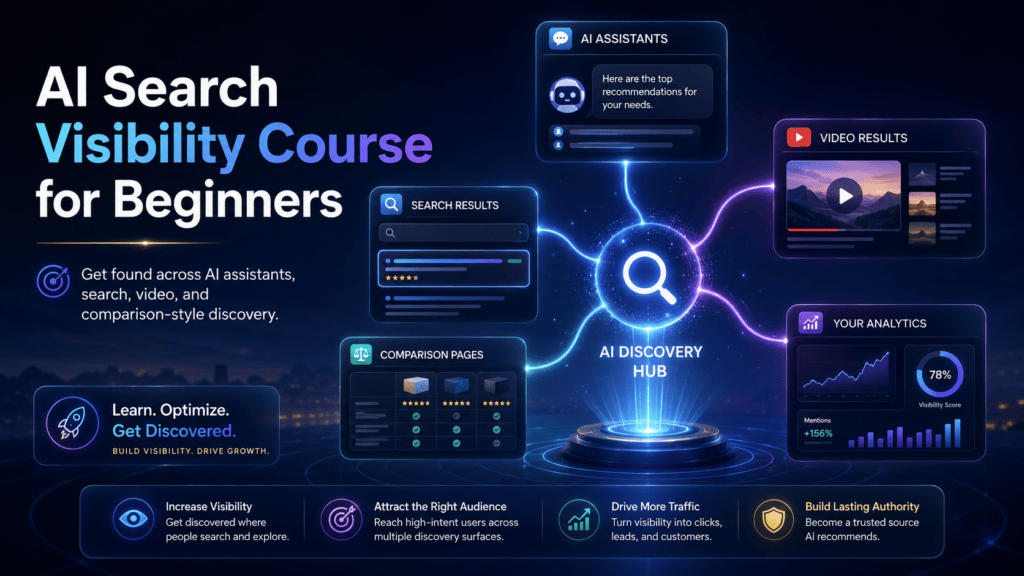
AI Search Visibility Course for Beginners
Learn how to make your product and content easier to understand, trust, and discover across ChatGPT, Perplexity, Gemini, Google AI Mode, AI Overviews, YouTube, and comparison-style search.
A free beginner course for AI founders, marketers, creators, and website owners who want to make their product easier to find, understand, trust, compare, and act on across Google, ChatGPT, Perplexity, Gemini, YouTube, and AI search.
Building this for an AI product? Use the scorecard first, then turn your result into a visibility plan.
Choose your path
Pick the route that matches what you need today. You can still use the full page, but this makes the first step obvious.
15-minute quick audit
Use this if you want a fast score and quick fixes for one product page, homepage, article, or channel.
Primary action: Run the AI Visibility Scorecard.
60-minute beginner course
Use this if you want to understand AI search visibility from the ground up before changing your site.
Primary action: Start Lesson 0.
Build a one-page visibility plan
Use this if you want a practical output for one product, site, article, or YouTube channel.
Primary action: Use the tools in order.
Trust and reality check
AI search visibility is not magic. It is the practical work of making your product, content, proof, and next steps easier for people and AI systems to understand.
Not a guaranteed ranking system
This course does not guarantee rankings, traffic, leads, AI citations, AI Overview inclusion, or recommendations from any AI tool.
SEO fundamentals still matter
Google’s public guidance says core SEO fundamentals remain relevant for generative AI features because these experiences rely on Search systems and accessible, useful content.
Make proof easier to parse
The goal is to clarify what you offer, who it helps, why it is credible, how it compares, and what a buyer or reader should do next.
This course is not for
Advanced technical SEOs looking for enterprise crawling architecture, people looking for AI ranking hacks, or anyone expecting guaranteed ChatGPT or Google AI citations.
AI Search Visibility vs SEO vs GEO vs AEO
These terms can sound bigger than they are. For beginners, the useful part is simple: make your pages clear, useful, structured, honest, and easy to evaluate.
SEO
Plain-English meaningHelping search engines and people understand, access, and trust your content.
Beginner takeawaySEO still matters. Clear pages, helpful content, crawlable structure, titles, headings, internal links, and useful examples are still important.
AEO
Plain-English meaningAnswer Engine Optimization. A term people use for making content easier for answer-style systems to summarize.
Beginner takeawayWrite clear answers to real questions. Do not write robotic content just for AI systems.
GEO
Plain-English meaningGenerative Engine Optimization. A term people use for improving visibility in generative AI search experiences.
Beginner takeawayMake your content specific, useful, structured, honest, and supported by proof.
AI search visibility
Plain-English meaningThe broader practical goal: being easier to understand, trust, cite, compare, and act on across search engines, AI answer systems, YouTube, comparison pages, and third-party sources.
Beginner takeawayDo the fundamentals well. Make the product clear, useful, evidenced, and easy to evaluate.
Google’s public guidance frames optimization for generative AI search as still connected to core search and SEO fundamentals. Do not present GEO or AEO as magic hacks.
What I see when AI companies launch products
Many AI products are not invisible because the product is bad. They are invisible because the page does not explain the category, audience, workflow, proof, demo, limitations, or next step clearly enough.
The product may be strong
But if the homepage sounds like every other AI tool, beginners and buyers cannot quickly place it in a category.
The workflow may be missing
People often need to see the input, process, output, and handoff before the value becomes obvious.
The proof may be too vague
Specific examples, screenshots, demos, limitations, source notes, and fair comparisons usually beat broad claims.
Before and after examples
These examples show how to move from vague hype to specific, useful copy. Use the pattern, then swap in your own audience, category, problem, proof, and outcome.
Vague homepage headline
“The future of AI productivity is here.”
“An AI scheduling assistant for solo consultants that turns messy email threads into booked meetings.”
It names the category, audience, problem, and outcome.
[Category] for [audience] that turns [messy problem] into [clear outcome].
Weak product description
“Our platform uses cutting-edge AI to transform work.”
“AcmeFlow is an AI workflow tool for small SaaS teams that turns customer requests into prioritized support tasks.”
It replaces vague claims with a named product, category, audience, input, and output.
[Product] is a [category] for [audience] that turns [input/problem] into [specific output].
Weak comparison page
“Why we are better than every alternative.”
“AcmeFlow vs manual support triage: which workflow fits a small SaaS team?”
It frames a fair decision instead of making a broad superiority claim.
[Product] vs [alternative]: which [workflow/tool/category] fits [specific audience]?
Weak FAQ
“Why choose us?”
“What type of team is AcmeFlow best for?”
It answers a real buyer-fit question instead of asking the reader to accept a sales claim.
Turn vague sales questions into specific fit, cost, risk, proof, or next-step questions.
Weak YouTube demo
“This AI tool is insane.”
“How a 5-person SaaS team can use AcmeFlow to organize customer requests in 10 minutes.”
It names the audience, product, use case, and time-bound demo angle.
How [specific audience] can use [product] to [specific task] in [demo timeframe].
What you will build
Your final project is a one-page AI search visibility plan. It is simple enough to make in one sitting and practical enough to guide a real content sprint.
One-page visibility plan
A single, useful plan for improving one product page, homepage, article, YouTube channel, or launch asset.
Entity clarity statement
A short statement that explains what you are, who you help, and what category you belong in.
Content gap list
A prioritized list of missing proof, explanations, comparisons, FAQs, and buyer questions.
Comparison page idea
A fair comparison angle that helps buyers understand alternatives without fake takedowns.
FAQ set
A beginner-friendly FAQ written from the questions real buyers, readers, and AI tools need answered.
YouTube discovery angle
A video or creator-led education idea that makes the product easier to see, understand, and share.
7-day action plan
A practical sprint that turns the course into one week of visible improvements.
Example final output
For a fictional AI meeting-notes tool, your final plan might include:
Entity statement
“An AI meeting-notes tool for small sales teams that turns Zoom calls into CRM-ready summaries.”
Content gap
Pricing clarity, integrations, example transcript, and a comparison with manual note-taking.
Comparison page
“AI meeting notes vs manual sales call notes.”
YouTube angle
“How a 5-person sales team can turn calls into CRM updates in 10 minutes.”
Lessons
The lessons are short, practical, and built for beginners. Each one gives you a clear move you can make on a real asset.
What is AI search visibility?
- Plain-English explanation
- AI search visibility means your product, website, article, or channel is understandable and trustworthy across search engines, AI answer systems, YouTube, comparison pages, and third-party mentions.
- Why it matters
- People may learn about you before they land on your site. Clear public information gives humans and AI tools better material to summarize, compare, and recommend accurately.
- Beginner mistake to avoid
- Do not treat visibility as a trick. A vague page with a few AI keywords is still vague.
- Practical example
- Instead of saying “the future of productivity,” say “an AI scheduling assistant for solo consultants that turns email threads into booked meetings.”
- Small action step
- Choose one important page and write a two-sentence description of what it is, who it helps, and why someone should trust it.
- Check yourself
- Could a stranger explain your offer correctly after reading only the first screen?
How AI search changes discovery
- Plain-English explanation
- AI-style search often starts with longer, more specific, comparison-oriented, planning-style questions, then continues with follow-up questions.
- Why it matters
- Your content needs to answer how people actually decide: what to use, when to use it, how it compares, what it costs, and what happens next.
- Beginner mistake to avoid
- Do not build every page around one short keyword. Short keywords miss the real buyer conversation.
- Practical example
- A buyer may ask, “What is the best AI support tool for a five-person SaaS team using Slack and Intercom?” not just “AI support tool.”
- Small action step
- Write five realistic questions your buyer would ask before choosing your product.
- Check yourself
- Does your page answer a real decision question, or only describe features?
How to make your product easier to understand
- Plain-English explanation
- Entity clarity means your product or site clearly answers: what is it, who is it for, what category is it in, what problem does it solve, what makes it different, and what proof supports it?
- Why it matters
- If your category and audience are unclear, people and AI systems can place you in the wrong bucket or skip you entirely.
- Beginner mistake to avoid
- Do not lead with a clever tagline before explaining the actual thing.
- Practical example
- “AcmeFlow is an AI onboarding tool for B2B SaaS teams that turns product docs into guided customer checklists, backed by live customer onboarding examples.”
- Small action step
- Fill in this sentence: “[Name] is a [category] for [audience] that helps with [problem] by [difference/proof].”
- Check yourself
- Could your homepage answer all six entity questions without someone clicking around?
Technical visibility basics for AI search
- Plain-English explanation
- Your important pages should be indexable, fast enough to use, written in readable text, and supported by clear URLs, page titles, meta descriptions, headings, and internal links.
- Why it matters
- If a search engine cannot access or understand the page, stronger copy and better proof may never get seen.
- Beginner mistake to avoid
- Do not hide core explanations behind broken scripts, images with no supporting text, popups, or tabs that fail to load.
- Practical example
- A useful product page has a clear URL like /ai-meeting-notes/, a title that names the product category, a readable summary, and links to pricing, demos, FAQs, and use cases.
- Small action step
- Open your top page in a private browser window and check whether the main offer, proof, and CTA load quickly without logging in.
- Check yourself
- Can a visitor understand the page if every fancy animation or script fails?
How to create AI-citable content
- Plain-English explanation
- AI-citable content gives people and AI tools clean material to quote or summarize: definitions, use cases, comparison tables, FAQs, original examples, limitations, pricing summaries when appropriate, first-hand experience, and dated source notes.
- Why it matters
- Clear, specific sections reduce the chance that your product is misunderstood or flattened into generic wording.
- Beginner mistake to avoid
- Do not make broad claims like “best AI tool” without explaining who it is best for, why, and what evidence supports that.
- Practical example
- Add a short section called “When this tool is a good fit” and another called “When this tool is not the right fit.”
- Small action step
- Add one definition, one use case, one limitation, and one real example to your most important page.
- Check yourself
- If someone quoted one paragraph from your page, would it be accurate and useful?
How to plan comparison and alternatives pages
- Plain-English explanation
- People search for “best tools for X,” “X vs Y,” “alternatives to X,” “should I use X,” “is X worth it,” and “how does X compare to Y” because they are trying to make a decision.
- Why it matters
- Comparison pages meet buyers near the bottom of the decision process, where clarity and honesty matter more than slogans.
- Beginner mistake to avoid
- Do not publish a fake comparison that only praises you and insults competitors. It feels thin and untrustworthy.
- Practical example
- A useful “Product A vs Product B” page compares audience fit, workflows, integrations, pricing logic, support needs, strengths, and limitations.
- Small action step
- Pick one alternative your buyers already mention and draft a fair comparison outline.
- Check yourself
- Would your comparison still help someone if they decided not to buy from you?
How YouTube helps AI product discovery
- Plain-English explanation
- Videos help when a homepage is not enough. A buyer can watch the product work, hear the use case, see the interface, and understand the value faster.
- Why it matters
- Creator-led discovery can turn a complex AI product into a clear demonstration that supports product education, search visibility, demo quality, and buyer confidence.
- Beginner mistake to avoid
- Do not make a vague hype video. Show the actual problem, the actual workflow, and the actual result.
- Practical example
- A strong Kingy AI-style video explains the product in plain language, shows the workflow on screen, names the ideal buyer, covers limitations, and links to useful next steps.
- Small action step
- Write one demo title: “How [audience] can use [product] to [specific outcome].”
- Check yourself
- Would a viewer understand the product after watching two minutes of your demo?
Why YouTube matters for AI product discovery
Many AI products are hard to understand from a homepage alone. A useful video can show the workflow, interface, before-and-after state, limitations, and ideal user in a way text often cannot.
- YouTube search can capture people looking for tutorials, reviews, comparisons, walkthroughs, and “is it worth it?” questions.
- A strong video can support product education, search visibility, demo quality, and buyer confidence.
- This does not guarantee sales, rankings, AI citations, or recommendations from any platform.
Product demo checklist
- Show the problem first.
- Name the audience.
- Show the interface.
- Complete one real workflow.
- Explain where the tool is strong.
- Explain where it is not a fit.
- Mention pricing or buying clarity when appropriate.
- Include source and product links.
- Include chapters.
- Include a pinned comment CTA.
- Pair the video with a written article or FAQ page.
How third-party proof supports AI search visibility
- Plain-English explanation
- Third-party proof is what other people and credible sources say or show about you: reviews, demos, customer stories, creator videos, Reddit or community mentions, founder pages, product pages, documentation, and case studies.
- Why it matters
- Buyers trust you more when your claims are supported outside your own homepage. AI systems may also encounter those signals when summarizing the market.
- Beginner mistake to avoid
- Do not invent proof or cherry-pick vague praise. Weak proof can hurt trust.
- Practical example
- A stronger product page links to docs, a real demo, client examples, a founder bio, review pages, and a specific customer story.
- Small action step
- Make a proof inventory with three columns: proof you have, proof you need, and where it should be linked.
- Check yourself
- If a buyer asked “who else says this works?”, what would you show them?
How to measure AI search visibility
- Plain-English explanation
- AI search measurement is directional. There is no perfect single metric, so track branded search, organic impressions and clicks, referral traffic, YouTube discovery, demo quality, repeated prospect questions, and manual AI answer checks.
- Why it matters
- No single report tells the whole story. A page or video may help a buyer understand you long before it gets credit for a conversion.
- Beginner mistake to avoid
- Do not treat AI citation checks as a perfect metric. Use them as a manual directional signal, not proof of success or failure.
- Practical example
- If branded searches rise, YouTube demo traffic improves, and sales calls ask better questions, your visibility work may be helping even before rankings are obvious.
- Small action step
- Create a simple monthly log with five prompts, your current search metrics, top traffic sources, and the most common buyer questions.
- Check yourself
- Are you measuring signals that match how buyers actually discover and evaluate you?
7-day AI search visibility sprint
- Plain-English explanation
- A 7-day sprint gives beginners a simple path: Day 1 clarify entity, Day 2 fix homepage or product page clarity, Day 3 write an FAQ section, Day 4 create one comparison or alternatives page, Day 5 create one use-case page, Day 6 create one YouTube demo angle, and Day 7 measure and improve.
- Why it matters
- A focused week turns AI visibility from a fuzzy idea into published improvements people can actually use.
- Beginner mistake to avoid
- Do not try to fix the whole website at once. Pick one important asset and make it genuinely clearer.
- Practical example
- A founder can spend one week improving the homepage, adding five FAQs, drafting a comparison page, outlining a use-case page, and planning a short product demo video.
- Small action step
- Choose the page most likely to influence a buyer, then schedule the seven sprint tasks on your calendar.
- Check yourself
- At the end of seven days, is your best page clearer, more useful, and easier to trust than it was on Day 1?
Simple monthly measurement worksheet
Use this once a month to track direction, not perfection. AI search visibility does not have one universal score, so look for a pattern across search, referrals, YouTube, buyer quality, and shipped improvements.
1. Branded search
Look for signs that more people are searching for the brand or product by name.
2. Organic search
Review whether useful pages are starting to get more search visibility.
3. Referral traffic
Check whether other places on the web are helping people discover you.
4. YouTube discovery
Track whether video is helping people understand the product before they visit or book a demo.
5. Buyer quality
Visibility work should make buyers more informed, not just create more raw visits.
6. Manual AI answer checks
Use the same small prompt set each month. Treat results as directional only, not a perfect ranking report.
7. Content improvements shipped
Track what you actually improved. Published work is the part you control.
What to look for
A good month is not always a dramatic spike. Look for clearer pages, better buyer questions, more useful referrals, stronger demos, and fewer repeated explanations on sales calls.
This worksheet stays local in the page. It does not send data anywhere, call an API, or track the user.
What not to do for AI search visibility
AI search visibility works best when the page becomes clearer and more trustworthy. These shortcuts usually make the page weaker.
Do not publish fake comparison pages
A comparison page should help the buyer make a fair decision, not pretend every competitor is bad.
Do not invent proof
Do not invent citations, customers, reviews, benchmarks, or proof. Missing proof should be marked as missing. Trust is more important than looking impressive.
Do not create thin keyword pages
A pile of weak keyword-variant pages is not the same as useful coverage. Focus on pages that answer real buyer questions.
Do not claim guaranteed AI citations
No one controls whether ChatGPT, Perplexity, Gemini, Google AI Mode, AI Overviews, or YouTube recommends or cites a page.
Do not hide the main explanation
Do not bury important content behind broken scripts, images, popups, or tabs. Important content should be readable as normal page text.
Do not write only for AI systems
The page should be useful to a human buyer, reader, or viewer first.
Do not ignore visual proof
For visual AI products, people often need video, screenshots, and demos to see the workflow before they understand the value.
The safest path is simple: be clear, useful, specific, honest, structured, and supported by proof.
Interactive tools area
Use these lightweight tools to build your final plan. Everything runs in your browser, uses vanilla JavaScript, and does not send your data anywhere.
AI Visibility Scorecard
Score one website or product page against the basics that make it easier to understand, trust, compare, and act on.
Entity Clarity Builder
Turn a vague product description into a polished statement you can use on your homepage, profile pages, and video scripts.
AI Search Query Map
Map the questions people may ask AI tools, search engines, YouTube, and comparison pages.
Content Brief Generator
Build a practical brief for one page, article, or video support page.
Comparison Page Planner
Plan a fair comparison or alternatives page.
FAQ Builder
Generate questions that help humans and AI tools understand the basics.
YouTube Discovery Planner
Create a practical video angle that helps people see the workflow, understand the fit, and know what to do next.
7-Day Sprint Checklist
Turn the course into one week of focused action.
Progress: 0%
Final Plan Export
Export a one-page plan using the outputs you generated above.
Copy-Paste Prompt Pack
These prompts are designed to be copied into ChatGPT, Codex, Claude, Gemini, or another AI assistant. They ask the AI to avoid invented facts, flag uncertainty, and stay practical.
AI Search Visibility Audit Prompt Who should use it: Founders, marketers, creators, and website owners who want a plain-English audit of one website, product page, article, or channel. What it produces: A prioritized audit of AI search visibility weaknesses, missing proof, unclear positioning, content gaps, and next steps.
Entity Clarity Prompt Who should use it: Anyone whose homepage, product page, About page, or channel description feels vague or hard to categorize. What it produces: A clear entity statement, headline options, category wording, differentiator language, and proof gaps.
Homepage Rewrite Prompt Who should use it: Website owners, AI founders, SaaS marketers, and creators who need a clearer homepage or product page. What it produces: A clearer page structure with hero copy, section headings, proof placeholders, FAQ ideas, internal links, and CTA improvements.
FAQ Expansion Prompt Who should use it: Beginners who need useful FAQ content for a homepage, product page, article, course page, or YouTube description. What it produces: A practical FAQ set covering beginner, buying, comparison, risk, objection, and next-step questions.
Comparison Page Prompt Who should use it: Product marketers, founders, and SEO beginners creating a fair “X vs Y” or “alternatives to X” page. What it produces: A comparison page outline with search angles, fair pros and cons, table fields, FAQs, proof needs, and a CTA.
YouTube Demo Angle Prompt Who should use it: AI companies, creators, and marketers who need a product demo angle that makes the product easier to understand. What it produces: Video title ideas, hook, demo structure, chapter outline, objection handling, pinned comment, and description copy.
Source and Proof Check Prompt Who should use it: Anyone who wants to make a page more trustworthy before publishing or refreshing it. What it produces: A proof gap review covering examples, dates, limitations, source notes, claims, and trust signals.
7-Day AI Visibility Sprint Prompt Who should use it: Busy founders, marketers, creators, and non-technical site owners who need a one-week action plan. What it produces: A practical seven-day sprint for improving entity clarity, homepage clarity, FAQs, comparison content, use cases, YouTube discovery, and measurement.
AI search visibility course FAQ
Quick answers for beginners deciding how to use the course.
Is this course free? Short answer: Yes. The lessons, tools, worksheets, and prompts on this page are free to use.
You do not need an account, API key, database, or technical setup. Everything runs locally in your browser inside this page.
Do I need technical SEO experience? Short answer: No. This course is written for founders, marketers, creators, and non-technical website owners.
You will see a few SEO terms, but the course explains them in plain English and focuses on practical clarity: what the product is, who it helps, how it works, what proof supports it, and what the next step should be.
Is AI search visibility the same as SEO? Short answer: No. SEO is part of it, but AI search visibility is broader.
SEO helps search engines and people access, understand, and trust your content. AI search visibility also includes entity clarity, comparison usefulness, FAQs, YouTube discovery, third-party proof, and making your product easy to evaluate across multiple discovery paths.
Does this guarantee AI citations? Short answer: No. No course can guarantee ChatGPT, Perplexity, Gemini, Google AI Mode, AI Overviews, or YouTube visibility.
The course helps you improve clarity, usefulness, structure, evidence, and buyer confidence. Those are worthwhile fundamentals, but platforms decide what they show, cite, recommend, or rank.
How long does the course take? Short answer: The quick audit takes about 15 minutes. The beginner course can be read in about an hour.
The 7-day sprint is for implementation. You can move faster or slower depending on how much content, proof, video, and website access you already have.
What should I do first? Short answer: Run the AI Visibility Scorecard, then build an entity clarity statement.
If you only have a short session, use the scorecard first. If you want a complete asset, use the tools in order and export the final one-page visibility plan.
Related AI search visibility resources from Kingy AI
Use these Kingy AI resources to keep learning, score your site, estimate video distribution value, and explore related beginner courses for AI builders and marketers.
Want your AI product explained to a large AI-native audience?
Kingy AI helps AI companies turn complex products into clear, useful YouTube videos that drive awareness, product understanding, demos, clicks, and search visibility.
Sources and accuracy note
This course is educational. It does not guarantee traffic, rankings, AI citations, AI Overview inclusion, Google AI Mode visibility, YouTube reach, leads, or revenue. AI search systems change over time, and users should verify important claims against official sources, platform documentation, and their own analytics before making business decisions.
- Google Search Central: Optimizing your website for generative AI features on Google Search
- Google Search Central: AI features and your website
- Google Blog: How AI Mode is changing and expanding the way people search
Last updated: May 28, 2026.
No-guarantee disclaimer
The practical goal is better clarity, structure, evidence, internal linking, comparison usefulness, and buyer confidence. Those improvements can support discoverability, but no course can control how search engines, AI answer systems, YouTube, or buyers respond.
A 30-day AI search visibility operating cadence
The beginner sprint above gets the first improvements shipped. Use this longer cadence when the source-of-truth work spans several pages, media assets, and external proof. It is a maintenance system, not a promise of citations or rankings.
- Days 1–7: make the entity unambiguous. Reconcile the company, product, category, pricing, official URL, and audience across the homepage, product page, profiles, and structured data.
- Days 8–14: make claims sourceable. Put important capabilities, limits, version details, pricing, and verification dates in clear page sections that can be quoted without losing context.
- Days 15–21: add inspectable proof. Publish a dated demo, methodology, screenshots, test conditions, and corrections. Separate vendor claims, third-party evidence, Kingy tests, and inference.
- Days 22–30: connect and measure. Repair internal links, earn legitimate third-party references, check branded and non-branded discovery, and record what changed. Repeat only the work that produced a measurable gain.
The six-layer check
Review technical access, entity clarity, sourceable content, third-party proof, demo/media visibility, and measurement. Schema can reinforce an already clear page; it cannot rescue vague positioning, unsupported claims, or hidden pricing.
The Kingy Brief
Get The Kingy Brief.
AI changes, original tests and one practical thing to try. Fridays at 09:00 Vancouver time.
Free · Double opt-in · Unsubscribe anytime
Signup help and newsletter schedule
Signup form provided by Beehiiv. After submitting, check your inbox for "Confirm your subscription to The Kingy Brief" and open its confirmation link. Check Spam or Promotions if you cannot find it.
Fridays at 09:00 Vancouver time: source-checked AI changes, original tests and one practical thing to try. The weekly restart begins October 9, 2026. We skip a week when there is not enough verified material. Free. Unsubscribe anytime.