There is a quiet rewrite happening inside the way work gets done. It is not the headline version, where a model “replaces” a job. It is something stranger and more interesting: jobs are being decomposed into many smaller units of execution, and those units are being routed between humans and software agents that can plan, retrieve, act, and self-check.
Once you see it, you see it everywhere. A support team that used to handle every ticket end-to-end now triages, supervises, and intervenes. An engineering team that wrote everything by hand now reviews machine-generated changes against a battery of evaluations. A finance team that manually reconciled invoices now defines policy, then audits exceptions.
The scarce resource is no longer raw execution. It is coordination capacity — the ability to clarify a goal, partition the work, choose the right human-agent mix, control quality, manage exceptions, and govern risk. That is the practical meaning of the phrase that has started circulating among operators: the shift from doing the work to managing swarms of work.
This guide is a practical map of that shift. It is opinionated where the evidence supports an opinion, careful where it does not, and links throughout to the primary sources so you can verify and go deeper. There are no magic numbers here. There is, however, a recognizable pattern.
1. What “AI-native work” actually means
It is tempting to define AI-native work as “an organization that uses AI a lot.” That is not quite right. A team can use ChatGPT every day and still be doing 1995 work with a 2026 keyboard.
A better definition comes from how the major providers describe agents in their own production documentation. OpenAI’s practical guide to building agents defines agents as systems that independently accomplish tasks on a user’s behalf, using a language model to manage workflow execution and tools to interact with external systems under explicit instructions and guardrails. Anthropic, in its widely cited essay on building effective agents, draws a useful boundary: a workflow is a system where code determines the path; an agent is a system where the model dynamically decides how to proceed. LangChain’s LangGraph documentation draws the same line.
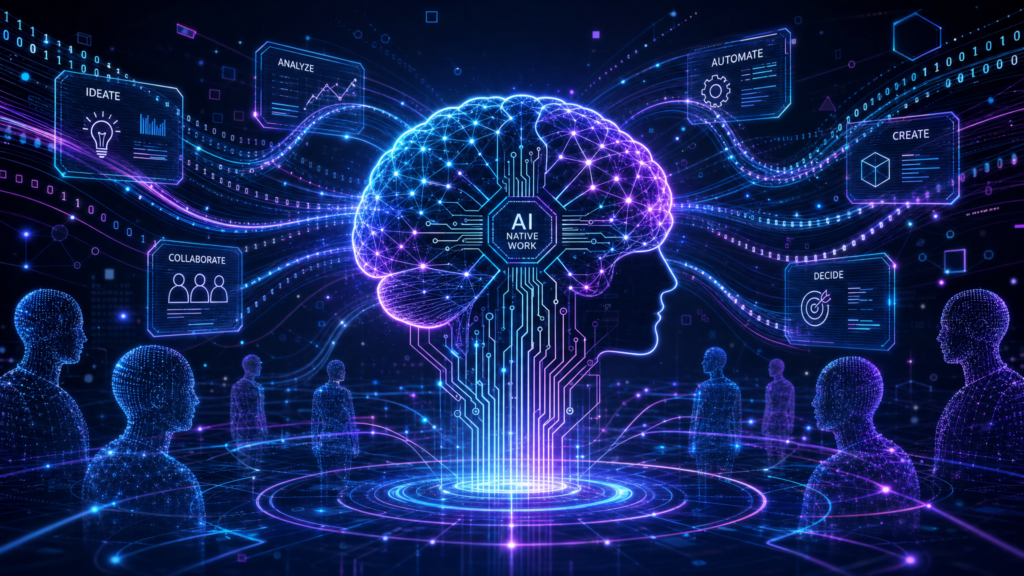
Put together, you can define AI-native work as: work designed so that parts of planning, retrieval, tool use, drafting, routing, execution, and evaluation can be delegated to model-driven systems, with humans supervising outcomes rather than manually performing every intermediate step.
That definition implies a recognizable set of traits. AI-native work is:
- Stateful, because real work has memory, resumability, and handoffs across long-running tasks.
- Tool-mediated, because work touches files, search, databases, APIs, code execution, and enterprise systems.
- Context-engineered, because performance depends on getting the right policies, knowledge, and history into the workflow.
- Evaluation-driven, because non-deterministic systems cannot be assumed correct; they must be measured continuously.
- Governed, because anything that touches sensitive data or takes real action needs role-based access, traceability, and escalation rules.
You can see those five traits reflected across nearly every serious production stack right now — from Microsoft’s Agent Framework to CrewAI to observability platforms like LangSmith, Phoenix, W&B Weave, and MLflow’s GenAI tools. The pattern is no longer about “good prompts.” It is about a measurable, observable, governable system.
2. The anatomy of (AI) swarm-managed work
“Managing swarms of work” sounds dramatic, but the underlying patterns are mundane and well-documented. A swarm is just many concurrent sub-tasks — often generated dynamically — running across humans and agents.
OpenAI’s guide describes two broad orchestration shapes. The first is a manager pattern, where one central agent coordinates specialists through tool calls. The second is a decentralized handoff pattern, where agents transfer control among peers. Anthropic’s building effective agents post catalogs the related building blocks: prompt chaining, routing, parallelization, orchestrator-workers, and evaluator-optimizer loops.
These patterns are spreading because the management problem is now about which pattern fits which workflow. A production guide from Lushbinary summarizes four production-tested patterns that recur across teams:
- Supervisor — a single orchestrator decomposes work, delegates to specialists, and synthesizes the result. Strongest for compliance-heavy workflows where you want a clean audit trail. The risk is that the supervisor itself becomes a bottleneck or a single point of failure.
- Router — a lightweight classifier inspects each request and sends it directly to the appropriate specialist. Strongest for high-volume, mixed-workload systems like support. The risk is misclassification.
- Pipeline — agents are chained in a fixed sequence (extract, transform, validate, publish). Easy to debug. The risk is that a failure mid-chain stalls everything downstream.
- Swarm — agents work in parallel with no central controller, claiming work from a shared queue. Strongest for raw throughput on parallelizable tasks. The risk is that debugging gets harder and costs spike if guardrails are weak.
Most real systems are hybrids: a router at the edge, a supervisor in the middle, a pipeline of evaluators along the side. The job of the operator is to know which shape fits, where humans stay in the loop, and how to bound cost, latency, and drift.
The control system underneath all of this is no longer a final proofreading step. It is layered. OpenAI’s guidance on agent evals urges teams to capture traces, build datasets, write graders, and run repeated eval runs as the spine of the workflow. The same pattern appears in Microsoft Foundry, OpenAI Evals, DeepEval, and Ragas.
Anthropic’s measuring agent autonomy research adds a subtle but important nuance from real users: as people get more comfortable, they auto-approve more and they interrupt more. Mature oversight shifts from approving every move to maintaining enough visibility to intervene when it matters. That is the cultural shift underneath swarm management — from micro-approval to informed supervisory control.
3. What the evidence actually says about productivity
This is the section where most articles overreach. So let’s be careful.
The evidence on AI productivity is real, but it is heterogeneous by task, role, and skill level. The studies that look most defensible are:
- In customer support, a randomized study summarized in NBER working paper 31161 found that a generative AI assistant increased throughput about 14% on average — and roughly 34% for novice or lower-skill workers, with minimal gains for the most experienced.
- In writing tasks, controlled experiments showed ChatGPT reduced completion time about 40% while improving quality by about 18%.
- In software development, a Microsoft Research study on GitHub Copilot found participants completed a specific task 55.8% faster. Later randomized field experiments across Microsoft, Accenture, and a Fortune 100 company showed gains, but more recent commentary has noted that less experienced developers may capture smaller gains than experienced peers in some real-world settings.
- In knowledge work, the well-known “jagged frontier” study found that consultants improved on tasks inside the model’s frontier but became less reliable on a complex task outside it.
The practical conclusion from these is not “AI makes everyone 30% better.” It is messier: expect task reallocation, skill compression in some areas, and skill amplification in others. The same model can boost a novice’s output and bore an expert. The same workflow can be transformed in one part and unaffected in another.
That is the right mental model when you read the more bullish enterprise reports. Microsoft’s 2025 Work Trend Index reports that 81% of leaders expect agents to be moderately or extensively integrated into AI strategy within 12 to 18 months, and the 2026 follow-up on agents and human agency shows leaders moving from AI as assistant toward agents as digital colleagues. OpenAI’s State of Enterprise AI report shows that depth of use — configurable GPTs, Projects, advanced tools, broad task coverage — correlates with larger time savings, while “frontier users” pull away from the median by using AI much more intensively.
Stanford’s AI Index tracks the model-capability side of this story — rapid gains on reasoning and software benchmarks — while also warning, in its 2026 technical chapter, that benchmark reliability and real-world evaluation lag the pace of model improvement. The right read of all this evidence together is not triumphalism. It is: the direction is clear, the magnitude varies, and the organizations that measure their own workflows will know more about their own ROI than any vendor report can tell them.
4. The new skill stack: technical, managerial, epistemic
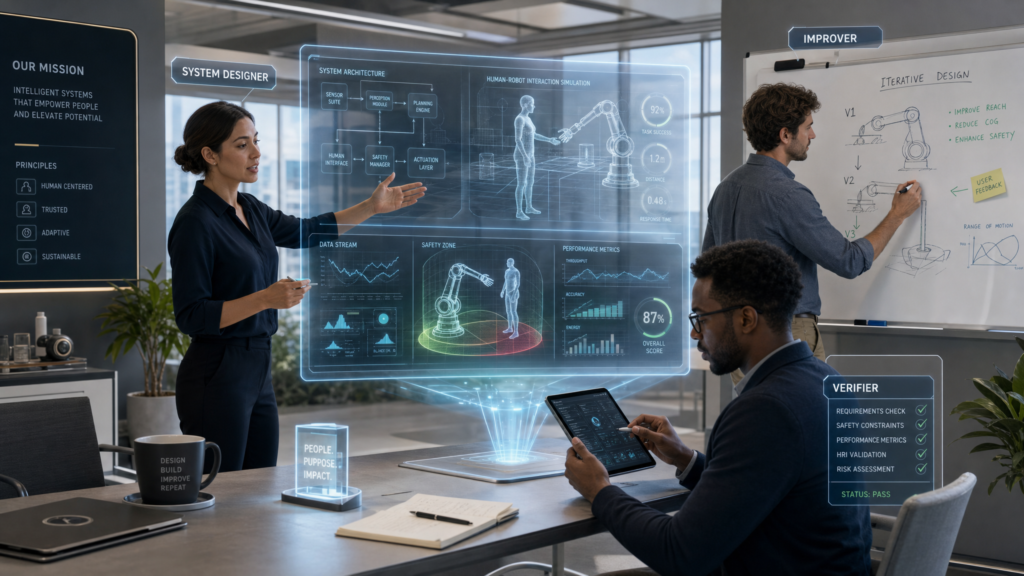
The winning individual profile is shifting from “person who can personally execute every step” toward “person who can design, verify, and improve reliable human-agent systems.”
That sounds abstract. In practice, it lands as three braided skill stacks.
The technical core. Tool and API literacy. Context engineering. Prompt and instruction design (still useful, just demoted from artisanal craft to one tool in a larger kit). Retrieval techniques. Evaluators. Trace inspection. Identity and access basics. The current frameworks — LangGraph, CrewAI, LlamaIndex, Haystack, Pinecone for RAG, and the Model Context Protocol for interoperability — all assume that you can think in terms of stateful, multi-step, tool-using systems rather than prompt-response wrappers.
The managerial core. Workflow decomposition. Service-level thinking. Exception-handling design. ROI modeling that includes the full system, not just token costs. The new managerial skill is being able to look at a tangled human process and see where to slice it: which steps are pure retrieval, which are reasoning, which are policy decisions, which are relationship-bearing communication, which are irreducibly human judgment.
The epistemic core. This is the least talked about and probably the most important. It is skepticism, evidence-seeking, calibration, and the willingness to stop or escalate when the system is uncertain. As Anthropic’s autonomy work and frameworks like NIST’s AI Risk Management Framework make clear, the high-value worker is no longer just an executor or even just a user. They are a reliable supervisor of reliability.
For different career stages, the strategic moves differ:
- Mid-career professionals. The largest risk is not age. It is being anchored to a credential or routine that can be partially compressed. The hedge is to become the person who can translate domain knowledge into governed workflows, reusable prompts, policies, evaluators, and institutional memory. Your domain context is the moat. Pair it with new fluency.
- Career changers. AI lowers some entry barriers by compressing prerequisite syntax and reference knowledge. But the durable advantage still comes from combining new technical fluency with prior domain context. The credentialed pathway is loosening; the demonstrated-skill pathway is hardening.
- CS students. The strategic mistake is to believe AI makes fundamentals irrelevant. The opposite is closer to true. The more generation becomes cheap, the more value accrues to people who can debug, reason about systems, evaluate tradeoffs, and secure workflows.
- Future students. Expect a curricular shift away from “memorize APIs in isolation” toward systems design, evaluation, data governance, HCI, and collaboration with agents. The World Economic Forum’s 2026 briefing on entry-level work confirms what early-career workers already sense: routine entry-level tasks are being automated, while early-career roles are moving toward judgment and creativity. Optimism and anxiety coexist for a reason.
For learning paths, the best sequence — across vendor materials and independent courses — looks roughly like: AI literacy → prompting and context fundamentals → workflow decomposition → tool use and RAG → evaluation and observability → governance and security → domain-specific implementation. Useful entry points include Microsoft Learn’s generative AI fundamentals, DeepLearning.AI’s Agentic AI course, AI Agents in LangGraph, Multi AI Agent Systems with crewAI, Anthropic’s build-with-Claude materials, and the OpenAI Academy. For more business-leaning learners, AWS Certified AI Practitioner and Google Cloud Generative AI Leader are reasonable on-ramps.
What works is not collecting badges. It is mapping each piece of learning to a real transition: from user to builder, from builder to operator, from operator to designer of an operating model.

5. The tooling landscape, without the hype
The tooling stack is converging. It is not stable yet, and there is no winner-take-all platform. But the shape is clear.
At the orchestration layer, you choose between a managed vendor stack (OpenAI’s Responses API plus Agents SDK; Microsoft’s Agent Framework, which Microsoft itself now positions as the successor to AutoGen and Semantic Kernel) and an open-source graph framework like LangGraph or a role-based framework like CrewAI. The trade-off is the usual one: integrated convenience versus flexibility and portability.
At the interoperability layer, the Model Context Protocol has gone from one vendor’s idea to a de facto industry standard. It matters because it reduces the cost of connecting models to tools across vendors. Independent analysis by FifthRow notes that MCP plus the Agent-to-Agent protocol now form a two-layer backbone of risk-managed agentic ecosystems in 2026 — though they also flag that “open protocols can abstract, rather than remove, critical orchestration risks.”
At the knowledge and retrieval layer, LlamaIndex is strong for document-heavy workflows, Haystack for cloud-portable pipelines, and Pinecone for managed vector infrastructure.
At the observability and evaluation layer, you have a real choice now. LangSmith is strongest when you’re already in the LangChain ecosystem. Phoenix leans into trace-based debugging and prompt iteration. W&B Weave closes the loop with experiment tracking. MLflow has become a credible vendor-neutral all-in-one with OpenTelemetry compatibility. For enterprises standardized on Azure, Microsoft Foundry observability brings tracing, eval, CI/CD gates, and governance under one roof. For evaluation specifically, OpenAI Evals, DeepEval, and Ragas are the names that recur in real production deployments.
A few practical takeaways from this landscape:
- There is no stable winner-take-all stack yet. Anyone telling you otherwise is selling something.
- Interoperability is a first-order concern, which is why MCP and OpenTelemetry matter even when you are committed to a single vendor today.
- The center of the discipline has moved. It is no longer prompt engineering as an artisanal skill. It is context engineering, evaluation engineering, and operations engineering. Treat them as first-class.
- Vendor choice should follow the operating model. If your constraint is enterprise governance, managed platforms are appealing. If your constraint is flexibility and lock-in risk, graph frameworks plus open-source observability and evals are likely a better long-term bet.
This is the only honest way to talk about the stack right now. The fundamentals are stabilizing. The specific tools will keep churning.
6. Redesigning roles around the new center of gravity
The most common mistake in AI adoption is to bolt “use AI” onto every existing role as a side duty. That produces shadow automation, uneven quality, and a lot of demos. It does not produce durable advantage.
The better move is to re-anchor each role around its highest-value human contribution in a human-agent workflow. The evidence from Microsoft’s Work Trend research suggests this is already happening: leaders report considering AI trainers, ROI analysts, AI workforce managers, security specialists, and agent specialists. About 36% of leaders in the same research expect managing agents to become part of their role or their teams’ scope.
Concretely, the role redesigns that show up across mature deployments look like this:
- Knowledge workers move from producing drafts and routine analysis to framing the problem, supervising agent outputs, handling exceptions, and communicating judgment. Their metrics should be acceptance rate of outputs, exception resolution time, and stakeholder satisfaction — not message volume.
- Software engineers move from writing most code by hand to designing repo-aware workflows, integrating tools, reviewing generated changes, and maintaining evals and guardrails. Their metrics should include change failure rate, eval pass rate, cycle time, and security escapes.
- Engineering managers allocate work across people and agents, set oversight policy, and remove bottlenecks in toolchains. Their metrics include throughput per team, intervention efficiency, incident rate, and developer time reclaimed.
- Product owners stop just specifying features. They specify workflows, thresholds, business rules, escalation points, and ROI. Their metrics are task success rate, business KPI lift, cost per successful workflow, and time-to-learn.
- Operations and support specialists triage, supervise, and improve ticket-handling agents while taking over edge cases. First-contact resolution, escalation precision, handle time, and human-save rate are the relevant measures.
- HR and recruiting specialists govern AI-assisted workflows, protect fairness and privacy, and handle candidate-sensitive decisions. Candidate experience, fairness and audit checks, privacy incidents, and cycle time become the leading indicators.
- Legal and compliance professionals define policy boundaries, approve high-risk workflows, audit logs, and manage incidents. Their metrics include policy exception rate, audit completeness, turnaround time, and high-risk false negatives.
These are not speculative role designs. They follow directly from the labor and product evidence. Execution is becoming cheaper. Framing, oversight, evaluation, and governance are becoming more valuable.
The organizational implication is usually a three-layer model:
- A shared AI platform and operations layer that owns model access, tooling, security, observability, and standards.
- Domain workflow owners in support, engineering, finance, HR, or sales who own use-case design and KPI alignment.
- A governance layer spanning legal, security, compliance, and responsible-AI leadership that sets policy on risk classification, escalation, auditability, and incident response.
ISO/IEC 42001, NIST’s AI RMF, and the major agent platforms all reinforce the need for this separation of duties. Build it deliberately or it will assemble itself accidentally.
Hiring should change too. For swarm-managed teams, the best hiring signals are not “talks fluently about AI” or “has a prompt portfolio.” They are the ability to decompose a workflow, define a gold-standard outcome, specify tool boundaries, design evaluation criteria, and reason about privacy and security tradeoffs. A strong interview loop now includes a workflow-design exercise, an eval-design exercise, and a trace-debugging or failure-analysis exercise. That mirrors the move toward evaluation-driven systems documented across OpenAI, LangSmith, Phoenix, Foundry, and MLflow.
7. The metrics that actually matter
Vanity metrics — number of GPTs created, messages sent, tokens consumed — tell you almost nothing about whether the work is getting better. The metrics that hold up in production look more like this:
- End-to-end task success rate: whether the workflow achieves the business goal. The core outcome measure.
- Eval pass rate by scenario: whether outputs remain within quality thresholds. Your best protection against silent regressions.
- Human intervention rate: how often humans must step in. Useful only when paired with task complexity and outcome quality.
- Escalation precision: whether the system escalates the right cases. Critical for both safety and efficient use of expert time.
- Cycle time: whether the swarm actually speeds up the work.
- Cost per successful completion: whether efficiency survives full-system costing, including model calls, retrieval, tools, observability, human review, and governance overhead.
- Incident rate by severity: whether risk is creeping upward.
- Knowledge freshness SLA: whether your retrieval sources remain current. Especially important for policy, compliance, and support flows.
- Reuse rate of prompts, GPTs, and skills: whether the organization is compounding learning, or just generating one-off artifacts.
- Business KPI lift: revenue, conversion, retention, quality, error reduction. The metric that connects everything to actual value.
Public case evidence supports this kind of full-system measurement. Microsoft’s Copilot Studio “Ask Microsoft” case reports up to 61% lower latency and up to 70% fewer human escalations after moving from a single web agent to a network of specialized sub-agents. OpenAI’s Morgan Stanley case study emphasizes the role of a rigorous evaluation framework in a high-stakes advisory environment. Anthropic’s research surfaces value from multi-agent setups for open-ended research and financial-services prep work, where the human time recovered is redirected toward higher-value insight work. The OpenAI enterprise report describes large-scale internal AI artifacts at firms like BBVA, with the consistent finding that deeper, more mature use saves more time.
Note what those measurements have in common. They are workflow-level. Comparing tokens to salaries in isolation is a category error. Comparing the end-to-end cost and outcome of a managed human-agent process to the prior manual process is the only ROI framing that survives contact with reality.
8. Risks, law, and the ethics of accountable delegation
The biggest implementation mistake is to treat swarm-managed work as a scaling problem before it is a control problem.
The good news is that the standards and security guidance is now remarkably aligned. NIST’s AI RMF and its Generative AI Profile push organizations to identify and mitigate generative-AI–specific risks. ISO/IEC 42001 provides a formal management-system standard for AI. The OECD AI Principles focus on rights, oversight, transparency, robustness, and accountability. The EU AI Act creates risk-based obligations and adds transparency, copyright, and systemic-risk expectations for general-purpose models. OWASP’s Top 10 for LLM Applications centers prompt injection, insecure output handling, and related real-world failure modes.
The combined message is unambiguous: if you scale agentic systems without governance, you are not moving fast. You are borrowing failure from the future.
A useful working taxonomy of the risks:
- Quality risks: hallucination, weak retrieval, poor reasoning on out-of-frontier tasks, silent regressions.
- Security risks: prompt injection, unsafe tool use, data exposure, insecure output handling, excessive permissions.
- Governance risks: unclear ownership, missing audit trails, absent evals, uncontrolled shadow deployments.
- Labor and fairness risks: biased hiring or performance decisions, deskilling in some pathways, unequal access to fluency-building opportunities.
- Legal risks: privacy, copyright, transparency, sector-specific obligations, employment discrimination.
Mitigations follow the categories. For quality, combine benchmark-like evals with real workflow fixtures and human review on edge cases. For security, use least-privilege tool access, output validation, sandboxing where relevant, and defense-in-depth guardrails. For governance, maintain traceability across prompts, tools, datasets, decisions, and incidents. For fairness and labor risk, prohibit unsupervised use in employment decisions and require meaningful review for consequential judgments.
It is worth saying this out loud: the strongest ethical stance for most organizations is not to promise fully autonomous intelligence. It is to build accountable delegation. Users know when AI is involved. High-stakes actions have clear ownership. Riskier workflows get tighter checkpoints. Systems can be challenged or overridden. The organization learns from incidents.
Anthropic’s agent autonomy research makes this practical: mature oversight is not maximal approval friction; it is having the visibility and the controls to intervene when it actually matters. That is the only sustainable way to scale swarm-managed work without either paralyzing it or making it reckless.
9. A staged playbook — for individuals and organizations
The temptation with a topic this large is to want a single answer. The honest answer is: stage it.
For individuals. Start small and concrete.
- Pick one recurring workflow you own that is document-heavy, exception-prone, or coordination-heavy. Not the most glamorous one. The one you do most often.
- Externalize the steps. Write the workflow as a sequence of distinct activities. Separate retrieval from reasoning from action. This alone will surface where the model can help and where it cannot.
- Build a simple checklist for what good output looks like. Specific. Measurable. Falsifiable.
- Apply AI to the bounded pieces first. Keep a log of failures, edits, and time saved. Resist the temptation to automate the whole thing on day one.
- Then learn one orchestration abstraction, one evaluation method, and one observability tool. The specific names matter less than the experience of using each.
That portfolio is more valuable than a stack of disconnected certificates. It also follows the “simplest workable system first” guidance in Anthropic’s building effective agents and the evaluation-first guidance from OpenAI and the broader LLMOps stack.
For organizations. The pattern is consistent across the more thoughtful sources.
- Identify workflows with frequent exceptions, large rule sets, or heavy unstructured data. These are the workflows that resisted deterministic automation and where agents can earn their cost.
- Start where business value is measurable and risk is bounded. Not the most consequential workflow. The most learnable one.
- Build evaluation fixtures before scaling. It is much harder to retrofit evaluation than to design with it.
- Instrument traces early. Treat traces as a first-class operational artifact, not a debugging convenience.
- Classify workflows by risk, intervention requirements, and data sensitivity. Different workflows deserve different checkpoint patterns.
- Redesign jobs around supervision and escalation, not hidden shadow automation. The organizations that suppress the redesign conversation end up with both the cost of AI and the cost of the old org chart.
- Scale only after the workflow is boringly measurable. “Boring” is a compliment here.
A reasonable rhythm for an organization with executive support is roughly 9 to 18 months from first bounded use cases to a managed multi-agent operating model. That matches Microsoft’s 2025 finding that 81% of leaders expect agents to be moderately or extensively integrated into AI strategy within 12 to 18 months, and it matches what the more candid case studies show: production maturity comes from many small, measured iterations, not one big rollout.
10. Industry scenarios, briefly
A few examples to anchor what this looks like outside slide decks. These are illustrative — human-supervised orchestration patterns, not promises of autonomous replacement.
In healthcare, a swarm-managed workflow might intake referral documents, retrieve policy and clinical context, draft a patient-ready summary, flag conflicts, and escalate to a clinician only when confidence is low or the decision is high risk.
In manufacturing, a workflow might combine maintenance logs, manuals, sensor anomalies, and spare-parts systems to route issues and pre-draft work orders. A human still releases the work order; the system removes the prep time.
In legal operations, a workflow might extract clauses from incoming contracts, compare against policy, flag deviations, and send only material exceptions to counsel. Throughput goes up; counsel time goes to the right cases.
In financial operations, a workflow might reconcile documents, detect anomalies, draft explanations, and require human release for any monetary action. The “human release” guardrail is the point, not a limitation.
In every case, the design question is the same: where do humans stay in the loop, what does “good output” look like, how is it measured, and what happens when the system is uncertain?
11. The open questions, honestly
A guide that pretends to know everything is not premium. It is decorative.
So the honest caveats:
- Long-run evidence on wages, headcount, and organizational productivity is still early relative to the speed of deployment.
- Several of the strongest sources are working papers, provider reports, or vendor documentation. They are useful for operating detail but not always neutral.
- Benchmark progress is real, but Stanford’s 2026 AI Index technical chapter warns that benchmark reliability and real-world validity are under pressure. Anthropic’s own autonomy work notes how hard it is to measure agent behavior comprehensively in practice.
- ROI figures published by vendors tend to be unaudited and sometimes ambiguously defined. The FifthRow 2026 enterprise playbook is unusually candid that headline numbers from major adopters are typically internal analyses rather than independent audits. Treat them as directional.
- Independent reporting suggests that a large share of enterprise agent pilots still stall before production — often for governance and integration reasons, not because the models are too weak. The lesson is operational, not technological.
The safest interpretation is not that the future is fully known. It is that the organizational direction is already clear: work is becoming more agentic, more orchestrated, more measurable, and more governance-dependent. The people and institutions that learn to manage swarms of work well will have a compounding advantage. The ones that bolt AI onto an unchanged operating model will be confused, in 18 months, about why their costs went up and their quality did not.
12. A small set of moves you can make this quarter
If you only take a few things from this guide, take these.
If you are an individual contributor. Choose one workflow. Externalize it. Build a checklist for “good.” Use AI on the bounded pieces. Log what works. Learn one orchestration tool, one evaluation method, and one observability tool. Then talk to your manager about how the redesigned workflow changes your role’s metrics. Make your contribution visible at the workflow level, not the message-count level.
If you are a manager. Pick the workflows your team actually owns. Define what “good output” looks like in specifics your team can argue about productively. Decide where humans must be in the loop and where they are wasting time. Sponsor a small evaluation and trace investment before sponsoring a big rollout. Then talk about role redesign explicitly, not implicitly. Your team will respect the honesty.
If you are a leader. Stand up the three-layer model — platform and operations, domain owners, governance — even if it is small. Adopt one risk framework formally (NIST AI RMF is a defensible default; ISO/IEC 42001 if you have the appetite for a management system). Fund evaluation and observability before you fund scale. Track full-system cost per successful completion and business KPI lift, not vanity adoption metrics. Resist the urge to declare victory in a press release based on a vendor’s internal study.
If you are a board member or executive sponsor. Ask three questions in every AI review. What is the workflow-level outcome? How are we measuring it? Where is a human still accountable for the consequential decision? If those three questions cannot be answered crisply, the program is not yet operational. It is theatre.
13. The deeper shift
Step back from the tooling and the metrics for a moment.
What is actually happening is that “work” is becoming a more legible substance. You can see its steps. You can route its parts. You can evaluate its outputs. You can govern its behavior. For most of the history of knowledge work, the activity has been opaque even to the people doing it. Now it is being instrumented.
That has uncomfortable implications. Some of the things that previously felt like skill turn out to be routine. Some of the things that felt like trivia turn out to matter. Some of the relationships between effort and value get re-priced. Some careers compress. Others open up in ways that did not exist five years ago.
It also has hopeful implications. Routine, repetitive, low-judgment work has been a tax on a lot of people’s lives. Letting agents carry more of that load — under supervision, with accountability — could push the median worker toward the parts of their job that are actually interesting, if the redesign is done well. Microsoft’s agents and human agency framing is worth taking seriously here: as agents take on more execution, humans gain more room to direct the work and own outcomes. “If the redesign is done well” is the load-bearing phrase.
That redesign is not somebody else’s problem. It is the work in front of operators, managers, and leaders this year. Swarm management is not a futurist concept. It is a discipline you can practice, badly or well, starting on Monday.
The organizations that practice it well will not be the ones with the most demos. They will be the ones whose workflows are measurable, whose evaluations are honest, whose humans know exactly where their judgment matters, and whose agents are accountable to systems that can catch them.
That is the real meaning of AI-native work. Not “we use AI.” Not even “we deploy agents.” It is: we have rebuilt the way we coordinate. And the coordination is now the product.
The Kingy Brief
Get The Kingy Brief.
Every Friday: the AI launches worth your time, what we actually tested, and one thing to try. Free. Unsubscribe anytime.
Free · Double opt-in · Unsubscribe anytime