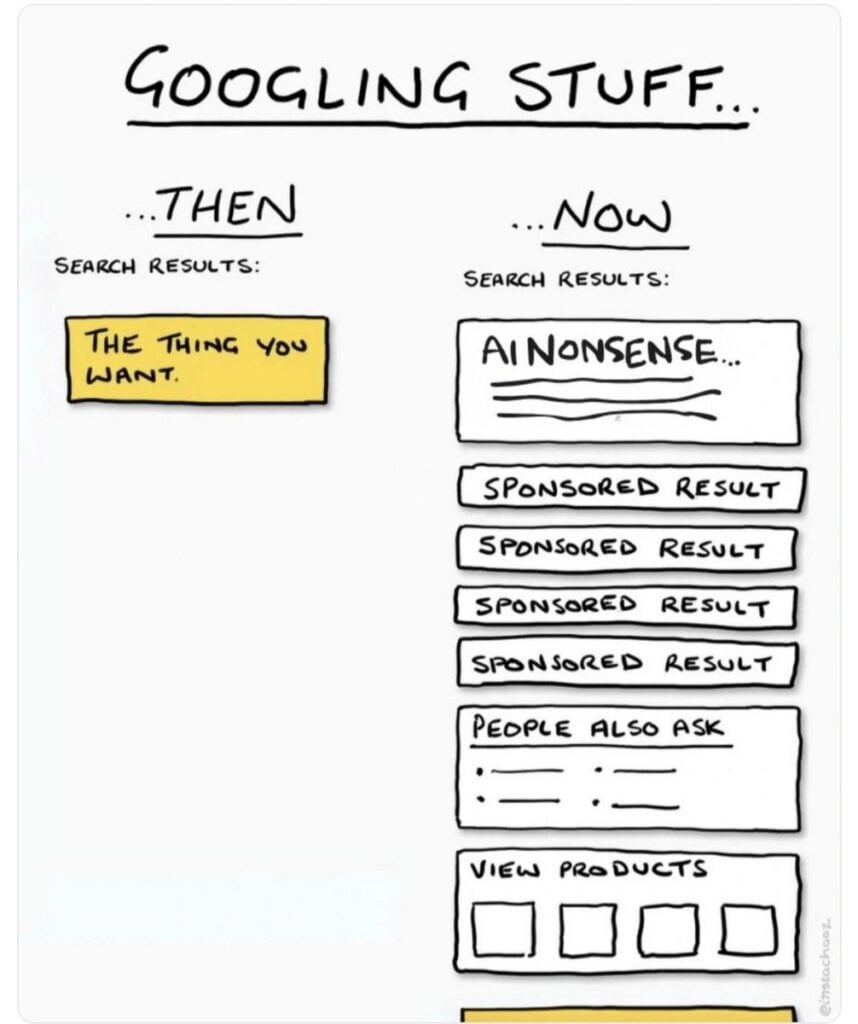
What Google actually announced at I/O 2026 — and what the end of “ten blue links” really means for the people who use the web every day
For most of the past 25 years, the way to find something on the internet has looked the same: type a few words into a box, hit enter, scan a list of blue links, click one, and hope it had what you needed. That habit is now ending — not gradually, but on a fixed schedule, by a company with the most to lose from changing it.
At Google I/O 2026 on May 19, Google announced what it is calling the biggest change to Search since the search box first appeared. The phrase “ten blue links” wasn’t just retired in a keynote slide — it was retired in the product. As TechCrunch put it the same day, “Google Search as you know it is over.”
That sounds like a headline written for clicks. In this case, it isn’t.
Below is a clear-eyed look at what was actually announced, what is launching when, and what it means in practice for people who use Google every day, for people who write on the web, and for the long, strange contract between Google and the open internet that has held since 1998.

What Google Actually Announced
There were four substantive pieces to the announcement. They’re worth taking one at a time, because they each do something different.
1. A new “intelligent” search box
The search box itself has been rebuilt. According to Google’s official I/O Search post, the box now expands dynamically to accept longer, more conversational questions, and uses AI-powered suggestions that go beyond traditional autocomplete to help you frame what you’re actually trying to ask. You can search with text, images, files, videos, or Chrome tabs as inputs in the same box.
Liz Reid, the VP who runs Search at Google, framed it simply: your curiosity doesn’t always fit into keywords. The box used to ask you to translate your question into the kind of phrase Google could rank. The new box tries to meet you where the question actually lives in your head.
This piece is live starting May 19, 2026, in every country and language where AI Mode is already available.
2. AI Mode keeps growing — and is now powered by Gemini 3.5 Flash
Google also confirmed that AI Mode, its conversational Search experience launched in 2025, has crossed one billion monthly users. AI Overviews — the short AI-written summaries that appear above results — are now used by more than 2.5 billion people each month, per TechCrunch.
For context, TechCrunch notes that ChatGPT reported around 900 million weekly active users earlier in 2026. The comparison isn’t quite apples-to-apples (weekly vs. monthly), but it tells you something real: AI search isn’t a side experiment anymore. It is the surface a meaningful share of the planet now uses to ask things.
Underneath, AI Mode’s default model is being upgraded globally to Gemini 3.5 Flash, Google’s newest frontier-grade-but-fast model. You can also now ask follow-up questions directly from an AI Overview and flow into a conversation without losing your place — small change, big shift in how Search feels.
3. Search Agents — information that comes to you
This is the part that genuinely breaks with the old model.
Google is introducing information agents inside Search. You can create, customize, and manage multiple agents that run quietly in the background — 24/7 — watching the web for the specific changes you care about and synthesizing what they find.
Reid’s example in the press briefing, quoted by TechCrunch: “You could send an alert to track market movements in a particular sector with very specific parameters, and the agent will map out a monitoring plan for you, including the tools and the data it needs to access — like our real-time finance data. And it will then keep track of those changes and let you know when the conditions are met, and provide a synthesized update with links and information you can dive into further.”
Google’s own examples lean more everyday: an agent that watches apartment listings against your exact criteria, or one that pings you the moment a specific athlete announces a sneaker drop.
If this sounds familiar, it’s because it is. Google launched Google Alerts back in 2003 to do something similar — email you when web results matched a saved query. Information agents are the obvious next generation: they don’t just notice that something changed, they read it, weigh it, and tell you what it means.
Google is also extending agentic capabilities to booking — local services, restaurants, things like “a private karaoke room for six on a Friday night that serves food late” — pulling pricing and availability and handing you off to the provider to finish. For categories like home repair, beauty, and pet care, it can even call businesses on your behalf.
Information agents launch first for Google AI Pro and Ultra subscribers this summer. Agentic booking and calling roll out to everyone in the U.S. this summer.
4. Generative UI and “mini apps” in Search
The most disorienting change, when you actually see it, is that Search results are no longer fixed templates. With agentic coding built on Google’s Antigravity platform and Gemini 3.5 Flash, Search can now generate the interface of an answer on the fly — interactive visualizations, tables, simulations, custom layouts assembled in real time around your specific question.
Ask about black holes and Search can render an interactive visual you can poke at. Ask a follow-up and the visualization regenerates. Ask Search to help you plan a wedding or manage a move, and it can build you a persistent dashboard — a “mini app” that remembers your context across sessions, pulls in live data, and lets you actually make progress on the task instead of running the same five searches every week.
Reid’s framing: “Search can build custom experiences just for your individual questions, from dynamic layouts, interactive visuals to persistent and stateful project spaces that you can return to again and again.”
Generative UI rolls out to everyone, free, this summer. The build-your-own-mini-app capability launches first for AI Pro and Ultra subscribers in the U.S., also this summer.
5. Personal Intelligence, expanded
Google is also expanding Personal Intelligence in AI Mode to nearly 200 countries and 98 languages, with no subscription required. If you choose to connect Gmail and Google Photos (and soon Google Calendar), Search can use your own context when answering — knowing the flight you’re booked on, the photo you’re trying to find, the calendar conflict you’re working around. Google emphasizes the connections are opt-in.
What This Actually Changes For You
Strip away the announcements and the demos and ask the simpler question: what does my Tuesday look like?
For straightforward questions — what year did this happen, who plays this character, what’s the conversion — almost nothing changes, because AI Overviews have already been answering those for two years. You’ll just get a tighter, faster, slightly smarter version.
For the messier questions, the change is real. Things that used to require five tabs and an hour — comparing options, tracking a thing that keeps moving, sketching out a plan, learning a concept that needs a diagram — are increasingly going to happen inside Search itself. You’ll spend less time clicking through and more time reading what Google’s agents and generated interfaces hand back.
That’s the practical shift. Search is moving from a place you go to find answers to a place you go to get work done with answers. It is becoming more like a workspace and less like a card catalog.
Whether that’s a good trade depends entirely on whether you trust the synthesis.
The Honest Uncertainties
This is the part most coverage will skip. A few things are worth being clear-eyed about.
Accuracy is still the open question. AI Overviews have been wrong, sometimes embarrassingly so, since they launched. Google says the new system uses Gemini 3.5 Flash with better grounding, but neither Google nor TechCrunch published independent error-rate data in connection with this announcement. The synthesis is going to be more confident-sounding. Whether it’s more correct is something we’ll learn from using it, not from the keynote.
Agents are powerful and brittle in the same breath. An agent that monitors an apartment market on your behalf is genuinely useful. An agent that misreads a listing’s “no pets” clause, or calls a business with the wrong details, is a different problem than a wrong search result, because it acts in the world. Google did not publicly detail the guardrails in I/O coverage beyond saying users remain in control. That’s a real thing to watch.
“Free” has a fence around it. The new intelligent search box, generative UI, and the Personal Intelligence expansion are free. The most agentic pieces — information agents and the mini-app builder — start behind the Google AI Pro and Ultra subscriptions. Google CEO Sundar Pichai said in his briefing that the long-term plan is to push these capabilities “to as many people as possible,” and Google has signaled that its personal AI agent Spark will eventually be free too. But for now, the most transformative parts of this announcement are paid first.
The model still hallucinates sometimes. Not as often as a year ago. But Google did not claim otherwise in the announcement, and neither will I.
What This Means For The Open Web
This is where the announcement gets uncomfortable.
For two and a half decades, Google and the open web had a working arrangement, even if no one ever signed it. Google indexed your site; in exchange, it sent you readers. Publishers, small businesses, hobbyist forums, niche blogs — the entire long tail — built themselves around that traffic. Ads followed the traffic. Jobs followed the ads.
AI Overviews already weakened that contract. Publishers across the web have reported declining referrals as users get their answers above the fold without ever clicking. Some ad-dependent media operations have already gone out of business, as TechCrunch notes.
What was announced this week tightens that further. If Search now builds you a custom dashboard or sends an agent to gather the answer for you, the click that used to land on a publisher’s page doesn’t happen at all. The agent reads the page. You read the synthesis.
Google’s framing is that supporting links and citations remain part of the experience and get “more relevant” as conversations deepen. That is probably true. It is also probably true that fewer people will follow them. Both can be the case at the same time.
If you write on the web for a living, the strategic implication is uncomfortable but clear:
- The traffic floor is shifting downward, again, and this time on a schedule announced in public.
- The value of being the source an AI cites may matter more than the value of being a destination, because being cited is increasingly the only way to reach a reader who never clicks.
- Content that an AI can’t fully summarize away — original reporting, expert judgment, primary data, voice, taste, opinion, the unsynthesizable — has more relative value than ever, and generic explainers have less.
There’s no satisfying advice here. It’s a structural change, and it is happening fast: the search box ships this week; generative UI and most of the rest ship this summer.
The Bigger Picture
Step back from the specific features and the shift is straightforward to describe: Google is repositioning Search from a retrieval tool into an action layer.
Retrieval — getting you to the right page — was the right product for a web where the answer existed somewhere and your job was to find it. An action layer is the right product for a web where the answer needs to be synthesized, monitored, scheduled, booked, called, visualized, or quietly tracked over weeks. That is closer to what people actually want from a search engine in 2026, even if they would not have phrased it that way.
It is also, not coincidentally, the right product for competing with ChatGPT, which has spent the past two years training a generation of users to expect a conversation, not a results page.
What Google did not do this week is replace Search with a chatbot. The links are still there, the box is still there, and for plenty of queries it will still look a lot like Google. What Google did do is make the box smarter than the page, and the agents more important than the click. That is the actual story.
What To Do This Week
A short, practical list:
- Try the new search box once it appears in your account — type questions the way you’d ask a person, not the way you’ve been trained to ask Google. The biggest practical change you’ll feel is in how the box handles a long, weird, real question.
- Try a follow-up from an AI Overview. That is now live worldwide on desktop and mobile.
- If you have a Google AI Pro or Ultra subscription, plan to experiment with information agents and mini apps when they launch this summer. Start with a low-stakes task — tracking a hobby market, planning a trip — before you trust an agent with anything that matters.
- If you publish on the web, take the next month to honestly audit which of your articles get clicked because they’re the best summary of something, and which get clicked because of you. The first category is the one most exposed.
- If you don’t publish on the web, just notice the change. The way an entire generation will be taught to find things online is being rewritten in public, on a schedule, and most people won’t realize it happened.
The search box you’ve used your whole adult life is being replaced. The replacement is not better in every way, and it is not worse in every way. It is genuinely different — and unlike most “this changes everything” announcements in tech, this one comes with shipping dates.
It is reasonable, this week, to read both the TechCrunch coverage and Google’s own post and form your own opinion before the rollout finishes.
The era of ten blue links was a good era. It’s worth being honest about the fact that it’s ending.
Continue Reading
- Google AI Is Rewriting Your Headlines — What It Means for SEO in 2026
- The AI Disruption of Google: How Generative Search is Upending Google Search, Ads, and the Web
Latest News
- Google Just Blew Up the Search Box, And Nothing Will Ever Be the Same
- AI Search Is the New SEO Battlefield: How to Get Cited by ChatGPT, Google AI Mode, Perplexity, Claude, Gemini, and Facebook AI Mode in 2026
- AI Search on Steroids: Google’s Bold Plan to Outshine Competitors
Compare
- Google AI Mode search feature: the New Feature Will Transform Your Online Experience
- Google’s AI Revolution: How Search Giants Are Reshaping the Digital Landscape
Recent Launches
The Kingy Brief
Get future Kingy Brief editions.
Source-checked AI changes, original tests and one practical thing to try.
Free · Choose your subjects · Double opt-in · Unsubscribe anytime
Regular sending is paused; no restart date is set.