
Silicon Valley’s New Obsession Has a Name
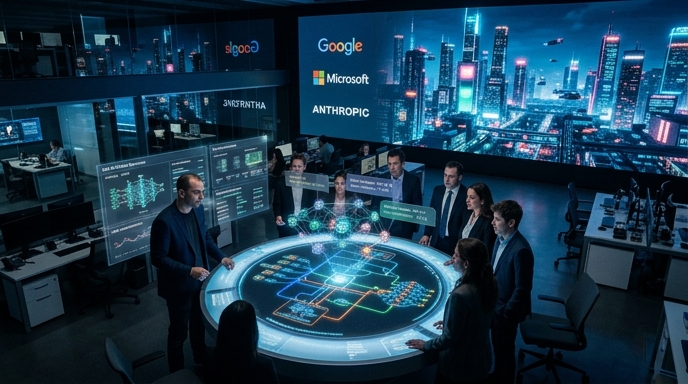
Inside OpenAI, the chairs keep moving.
Executives switch roles. Teams merge. Responsibilities expand. Product leaders suddenly oversee entirely new divisions. To outsiders, the reshuffling can look chaotic. Maybe even desperate. But beneath the organizational turbulence sits a very clear strategy.
OpenAI is preparing for the AI agent era.
And according to multiple reports from The Verge, Wired, LiveMint, and The Daily Tech Feed, one person now sits closer to the center of that strategy than ever before: Greg Brockman.
The OpenAI cofounder has quietly gained more influence over product direction at a moment when the company faces pressure from every direction. Google pushes Gemini into everything. Anthropic courts enterprises with Claude. Meta throws open-source models into the wild like T-shirts at a basketball game. Elon Musk’s xAI wants attention. Microsoft wants integration. Investors want revenue. Users want magic.
Meanwhile, OpenAI wants dominance.
That explains the latest executive shake-up. It also explains why the company moved leadership around ChatGPT itself. According to reports, Nick Turley, previously one of the key leaders behind ChatGPT, shifted responsibilities while Brockman expanded his reach over product strategy and development.
This is not normal corporate housekeeping. This is wartime positioning.
Because the next battle in AI is no longer about who has the smartest chatbot.
It is about who builds the best autonomous digital worker.
And that changes everything.
The AI Industry Has Moved Beyond Chatbots
Two years ago, the industry obsessed over prompts.
Today, it obsesses over agents.
The distinction matters.
A chatbot answers questions. An AI agent performs tasks. It remembers context, It navigates software. It makes decisions, It chains actions together. Ideally, it acts less like a search engine and more like a competent employee who never sleeps and never asks for PTO.
That shift changes the economics of AI completely.
A chatbot is useful. An agent can replace workflows.
OpenAI understands this better than almost anyone. That realization now appears to drive the company’s internal restructuring. Reports from The Verge suggest the company has aggressively reorganized leadership in an effort to compete in what many insiders see as the next decisive AI race.
The race is not merely technical. It is operational.
Who can ship products fastest, also who can integrate AI into real work? And lastly who can build systems reliable enough for people to trust with meaningful tasks?
That is where Greg Brockman enters the picture.
Brockman has always occupied a somewhat unusual position inside OpenAI. Sam Altman became the public face. Researchers drove the breakthroughs. But Brockman often sat between engineering execution and product realization. He understood how to turn raw capability into deployable systems.
That skill suddenly matters more than ever.
Because building frontier models is hard.
Building products people actually use every day is harder.
Greg Brockman’s Expanded Role Signals a Major Strategic Shift
The recent reporting paints a consistent picture.
OpenAI wants tighter alignment between research and product execution. The company appears increasingly focused on accelerating deployment cycles while transforming ChatGPT into a broader AI operating system rather than a standalone app.
That is where Brockman reportedly gained additional authority.
According to Wired, Brockman took on broader product oversight responsibilities after returning from leave. The move effectively places him closer to the center of OpenAI’s commercial and product future. Other reports described it as a “massive shake-up,” which honestly sounds dramatic until you realize how much money sits on the table.
Potentially trillions.
The interesting part is not merely who reports to whom. The interesting part is what OpenAI’s structure now reveals about its priorities.
Research alone no longer wins.
Execution wins.
Speed wins.
Integration wins.
And increasingly, trust wins.
The AI industry learned a brutal lesson over the past year: dazzling demos mean very little if products fail under real-world pressure. Users tolerate hallucinations in novelty apps. They do not tolerate them when AI handles contracts, finances, customer support, or healthcare documentation.
That means OpenAI must mature.
Fast.
Brockman’s expanded control suggests the company wants fewer gaps between invention and implementation. Fewer disconnected teams. Faster deployment loops. More unified product thinking.
In plain English: less science fair, more operating system.
ChatGPT Is Quietly Becoming Something Much Bigger
Many people still think of ChatGPT as a chatbot.
That view is outdated.
OpenAI increasingly treats ChatGPT as a universal interface layer for digital work. The company already added browsing, memory, multimodal interaction, voice, file analysis, coding support, and task automation. Each feature pushes the platform further away from simple conversation and closer toward becoming an intelligent computing environment.
The executive restructuring reinforces that trajectory.
When leadership shifts toward product consolidation, it usually means the company wants tighter integration across services. OpenAI does not merely want users opening ChatGPT occasionally for questions. It wants users living inside the ecosystem daily.
Think about the trajectory.
Today, ChatGPT helps draft emails.
Tomorrow, it schedules meetings, negotiates calendars, summarizes calls, builds presentations, handles customer support tickets, monitors analytics dashboards, writes code, and executes workflows automatically.
Eventually, users may stop opening traditional software first.
They may start with the AI instead.
That possibility terrifies competitors for good reason.
If AI agents become the primary interface to computing, the companies controlling those agents gain extraordinary leverage. Suddenly the AI layer matters more than the underlying apps themselves.
That is why Google, Microsoft, Anthropic, and OpenAI all push toward agent ecosystems simultaneously.
Nobody wants to become invisible infrastructure underneath somebody else’s assistant.
OpenAI’s Biggest Problem Is Not Technology

It is scale.
More specifically, organizational scale.
The company exploded from research lab to global platform at absurd speed. That kind of growth creates internal friction almost automatically. Teams duplicate work. Decision-making slows. Product priorities collide. Leadership structures become messy.
The recent reshuffling looks partly like a response to that pressure.
OpenAI now sits in an awkward transitional phase between startup and empire. The company still wants startup velocity while managing enterprise partnerships, regulatory scrutiny, infrastructure demands, and consumer expectations from hundreds of millions of users.
That balancing act breaks companies all the time.
History is filled with examples.
Google struggled with product fragmentation for years. Meta repeatedly reorganized during platform transitions. Even Microsoft lost entire eras because internal divisions fought each other more than competitors.
OpenAI clearly wants to avoid that trap.
Consolidating authority under leaders like Brockman may reduce fragmentation while increasing accountability. It also suggests the company recognizes something uncomfortable: brilliant research culture alone cannot sustain long-term product dominance.
At some point, operational discipline matters.
That sentence probably makes half of Silicon Valley physically ill.
But it remains true.
The AI Agent Race Will Get Weird Very Quickly
Most consumers still underestimate what AI agents could become over the next three years.
They imagine improved assistants.
The industry imagines software labor.
That distinction matters enormously.
An advanced agent does not simply respond to commands. It manages objectives, It adapts to changing information, It coordinates across systems. It proactively handles tasks with limited supervision.
In theory, one competent AI agent could eventually replace large portions of repetitive digital work.
Not all work. Not most work. But enough to reshape entire industries.
OpenAI appears determined to lead that transition.
The executive restructuring supports that conclusion because agent development requires intense coordination between research, infrastructure, product design, safety systems, and deployment engineering. Fragmented leadership slows everything down.
And speed matters now.
Anthropic already pushes Claude toward deeper workplace integration. Google aggressively embeds Gemini into Workspace. Microsoft wants Copilot inside every productivity workflow imaginable. Meta wants open-source dominance. Everyone sees the same future approaching.
The difference lies in execution quality.
Who builds agents people genuinely trust?
That remains unresolved.
Consumers tolerate AI mistakes when generating anime portraits or vacation itineraries. They become much less forgiving when agents handle payroll, legal review, or financial forecasting.
Reliability becomes the real moat.
Not merely intelligence.
Sam Altman Still Looms Over Everything
No discussion of OpenAI’s internal changes makes sense without understanding Sam Altman’s role.
Altman remains the gravitational center of the company.
Even when other executives gain influence, Altman shapes the overarching strategic direction. He thinks in terms of platforms, ecosystems, infrastructure, and civilization-scale transformation. Sometimes that ambition sounds visionary. Sometimes it sounds like a TED Talk written during a caffeine overdose.
Usually both.
The recent changes do not weaken Altman. They arguably strengthen his broader strategy. Delegating more operational product control to Brockman may free Altman to focus on fundraising, partnerships, policy, infrastructure expansion, and long-term positioning.
And OpenAI desperately needs all of those.
The company burns extraordinary amounts of money. AI infrastructure costs remain staggering. Training frontier models requires massive compute resources, enormous electricity demands, and increasingly specialized hardware.
At the same time, expectations keep rising.
Users expect smarter systems every few months. Investors expect revenue growth. Governments expect safety assurances. Enterprise customers expect reliability.
Meanwhile, competitors attack from every angle.
OpenAI cannot afford organizational drift under those conditions.
The reshuffling reflects that reality.
This Is What a Tech Power Struggle Looks Like in Real Time
One of the most fascinating aspects of OpenAI’s evolution is how public the internal tension has become.
A decade ago, companies carefully hid leadership instability. Today, executive reshuffles leak almost instantly. Product disagreements surface publicly. Strategic pivots happen in full view of millions of observers on social media.
That visibility creates strange pressure.
Every move becomes interpreted as either genius or panic.
Reality usually sits somewhere in between.
The current restructuring likely reflects genuine strategic urgency rather than dysfunction. OpenAI recognizes that the window for establishing dominance in AI agents may be surprisingly short. Platform transitions happen quickly once consumer behavior changes.
Smartphones reshaped computing within a few years.
Social media platforms rose and collapsed with shocking speed.
AI agents could trigger an equally dramatic shift.
That possibility explains the intensity surrounding OpenAI right now. The company is not merely competing for market share. It is competing to define the next interface layer of computing itself.
Whoever wins that layer gains immense power.
Not absolute power. Not monopoly power. But platform-level influence.
That is the prize everybody chases.
The Real Question: Can OpenAI Stay Coherent?

Here is the uncomfortable truth.
OpenAI’s greatest threat may not come from Google, Anthropic, or Meta.
It may come from its own complexity.
Fast-growing technology companies often collapse under coordination problems long before competitors destroy them externally. Internal confusion compounds over time. Product visions drift apart. Leadership bottlenecks emerge. Employees lose clarity.
The recent executive changes appear designed to prevent exactly that outcome.
Whether they succeed remains unclear.
Confidence level: moderate.
The company still possesses extraordinary advantages. Brand recognition. Talent density. Distribution scale. Infrastructure partnerships. Consumer mindshare. Technical capability. Those are difficult assets to replicate quickly.
But advantages decay faster in technology than executives like admitting.
Especially during platform transitions.
The AI industry now moves at such insane velocity that six months can alter competitive dynamics completely. A single breakthrough product can redraw expectations overnight.
That volatility explains OpenAI’s aggressive posture.
The company understands the stakes perfectly.
This is no longer about building clever demos or viral chatbots.
This is about owning the future architecture of digital work.
And OpenAI just reorganized itself for the fight.
Sources
- The Verge – OpenAI keeps shuffling its executives in bid to win AI agent battle
- Wired – Greg Brockman Takes Bigger Product Role at OpenAI
- The Daily Tech Feed – Greg Brockman Takes Helm of OpenAI’s Product Strategy
- LiveMint – OpenAI gives Greg Brockman more control in massive shake-up
The Kingy Brief
Get future Kingy Brief editions.
Source-checked AI changes, original tests and one practical thing to try.
Free · Choose your subjects · Double opt-in · Unsubscribe anytime
Regular sending is paused; no restart date is set.