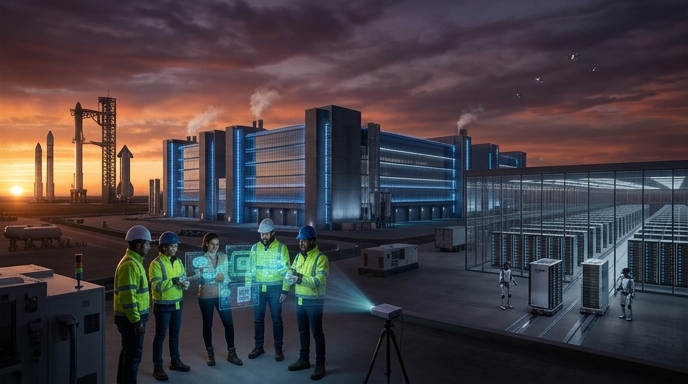
The Big Swing
Elon Musk’s newest moonshot may not start with a rocket. It may start with dirt, tax paperwork, and a very large chip factory in Texas.
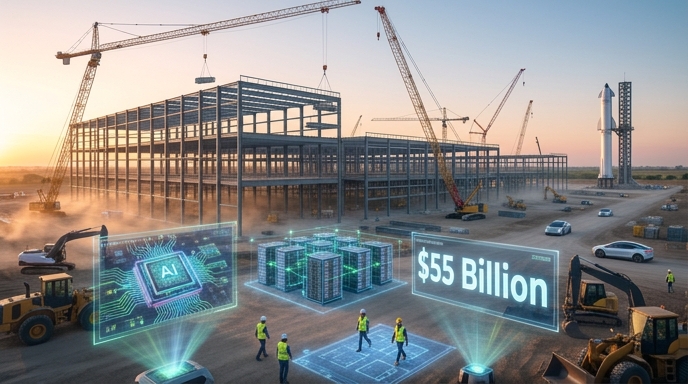
SpaceX has filed plans for a semiconductor and advanced computing facility in Grimes County, Texas, with an initial proposed investment of $55 billion. If later phases happen, the total could rise to $119 billion. That number is not a typo. It is “new airport, small war, or several sports leagues” money.
The project is called Terafab, and its ambition is blunt: make enough AI chips to feed Musk’s companies without depending so heavily on outside suppliers. SpaceX, Tesla, and xAI all need compute. Lots of it. The AI boom has turned chips into the new oil, except the oil has nanometer-scale transistors and occasionally gets mentioned in earnings calls with religious intensity.
The proposed facility would be in Grimes County, a rural area northwest of Houston. Local officials are expected to consider a property tax abatement tied to the project.
Why This Matters
AI is hungry. Not metaphorically hungry. Electrically hungry. Hardware hungry. Capital hungry.
Modern AI systems need specialized chips, huge data centers, power infrastructure, cooling systems, networking gear, and supply chains that behave like symphonies conducted by caffeine-addled engineers. Whoever controls chips controls the pace of AI deployment.
That is why Terafab matters.
Musk does not merely want to buy chips. He appears to want a vertically integrated AI machine: rockets, cars, robots, data centers, models, and now possibly chip fabrication. The logic is simple. If chips are the bottleneck, own the bottleneck.
Bisnow reported that Terafab aims to produce more than one terawatt of computing power per year for Earth-based uses and future space travel. The Verge reported that Musk previously described ambitions for chips supporting up to 200 gigawatts per year of computing power on Earth and up to one terawatt in space.
That is not a factory pitch. That is a civilization-scale infrastructure pitch wearing a hard hat.
The Texas Clue
The location has been the puzzle piece everyone wanted.
Musk had previously pointed to Austin for Terafab, but the new filing points to Grimes County. Bisnow places the proposal a little over an hour northwest of Houston. BattleSwarm, writing from a Texas-focused angle, frames the same question sharply: is Terafab going into Grimes County? Its summary notes that the location now appears likely based on regulatory filings.
Grimes County is not downtown Austin. It is more rural, but strategically interesting. BattleSwarm describes it as sitting near the edge of the Houston exurbs, between Huntsville, Conroe, and College Station.
That matters. Big fabs need land. They need power. They need water. They need transport access. They need local governments willing to cut deals. They also need space to sprawl, because chip fabs are not cute little workshops. They are industrial cathedrals.
Texas offers one more thing: political and regulatory hospitality. Musk has already moved major business activity into the state. SpaceX, Tesla, and xAI are increasingly Texas-shaped companies.
The Tax Break Game
The Grimes County Commissioners Court is scheduled to consider a property tax abatement for SpaceX’s proposal on June 3, 2026, according to Bisnow’s reporting on the public notice. The notice does not name Terafab directly, but it describes a “multi-phase, next-generation, vertically integrated semiconductor manufacturing and advanced computing fabrication facility.”
That phrase is government-speak for: “Something huge is coming, and someone brought lawyers.”
Tax abatements are standard in mega-projects. Companies ask for relief. Counties ask for jobs, investment, prestige, and future tax base. Everyone smiles in public. Then the spreadsheets come out and start biting.
The core question is whether local taxpayers get enough in return. A $55 billion investment sounds enormous because it is enormous. But chip fabs also demand roads, utilities, water planning, power infrastructure, permitting capacity, emergency services, and long-term environmental oversight.
A bad deal can leave a county subsidizing someone else’s empire. A good deal can reshape a region for decades.
This is why the June hearing matters. It is not just clerical. It is where fantasy meets county budget.
The Chip War Behind the Curtain
The real story is not “SpaceX builds factory.” The real story is dependency.
AI companies depend on chip suppliers. Those suppliers depend on fabrication capacity. Fabrication capacity depends on equipment makers, chemicals, ultra-clean facilities, specialized labor, and machines so expensive they make yachts look financially mature.
Bisnow reported that Terafab is aimed partly at reducing reliance on outside chip suppliers such as Samsung and TSMC.
That is the heart of it.
TSMC dominates advanced chip fabrication. Samsung competes. Intel wants to regain ground. Nvidia designs the AI accelerators everyone wants. Big Tech buys what it can. Governments panic quietly, then loudly, then write subsidy bills.
Musk’s apparent answer: build the pipeline yourself.
It is not a small pivot. It is a return to industrial vertical integration. Design the system. Build the chips. Use them in your cars, robots, rockets, models, and data centers. Repeat until competitors develop migraines.
Intel Enters the Chat
Intel appears to be a key piece of the Terafab story.
The Verge reported that Intel said it would help design and build Terafab, citing Intel’s ability to design, fabricate, and package ultra-high-performance chips at scale.
BattleSwarm’s earlier commentary argued that Intel could be doing the heavy lifting, with Musk’s companies funding or absorbing output from a dedicated production arrangement. That interpretation is explicitly speculative, but it fits one obvious reality: building cutting-edge fabs is not a beginner hobby.
Intel knows fabs. It knows suppliers. It knows process engineering. It knows how many things can go wrong before breakfast.
That does not make Terafab easy. It makes it less absurd.
Without Intel, the plan sounds like someone trying to open a Michelin restaurant after watching three cooking videos. With Intel, it sounds more like a brutal, expensive, technically plausible campaign.
Still hard. Still risky. But no longer pure vapor.
The Numbers Are Wild
The numbers deserve their own spotlight because they are the whole circus.
Initial investment: $55 billion. Possible total investment: $119 billion. Target: more than one terawatt of computing power per year, according to Bisnow.
The Verge reported that Musk had discussed enough chip production to support up to 200 gigawatts per year of computing power on Earth and up to one terawatt in space.
Bisnow also reported Musk’s claim that current worldwide AI chip plant output is about 20 gigawatts per year, or only about 2% of what his project needs.
Here is the translation: Musk is not talking about adding another chip source. He is talking about building a monster.
A friendly monster, perhaps. A useful monster, maybe. But a monster.
The project’s scale suggests Musk sees AI compute not as a procurement issue, but as an existential constraint on his business empire. No chips, no AI. No AI, no humanoid robots. No robots, weaker Tesla future. No compute, weaker xAI. No space-grade compute, less ambitious orbital infrastructure.
It all stacks.
Space Data Centers? Yes, Apparently

One of the strangest parts of the Terafab story is the space angle.
The Verge reported that Musk has discussed chips for space-based data centers, and that Terafab’s output would be used for AI, robotics, and space-based computing.
That sounds ridiculous until you remember who is saying it.
SpaceX already operates Starlink. It already launches hardware at scale. It already thinks in orbital infrastructure. If any company would look at terrestrial data-center constraints and say, “What if we put some of this in space?” it would be SpaceX.
The engineering problems are nasty. Radiation. Heat rejection. Maintenance. Latency. Launch costs. Orbital debris. Upgrades. Power. Repairs. More heat. Always heat.
But the direction is clear. Musk’s companies are not merely chasing AI software. They are chasing compute infrastructure wherever it can be built.
Earth first. Orbit later. Mars PowerPoint eventually.
The Data Center Connection
Terafab is not happening in isolation.
The Verge reported that SpaceX is expanding its data center footprint and currently operates a “Colossus” data center in Memphis, Tennessee, which signed an agreement to power Anthropic’s AI models.
That detail matters because chips and data centers are Siamese twins in the AI economy. A chip without a data center is inventory. A data center without chips is expensive real estate with blinking lights.
Musk’s broader AI push needs both.
xAI needs training and inference capacity. Tesla needs compute for autonomous driving and robotics. SpaceX may need compute for simulation, autonomy, satellite operations, and future orbital systems. The common denominator is hardware.
In the old tech world, software ate the world. In the AI world, infrastructure eats the software budget.
Terafab is the hardware answer to that problem.
Why Grimes County Could Change Fast
If the project lands in Grimes County at anything like the reported scale, the local impact would be dramatic.
A semiconductor megafab does not arrive alone. It brings contractors, engineers, suppliers, utility upgrades, logistics providers, security, construction crews, housing pressure, traffic, and political attention. Then come restaurants, hotels, warehouses, service businesses, and the inevitable arguments over roads.
BattleSwarm highlights the county’s rural character and its position near larger Texas growth corridors.
That is exactly why the site makes sense. Rural enough for land. Close enough to labor markets and regional infrastructure. Near enough to Houston, College Station, and other Texas talent pools.
But growth is never clean. Local residents may get jobs and rising land values. They may also get congestion, noise, higher housing costs, and a county government suddenly playing in the industrial big leagues.
Mega-projects bring money. They also bring headaches with steel-toed boots.
The Feasibility Problem
Now for the cold water.
Building an advanced semiconductor fab is brutally hard. Scaling one to world-historic output is harder. Doing it quickly is harder still. Doing it while targeting AI chips, robotics chips, possible memory production, and space-oriented compute is the kind of thing that makes project managers stare into the middle distance.
BattleSwarm’s commentary is skeptical on timing. It argues that some Terafab goals may be technically possible, but not on the fastest timelines or lowest costs floated in earlier discussion.
That skepticism is warranted.
Fabs depend on long-lead equipment. Extreme ultraviolet lithography machines are not sitting on a shelf at Costco. Skilled semiconductor labor is scarce. Yield ramps take time. Process defects do not care about charisma. Supply chains have their own cruel sense of humor.
So yes, Terafab may be plausible in concept. But the timeline is the dragon.
Musk often announces impossible-seeming timelines. Sometimes reality bends. Sometimes it sends an invoice.
Why Musk Wants Control
The first-principles logic is strong.
If your companies depend on AI, and AI depends on chips, then chips become strategic. If chips are strategic, relying entirely on outside suppliers becomes a vulnerability. If suppliers are constrained, expensive, or geopolitically exposed, vertical integration starts looking less crazy.
This is not new. Old-school computing companies often controlled more of their hardware stack. The foundry model later separated chip design from chip manufacturing. That model worked beautifully for many companies. But AI has changed the incentives.
When demand outruns supply, buyers start dreaming of factories.
Musk’s companies are especially exposed. Tesla wants autonomy and robotics. xAI wants model training. SpaceX wants advanced computing for satellites, rockets, and perhaps space infrastructure. A shared chip pipeline could serve all three.
The aggressive version of the strategy is simple: stop waiting in line.
The AI Arms Race Gets Physical
AI used to look like a software race. Models. Prompts. Chatbots. Benchmarks. Demos. Weird hands in generated images. You know, the classics.
Now it looks like an industrial race.
The winners need land, power, chips, cooling, transformers, substations, water rights, construction crews, and fabrication capacity. The AI revolution has left the browser tab and walked onto a construction site.
Terafab is part of that shift.
The Verge places it alongside SpaceX’s data center expansion. Bisnow places it inside a broader Musk move toward an integrated AI ecosystem. BattleSwarm places it in the Texas geography and feasibility debate. Together, they tell one story: AI is becoming heavy industry.
That is the fun part and the terrifying part. The chatbot era was cute. The build-a-$119-billion-chip-complex era is not cute. It wears a reflective vest.
What We Know
Here is the clean version.
SpaceX has proposed an initial $55 billion semiconductor facility in Grimes County, Texas. The project could eventually reach $119 billion if expanded. The local commissioners court is expected to consider a tax abatement connected to the project on June 3, 2026.
The project is associated with Terafab, Musk’s plan to produce AI chips at massive scale. The Verge reports that the plant would be run by SpaceX and Tesla and produce chips for both companies. Bisnow describes Terafab as involving Tesla, SpaceX, and xAI.
Intel has been reported as a partner helping design and build the facility.
The intended uses include AI, robotics, and possibly space-based data centers.
The location appears to be Grimes County, though the public notice reportedly does not name Terafab directly.
That is the factual spine. Everything else is inference, ambition, or industrial theater.
What We Do Not Know
We do not know whether all phases will be built.
We do not know whether the final cost will hit $119 billion, stay near $55 billion, or mutate into some new beast with extra zeros.
We do not know exact production timelines from the filings cited in these reports.
We do not know the final tax abatement terms.
We do not know how responsibilities would be divided among SpaceX, Tesla, xAI, and Intel.
We do not know whether Terafab can hit Musk’s most aggressive compute targets.
That uncertainty matters. Mega-projects often start with thunder and end with revised schedules. Semiconductor projects are especially prone to delays because reality is rude at nanometer scale.
Still, the filings make one thing clear: this is no longer just a tweet-shaped dream. It has entered the land of county notices, tax abatements, and capital planning.
That is where big ideas either grow legs or fall into a permitting swamp.
The Bottom Line

Terafab is Musk’s most industrial AI idea yet.
It combines SpaceX’s infrastructure ambition, Tesla’s robotics needs, xAI’s compute hunger, Intel’s manufacturing expertise, and Texas’ appetite for mega-projects. It is also risky, expensive, and probably harder than the public pitch makes it sound.
But the strategy is coherent.
Musk is trying to build an AI stack from the ground up. Not just models. Not just apps. Not just data centers. The whole machine: chips, fabs, power-hungry compute, robots, vehicles, satellites, maybe orbital data centers.
That is why the Grimes County filing matters. It is not merely a local real estate story. It is a signal that the AI race has moved into its steel-and-concrete phase.
The software people had their moment. Now the bulldozers have entered the chat.
Sources
- The Verge: “SpaceX has a $55 billion plan to build AI chips in Texas” (The Verge)
- Bisnow: “SpaceX Files Plans For $55B Terafab Chip Facility In Southeast Texas” (Bisnow)
- BattleSwarm Blog: “Musk’s Terafab Going In Grimes County?” (battleswarmblog.com)
The Kingy Brief
Get future Kingy Brief editions.
Source-checked AI changes, original tests and one practical thing to try.
Free · Choose your subjects · Double opt-in · Unsubscribe anytime
Regular sending is paused; no restart date is set.