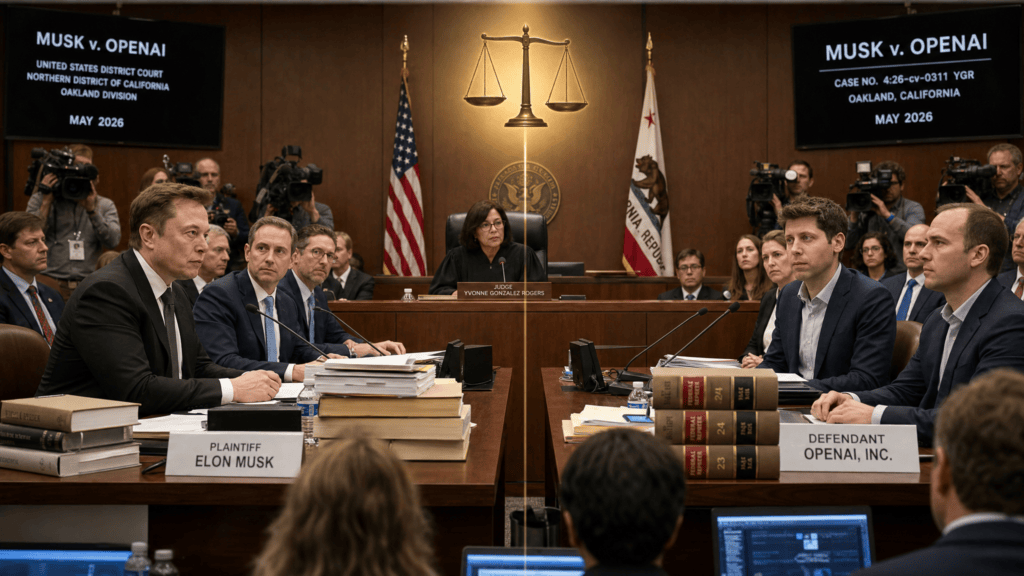
The private notes that may decide whether OpenAI’s for-profit turn was mission evolution — or a charitable bait-and-switch
The strongest counterargument to Elon Musk is simple: Greg Brockman’s diary is not, by itself, proof that OpenAI committed fraud. It is not a complete notebook archive. It is not a jury verdict. It is not an admission that the 2019 capped-profit structure was illegal. And it sits inside a record showing that Musk himself discussed a for-profit OpenAI, pushed for control, considered Tesla as the vehicle, and later founded a direct competitor, xAI. That matters.
But the strongest counterargument to OpenAI is sharper: Brockman’s diary is exactly the kind of contemporaneous, unguarded evidence that makes polished litigation narratives look synthetic. In public and donor-facing language, OpenAI was born as a nonprofit dedicated to building artificial intelligence “to benefit humanity as a whole,” “unconstrained by a need to generate financial return,” and to “build value for everyone rather than shareholders,” as OpenAI wrote in its 2015 founding announcement, Introducing OpenAI.
In private, according to a January 15, 2026 federal court order, Brockman wrote that he and others “truly want the b-corp,” that saying they were committed to the nonprofit could be “a lie,” that “the true answer is that we want [Musk] out,” and that Musk’s story would “correctly be that we weren’t honest with him in the end about still wanting to do the for profit just without him.”
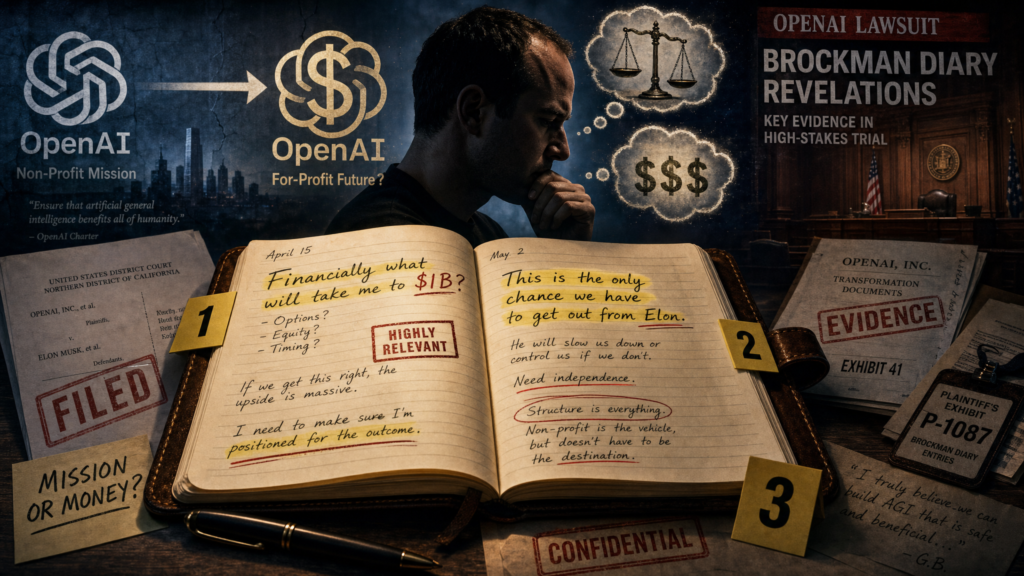
That is not background noise. That is the evidentiary hinge.
The correct interpretation is not the crude one: “Brockman’s diary proves everything Musk says.” It does not. The correct interpretation is more damaging because it is more precise: Brockman’s diary appears to show that OpenAI’s leadership understood, in real time, that there was a serious moral and legal problem in reassuring Musk about nonprofit continuity while privately preferring a for-profit route without him. That is why U.S. District Judge Yvonne Gonzalez Rogers denied summary judgment to the OpenAI defendants on Musk’s key phase-one claims in Musk v. Altman, Case No. 4:24-cv-04722-YGR.
As of May 4, 2026, the case is not theoretical. Reuters reports that the Oakland trial began April 28, 2026, that Musk is seeking changes to OpenAI’s leadership and roughly $150 billion in damages from OpenAI and Microsoft, and that the trial could produce a verdict by mid-May. See Reuters’ trial coverage: Musk sought settlement with OpenAI before Oakland trial, filing shows and Elon Musk trial against Sam Altman to reveal OpenAI power struggle.
Step 1: OpenAI’s founding promise was unusually clear
OpenAI did not launch as a conventional startup with a vague social mission stapled to a venture-capital plan. Its December 2015 public announcement described it as “a non-profit artificial intelligence research company” with the goal of advancing digital intelligence “in the way that is most likely to benefit humanity as a whole,” specifically “unconstrained by a need to generate financial return.” The same post said: “As a non-profit, our aim is to build value for everyone rather than shareholders.” Greg Brockman was named CTO; Sam Altman and Elon Musk were named co-chairs; Ilya Sutskever was research director.
That language is not incidental. It is the baseline against which Musk’s charitable-trust and fraud theories are measured. Musk’s position is that he donated money, reputation, recruiting power, and strategic help to a nonprofit project whose defining purpose was not private enrichment. According to the January 2026 court order, Musk donated approximately $38 million to OpenAI, including quarterly donations and payments for leased office space. Reuters also reports the same approximate figure in its trial coverage: Elon Musk trial against Sam Altman to reveal OpenAI power struggle.
OpenAI’s answer is not that the founding language never existed. It obviously did. OpenAI’s answer is that the world changed: building frontier AI required far more compute, talent, and capital than a traditional nonprofit could obtain. In its 2024 response, OpenAI wrote that by early 2017 it realized building AGI would require “billions of dollars per year,” far beyond what the nonprofit could raise. See OpenAI and Elon Musk.
That is OpenAI’s best argument. A nonprofit AI lab promising to compete with Google DeepMind while refusing investment capital may have been structurally doomed. First principles support this: if frontier AI is a scale game driven by compute, data centers, chips, elite researchers, and distribution, then a donation-funded nonprofit is fighting tanks with a bicycle. The need for capital was real.
But real necessity does not automatically cleanse misrepresentation. The case is not simply “was a for-profit structure rational?” It is “what was promised, what was concealed, when was it concealed, and did OpenAI insiders use charitable assets and donor trust to build a private wealth machine?”
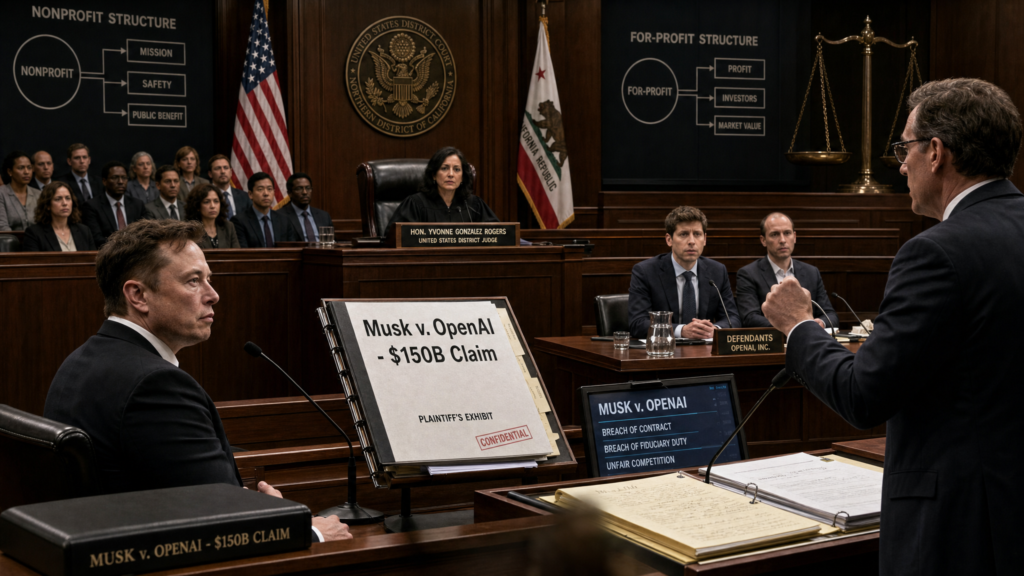
Step 2: The 2017 fracture is the whole case
The dispute turns on 2017. That is when OpenAI’s founders confronted the brutal economics of AGI. It is also when the diary passages appear.
OpenAI says Musk was not some naïve donor blindsided by capitalism. In December 2024, OpenAI published a detailed post arguing that Musk himself wanted an OpenAI for-profit, discussed corporate restructuring, demanded majority equity, wanted initial control, wanted to be CEO, and even caused a public benefit corporation named “Open Artificial Intelligence Technologies, Inc.” to be created in September 2017. See Elon Musk wanted an OpenAI for-profit.
That point is devastating to any simplified Musk narrative that says: “I only ever wanted pure nonprofit OpenAI, and they alone invented the for-profit betrayal.” The record is more complicated. OpenAI’s post quotes a September 2017 call in which Musk discussed transitioning “from non-profit to something which is essentially philanthropic endeavor and is B-corp or C-corp or something,” while also saying the nonprofit should still exist “in some form.” OpenAI argues that this is basically what OpenAI later became: a for-profit entity under nonprofit control.
But this does not end the case. It reframes it. Musk can lose the “for-profit was never discussed” argument and still have a serious claim if he proves that the structure ultimately adopted differed materially from what he agreed to, that OpenAI’s leaders falsely reassured him, or that charitable assets were moved into a structure creating impermissible private benefit.
The January 2026 court order states that on September 20, 2017, Musk wrote to Altman, Brockman, and Sutskever: “Either go do something on your own or continue with OpenAI as a nonprofit. I will no longer fund OpenAI until you have made a firm commitment to stay or I’m just being a fool who is essentially providing free funding for you to create a startup.” Altman responded that he remained “enthusiastic about the non-profit structure.” Brockman also allegedly reassured Musk through Shivon Zilis that he would like to continue with the nonprofit structure. Source: January 15, 2026 order.
This is where Brockman’s diary becomes explosive.
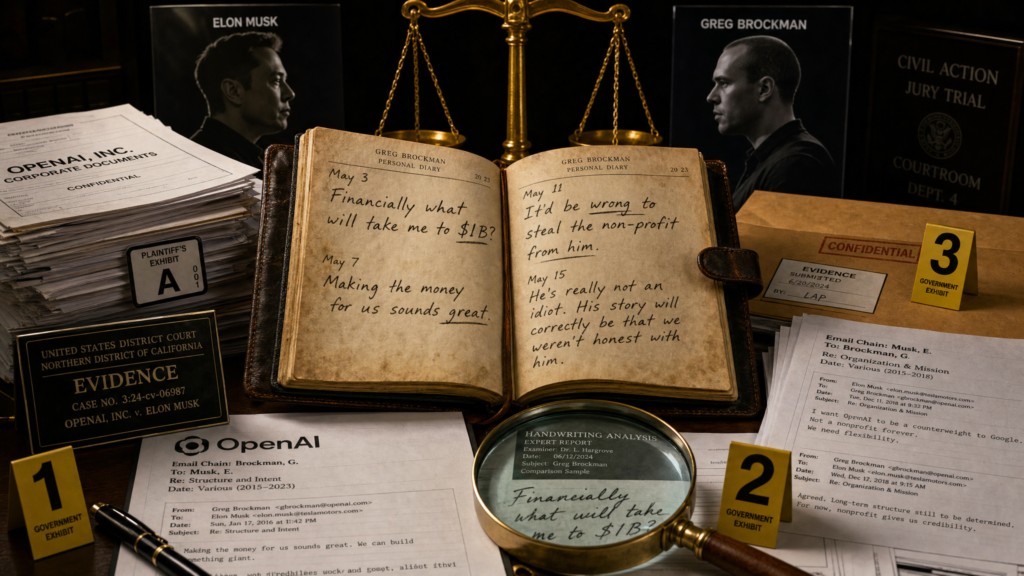
Step 3: Brockman’s diary is powerful because it is contemporaneous
The most important public diary passages come from September and November 2017. According to the January 2026 order, Brockman wrote in September 2017:
“This is the only chance we have to get out from Elon. Is he the ‘glorious leader’ that I would pick? We truly have a chance to make this happen. Financially, what will take me to $1B? … Accepting Elon’s terms nukes two things: our ability to choose … and the economics.”
Reuters also highlighted this passage in its April 27 trial preview, reporting that Brockman wrote: “This is the only chance we have to get out from Elon,” and “Financially, what will take me to $1B?” See Reuters.
Then comes November 6, 2017. The court order quotes Brockman writing that the “conclusion is we truly want the b-corp.” He continued:
“cannot say that we are committed to the non-profit. don’t want to say that we’re committed. if three months later we’re doing b-corp then it was a lie.”
He also wrote:
“the true answer is that we want [Musk] out.”
And:
“his story will correctly be that we weren’t honest with him in the end about still wanting to do the for profit just without him.”
Finally, after a meeting with Musk, Brockman wrote that converting to a B-corp without Musk would be “pretty morally bankrupt” and that Musk was “really not an idiot.” Source: January 15, 2026 order.
Those lines are legally potent for three reasons.
First, they are close in time to the disputed representations. A diary entry written in 2017 is far more probative than a 2026 courtroom explanation written through lawyers.
Second, they speak to state of mind. Fraud usually turns on intent, knowledge, reliance, and materiality. A private note saying “if three months later we’re doing b-corp then it was a lie” is not merely evidence of structural disagreement. It is evidence that Brockman recognized the dishonesty problem himself.
Third, they are not just anti-Musk venting. “We want him out” is venting. “What will take me to $1B?” may be ambition, anxiety, or greed, depending on context. But “his story will correctly be that we weren’t honest with him” is different. That is a private admission about the likely truth of Musk’s future grievance.
That is why the court wrote that Brockman’s notes “could be read to suggest that Brockman intended to deceive” Musk about “the existence and maintenance of the non-profit structure of OpenAI.” Source: January 15, 2026 order.
Step 4: OpenAI’s contextual defense is real, but not exonerating
OpenAI’s January 2026 response, The truth Elon left out, is not a throwaway PR blog. It is the best public defense of the diary passages. OpenAI says Musk cherry-picked snippets from Brockman’s private journal and omitted context showing that Musk had already agreed a for-profit structure might be necessary, that the founders were trying to avoid a Tesla merger or Musk-controlled AGI dictatorship, and that Greg and Ilya Sutskever were still open to trying to make the nonprofit work if enough funding could be raised.
OpenAI’s published context around the November 6 notes includes language suggesting the founders saw multiple possible paths: a “b-corp w/ appropriate control structure,” a “non-profit w/ lots of funding,” or quitting and doing their own thing. OpenAI says the relevant point was that they did not want to accept Musk’s demand that they “commit” to the nonprofit if they believed they might later need a B-corp. In that framing, Brockman’s “it was a lie” line was not a confession that he lied; it was a warning that lying would be wrong.
That defense has force. In fact, the “morally bankrupt” line cuts both ways. Musk uses it as evidence that Brockman knew a conversion without Musk would be unethical. OpenAI can use it as evidence that Brockman was trying to avoid doing exactly that.
But there is a problem. The defense converts “we did not lie because we were internally worried about lying” into a full exoneration. That does not follow. The legal question is not whether Brockman recognized that lying would be bad. The legal question is whether Altman, Brockman, or others nevertheless made statements to Musk that were materially misleading in context.
OpenAI’s contextual materials also do not erase the optics of later events: Musk leaves the board in February 2018; OpenAI announces a capped-profit entity in March 2019; Microsoft invests $1 billion in July 2019; the company later becomes the dominant generative-AI platform; and by 2025 its structure is updated into a public benefit corporation with the nonprofit Foundation holding a 26% equity stake. OpenAI’s current structure page says Microsoft holds roughly 27%, the Foundation holds 26%, and the remaining 47% is held by current and former employees and investors. Source: OpenAI — Our structure.
The brute fact remains: a nonprofit founded to avoid shareholder incentives became a massive hybrid institution in which employees, investors, Microsoft, and the nonprofit all hold economically meaningful stakes. OpenAI can argue that this was necessary to pursue the mission. It cannot credibly argue that nothing fundamental changed.
Step 5: The 2019 capped-profit structure is the legal and moral pivot
On March 11, 2019, OpenAI publicly announced OpenAI LP, calling it a “hybrid of a for-profit and nonprofit” and a “capped-profit” company. OpenAI said it needed to invest billions into cloud compute, talent, and AI supercomputers. Investors and employees could receive a capped return, while excess value would go to the nonprofit. OpenAI emphasized that the nonprofit would control the LP and that the mission came first. Source: OpenAI LP.
As a business answer, this was elegant. As a moral answer, it was unstable. The cap for early investors was described publicly as 100x. A 100x return is “capped” in the same technical sense that a skyscraper is “height-limited.” It may be legally meaningful, but it is not what ordinary people hear when they hear nonprofit restraint.
The court order also notes that the LP’s profit cap was set “north of $250 billion” before residual returns would be shared with the nonprofit. That figure, if accepted at trial, matters because it supports Musk’s argument that the cap was not a serious nonprofit protection but a mechanism that let insiders and investors claim mission alignment while preserving enormous upside. Source: January 15, 2026 order.
OpenAI’s response is that frontier AI simply cannot be built on bake-sale economics. That is right. But again, necessity does not settle fiduciary duty. If charitable assets, nonprofit credibility, donor funds, and public-interest branding were used to create a structure generating enormous private wealth, the law will ask whether the transfer respected the original charitable purpose.
Reuters reported on May 4, 2026, that Brockman testified his OpenAI stake is worth close to $30 billion and disclosed financial ties to Altman, including a stake in Altman’s family office that was worth $10 million in 2017. See OpenAI co-founder discloses nearly $30 billion stake, financial ties to Altman.
That testimony is disastrous for OpenAI’s optics. It does not prove illegality. But it makes the “we only did this for humanity” story harder to sell to a jury. When the cofounder who privately asked “what will take me to $1B?” later testifies to a stake worth nearly $30 billion, a plaintiff’s lawyer does not need much imagination.
Step 6: Musk’s case is strong on betrayal, weaker on innocence
Musk’s strongest claim is not that he was never aware of for-profit discussions. Reuters reported that Musk testified he knew about early discussions around turning OpenAI into a for-profit company but said he was reassured by Altman that it would remain a nonprofit. He also testified that he did not read the fine print of a 2017 term sheet, “just the headline.” See Reuters: Musk testifies he did not read ‘fine print’ about OpenAI becoming for-profit company.
That is not ideal for Musk. A sophisticated billionaire founder who participated in restructuring discussions and then claims surprise faces an obvious reliance problem. OpenAI’s lawyers will hammer the point: Musk knew, Musk negotiated, Musk wanted control, Musk lost, Musk left, Musk later founded xAI, and Musk now wants a court to injure a competitor.
The May 4 Reuters report about Musk contacting Brockman shortly before trial to gauge settlement interest adds more ammunition for OpenAI’s motive argument. According to Reuters, OpenAI said in a filing that when Brockman suggested both sides drop their claims, Musk responded: “By the end of this week, you and Sam will be the most hated men in America. If you insist, so it will be.” Source: Reuters.
That is ugly. But motive cuts both ways. Musk may be vindictive and still have been misled. OpenAI may be mission-driven and still have created impermissible private benefit. Litigation is not a sainthood contest.
Musk’s more durable argument is that he funded and legitimized a nonprofit whose leaders privately knew that donor-facing assurances about nonprofit continuity were, at best, unstable and, at worst, false. The diary supports that argument. The 2015 founding materials support the baseline. The 2019 asset shift and for-profit buildout support the theory of transformation. The $30 billion Brockman stake supports the enrichment narrative.
Musk’s weakest argument is any claim that the mere existence of a for-profit entity was inherently unforeseeable or categorically outside all founder discussions. It was not. OpenAI has produced substantial public evidence that Musk himself explored a for-profit path. See Elon Musk wanted an OpenAI for-profit.
Step 7: The court did not decide fraud — it decided a jury could
The January 2026 order is often overstated online. The judge did not rule that OpenAI committed fraud. She denied summary judgment, meaning she found genuine disputes of material fact for trial.
That distinction matters. Summary judgment asks whether one side is entitled to win as a matter of law because no reasonable jury could find otherwise. The court said no. Musk’s claims for breach of charitable trust, constructive fraud, fraud, and unjust enrichment against the OpenAI defendants survived. Microsoft won summary judgment on some claims, but the court denied Microsoft summary judgment on the aiding-and-abetting breach-of-fiduciary-duty theory. Source: January 15, 2026 order.
The fraud analysis is the heart of it. The court found that Altman and Brockman’s late-2017 and early-2018 statements about commitment to the nonprofit could be actionable. It found factual disputes over reliance, because Musk continued donating after the alleged reassurances. It found factual disputes over when Musk discovered or should have discovered the alleged fraud. And it specifically identified Brockman’s notes as evidence that could support an inference of deceptive intent.
This is why the diary matters. Without it, Musk’s case could look like a wealthy founder’s retrospective grievance after losing control. With it, the case looks like a real-time record of insiders wrestling with whether their reassurances to Musk would later be exposed as false.
The real issue: not capitalism, but laundering capitalism through charity
The lazy version of this debate is “nonprofit good, for-profit bad.” That is unserious. For-profit companies build useful things. Nonprofits can be incompetent, self-serving, and captured. The issue is not whether OpenAI should have raised capital. The issue is whether OpenAI used a nonprofit promise as a trust-acquisition device, then converted trust into private upside once the asset became valuable.
From first principles, a charitable structure does three things. It attracts tax-favored donations. It attracts mission-motivated talent. It creates public legitimacy. Those are assets. They are not merely sentimental. In OpenAI’s case, they helped recruit elite researchers, distinguish the lab from Google, and secure Musk’s early funding and brand halo.
If those assets are later transferred into a structure where insiders and investors can become unimaginably rich, the question is not “did the mission statement remain on the website?” The question is who got the surplus value created by the nonprofit’s early trust.
OpenAI’s current answer is that the nonprofit Foundation may become extraordinarily wealthy because it owns a 26% stake and warrants tied to valuation milestones. That is a serious answer. The Foundation’s stake, valued by OpenAI at about $130 billion as of the recapitalization, is not trivial. Source: OpenAI — Our structure.
But the counteranswer is also serious: if the nonprofit originally owned the mission, credibility, intellectual foundations, and early assets, why does it now own 26% while Microsoft owns roughly 27% and employees/investors own the remaining 47%? That may be lawful. It may even be strategically necessary. But it is not obviously faithful to the original nonprofit bargain.
The diary’s historical significance
Brockman’s diary is not the most impactful document set of the 21st century. The Snowden disclosures, Panama Papers, and Facebook Papers have already had broader public consequences. The Brockman diary excerpts are narrower and still contingent on trial outcome, appeal, settlement, and historical interpretation.
But among single-founder or executive diary-like records, the Brockman material is extraordinary. It is a private, contemporaneous record from inside the governance crisis of one of the most important AI institutions in the world. Reuters reports OpenAI has evolved from a nonprofit research lab in Brockman’s apartment into a company worth more than $850 billion, with a possible IPO that could value it at $1 trillion. Source: Reuters.
If OpenAI remains central to the development of AGI or near-AGI systems, these diary excerpts may become one of the primary artifacts historians use to understand the moment when AI idealism became AI capitalism. Not because the diary answers every question, but because it captures the transition before everyone learned to speak in counsel-approved language.
The most revealing phrase is not “what will take me to $1B?” Ambition is common. The most revealing phrase is: “his story will correctly be that we weren’t honest with him.” That sentence contains the whole tragedy of OpenAI’s origin myth: the founders wanted to save the world, needed money to do it, feared domination by Musk, feared domination by Google, feared mission failure, and then built a structure in which mission and private wealth became inseparable.
Bottom line
Brockman’s diary is damaging but not dispositive. It is not a full confession. It does not erase Musk’s own push for control or his later competitive motives. It does not prove that the 2019 capped-profit model was unlawful. It does not answer damages.
But it does something narrower and more dangerous for OpenAI: it gives Musk contemporaneous evidence that at least one key insider privately understood the dishonesty problem at the exact moment OpenAI’s leaders were trying to keep Musk, funding, nonprofit legitimacy, and future for-profit optionality alive at the same time.
That is why the diary survived as more than gossip. That is why the judge treated it as legally material. And that is why, if Musk wins or extracts a major settlement, Brockman’s private notes will be remembered as the documentary hinge of the case.
The Kingy Brief
Get the next Kingy Brief.
Source-checked AI changes, original tests and one practical thing to try.
Free · Choose your subjects · Double opt-in · Unsubscribe anytime