The social media giant snaps up Assured Robot Intelligence, and suddenly your next housemate might have a charging port.
Wait, Meta Is Building Robots Now?
Yes. You read that right. Meta, the company behind your Facebook feed, your Instagram Reels rabbit holes, and those slightly awkward VR headsets, has officially stepped into the world of humanoid robotics. And they’re not tiptoeing in. They’re kicking the door wide open.
On May 1, 2026, Meta confirmed it acquired Assured Robot Intelligence (ARI), a cutting-edge startup laser-focused on building the artificial intelligence that makes robots actually smart. Not just “move-the-same-box-on-a-conveyor-belt” smart. We’re talking about robots that can understand, predict, and adapt to how humans move and behave in messy, unpredictable, real-world environments.
This is a big deal. Like, a really big deal. And if you’re not paying attention, you probably should be.
So What Exactly Is Assured Robot Intelligence?
Think of ARI as the company building the brain for humanoid machines. Not the body — the brain.
Most industrial robots are dumb in the best possible way. They’re incredibly precise, but they do the same thing over and over. Ask one to pick up a coffee mug that’s been moved three inches to the left, and it’ll have an existential crisis. ARI’s technology is different. It focuses on adaptability, giving robots the ability to learn from human behavior and respond to environments that are constantly changing.
According to iPhone in Canada, Meta describes ARI’s work as being “at the frontier of robotic intelligence.” That’s not just marketing fluff. The startup was building foundation models for humanoid robots, essentially the same concept as large language models like ChatGPT, but for physical movement and real-world interaction.
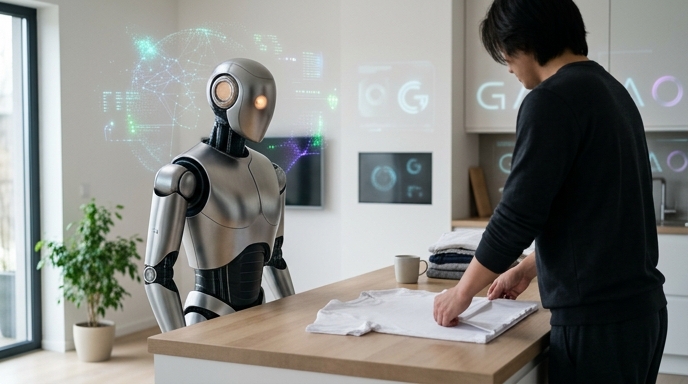
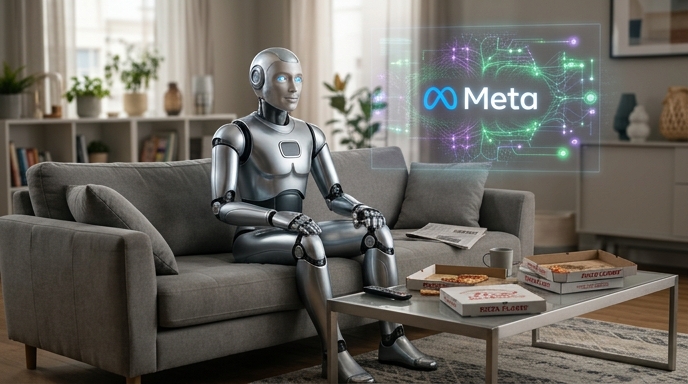
ARI’s goal? Robots that can do household chores. Fold laundry. Wash dishes. Maybe even judge you silently for leaving pizza boxes on the floor. The dream is a general-purpose physical agent that learns directly from human experience.
Meet the Brains Behind the Brains
Every great acquisition has a great team behind it. ARI is no exception.
The startup was co-founded by Xiaolong Wang, Lerrel Pinto, and Xuxin Cheng, and this trio brings some serious firepower to the table.
Wang is no stranger to the AI world. He previously worked as a researcher at Nvidia, the company that basically powers the entire AI revolution with its chips. He also served as an associate professor at UC San Diego and has racked up a string of prestigious awards. In a post on X, Wang explained that from day one, ARI knew their mission required “training a truly general-purpose physical agent.” He added that they now believe that agent will be humanoid, and that “scaling will come from learning directly from human experience.”
Then there’s Lerrel Pinto, who previously taught at NYU and co-founded Fauna Robotics, a kid-sized humanoid startup that Amazon snapped up just last month. Yes, Amazon. We’ll get back to that. Pinto left Fauna before the acquisition and clearly had bigger plans in mind.
All three co-founders, along with the entire ARI team, will now be joining Meta’s Superintelligence Labs, a research division that sounds like it was named by someone who just finished watching a sci-fi marathon. They’ll work alongside the Meta Robotics Studio, a group formed just last year to develop foundational technology for humanoid machines.
Why Does Meta Even Want Robots?
Fair question. Meta makes its money from ads. Lots and lots of ads. So why is Zuckerberg suddenly interested in building humanoid machines?
The answer is both strategic and philosophical.
On the strategic side, Meta CTO Andrew Bosworth laid out the vision back in 2025. He said the company wants to create software that other companies can license, similar to what Google does with Android. His exact words? “Software is the bottleneck.”
The plan is to start by developing software that powers a dexterous robotic hand, then build outward from there. Meta doesn’t necessarily want to manufacture robots. They want to be the operating system of the robotics industry. Think Android for humanoids. If that works, every robot company in the world could be running on Meta’s platform.
That’s not just a business play. That’s a power move.
On the philosophical side, there’s something even more interesting happening. Many AI experts now believe that the path to Artificial General Intelligence (AGI), the theoretical point where AI matches or surpasses human-level intelligence across all domains, will require training AI in the physical world. Not just on text and images, but through direct interaction with real environments.
Robots, in other words, might be the key to unlocking true AGI. And Meta wants a front-row seat.
The Humanoid Robot Race Is Officially On
Here’s where things get really fun. Meta isn’t the only player in this game. Not even close.
According to Engadget, Amazon has also been making aggressive moves in the humanoid space. The e-commerce giant recently acquired Fauna Robotics, yes, the same company that Lerrel Pinto co-founded. Amazon wants humanoid robots for its warehouses, its delivery operations, and probably a dozen other things it hasn’t told us about yet.
And then there’s Tesla. Elon Musk’s company has been working on its Optimus humanoid robot for years. In a jaw-dropping move earlier this year, Tesla decided to stop producing its Model S and Model X cars entirely, converting that production space at its Fremont factory to manufacture Optimus robots instead. Let that sink in. Tesla is literally trading cars for robots.
So you’ve got Meta, Amazon, and Tesla all sprinting toward the same finish line. The humanoid robot race isn’t coming. It’s already here.
What Makes ARI Different From the Competition?
Good question. The robotics space is crowded. Startups are popping up everywhere. So what made ARI worth acquiring?
Two things stand out.
First, the team’s academic pedigree is exceptional. Wang and Pinto aren’t just entrepreneurs, they’re researchers who have spent years publishing groundbreaking work on robot learning and physical AI. They understand the science at a deep level. That’s rare.
Second, ARI’s approach to learning is unique. Most robotics companies focus on programming robots with specific instructions. ARI focused on building models that allow robots to learn from watching humans. The idea is that a robot trained on human movement data can generalize to new situations, just like how a person who knows how to cook can figure out a new recipe without step-by-step instructions.
Wang put it plainly: scaling will come from “learning directly from human experience.” That’s a fundamentally different philosophy from traditional robotics, and it aligns perfectly with how modern AI systems like large language models have achieved their breakthroughs.
Meta, with its massive infrastructure, its AI research teams, and its access to enormous amounts of data, gives ARI the resources to actually test that philosophy at scale.
What About the Money?
Here’s the one thing nobody’s talking about, because nobody knows.
Meta has not disclosed the financial terms of the acquisition. No price tag. No valuation. Nothing. ARI had previously raised an undisclosed seed round from AIX Ventures, an AI-focused seed firm, but the company was still early-stage.
Given the talent involved and the strategic importance of the deal, analysts expect the acquisition price was significant. But in the world of Big Tech acquisitions, “significant” could mean anywhere from $100 million to well over a billion dollars.
What we do know is that Meta is spending heavily across the board. The company has been on an AI hiring and acquisition spree, and the ARI deal fits neatly into a broader pattern of aggressive investment in next-generation technology.
The Bigger Picture: What This Means for All of Us
Let’s zoom out for a second.
The humanoid robot market is projected to be enormous. TechCrunch notes that forecasts vary wildly, Goldman Sachs projects the market will hit $38 billion by 2035, while Morgan Stanley’s estimate goes all the way to $5 trillion by 2050. That’s a massive spread, and it reflects both the enormous potential and the genuine uncertainty around technology that’s still finding its footing.
But here’s the thing. Whether or not humanoid robots become a $5 trillion industry, the underlying AI technology being developed right now will matter enormously. The models that teach robots to understand human behavior, navigate complex environments, and learn from experience, those models will have applications far beyond robotics.
They’ll power smarter AI assistants. Better autonomous vehicles. More capable medical devices. The ripple effects are hard to predict, but they’re coming.
Meta’s acquisition of ARI isn’t just a robotics story. It’s an AI story. It’s a story about who gets to define the next era of intelligent machines, and who gets to profit from it.
Should You Be Excited? Nervous? Both?

Honestly? Both seems reasonable.
The idea of robots that can help with household chores, assist elderly people, or handle dangerous jobs is genuinely exciting. The potential to improve quality of life is real. And the science being developed by teams like ARI is legitimately impressive.
But there are also real questions worth asking. Who controls these robots? What happens to workers in industries that get automated? How do we ensure that the AI powering these machines is safe, transparent, and accountable?
Meta, for its part, is framing this as a long-term research initiative. They’re not promising a robot on your doorstep next year. They’re playing the long game, building the foundational software layer that could power an entire industry.
Whether that vision becomes reality depends on a lot of things. The science. The regulation. The market. And yes, the competition from Amazon, Tesla, and a dozen other companies racing toward the same future.
One thing is certain: the humanoid robot era is no longer science fiction. It’s a business strategy. And Meta just made a very loud statement about where it wants to stand when that era arrives.
Buckle up. The robots are coming, and they’re learning from us.
Sources
- iPhone in Canada — Meta Steps Into Robotics With New AI Acquisition
- Engadget — Meta Acquires Robotics AI Startup as It Makes the Push Into Humanoid Machines
- Cryptopolitan — Meta’s Humanoid AI Bet Deepens With Assured Robot Deal
- Bloomberg — Meta Buys Assured Robot Intelligence to Advance Humanoid AI Technology
- TechCrunch — Meta Buys Robotics Startup to Bolster Its Humanoid AI Ambitions
- Xiaolong Wang on X
The Kingy Brief
Get the next Kingy Brief.
Source-checked AI changes, original tests and one practical thing to try.
Free · Choose your subjects · Double opt-in · Unsubscribe anytime