The AI giant’s internal playbook is out in the open. Here’s what it means for the future of artificial intelligence.
The Memo Nobody Was Supposed to See
Imagine sending a four-page strategy memo to your entire company on a Sunday and then watching it land on the front page of The Verge by Monday. That’s exactly what happened to Denise Dresser, OpenAI’s Chief Revenue Officer.
The memo dropped. The internet exploded. And suddenly, everyone got a front-row seat to OpenAI’s most candid moment in years.
Dresser sent the internal document to employees on April 13, 2026. It was meant to rally the troops heading into Q2. Instead, it became one of the most-discussed leaks in recent AI history. The memo covers everything, new models, enterprise strategy, a bold Amazon partnership, and some surprisingly sharp jabs at rival Anthropic.
Buckle up. This one’s got layers.
“The Market Is as Competitive as I Have Ever Seen It”
Let’s start with the headline quote, because it’s a big one.
“The market is as competitive as I have ever seen it,” Dresser wrote. That’s not a throwaway line. That’s the CRO of the most famous AI company in the world waving a red flag in front of her own team.
Think about what that means. OpenAI launched ChatGPT in November 2022. It broke the internet It hit one million users in five days. It sparked a global AI arms race. And now, just a few years later, the company that started all of this is fighting to hold its ground.
The Verge reported that the memo “repeatedly underlines the importance of building a moat around its AI products.” Why? Because users switch between AI models like they’re flipping TV channels. One week it’s GPT. Next week it’s Claude. The week after that? Who knows.
Brand loyalty in AI, it turns out, is basically nonexistent. And OpenAI knows it.
Meet “Spud” — OpenAI’s Secret Weapon
Here’s where things get interesting. Buried inside the memo is a reference to a new model with a very humble codename: Spud.
Yes. Spud. Like the potato.
Don’t let the name fool you, though. According to Dresser, Spud is “an important step in the intelligence foundation for the next generation of work.” She says early customer feedback is “very positive.” The model delivers stronger reasoning, better understanding of intent and dependencies, and more reliable output in production environments.
But here’s the kicker. Dresser claims Spud will make all of OpenAI’s core products “significantly better.” Not just one product. All of them.
The Decoder broke down exactly what that means in practice. Better models lift the entire stack. Higher token limits. Lower latency. More reliable execution of complex workflows. Every improvement in compute lets OpenAI train stronger models, serve more demand, and lower the cost per unit of intelligence.
That’s what Dresser calls “durable business leverage.” And it’s the foundation of OpenAI’s path to what she describes as the “super app.”
From Chatbot to Platform: The “Frontier” Play
Here’s the strategic shift that might matter most in the long run.
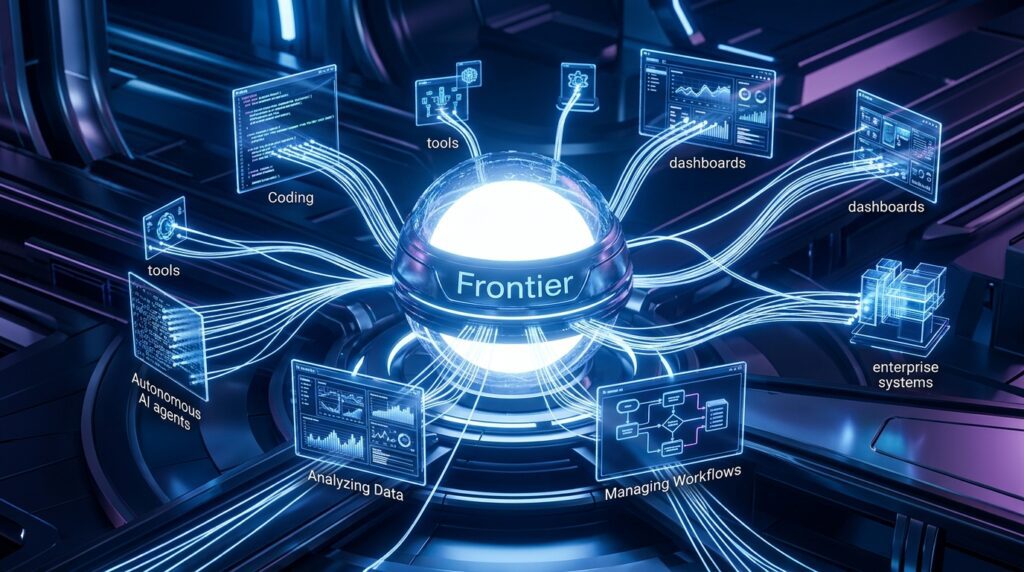
OpenAI isn’t just trying to be the best chatbot anymore. It wants to be the operating infrastructure of enterprise AI. And the vehicle for that ambition is a platform called Frontier.
“The market has moved from prompts to agents,” Dresser writes. Customers don’t just want a model that answers questions. They want systems that use tools on their own, operate across workflows, and function reliably inside real business environments.
Frontier is OpenAI’s answer to that demand. The memo positions it as “the default platform for enterprise agents.” Think of it as the layer that ties everything together, model intelligence, agent performance, orchestration, security, and governance.
The logic is elegant. Better models make the platform more valuable. Deeper integration raises switching costs. More workflows running through the system make OpenAI harder to replace. As The Decoder put it: “That is how we move from product vendor to operating infrastructure.”
That’s a massive ambition. And it’s a direct shot at every enterprise software company that thought AI was just a feature, not a foundation.
The Amazon Deal Nobody Saw Coming
OpenAI’s partnership with Microsoft has been foundational. Everyone knows that. But Dresser’s memo drops a bombshell: that same partnership has limited OpenAI’s reach.
Many enterprises live inside Amazon’s AWS ecosystem. They use Bedrock. They’re not going to migrate to Azure just to access OpenAI’s models. So OpenAI went to Amazon instead.
The partnership, announced in late February 2026, has generated demand that Dresser describes as “frankly staggering.” The key piece of the deal is something called the Amazon Stateful Runtime Environment, a system that goes beyond simple model access to enable memory, context, and continuity across interactions.
That’s a big deal. Most AI interactions today are stateless. You ask a question, you get an answer, and the system forgets everything. The Amazon runtime changes that. It lets AI systems work reliably over time, across complex, multi-step business processes.
Dresser lists three advantages: lower adoption friction for AWS-native customers, a stronger foothold in regulated industries, and deeper integration down to production runtime for long-running agents. In short, OpenAI just opened a second major distribution channel and it’s already on fire.
The Full Stack Vision: One Platform to Rule Them All
Dresser’s memo paints a picture of OpenAI as a company with multiple entry points into the enterprise. ChatGPT for Work handles knowledge work. Codex handles software development. The API powers embedded intelligence. Frontier runs agents. The Amazon runtime handles production-grade execution.
“We should stop thinking like a company with separate product lines,” she writes. “We should think like a platform company with multiple entry points and one integrated enterprise offering.”
The flywheel she describes is compelling. Better models drive more usage. More usage drives deeper integration. Deeper integration drives multi-product adoption. And multi-product adoption makes OpenAI harder to replace.
There’s also a new service called DeployCo in the works. The biggest bottleneck in enterprise AI isn’t whether the technology works, it’s whether companies can actually deploy it at scale. DeployCo aims to be the deployment engine that helps companies prove value faster, reduce risk, and scale adoption across their organizations.
TechBuzz compared this strategy to the playbooks that built Microsoft and Salesforce into durable businesses. Land a Fortune 500 client. Embed your product into their workflows. Create real switching costs. That’s the moat that actually holds water.
The Anthropic Section: Gloves Off
Now for the part of the memo that really got people talking.
Dresser dedicates an entire section to Anthropic. And she does not hold back.
“Their story is built on fear, restriction, and the idea that a small group of elites should control AI,” she writes. That’s a direct, pointed attack on Anthropic’s brand identity, a company that has long positioned itself as the “safe” AI lab.
OpenAI has consistently marketed itself as “democratic AI.” CEO Sam Altman wrote in February that “Anthropic serves an expensive product to rich people.” Dresser’s memo doubles down on that narrative.
But the memo goes further than rhetoric. It makes three specific claims about Anthropic’s weaknesses.
First, compute. Dresser says Anthropic made a “strategic misstep” by not acquiring enough compute. Customers feel it through throttling, spotty availability, and a less reliable experience. OpenAI saw the exponential compute curve earlier and moved faster.
Second, focus. Anthropic’s early emphasis on coding tools gave it a head start with developers. But in a platform war, that narrow focus becomes a liability as AI spreads beyond developers to every team and industry.
Third, and most aggressively revenue. Dresser claims Anthropic’s stated $30 billion run rate is inflated by roughly $8 billion. The accusation is that Anthropic grosses up revenue share payments from Amazon and Google, making its numbers look bigger than they actually are. OpenAI, she says, reports its Microsoft revenue share on a net basis, “which is more inline with standards we would be held to as a public company.”
It’s worth noting, as The Decoder points out, that none of these claims can be independently verified. Neither company is publicly traded. Both reportedly plan to go public this year, which means these accounting debates are about to get a lot more scrutiny.
What This Memo Really Tells Us
Step back for a second. What does a leaked Sunday memo from a CRO actually reveal?
A lot, it turns out.
It tells us OpenAI is feeling real pressure. You don’t send urgent four-page strategy documents on weekends unless the competitive heat is genuine. TechBuzz put it bluntly: “OpenAI just acknowledged what the rest of the AI industry already knew: being first doesn’t guarantee you’ll finish first.”
It tells us the AI market is commoditizing faster than expected. Technical differentiation between top models is narrowing. Benchmark leaderboards shift weekly. What looked like an unassailable lead 18 months ago now feels precarious.
It tells us enterprise is the battleground. Consumer users are fickle. Enterprise clients are sticky. The entire memo is oriented around locking in businesses, not individuals.
And it tells us the AI wars are just getting started. Anthropic is well-funded and shipping fast. Google can subsidize Gemini indefinitely. Meta gives away competitive models for free. Amazon and Microsoft hedge their bets by partnering with everyone.
OpenAI sparked the generative AI revolution. Now it’s fighting to lead the next chapter of it.
The Bottom Line

Denise Dresser’s memo is many things at once. It’s a rallying cry It’s a strategic blueprint. It’s a competitive takedown. And thanks to a leak, it’s now a public document that tells the whole world exactly how OpenAI sees the battlefield.
The company is betting on Spud to sharpen its models, Frontier to own the agent layer, Amazon to expand its reach, and DeployCo to win the deployment game. It’s a bold, multi-front strategy from a company that knows it can’t afford to coast.
The AI race is wide open. And OpenAI just showed everyone its hand.
Sources
- Read OpenAI’s Latest Internal Memo About Beating the Competition — The Verge
- OpenAI’s Leaked Memo Says New “Spud” Model Will Make All Its Products “Significantly Better” — The Decoder
- OpenAI CRO Warns Staff: AI Market ‘As Competitive as Ever’ — TechBuzz
The Kingy Brief
Get The Kingy Brief.
AI changes, original tests and one practical thing to try. Fridays at 09:00 Vancouver time.
Free · Double opt-in · Unsubscribe anytime
Signup help and newsletter schedule
Signup form provided by Beehiiv. After submitting, check your inbox for "Confirm your subscription to The Kingy Brief" and open its confirmation link. Check Spam or Promotions if you cannot find it.
Fridays at 09:00 Vancouver time: source-checked AI changes, original tests and one practical thing to try. The weekly restart begins October 9, 2026. We skip a week when there is not enough verified material. Free. Unsubscribe anytime.