The rumor just got a lot more interesting
Apple smart glasses have lived in the rumor mill for so long that they almost feel like tech folklore. They sit in that strange corner of gadget culture reserved for flying cars, foldable iPads, and products that somehow always seem “two years away.” But the latest wave of reporting feels different. It feels less like a moonshot and more like a product plan.
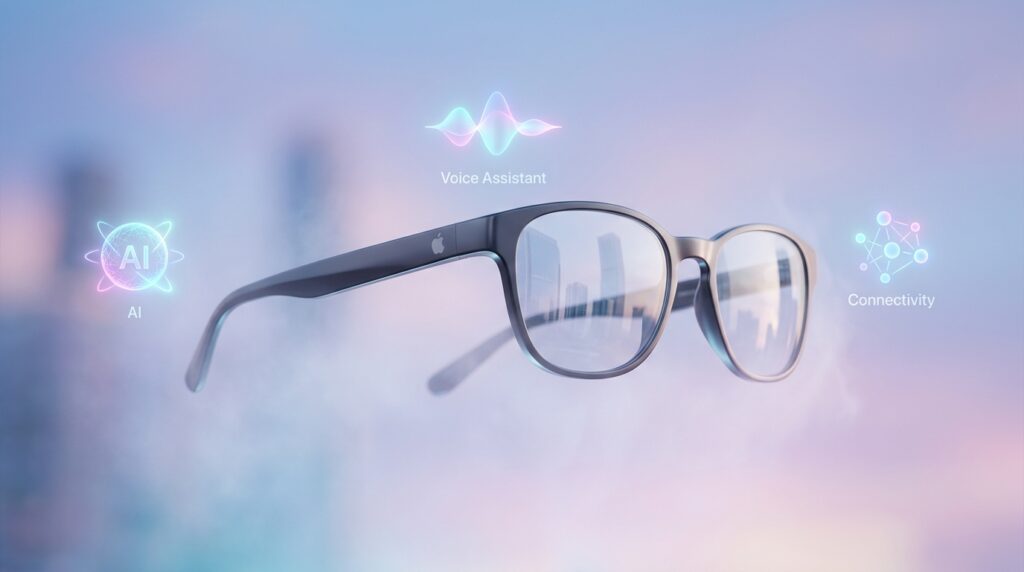
Across reports from ExtremeTech, The Decoder, heise online, and NDTV Profit, a consistent picture starts to emerge. Apple appears to be testing multiple frame designs for its first smart glasses, building them around cameras, microphones, speakers, and Siri-driven assistance rather than a full augmented reality display.
That last part matters. A lot.
This does not sound like a mini Vision Pro strapped to your face. It sounds more like Apple’s answer to the Meta Ray-Ban formula: something lighter, more social, more wearable, and much easier to imagine using in the real world. In plain English, Apple may have decided that the first big win in face-worn computing will not come from sci-fi holograms. It will come from glasses that people actually want to wear to lunch.
And honestly? That may be the smartest move Apple could make.
Four frame designs, premium materials, and a very Apple obsession with looks
If these reports are accurate, Apple is not treating its first smart glasses like a nerdy prototype dressed up as a consumer product. It is treating them like eyewear first and technology second. That sounds like a subtle distinction, but it could decide whether the product succeeds or becomes another gadget people admire in demos and ignore in daily life.
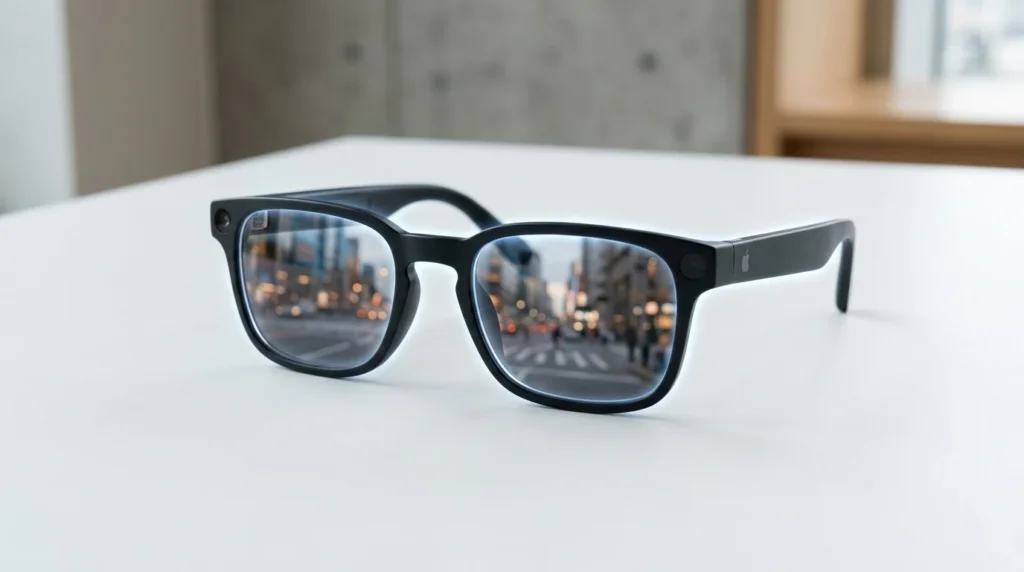
The linked reporting says Apple is testing at least four frame styles. Those reportedly include a large rectangular design, a slimmer rectangular shape said to resemble the everyday glasses worn by Tim Cook, and at least two oval or circular variants in different sizes. The company is also said to be experimenting with premium acetate frames and colors such as black, ocean blue, and light brown. That sounds less like a lab experiment and more like the early menu for an accessories line.
There is also talk of a vertically oriented oval camera module on the temple. That detail keeps popping up across reports, and it stands out because Apple usually sweats this kind of visual signature. If Meta’s smart glasses normalized the idea of cameras in frames, Apple may want its own instantly recognizable silhouette.
That is classic Apple behavior. The company rarely enters a category just to participate. It usually enters late, watches what works, and then tries to own the design language. Smart glasses, if they arrive, will need to look intentional. Not medical Not goofy. Not like a wearable apology.
So yes, the shape of the frame matters. In this category, the fashion is the feature.
Apple seems to be choosing AI over AR, at least for round one
The most revealing part of the reporting is not the color palette or the camera shape. It is the apparent lack of a display.
According to The Decoder, Apple is building smart glasses without a display and positioning them as an AI wearable. That would put the product in a very different lane from the futuristic AR glasses people have imagined for years. It also marks a practical retreat from the idea that consumers are ready for always-on digital overlays floating in front of their eyes.
That retreat may not be glamorous, but it makes a lot of business sense.
The NDTV Profit and ExtremeTech reports both frame Apple’s glasses as lightweight, practical, and built for everyday wear rather than immersive mixed reality. That sounds like a direct response to the limits of the current market. Consumers may admire the technical ambition of headsets, but they still care about weight, battery life, comfort, price, and whether a device makes them look like they are cosplaying the future in public.
Apple knows this. The company also knows the Vision Pro did not become a mass-market breakout. It became a fascinating, expensive signal flare.
So now Apple appears to be aiming lower in spectacle and higher in usability. That is not failure. That is course correction. And in tech, course correction often separates the products people tweet about from the products people actually buy.
What these glasses might actually do in daily life

Let’s talk about the part consumers will care about most: what the glasses can do when the novelty wears off.
The reports point to a familiar but increasingly useful feature set. Apple’s glasses are expected to rely on cameras, microphones, and speakers to support hands-free photos, short videos, voice calls, music playback, and context-aware assistance. ExtremeTech specifically mentions possible use cases like asking Siri about a landmark, translating a menu, or identifying objects in view. The Decoder adds a broader AI angle, describing a three-device strategy involving glasses, AirPods, and a camera pendant that capture the user’s surroundings through computer vision and feed that information to Siri and Apple Intelligence.
That is where the product starts to click.
This is not just about snapping point-of-view videos. It is about turning eyewear into an ambient interface. Walk through a city and get better navigation cues. Glance at a restaurant menu in another language and ask for help. Notice a building, artwork, or storefront and query it without pulling out your phone. The glasses become less like a screen and more like a layer of friction removal.
Of course, none of that works if the AI feels slow, clumsy, or weirdly unhelpful. But the use cases themselves are strong because they are boring in the best possible way. They solve tiny daily annoyances. Products win when they do that well.
Siri is now the make-or-break story
Here is the catch. Maybe the whole catch.
Apple can build gorgeous hardware. It can integrate chips, sensors, and industrial design better than almost anyone. But smart glasses are not won by hardware alone. They are won by intelligence, responsiveness, and trust. In other words, they are won by the assistant.
That puts Siri in the spotlight whether Apple likes it or not.
The Decoder reports that the glasses will rely on a new version of Siri shipping with iOS 27. heise online similarly notes that a significantly improved Siri is expected to line up with the glasses’ eventual launch window. That alignment is not a side note. It is the whole game.
If Siri still behaves like a voice interface from another era, the glasses risk feeling like attractive shells waiting for smarter software. If Siri becomes faster, more contextual, and genuinely multimodal, the glasses could feel magical without needing a display.
There is also pressure inside Apple’s AI story. The same Decoder report notes that former AI chief John Giannandrea is leaving the company after Apple Intelligence had an underwhelming rollout. That gives the glasses even more symbolic weight. They are not just a new gadget. They could become a public test of whether Apple can turn its AI ambitions into something coherent, useful, and delightfully invisible.
No pressure, Siri.
Apple is entering a market Meta helped validate
A few years ago, smart glasses still felt like a category in search of a reason to exist. Meta changed that. Its Ray-Ban smart glasses did something that many wearables fail to do: they made the device look normal enough to wear outside a keynote.
Apple has clearly noticed.
Several of the linked reports compare Apple’s rumored approach to Meta’s smart glasses. That comparison is unavoidable because the broad formula now looks obvious: stylish frames, cameras, audio, voice interaction, and AI features that feel helpful in the moment rather than revolutionary on a poster. Apple appears to be borrowing the market lesson without copying the exact execution.
And that lesson is simple. People will forgive limited functionality if a device fits naturally into their lives. They will not forgive awkwardness.
Still, Apple has some advantages Meta does not. Tight iPhone integration could make setup cleaner, notifications smarter, and cross-device handoff more polished. Apple also has a stronger reputation for on-device processing, privacy messaging, and hardware-software coordination. If the company can say, with a straight face, that these glasses work seamlessly with your phone and treat your surroundings responsibly, that message will land.
At the same time, the reporting hints at one unresolved point: who shapes the final fashion story. heise online says EssilorLuxottica is involved in manufacturing, while The Decoder says Apple plans to handle the design in-house. Those details are not identical, but they are not mutually exclusive either. Apple may want outside manufacturing muscle while still controlling the aesthetic.
That sounds, again, very Apple.
The hardest problems are not technical. They are human.
Smart glasses always hit the same wall eventually: people.
Not processors, Not sensors, Not industrial design. People.
Can you wear them for hours without discomfort? Can you charge them without changing your life? Will people around you know when you are recording, will they trust those signals? Will consumers feel cool wearing them, or merely compliant? These questions do not fit neatly on a spec sheet, but they decide the fate of almost every wearable.
The latest reports suggest Apple understands at least some of that. The camera module is said to be surrounded by lights that indicate recording, a small detail mentioned by ExtremeTech. That matters because smart glasses live or die by social acceptability. Google Glass taught the industry a brutal lesson: if bystanders feel uneasy, the product becomes radioactive no matter how advanced it is.
Battery life presents another quiet threat. AI features, cameras, microphones, speakers, and constant connectivity all demand power. The product must remain light while doing real work. That is a nasty engineering puzzle.
Then there is price. None of the linked reports confirms pricing, and that silence is loud. If Apple prices the glasses like a luxury experiment, the category stays niche. If it prices them more like a premium daily accessory, adoption becomes plausible.
In short, Apple does not just need to build smart glasses. It needs to build socially survivable smart glasses. That is a much taller order.
Timing matters, and Apple still seems to be feeling its way forward
The timeline in the reporting is promising but hardly locked down. The Decoder points to an announcement in late 2026 or early 2027, with sales the same year. heise online also points to 2027 as the likely market arrival. NDTV Profit adds the possibility that prototypes or concepts could surface by the end of 2026.
That sounds about right for Apple: close enough to feel real, far enough to remain flexible.
Flexibility matters because Apple has a long history of changing its mind when a product fails to meet its standards or the market shifts underneath it. ExtremeTech notes that Apple could still alter its plans or cancel projects outright, much as it did with the Apple Car. Rumors are not roadmaps. They are snapshots of motion.
Still, the volume and consistency of these reports make it harder to dismiss the project as vapor. Apple seems to be making real choices now: display or no display, one frame or many, bold concept or everyday object. Those are not the kinds of decisions companies make when they are merely daydreaming.
They are the kinds of decisions companies make when they are trying to land the plane.
Apple’s first smart glasses could define the next chapter of AI hardware
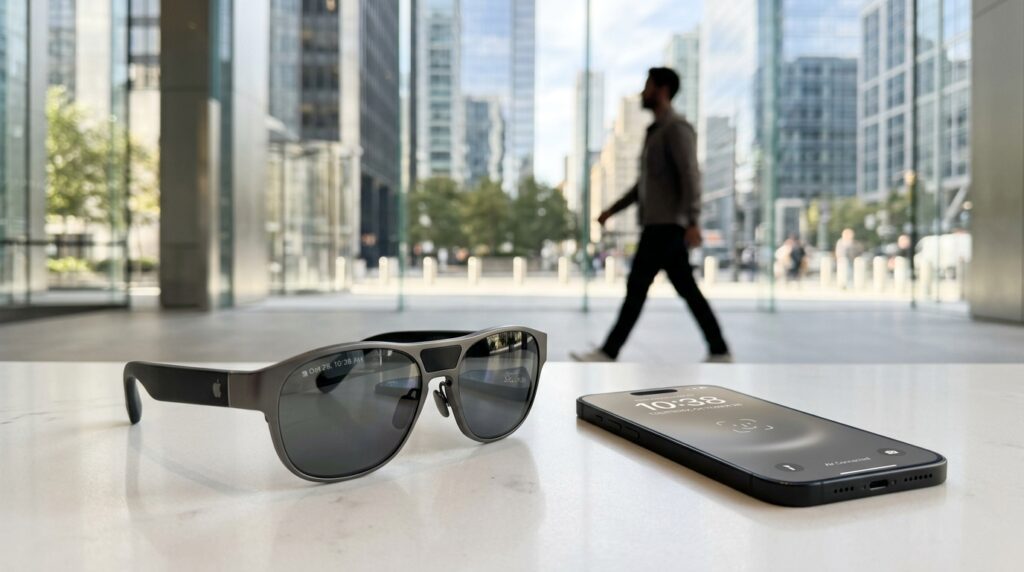
Here is the big picture: Apple may be approaching smart glasses not as a new screen, but as the first truly mainstream AI accessory.
That framing changes everything.
If the company can make eyewear that looks good, sounds good, captures useful context, and feeds that context into a more capable Siri, it may help shift AI away from the chatbot box on a phone screen and into the flow of everyday life. Not with fireworks. With convenience With tiny moments of assistance. With less reaching, tapping, and fumbling.
That is why these rumors feel bigger than a hardware leak. They hint at Apple’s answer to a rapidly changing AI landscape. Rivals have moved fast. Meta found product-market traction. Google and Samsung keep circling the space. Apple, after some stumbles in AI messaging and some very expensive lessons in mixed reality, now appears to be choosing a more grounded strategy.
Make the glasses light, make them handsome, make them useful. Make the AI good enough that people stop thinking about the AI.
That is a very Apple ambition. It is also a risky one. If the company nails the design but misses on Siri, the glasses will feel hollow. If it nails the AI but misses the social fit, people will leave them in drawers. But if Apple gets both right, its first smart glasses may do something the industry has struggled to pull off for years: make face-worn computing feel normal.
And that, more than any futuristic demo, would be the real breakthrough.
Sources
- ExtremeTech: Apple Could Launch Smart Glasses Inspired by Tim Cook’s Own Specs
- The Decoder: Apple is building smart glasses without a display to serve as an AI wearable
- heise online: Apple reportedly working on four different designs for its first smart glasses
- NDTV Profit: Apple Smart Glasses, In Four Distinct Frame Designs, May Be Unveiled Later This Year: Mark Gurman
- 4sysops activity link 76359
- 4sysops activity link 76399
Apple Wearables
Apple Hardware Roadmap
Apple Smart Glasses
AI Smart Glasses
Meta Smart Glasses
The Kingy Brief
Get The Kingy Brief.
AI changes, original tests and one practical thing to try. Fridays at 09:00 Vancouver time.
Free · Double opt-in · Unsubscribe anytime
Signup help and newsletter schedule
Signup form provided by Beehiiv. After submitting, check your inbox for "Confirm your subscription to The Kingy Brief" and open its confirmation link. Check Spam or Promotions if you cannot find it.
Fridays at 09:00 Vancouver time: source-checked AI changes, original tests and one practical thing to try. The weekly restart begins October 9, 2026. We skip a week when there is not enough verified material. Free. Unsubscribe anytime.