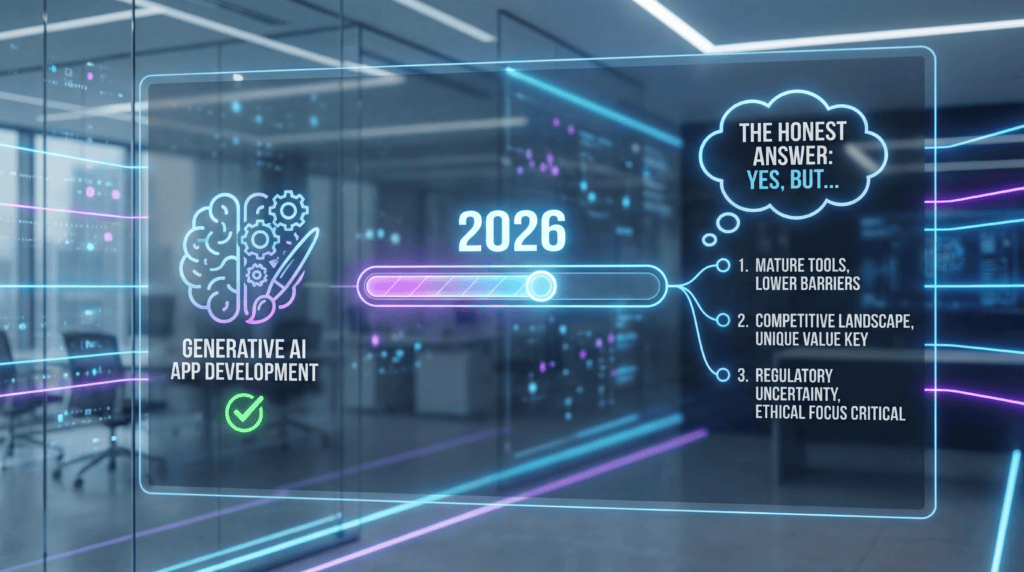
The market is bigger than ever. The risks are more real than ever. Here’s how to think about it.
There is a particular kind of startup founder energy in the air right now — the kind that arrives when a technology wave is clearly real, clearly massive, and clearly not yet figured out. Generative AI in 2026 has that energy in abundance. The spending numbers are staggering. The adoption curves are genuinely historic. The exit activity is accelerating. And yet, in the same week that analysts are projecting trillions of dollars in AI infrastructure spend, OpenAI quietly published a help center page announcing that Sora — its flagship consumer video generation product — will be discontinued on April 26, 2026, with the API following on September 24, 2026.
That tension — between extraordinary opportunity and extraordinary fragility — is exactly what any serious founder needs to sit with before writing a single line of code.
So let’s be rigorous. Not pessimistic, not hype-fueled. Let’s actually look at the data.
The Market Signal Is Deafening
Start with the numbers, because they’re genuinely hard to dismiss.
Gartner forecasts worldwide generative AI spending will reach $644 billion in 2025 — a 76.4% year-over-year increase from $365 billion in 2024. But this figure requires a crucial footnote: approximately 80% of that spend is concentrated in hardware — AI-capable devices, servers, and chips. Smartphones, PCs, and data centers are being redesigned around AI as a core capability, which means GenAI is being embedded into the consumer stack rather than sold purely as standalone apps. This is both an opportunity and a warning, which we’ll return to.
Looking further out, Gartner projects total worldwide AI spending will reach $2.52 trillion in 2026 and $3.34 trillion in 2027, with infrastructure remaining the largest component. Bloomberg Intelligence estimates that generative AI will produce $1.3 trillion in revenue by 2032, growing at roughly 43% CAGR from approximately $64 billion in 2023 — spanning hardware, software, services, advertising, and gaming. These aren’t niche forecasts from AI boosters. They’re mainstream analyst consensus.
For a consumer media startup specifically — someone building tools for video, image, or audio generation — the more relevant slice is the intersection of the creator economy and media production tooling, and how dramatically generative AI is changing who can produce shareable, professional-quality media. That intersection is still in its early innings, even as the broader market scales rapidly.
Adoption Is Real — And Faster Than Any Technology Before It
The Stanford Institute for Human-Centered Artificial Intelligence’s 2026 AI Index Report reports 53% population adoption within three years — a pace faster than PCs or the internet. The Stanford report also estimates $172 billion in annual value delivered to U.S. consumers, much of it from “free” tools, and notes that the U.S. ranks 24th globally in adoption at 28.3%.
Microsoft’s AI Diffusion Report, which uses telemetry-based methodology adjusted for device share and internet penetration, estimates that 16.3% of the world’s population used a GenAI product during H2 2025. These figures aren’t contradictory — they measure different things (“ever adopted” vs. “used in a measured period”). Together, they paint a coherent picture: the market is decisively past “early adopter only,” but habitual usage is still being formed.
The consumer adoption evidence is equally compelling. Pew Research Center found that 34% of U.S. adults have used ChatGPT as of June 2025 — roughly double the share from 2023 — including 58% of adults under 30. For teens, Pew reports that roughly two-thirds of U.S. teens (13–17) use AI chatbots, with about three-in-ten using them daily. Even if “chatbot use” doesn’t equal “media generation,” the behavioral implication is significant: future creators are growing up with AI as a default tool. For founders building creation workflows, that is a cultural tailwind that compounds over time.
On the traffic side, Similarweb reports that ChatGPT.com scaled from 2.6 billion to 5.7 billion monthly visits over a 12-month period — a 117% increase — and that AI platform visits broadly grew approximately 28.6% from January 2025 to January 2026. These are not speculative projections. They are observed traffic data.
The practical founder interpretation is this: the reachable audience is already enormous. The bottleneck is no longer consumer education — it’s differentiation and value capture.
The Funding Environment Tells the Same Story (With a Caveat)
Private capital has converged on AI with a ferocity that hasn’t been seen since the mobile internet wave. CB Insights reports $225.8 billion in global private AI equity funding in 2025 across 6,913 deals — nearly double the $114.4 billion raised in 2024. Exit activity is equally significant: 782 AI M&A exits in 2025 (vs. 484 in 2024), plus 40 AI IPOs.
For consumer generative AI media specifically, the category signals are strong. Runway, the AI video startup, raised a $315 million Series E led by General Atlantic at a ~$5.3 billion valuation, with NVIDIA’s venture arm among the strategic participants. Suno announced a $250 million Series C at a $2.45 billion post-money valuation, alongside a rapidly growing subscription business. These rounds matter not just as data points on capital availability, but as signals that creative-first consumer AI can become a platform business rather than a feature.
The caveat? CB Insights also shows that the largest private valuations in AI — OpenAI at $500 billion, Anthropic at $350 billion — highlight a stark reality: the platform layer has the capital to outbid, out-compute, and out-distribute almost any consumer app startup. When you’re building on APIs owned by companies with those valuations, your differentiation cannot be purely about model quality. They will always have better models than you.
The Sora Warning: Platform Risk Is Not Theoretical
Let’s talk about the elephant in the room.
In late March 2026, OpenAI announced the discontinuation of Sora — its consumer video generation product — barely six months after its public launch. The app will go dark on April 26, 2026. The API shuts down on September 24, 2026. According to reporting from TechCrunch, Sora’s worldwide user count peaked at around one million and then collapsed to fewer than 500,000, while the service cost approximately $1 million per day to operate due to the computational demands of video generation.
The strategic rationale was compute reallocation toward more profitable enterprise and coding products — an acknowledgment that consumer video generation, at current economics and scale, couldn’t justify the infrastructure burn. Reuters reported that even Disney — which had committed $1 billion to the OpenAI partnership — found out about Sora’s discontinuation less than an hour before the public announcement.
Think about that for a moment. A billion-dollar enterprise partner had less than one hour’s notice.
For founders building on third-party AI platforms, this is not a cautionary tale about a bad product. Sora was technically impressive. It’s a cautionary tale about structural fragility. When your entire product layer depends on a single provider’s API, you inherit all of their business decisions. Their compute constraints become your outages. Their strategic pivots become your shutdowns.
This risk generalizes in multiple directions: model deprecations, pricing changes, sudden safety policy shifts that restrict outputs central to your niche community, and capacity rationing during compute shortages — video generation being particularly vulnerable to this last one. One solo developer’s experience making headlines illustrates the issue from another angle: a leaked Google API key resulted in a $15,000 bill overnight, effectively destroying a startup before it had shipped.
The lesson for founders: treat model API access like a cloud dependency with high churn probability. Build for provider volatility from day one.
The Incumbent Bundling Problem
There’s a second structural headwind that founders often underestimate until it’s too late: incumbents embedding GenAI into their existing products for free.
Gartner’s forecast data makes this explicit. The reason 80% of GenAI spending goes to hardware is that AI capabilities are being integrated into devices and platforms as default features — not as standalone apps you pay for separately. As Gartner’s research notes, by 2028, “AI-enabled devices will comprise almost the entire consumer device market.” Consumers won’t be choosing to buy AI; they’ll be buying a phone and AI will come with it.
Translate this to the consumer media creation space: Adobe has AI generation built into Creative Cloud. Meta has AI image and video tools embedded directly into Instagram and Reels. Google’s Veo 3.1 is integrated into Workspace and YouTube’s creator tools. Apple Intelligence is baked into iOS. When a user already has a “good enough” video or image generator in the apps they already use, the bar for installing and paying for a dedicated standalone app rises dramatically.
This is the “feature replication” risk, and it’s fast. A genuinely novel AI interaction pattern has, in recent cycles, gone from “startup exclusive” to “Big Tech default feature” in roughly 6–18 months. Any go-to-market strategy that doesn’t account for this is a go-to-market strategy built on a melting foundation.
The Technical Realities of Shipping in 2026
Development speed is genuinely improving. Open-source inference infrastructure like vLLM — with features like PagedAttention, continuous batching, and quantization support — and NVIDIA’s TensorRT-LLM have made high-throughput serving significantly more accessible. A well-funded team can now build a production-grade AI pipeline in weeks rather than years.
But “cheap tokens” don’t guarantee a profitable application. Gartner forecasts that by 2030, inference on a 1-trillion-parameter model will cost GenAI providers over 90% less than in 2025 — but also warns that token demand, especially for agentic workloads, can rise faster than unit costs fall. For consumer media apps, the analog is this: per-generation cost can fall, but user appetite for higher-resolution video, longer clips, and iterative re-rolls grows in parallel. Total variable cost can still climb unless you engineer constraints and upsell paths into the UX from the beginning.
The unit economics that actually matter for a consumer GenAI media startup are: variable inference cost per creation event (especially for video, which is iteration-heavy and users re-roll frequently), what fraction of usage can be cached or batched (which can change costs by multiples in token-priced systems — see Anthropic’s pricing documentation and OpenAI’s batch pricing tiers), and fraud and abuse costs, which can be catastrophic if API keys are compromised.
The practical implication: a consumer media startup can often win on cost-per-delight by intelligently combining cheaper models for routine steps, caching repeated context (style kits, brand references, system prompts), and batching non-interactive generation — rather than routing every user action through the most expensive model available.
The Regulatory Reality Check
If you’re building for a global consumer market in 2026, compliance is not future work. It’s current work.
The EU AI Act entered into force on August 1, 2024. General-purpose AI model obligations became applicable on August 2, 2025. The Act becomes fully applicable on August 2, 2026 — which is roughly 16 weeks from today. Any consumer GenAI media product operating in European markets needs to be thinking about disclosure norms, transparency requirements, and prohibited use cases now.
In the U.S., deepfake-related legislation has proliferated rapidly at the state level. The National Conference of State Legislatures tracks 2024 deepfake legislation covering categories including non-consensual intimate imagery and political deepfakes — and more states are legislating in 2025 and 2026. For any app that can generate realistic video or voice content of real people, this is an existential liability question, not an abstract one.
Copyright is equally real. The U.S. Copyright Office’s January 2025 report on AI and copyrightability has begun to clarify the rules of the road for AI-generated content ownership. Output ownership can depend on the level of human authorship contribution, the terms of the tool being used, and how training data disputes resolve in court. For music in particular, Suno’s $2.45 billion valuation coexists directly with ongoing litigation pressure from major labels — a reminder that strong consumer monetization does not insulate you from IP risk.
The NIST AI Risk Management Framework (NIST AI 600-1) for generative AI systems, while voluntary, is becoming a de facto procurement and governance reference for platforms and enterprise buyers alike. And for content provenance, the C2PA (Coalition for Content Provenance and Authenticity) technical specification is quietly becoming a distribution requirement as platforms, advertisers, and app stores tighten their policies around AI-generated media.
Practical implication: for any audio or video product in 2026, provenance, watermarking, and robust impersonation protections aren’t compliance overhead — they’re distribution unlocks that will increasingly determine whether platforms will carry your content and advertisers will support your business.
So Is It a Good Time? The Honest Answer.
Yes — and it depends entirely on what you build.
The aggregate signals are genuinely positive. Adoption is fast and real. Funding is available. Exit activity is accelerating, with M&A as the dominant path. The technology has crossed the threshold from “research lab demo” to “consumer product.” The cultural moment for AI creativity is arguably the most receptive it has ever been, with teens and young adults treating generative AI as a default tool rather than a novelty.
But the risks are equally real and more acute than many first-time AI founders appreciate. Platform volatility is not hypothetical — Sora’s shutdown just demonstrated it with a countdown clock and permanent data deletion. Bundling by incumbents is not a future risk — it is an active present tense. Unit economics can turn catastrophic at video generation scale without disciplined UX design. And the regulatory window is closing: the EU AI Act becomes fully applicable in August 2026.
The founders most likely to succeed are those who internalize a specific strategic posture: you are not building a “generation” product. You are building a workflow.
What the Winning Play Actually Looks Like
The strongest consumer GenAI media products in 2026 share a common architecture: they are workflow-native rather than “general generators,” and they accrue defensibility through community, content rights, and integration depth — not model quality.
Choose a vertical creative job-to-be-done. “Shop-quality product clips for e-commerce sellers,” “anime-style sequences for fandom creators,” “stems and soundtracks for short-form video creators” — the goal is to become part of a concrete workflow where users pay for speed, consistency, and control. Not just for the output itself. Runway has explicitly positioned its Gen-4 model around “consistent and controllable media generation” — a workflow attribute, not a raw capability claim.
Build multi-provider portability from day one. Model routing, abstraction layers, exportable user assets, and “bring your own model” options for power users are no longer nice-to-haves. They’re the difference between surviving a Sora-style shutdown and being stranded. Contractual SLAs matter for any B2B or prosumer tier.
Design unit economics into UX before you write the monetization layer. Credit systems and generation constraints are cost-control mechanisms, not just pricing decisions. Preview modes, limited default resolutions, and “draft mode” generation are the features that keep a consumer video product solvent. The subscription-plus-credits model used by Suno (with tiers at $8 and $24/month) and Runway (credit-based plans with free-to-paid upgrade paths) reflects hard-won unit economics discipline.
Differentiate on rights and trust, especially for audio and video. The products that survive the coming wave of regulation and platform scrutiny will be those that make commercial rights clarity, provenance defaults, and brand/artist controls first-class features — not legal afterthoughts appended to the terms of service. Licensed datasets, opt-out/opt-in controls for creator content, and similarity filters are the technical infrastructure of a sustainable business in this space.
Plan your exit as a strategic acquisition target. With CB Insights showing 782 AI M&A exits in 2025 against just 40 IPOs, the realistic outcome for most consumer GenAI media companies is acquisition by a creative suite (Adobe, Canva), a social platform (Meta, TikTok’s parent), or a media or entertainment incumbent seeking workflow, distribution, and rights positioning. Build assets that are acquirable: a defensible niche workflow, a creator community with genuine lock-in, proprietary data partnerships, and a clean IP posture.
The Weakest Play (And Why Founders Keep Doing It Anyway)
For balance, it’s worth naming the patterns most likely to fail.
A generic text-to-video or text-to-image app with no proprietary data, no network effects, a single-provider API dependency, and no clear community loop is probably the single most funded startup archetype in AI right now — and one of the most precarious. Not because the technology doesn’t work. Because the market structure makes it almost impossible to defend. The same generation that makes your product impressive will be bundled into the phone operating system 18 months from now.
The same logic applies to “ChatGPT wrapper” businesses that provide a UI layer over a foundation model with no differentiated data, no workflow depth, and no community — and charge for access to something users can get directly.
The irony is that this is exactly the kind of product that’s easiest to demo. It feels like a product. It gets signups. It might even get funding. But without a moat that survives model commoditization, it’s a business on borrowed time.
The Bottom Line
April 2026 is simultaneously the best time and the most treacherous time to start a consumer generative AI media company.
The best time: because the market is real, the adoption is fast, the capital is available, and the cultural moment for AI creativity is broadly normalized for the first time in history. Consumers are ready. Investors are ready. The exit paths are defined.
The most treacherous time: because platform volatility is live and documented, incumbent bundling is accelerating, regulatory timelines are imminent, and the unit economics of consumer video at scale have already burned one well-funded team into the ground.
The honest framework is this: build only if your strategy is defensible against model commoditization, platform shutdowns, feature replication by incumbents, regulatory tightening, and compute cost shocks. That means a workflow-native product with proprietary distribution loops, rights-aware architecture, multi-provider portability, and community or data assets that incumbents cannot replicate by simply upgrading their API.
If your answer to “what is your moat?” is “we have better prompts” or “we use the latest model” — it is not a good time to build. If your answer is “we have a creator community that generates proprietary data, a workflow that competitors can’t bundle into a phone OS, and a rights posture that lets us operate where others can’t” — then yes. It is a very good time to build.
The window is open. But it has latches.
Generative AI Market Timing
- generative AI market forecast to 2032
- state of generative AI in 2026
- generative AI trends and opportunities in 2025
AI Founder Funding Context
AI App Market Structure
Enterprise Generative AI Adoption
The Kingy Brief
Get The Kingy Brief.
AI changes, original tests and one practical thing to try. Fridays at 09:00 Vancouver time.
Free · Double opt-in · Unsubscribe anytime
Signup help and newsletter schedule
Signup form provided by Beehiiv. After submitting, check your inbox for "Confirm your subscription to The Kingy Brief" and open its confirmation link. Check Spam or Promotions if you cannot find it.
Fridays at 09:00 Vancouver time: source-checked AI changes, original tests and one practical thing to try. The weekly restart begins October 9, 2026. We skip a week when there is not enough verified material. Free. Unsubscribe anytime.