
The Letter That Moved Markets
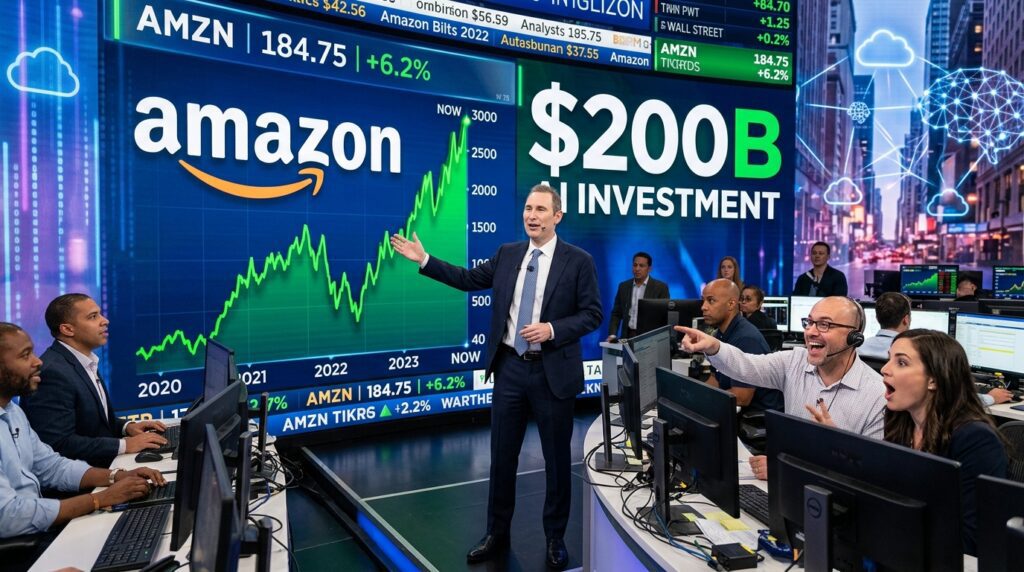
On Thursday morning, Amazon CEO Andy Jassy dropped his annual shareholder letter — and Wall Street paid attention. Fast.
Amazon shares surged 5.6% by the close of trading on April 9, 2026. Trading volume hit 64.9 million shares — about 30% above its three-month average. That’s not a coincidence. Jassy didn’t just write a letter. He made a case. A bold, unapologetic, “we’re going to win this thing” kind of case.
The headline? Amazon plans to spend roughly $200 billion on capital expenditures in 2026, with the lion’s share going straight into AI infrastructure — data centers, chips, and networking equipment. That’s a nearly 60% jump from last year. And more than any of its tech peers.
Some investors had been nervous. Skeptical, even. Jassy’s response? Direct and unambiguous.
“We’re not going to be conservative in how we play this — we’re investing to be the meaningful leader.”
That’s not corporate speak. That’s a declaration.
$15 Billion and Climbing: AWS’s AI Revenue Is Real
Here’s where it gets really interesting. For the first time ever, Amazon revealed exactly how much money its AI services are generating inside AWS.
The number? $15 billion in annual run rate — and that’s just from Q1 2026. That’s roughly 10% of AWS’s total $142 billion annual revenue rate. And Jassy says it’s “ascending rapidly.”
To put that in perspective, consider this: three years after AWS launched commercially, it had a $58 million revenue run rate. Three years into the AI wave? AWS’s AI revenue alone is over $15 billion. That’s nearly 260 times larger at the same point in the growth curve.
Let that sink in for a second.
Customers aren’t just experimenting with AI on AWS. They’re committing to it. Jassy pointed to the over $100 billion commitment from OpenAI as one example. He also noted that Amazon has already secured customer commitments for “a substantial portion” of its 2026 capex spend — with most of it expected to be monetized in 2027 and 2028.
“We’re not investing approximately $200 billion in capex in 2026 on a hunch,” Jassy wrote.
Fair point.
The Chip Business Nobody Saw Coming
Okay, this is the part of the story that deserves its own spotlight. Because it’s wild.
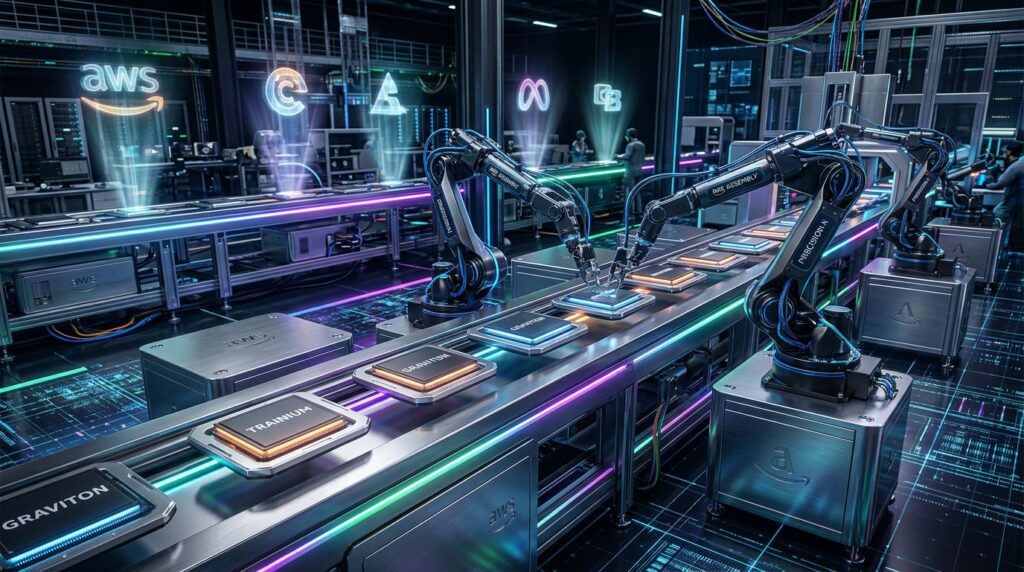
Amazon’s custom chip business — which includes its Graviton processors, Trainium AI chips, and Nitro architecture — now sits at an annual revenue run rate of over $20 billion. And it’s growing at triple-digit percentages year over year.
Triple digits. Year over year.
Jassy called it “on fire.” That might actually be an understatement.
Here’s the kicker: if Amazon’s chip division were a standalone business selling semiconductors to AWS and third parties — the way Nvidia or Broadcom does — its annual run rate would be approximately $50 billion. That would make it one of the most valuable semiconductor businesses on the planet.
For context, Broadcom’s AI chip operations are projected to deliver around $10.7 billion in a single quarter. Broadcom commands a market cap of $1.66 trillion. Amazon’s chip business, if spun out, would be in that same conversation.
Selling Chips to the Competition? Maybe.
Here’s where things get spicy.
Jassy hinted that Amazon might start selling its chips directly to third-party companies — not just renting them through AWS. The demand is simply that intense.
“There’s so much demand for our chips that it’s quite possible we’ll sell racks of them to third parties in the future,” Jassy said.
Think about what that means. Amazon — which currently buys chips from Nvidia — could become a chip seller competing directly with Nvidia. And with Broadcom. That’s a seismic shift in the semiconductor landscape.
The Trainium story backs this up. Trainium2 offered about 30% better price-performance than comparable GPUs and largely sold out. Trainium3, which started shipping in early 2026, is 30–40% more price-performant than Trainium2 — and it’s nearly fully subscribed. A significant chunk of Trainium4, still about 18 months from broad availability, has already been reserved.
Customers aren’t waiting. They’re lining up.
Rebuilding the Shopping Experience From Scratch
The AI ambitions don’t stop at the cloud. Not even close.
Jassy made clear that Amazon plans to rebuild its entire customer shopping experience around AI — from the ground up. Not just adding AI features on top of what already exists. Starting over.
“The temptation is to just add a little AI to the existing experience,” Jassy wrote. But the real move, he argued, is “reimagining your experiences from a clean sheet of paper.”
That’s a bold thing to say when your existing experience already serves hundreds of millions of customers. Jassy acknowledged it feels like “going backwards.” But he argued that standing still during a moment of rapid technological change is the riskier bet.
“AI is not a standalone initiative — it’s a multiplier,” he wrote. “It will reshape every customer experience we offer and unlock entirely new ones.”
The interface customers use to interact with a retailer, Jassy suggested, could look “substantially different” in the years ahead. He’s not just talking about a smarter search bar. He’s talking about a fundamentally different way to shop.
The Long Game: Bezos Did This Before
If all of this sounds familiar, it should.
Jassy deliberately echoed the playbook of his predecessor, Jeff Bezos. Back in the early days of Amazon, Bezos told Wall Street to be patient. The company stayed unprofitable for years. Investors grumbled. Then Amazon built AWS, dominated e-commerce, and became one of the most valuable companies in history.
Jassy is making the same argument now. Spend big. Endure short-term pain. Win the long game.
“We are willing to make large capex investments and endure short-term FCF headwinds for the substantial medium to long-term FCF surplus,” Jassy wrote.
Amazon’s revenue grew 12% year-over-year in 2025, from $638 billion to $717 billion. AWS added 3.9 gigawatts of new power capacity in 2025 alone and expects to double its total power capacity by the end of 2027. The company also announced $12 billion in new data center investments in Mississippi, bringing its total investment in the state to $25 billion.
This isn’t a company hedging its bets. This is a company going all in.
What This Means for Investors
So what should investors make of all this?
The market’s initial reaction was clear — a 5.6% single-day surge tells you something. But the real story plays out over the next two to three years, as those 2026 capex investments start generating revenue in 2027 and 2028.
According to The Motley Fool, investors will now focus on how aggressive AI infrastructure spending translates into future AWS and chip revenue growth. The $15 billion AI revenue run rate answers part of that question. The chip business answers another part. The retail reinvention answers a third.
Jassy isn’t asking investors to trust a vision. He’s showing them receipts.
Customer commitments. Revenue run rates. Chip subscriptions booked 18 months in advance. These aren’t projections. They’re signals.
The Bottom Line

Amazon isn’t just defending its AI spend. It’s doubling down on it — with data, with conviction, and with a roadmap that stretches years into the future.
The $200 billion bet is big. The chip business is bigger than most people realized. The retail reinvention is ambitious. And the AWS AI revenue numbers are real.
Jassy said it best: “AI is a once-in-a-lifetime opportunity where the current growth is unprecedented and the future growth even bigger.”
Whether you’re an investor, a developer, a shopper, or just someone who pays attention to where the world is heading — Amazon just told you exactly where it’s going.
And it’s not slowing down.
Sources
- CNBC — Amazon CEO Jassy defends $200 billion AI spend
- The Motley Fool — Stock Market Today, April 9: Amazon Surges After CEO Details AI and AWS Growth Plans
- About Amazon — Amazon CEO Andy Jassy talks 6 truths surrounding the rise of AI
- Fox Business — Amazon disrupting itself, rebuilding customer shopping experience around AI from ground up
- Business Standard — Amazon considers selling in-house AI chips to firms amid demand surge
- MoneyCheck — Amazon (AMZN) Stock Climbs After CEO Reveals Chip Division Could Hit $50B Valuation
Compare
Popular Tools
Recent Launches
Latest News
The Kingy Brief
Get The Kingy Brief.
AI changes, original tests and one practical thing to try. Fridays at 09:00 Vancouver time.
Free · Double opt-in · Unsubscribe anytime
Signup help and newsletter schedule
Signup form provided by Beehiiv. After submitting, check your inbox for "Confirm your subscription to The Kingy Brief" and open its confirmation link. Check Spam or Promotions if you cannot find it.
Fridays at 09:00 Vancouver time: source-checked AI changes, original tests and one practical thing to try. The weekly restart begins October 9, 2026. We skip a week when there is not enough verified material. Free. Unsubscribe anytime.