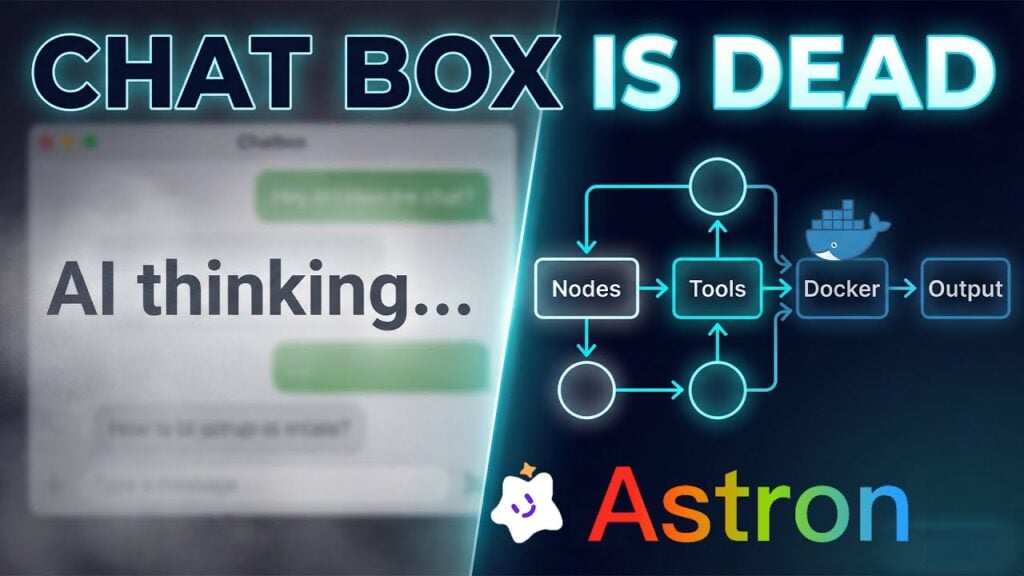
There’s a moment every developer has experienced when evaluating a new AI agent framework: that queasy realization that the tool they’ve been demoing in a sandbox environment has absolutely no prayer of surviving contact with a real enterprise. The workflow breaks the moment you try to integrate a legacy CRM. The authentication story is basically “good luck.” Scalability is a footnote. And somewhere buried in the README is a sentence that says something like “for production deployments, consult your cloud provider.”
Astron Agent is the rare exception. Built by iFlyTek, one of China’s most prominent AI companies, Astron Agent is an open-source, enterprise-grade agentic workflow platform that takes production seriously from line one of its architecture document. It has over 10,500 GitHub stars and more than 1,100 forks as of March 2026, it just released v1.0.3, and it appeared at MWC Barcelona 2026 — clear signals that this isn’t an experimental side project. It’s a serious bet on what enterprise AI infrastructure should look like.
This review is a deep dive into everything Astron Agent offers: its architecture, its features, its strengths, its blind spots, and whether it belongs in your organization’s AI stack. We’ll walk through what the platform does, how it actually works under the hood, what happens when you deploy it locally (based on the hands-on walkthrough video), and how it compares to alternatives like LangGraph, CrewAI, and Microsoft AutoGen.
What Is Astron Agent, Actually?
At its core, Astron Agent is described as an “enterprise-grade, commercial-friendly Agentic Workflow development platform.” That phrase packs a lot in. The “enterprise-grade” part isn’t just marketing copy — Astron is built on the same core technology that powers the iFlyTek Astron Agent Platform in production, used by real enterprise customers. The “commercial-friendly” designation refers to its Apache 2.0 license, which means free use, free modification, free redistribution, and free commercial deployment with no strings attached.
The platform’s central promise is enabling organizations to build what it calls SuperAgents — multi-agent applications that coordinate large language models, external tools, RPA automation, and human input across end-to-end workflows. Think of it less as a chatbot framework and more as a full-stack AI operating system for enterprise automation.
The four foundational pillars iFlyTek emphasizes for Astron are:
Stable and Reliable. Astron is built on battle-tested infrastructure from iFlyTek’s production platform. It’s not a research prototype. The full high-availability version is open-sourced, so you’re getting the same production-grade reliability that enterprise customers rely on.
Cross-System Integration. Native RPA integration allows agents to not just think and decide, but act — triggering automated processes across internal and external enterprise systems. This “decision-to-action” loop is one of Astron’s most distinctive capabilities.
Enterprise-Grade Open Ecosystem. Deep compatibility with industry models and tools, the Model Context Protocol (MCP) standard, and iFlyTek’s own AI tooling ecosystem gives organizations access to a broad, extensible integration surface.
Business-Friendly Licensing. Apache 2.0 with no commercial restrictions makes enterprise adoption a legal non-event. There are no per-seat fees, no usage caps buried in fine print, and no forced vendor lock-in through licensing terms.
The Architecture: Polyglot Microservices Done Right
If there’s one thing that separates Astron from lighter-weight agentic frameworks, it’s the architecture. Most agent libraries are single-process Python applications. Astron is a full microservices platform, and the technology choices are deliberate and smart.
The system is composed of multiple specialized services, each written in the language best suited to its job:
The Console Frontend is a React 18 + TypeScript single-page application that delivers the visual workflow editor, agent configuration panels, knowledge base management UI, and real-time chat windows. It uses ReactFlow for the drag-and-drop workflow canvas, Ant Design for UI components, and Tailwind CSS for styling.
The Console Backend is a Java 21 / Spring Boot 3.x service that acts as the API gateway and management layer. It handles authentication via Casdoor (an open-source SSO solution) with Spring Security and OAuth2, manages multi-tenant spaces, and provides all the CRUD APIs for agents, workflows, and knowledge bases. The choice of Java here is telling — for governance-heavy, request-intensive API serving, Spring Boot’s maturity and ecosystem are hard to beat.
The Core Services are all Python 3.9+ / FastAPI microservices, each owning a distinct domain:
core-agent— the agent orchestration engine that executes agent lifecycles, manages tool/plugin invocations, and maintains context and session persistencecore-workflow— the workflow execution engine (called “Spark Flow”) that handles multi-step orchestration with event-driven execution via Kafka, supports workflow versioning, and enables async debuggingcore-knowledge— the RAG system that handles document ingestion, vectorization, embedding generation, and semantic search, integrated with RAGFlow SDKcore-database— a dynamic memory database service storing conversation history and long/short-term contextcore-link— the HTTP and MCP tool management servicecore-rpa— the RPA automation bridge servicecore-aitools— AI capabilities service (TTS, OCR, translation, and other iFlyTek AI features)
The Tenant Service is written in Go using the Fiber framework — the right call for a high-throughput, low-overhead service handling multi-tenancy, organizational structures, permissions, and quotas. Go’s concurrency model and small memory footprint make it ideal here.
All services communicate within a Docker bridge network (astron-agent-network), with Nginx serving as the entry point and routing traffic based on path prefixes. Inter-service event communication flows through Kafka — which means workflow events, knowledge events, and agent events can be processed asynchronously, enabling the platform to handle complex, long-running workflows without blocking. MySQL serves as the primary relational database, with a database-per-service pattern for proper isolation. Redis handles caching and distributed locking. MinIO provides S3-compatible object storage for documents, embeddings, and agent artifacts.
This is not a simple stack to operate — and we’ll get to that — but it’s a genuinely well-designed one. The polyglot approach means each component is built with the right tool for the job, rather than forcing everything into a single language or runtime. The event-driven architecture via Kafka means the system scales horizontally and handles failures gracefully.
Key Features: What Astron Agent Actually Does
Visual Low-Code Workflow Builder
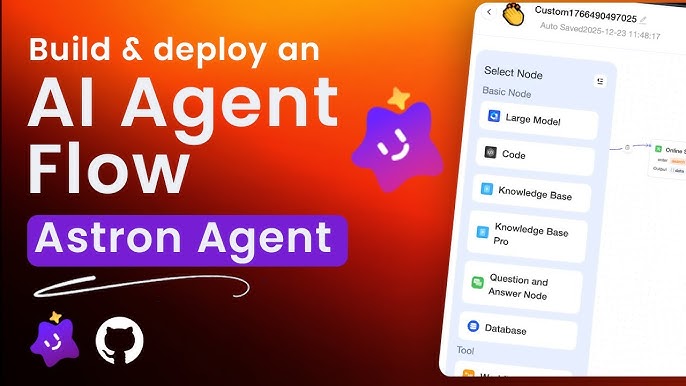
Astron’s workflow editor is one of its most approachable features. The hands-on video demonstration at approximately the 3:16 mark walks through creating a complete agent workflow from scratch. Starting from a blank canvas with “start” and “finish” nodes, you drag a “Large Model” node from the Basic Node library, wire the start node’s output to the LLM node’s input, configure the model selection and system prompt, then connect the output to the finish node.
It takes under two minutes to build a functional, deployable workflow. That’s genuinely impressive. For more complex scenarios, the editor supports branching logic, loops, parallel execution paths, human-in-the-loop checkpoints, and nested sub-workflows. The visual representation makes it possible for both engineers and technically-literate business stakeholders to understand, review, and modify automation logic.
Multi-Agent Orchestration
Astron supports multiple agent paradigms: chat agents for conversational interaction, chain-of-thought agents for structured reasoning tasks, and process agents for multi-step execution flows. Agents can be composed into larger multi-agent systems where specialized agents handle different parts of a workflow — one agent fetches and preprocesses data, another analyzes it with an LLM, a third triggers downstream actions.
The platform’s context-sharing architecture, through the Memory DB Service and Redis caching layer, means agents within a workflow maintain coherent shared state. This is crucial for enterprise scenarios where a long-running automation process needs to carry context across many steps and potentially across multiple work sessions.
Intelligent RPA Integration
This is Astron’s most distinctive capability, and it’s worth dwelling on. Most AI agent frameworks end at the decision layer — they figure out what should happen, but actually doing it in a real enterprise system requires a separate RPA implementation. Astron collapses that gap.
Through the astron-rpa companion project — which has accumulated 7,200+ GitHub stars in its own right — Astron agents can directly trigger RPA workflow nodes. AstronRPA supports 300+ pre-built atomic capabilities covering Windows desktop application automation, web browser automation (IE, Edge, Chrome), WPS/Office document processing, financial and ERP systems like Kingdee and YonYou, image recognition via computer vision, email handling, PDF processing, and API integrations. The bi-directional call architecture means Agent workflows can invoke RPA tasks, and RPA workflows can call back into Agent logic — creating a genuine decision-to-action loop that doesn’t require stitching together separate platforms.
Flexible Large Language Model Support
Astron takes a “Model-of-Models” approach to LLM integration. Rather than tying you to a single provider, it offers a unified model management interface that supports OpenAI, Azure OpenAI, local/self-hosted models, and iFlyTek’s own Spark LLM series. You can configure different models for different workflow steps — using a lightweight, fast model for simple classification tasks and a more capable model for complex reasoning steps — without restructuring your workflow architecture.
The video demonstration shows this in practice: at the 2:55 mark, the presenter walks through adding an LLM (SparkX 1.5) under “Model Management” by providing a model name, API endpoint, and API key. The model is immediately available for selection in any workflow node. For organizations that want to run models on-premises, Astron supports one-click deployment of enterprise-level MaaS (Model as a Service) clusters, though this feature is still marked as being in preview.

Knowledge Base and RAG
Astron’s Knowledge Service provides a fully integrated retrieval-augmented generation pipeline. It handles multi-format document ingestion (PDF, Word, text, and more), generates vector embeddings using configured LLMs, stores them in a vector index, and serves semantic search results to agents at runtime. The integration with RAGFlow SDK provides a robust underlying RAG implementation, and the Redis caching layer ensures repeated queries on large knowledge bases don’t incur repeated embedding lookups.
This is critical for enterprise knowledge management use cases: internal policy assistants, technical support bots, compliance checking workflows, and any scenario where agents need to reason over organizational documents rather than just their training data.
MCP Protocol Integration
Astron’s support for the Model Context Protocol (MCP) standard deserves special attention. MCP compatibility works in both directions: Astron can consume MCP tools from external providers, and Astron workflows can act as an MCP server — meaning any MCP-aware agent client, including Anthropic’s Claude, can call into Astron to trigger complex multi-step workflows. This positions Astron not just as a standalone platform but as a composable component in a broader AI infrastructure ecosystem, as detailed in this technical analysis from Skywork AI.
Multi-Tenancy and Enterprise Governance
Astron’s multi-tenant architecture, managed by the Go-based Tenant Service, provides organizational isolation out of the box. Different teams can operate with completely isolated agents, workflows, knowledge bases, and data. Role-based access control, managed through Casdoor and Spring Security/OAuth2, ensures that users only access the resources they’re authorized for. Analytics dashboards provide usage visibility and collaboration features support team-based workflow development.
Deploying Astron: What It Actually Looks Like
The video walkthrough provides a genuinely useful picture of what local deployment looks like for a new user. The prerequisites are Docker Desktop and Git. From there, the deployment flow is:
git clone https://github.com/iflytek/astron-agent.git
cd docker/astronAgent
cp .env.example .env
# configure environment variables
docker compose -f docker-compose-with-auth.yaml up -d
The .env file is where you configure LLM credentials, including PLATFORM_APP_ID, PLATFORM_API_KEY, and PLATFORM_API_SECRET for iFlyTek’s Spark LLM, along with connection strings for the various data services. Once running, the platform is accessible at http://localhost/ with Casdoor admin at http://localhost:8000.
The presenter in the video confirms the process takes only minutes to reach a functional first workflow. This is the “happy path” — and it genuinely works smoothly. The first time you successfully debug a live workflow and watch the nodes trigger sequentially, producing LLM-generated output in real time, the platform earns real credibility.
One important security note: the default Casdoor credentials are admin / 123. This is clearly called out in the documentation and should be the absolute first thing changed before any real deployment. It’s not a hidden gotcha — the docs are explicit — but it’s worth flagging for anyone who skips past configuration sections in their rush to get running.
For organizations that don’t want to manage the infrastructure themselves, Astron Cloud provides a hosted environment for creating and managing agents. The hosted environment is primarily oriented toward Chinese markets and developer account access, but it represents a viable “try before you deploy” option.
Where Astron Has Room to Grow
Honest reviews require honest accounting of limitations, and Astron has a few that enterprise evaluators should factor into their planning.
Deployment Complexity. The multi-service stack is comprehensive, but that comprehensiveness has a price. You’re orchestrating MySQL, Redis, Kafka, MinIO, Casdoor, Nginx, a Java Spring Boot service, multiple Python FastAPI services, and a Go service, all in Docker. For organizations with mature DevOps teams and Kubernetes infrastructure, this is manageable. For smaller teams without dedicated platform engineering, the operational overhead is real. The Kubernetes Helm chart deployment option is still marked as “coming soon” — it’s in the repository but not yet released as of v1.0.3. Until that ships, production Kubernetes deployments require manual work.
iFlyTek Ecosystem Alignment. Astron’s deep integration with iFlyTek’s tooling — the Spark LLM, iFLYTEK Open Platform APIs, Casdoor for auth — is a strength in many respects but introduces a degree of ecosystem dependency. For global teams not already within the iFlyTek developer ecosystem, there’s a learning curve around obtaining API credentials and navigating Chinese-language documentation for some components. The GitHub repository does offer both English and Chinese documentation, and English support is improving, but some deployment guides still have gaps.
Relative Youth. Astron Agent launched mid-2025 and has moved fast — 10,500+ stars and 12 releases as of March 2026 is impressive growth — but it’s still younger than frameworks like LangChain or AutoGen. Independent performance benchmarks don’t yet exist, and some edge cases in the workflow engine (evidenced by the active issues queue on GitHub, where bugs like nested object parameter handling and decision node execution failures are being actively addressed) reflect a platform still in active refinement. The CI/CD pipeline is robust (Claude Code, CodeQL, and Copilot code review are all wired into the GitHub Actions workflow), and the development cadence is healthy, but enterprises should plan for a more active patching cycle than they’d have with more mature frameworks.
Security Documentation. For an enterprise platform, the absence of explicit documentation around compliance certifications, data retention policies, and encryption-at-rest configuration is a gap. The security model is largely correct — Casdoor for identity, OAuth2 for authorization, HTTPS for external calls — but it’s self-managed and self-documented. Enterprise security teams will need to conduct their own reviews and may need to fill in configuration guidance themselves. The default credentials issue noted above is the most concrete manifestation of this, but it’s representative of a broader pattern where security hardening is the deployer’s responsibility.
How Astron Compares to the Competition
The agentic AI framework landscape has gotten crowded. LangGraph, CrewAI, Microsoft AutoGen, and various commercial platforms all compete for enterprise AI workflow mindshare. Here’s where Astron sits relative to the field:
LangGraph is Astron’s closest technical peer in terms of capability depth. LangGraph offers a graph-based DAG workflow architecture, explicit state management, real-time token streaming, and human-in-the-loop checkpoints. It’s well-integrated with the broader LangChain ecosystem and benefits from a large, established community.
The key differences: LangGraph is primarily code-centric (it doesn’t offer Astron’s visual drag-and-drop workflow editor), it has no native RPA integration, and its deployment story assumes you’re handling your own infrastructure without Astron’s built-in enterprise services layer. LangGraph offers a hosted plan starting at $39/month; the core framework is MIT-licensed and free.
CrewAI takes a role-based approach to multi-agent coordination, defining Planner and Worker agents in structured YAML configurations. It’s elegant for well-defined, structured automation scenarios where agent roles are clear. Where it falls short relative to Astron: no native concurrency (execution is turn-based/sequential by design), no built-in RPA, and no visual workflow editor.
CrewAI’s cloud service runs at $25/month for the Professional tier, with a free basic tier. For teams needing predictable, role-structured agent coordination, CrewAI is compelling. For enterprises needing end-to-end cross-system automation, Astron is the stronger choice.
Microsoft AutoGen offers highly flexible conversational multi-agent coordination with deep Azure integration. Its strength is adaptability — the conversational loop between agents can handle complex, dynamic instruction sets. Its weakness is unpredictability: because the agent interaction pattern is conversational rather than explicitly structured, token usage can be high and workflow tracing can be difficult.
AutoGen has no visual editor and no native RPA. For organizations already deep in the Azure ecosystem, AutoGen has natural advantages. For everyone else, Astron’s combination of visual tooling, RPA, and structured workflow design is a more pragmatic choice.
What no other major framework in this space offers is Astron’s combination of a visual workflow editor + native enterprise RPA + multi-tenant governance + MCP server capability + Apache 2.0 licensing. That specific combination is genuinely differentiated. If your use case is purely chatbot development or simple tool-calling pipelines, lighter frameworks may be more appropriate. If your use case involves complex cross-system automation where AI agents need to trigger real-world processes across enterprise systems — the kind of end-to-end automation that bridges AI decision-making with operational execution — Astron’s integrated platform is compelling.
Real-World Use Cases Where Astron Shines
The platform’s design makes it particularly well-suited for several categories of enterprise automation:
Automated Customer Support Workflows. An Astron workflow can accept an incoming customer inquiry, query a knowledge base of product documentation and support history, route to the appropriate specialized agent based on intent classification, trigger an automated response, and — if escalation is needed — hand off to a human with full context. The RPA integration means it can simultaneously update CRM records and trigger notifications without requiring a separate automation layer.
Knowledge-Driven Business Processes. Finance, legal, and compliance teams frequently need AI assistance that reasons over large document corpora — contracts, regulations, policy manuals. Astron’s integrated RAG pipeline, combined with its workflow orchestration, makes it possible to build agents that pull from multiple knowledge sources, cross-reference information, and produce structured outputs that feed into downstream business processes.
Multi-Step Data Pipelines. Data engineering workflows that involve fetching data from APIs, transforming it with LLM assistance, validating outputs against business rules, and writing results to enterprise systems are a natural fit for Astron’s node-based workflow design. The parallel execution capability means independent data processing steps can run concurrently, reducing end-to-end latency.
Automated Operations and IT Automation. IT teams can build Astron workflows that monitor system events, reason about anomalies, trigger diagnostic procedures, and initiate remediation actions — all without human intervention for routine scenarios. The RPA layer enables interaction with systems that don’t expose APIs, which is a practical reality in most enterprise IT environments.
As Jimmy Song’s analysis notes, Astron is “suitable for enterprise automation requiring cross-system coordination and complex process automation, such as automated customer support, knowledge-driven business workflows, automated operations, and multi-step data pipelines.”
The Open Source Health Check
A platform is only as good as its maintenance and community, and Astron’s signals here are encouraging. The GitHub repository shows 2,597 commits, 5,090+ CI workflow runs, and active triage of open issues. The codebase uses Domain-Driven Design patterns, type checking, linting, OpenTelemetry-based observability, and a comprehensive CI/CD pipeline that includes CodeQL security scanning, Claude Code for automated code review, and GitHub Copilot integration.
iFlyTek has also been actively building community momentum beyond GitHub: Astron has been featured at the 2025 iFlyTek Global 1024 Developer Festival, hosted meetups in Zhengzhou, Qingdao, Hefei, and Chongqing, run a campus outreach program at Zhejiang University of Finance and Economics, and appeared at MWC Barcelona 2026. An active industrial intelligence hackathon is ongoing. This combination of enterprise credibility and developer community investment is relatively rare in open-source AI infrastructure projects.
The companion SkillHub repository — a self-hosted open-source agent skill registry for enterprises — and agentbridge (a cross-platform AI workflow DSL converter supporting iFlyTek Spark, Dify, and Coze) suggest iFlyTek is building a cohesive ecosystem of complementary tools around Astron, not just a standalone product.
Getting Started: A Practical POC Path
For teams evaluating Astron for enterprise adoption, a proof-of-concept deployment can realistically be completed in a few days. The recommended path:
Start with Docker Compose on a development machine — the Quick Start documentation makes this achievable in under an hour. Get a working workflow running that uses a configured LLM, then iterate toward complexity: add a knowledge base, wire in an external tool via MCP, and try triggering a simple RPA action. Validate that multi-tenant isolation works as expected by creating two separate team spaces and verifying that agents, workflows, and data don’t cross-contaminate. Then stress-test with concurrent agent executions to understand the resource profile of your intended workload.
Success metrics for a POC should cover: agents completing defined tasks correctly end-to-end, response latency meeting your operational requirements, no unauthorized data access, and engineer feedback on the time required to build and modify workflows. If your team can build a representative workflow in a reasonable timeframe and the platform holds up under your load requirements, Astron is likely production-viable for your use case.
Final Verdict
Astron Agent is one of the most technically serious open-source enterprise AI workflow platforms available today. It doesn’t cut corners on architecture — the polyglot microservices design, event-driven execution via Kafka, multi-tenant governance, and integrated RPA capability represent genuine engineering investment in enterprise requirements. The visual workflow editor makes complex multi-agent orchestration accessible without sacrificing the depth that power users need. The Apache 2.0 license removes adoption barriers that would otherwise slow enterprise procurement cycles.
The primary asks of any team evaluating Astron are operational readiness and patience with a young ecosystem. This is a platform that rewards investment: the more you engage with its architecture, the more leverage you get. It’s not the right tool for someone building a weekend chatbot project. It is very much the right tool for an enterprise team that needs to build AI-powered automation that actually integrates with real systems, scales to production loads, and operates within enterprise governance requirements.
For the developer who wants control, transparency, and a platform that doesn’t disappear under the pressure of real-world complexity, Astron Agent is absolutely worth a serious look. Watch the walkthrough video, clone the repository, and spin up a local deployment. The jump from “first working workflow” to “production SuperAgent” is long — but Astron gives you a credible path to make it.
The Kingy Brief
Get The Kingy Brief.
AI changes, original tests and one practical thing to try. Fridays at 09:00 Vancouver time.
Free · Double opt-in · Unsubscribe anytime
Signup help and newsletter schedule
Signup form provided by Beehiiv. After submitting, check your inbox for "Confirm your subscription to The Kingy Brief" and open its confirmation link. Check Spam or Promotions if you cannot find it.
Fridays at 09:00 Vancouver time: source-checked AI changes, original tests and one practical thing to try. The weekly restart begins October 9, 2026. We skip a week when there is not enough verified material. Free. Unsubscribe anytime.