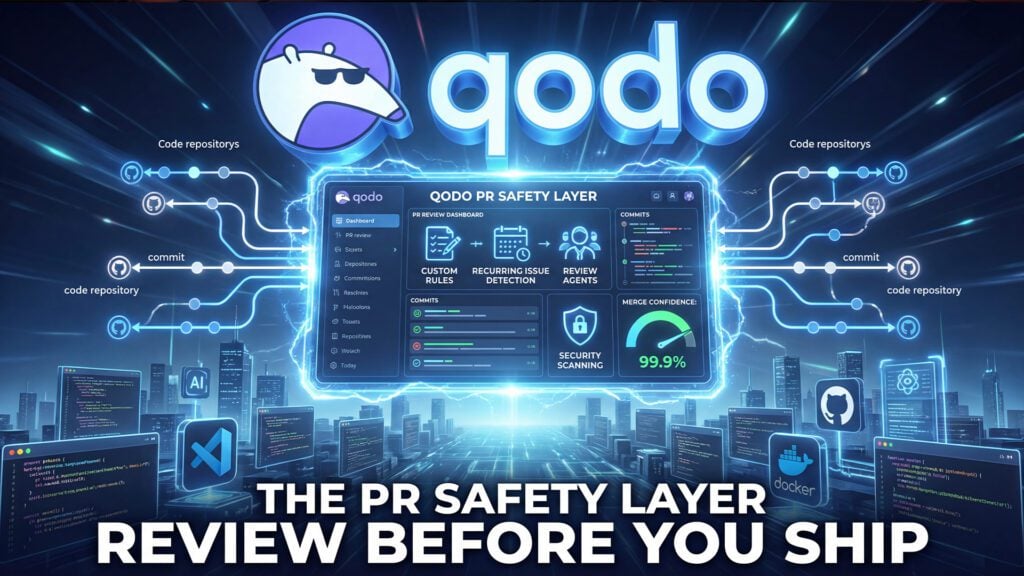
Introduction: The Quality Crisis at the Heart of AI-Driven Development
There is an uncomfortable paradox sitting at the centre of the AI coding revolution. Tools like GitHub Copilot, Cursor, and Amazon Q Developer have made it faster than ever for engineers — at every experience level — to write code. Lines-per-hour metrics are up. PR velocity is up. Feature output is up. But so, too, is the volume of bugs, security vulnerabilities, and architectural inconsistencies reaching production. The faster teams ship with AI assistance, the harder it becomes to review what they’re shipping.
Into this gap steps Qodo (formerly CodiumAI), a startup that has made a very deliberate bet: the missing layer in the AI development stack is not another code generation tool — it’s a dedicated, intelligent code review platform. Qodo describes itself as “the quality layer across your SDLC,” and while that language carries the usual marketing shimmer, a closer examination of the platform reveals something more substantive: a genuinely well-architected system that is becoming a serious fixture in enterprise engineering workflows.
Origins: From CodiumAI to Qodo
Qodo was founded in 2022 under the name CodiumAI by two fellas with strong technical pedigrees. Itamar Friedman had previously served as Director of NVIDIA’s and Alibaba Group’s AI labs in Israel. Dedy Kredo had led product and data science teams at Exploriem and VMware. Their original thesis was focused specifically on automated test generation — the idea that AI could not only write code, but write the tests that validate it.
As Wikipedia documents, the company launched out of stealth in early 2023 and raised $11 million in seed funding that same year, with backing from TLV Partners, Vine Ventures, and angel investors including executives from OpenAI and VMware. The reception was warm enough that the company’s vision quickly expanded: if you’re ensuring code quality at the test-generation layer, why not extend that quality mandate to the entire software development lifecycle (SDLC)?
The rebranding from CodiumAI to Qodo — announced alongside a $40 million Series A round in September 2024 — marked this philosophical shift. According to the company’s own blog, the name “Qodo” is derived from a blend of “Quality” and “Code,” reflecting a broader mandate to embed quality at every stage of the development process, not just at the point of testing. The underlying AI models retained the name “Codium,” nodding to the company’s heritage.
As TechCrunch reported, the Series A round was led by Susa Ventures and Square Peg, with additional participation from Firestreak Ventures, ICON Continuity Fund, and returning seed investors TLV Partners and Vine Ventures. This brought total funding to $50 million. Notably, the round was described as oversubscribed — a meaningful signal of investor confidence in a crowded developer tools market.
By 2025, the company had grown to approximately 100 employees operating across Israel, the United States, and Europe. Enterprise sales had crossed $1 million in ARR within just three months of launching their teams offering, and the platform had accumulated over one million developer users. Fortune 100 companies — including monday.com, Ford, and Intuit — had adopted the enterprise platform.
In September 2025, Qodo received perhaps its most prestigious piece of validation: it was named a Visionary in the 2025 Gartner Magic Quadrant for AI Code Assistants, recognised specifically for its “Completeness of Vision and Ability to Execute.” In February 2026, the company released Qodo 2.0, introducing a multi-agent architecture and an expanded context engine that incorporates pull request history alongside full codebase context.
The Core Philosophy: Review-First, Not Copilot-First
To understand Qodo, it helps to be clear about what it is not. It is not primarily a code generation tool. It does not compete head-on with GitHub Copilot’s inline autocomplete, nor with Cursor’s conversational coding assistant. While Qodo’s IDE plugin does include coding assistance features, the product’s centre of gravity is review, governance, and quality enforcement — applied continuously, from the moment a developer writes their first line of code to the moment a PR is merged.
This positioning matters because it reflects a genuine insight about where the AI coding wave creates risk. As SonarSource research cited by Qodo’s documentation notes, AI-generated code contains approximately 3x more security vulnerabilities than traditionally developed code. GitHub Copilot, Cursor, and similar tools dramatically accelerate the rate at which code is produced, but they apply little to no scrutiny to the code they produce. Qodo’s argument — backed by its own benchmark data and by independent enterprise case studies — is that this acceleration without scrutiny creates compounding technical debt and security exposure at scale.
Qodo CEO Itamar Friedman put it plainly in the TechCrunch profile: “We call ourselves the first quality-first code generation platform for complex code. In order to enable quality-first code generation, we believe we need to integrate into the entire software development lifecycle.” Jenna Zerker at lead investor Susa Ventures echoed this framing: “Recent outage events highlight the devastating potential of errors within software. This affirms that enterprises absolutely cannot risk embracing a high degree of AI autonomy in software development without having the proper validation and safeguards in place first.”
This philosophy shapes every product decision Qodo has made. The result is a platform that sits between “AI wrote it” and “production-ready,” to use their own words — a quality assurance layer that works in tandem with, rather than replacing, human reviewers.
The Platform Architecture: Four Integrated Pillars
Qodo’s platform is built around four integrated components that formerly had distinct product names (Qodo Merge, Qodo Gen, Qodo Command, and Qodo Aware) but have since been unified under the core Qodo AI Code Review Platform. Understanding how these four pillars interact is essential to evaluating whether the platform delivers on its promises.
1. The Git Integration (Pull Request Review)
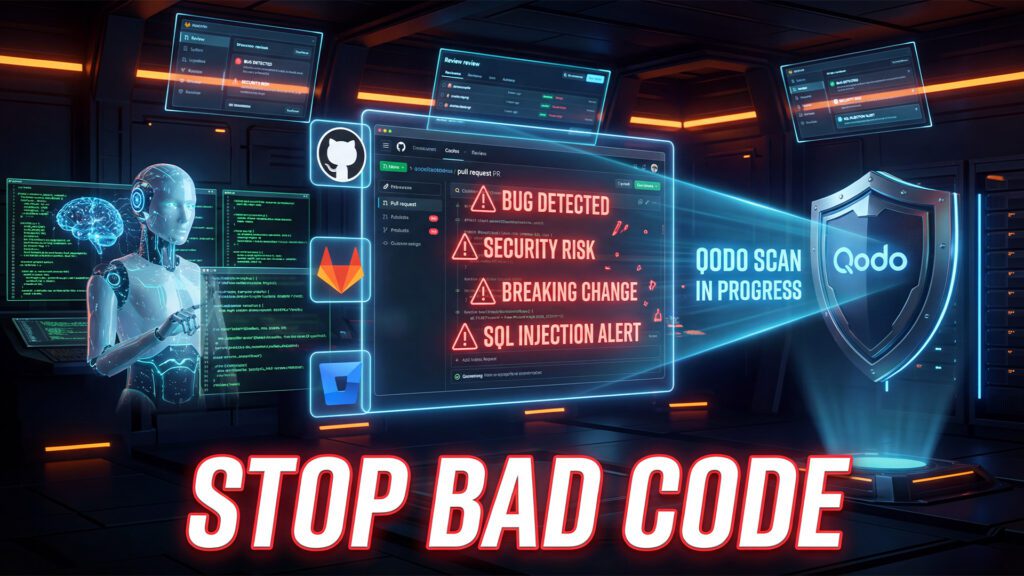
The Git integration is the component most users encounter first, and arguably the most immediately impactful for engineering teams. When connected to GitHub, GitLab, or Bitbucket, Qodo automatically triggers a review on every pull request. This review runs 15+ automated checks, covering style violations, missing documentation, missing tests, security vulnerabilities, logic gaps, architectural inconsistencies, and compliance policy adherence.
The pull request review is interactive. Reviewers and developers can invoke Qodo using slash commands directly in PR comments: /review triggers a fresh analysis, /improve requests code suggestions, /describe generates a full PR description and change walkthrough, /implement applies a suggested fix directly to the branch, and /compliance validates the PR against organisational security and policy rules. This slash-command interface is particularly valued by teams because it keeps Qodo inside the existing PR workflow rather than forcing context switches.
What distinguishes Qodo’s PR review from simpler bots is its use of historical context. According to Qodo’s platform documentation, the system learns from past PR comments, accepted suggestions, and review discussions over time, continuously adapting to a team’s specific coding standards. A suggestion that was consistently rejected in past reviews will eventually stop being surfaced. A pattern that has consistently been flagged by human reviewers will be reinforced.
The real-world results at monday.com are frequently cited as a benchmark. According to Qodo’s published case study data, the platform prevents over 800 potential issues per month at monday.com while maintaining a 73.8% acceptance rate on code suggestions — a high signal-to-noise ratio that is meaningfully better than many competing tools. Review time was reduced by up to one hour per pull request.
2. The IDE Plugin (Local Code Review)
Qodo’s IDE plugin is available for VS Code and JetBrains, and functions as a shift-left review layer — catching issues before they ever reach the PR queue. As of early 2026, the VS Code extension has 842,000+ installs with a 4.7/5 star rating, and the JetBrains plugin has 611,000+ installs. These are not trivial numbers for a developer tool focused specifically on review rather than code completion.
In practice, the IDE plugin allows developers to run a “local review” on their current code diff at any time. The review analyses the changed code in context of the full codebase (via the Context Engine described below), surfacing logic errors, security risks, missing tests, and standards violations — all before a commit is made. Issues can be resolved with a single click or via guided suggestions. The plugin also generates test cases for new code, integrating what was formerly the Qodo Gen capability.
The IDE plugin also introduces Qodo’s new concept of “Modes” and “Workflows.” Modes are persona-driven AI agents for ongoing, context-aware conversations — for instance, an “Ask Mode” for quick questions, a “Code Mode” for full coding assistance, or a “Plan Mode” for architecture-level reasoning. Workflows, by contrast, are single-task agents that execute a defined process from start to finish: generating documentation, running and fixing test suites, or performing code maintenance. Both Modes and Workflows can be shared across teams as .toml files, enabling standardisation.
3. The Context Engine (Multi-Repo Codebase Intelligence)
The Context Engine is Qodo’s most technically ambitious component, and the one that most clearly differentiates it from simpler AI code review tools. It continuously indexes entire codebases across multiple repositories using a sophisticated Retrieval-Augmented Generation (RAG) pipeline, creating a persistent, searchable model of a team’s entire codebase — including cross-repo dependencies, shared modules, historical PR data, and documentation.
This matters enormously for enterprise engineering teams. Large-scale systems are never self-contained: a change to a shared authentication library might break a dozen downstream services. A change to an API response format might invalidate client-side assumptions scattered across repositories. Tools that only analyse the diff of a single PR — without understanding what that diff touches across the broader system — will miss these cross-cutting issues entirely.
According to Qodo’s platform page, the Context Engine is used by NVIDIA at enterprise scale, providing “deep agentic code search and retrieval” across large, complex codebases. The indexing monitor tracks file counts across repositories in real time; in documented examples, the system has indexed front-end repositories containing 34,000+ files and back-end repositories of 6,000–8,000 files, running continuous re-indexing every few hours.
4. The CLI Tool (Agentic Quality Workflows)
The CLI component is aimed at DevOps engineers and platform teams who want to script multi-step quality processes and integrate Qodo into CI/CD pipelines. Through the CLI, teams can build and deploy custom “review agents” that execute defined workflows — for example, running a diff check, triggering test generation for new code, validating compliance against a ruleset, and generating a changelog, all in a single automated sequence.
The CLI supports the same agent capabilities as the IDE and Git integrations, but in a terminal-based, scriptable form that can be embedded in GitHub Actions, GitLab CI, Jenkins, or any other pipeline tooling. This enables teams to enforce quality gates as part of automated builds — for example, blocking a merge if critical security issues are detected or if test coverage drops below a threshold.
The Rules System: Codified Governance
One of Qodo’s most distinctive features — and one that resonates particularly with engineering leaders and CTOs — is its Rules System. This is a centralised interface for defining, managing, and enforcing organisational coding standards, security policies, and compliance requirements across all of Qodo’s review surfaces simultaneously.
In practice, a team can encode rules such as “no hardcoded API keys,” “all database queries must use parameterised statements,” “error handling must follow company guidelines,” or “all new endpoints must have corresponding integration tests.” These rules are then enforced automatically on every code change — in the IDE before commit, in the PR before merge, and in the CI pipeline before deployment.
The Rules System is designed to evolve. Qodo’s platform documentation describes the system as “living” — rules can be updated centrally and propagate immediately across all enforcement points. The system also learns: as developers accept or modify suggestions, the rule engine adapts to reflect what the team actually values, not just what was initially configured.
This is particularly valuable for regulated industries. According to Qodo’s Trust Center, the platform supports OWASP security rule enforcement, SOC 2 Type II compliance, and can be configured to enforce sector-specific requirements in financial services, healthcare, and other regulated domains. For companies navigating AI-generated code at scale, having a centralised, auditable governance layer is not a luxury — it is a compliance necessity.
Security Architecture and Data Privacy
Enterprise adoption of any AI tool that processes proprietary source code raises legitimate data privacy concerns. Qodo has made a concerted effort to address these concerns with a multi-layered security posture.
According to Qodo’s published documentation, the platform holds SOC 2 Type II certification, enforces end-to-end SSL encryption, and processes only the code snippets necessary for review. For teams on paid plans, code is retained for a maximum of 48 hours for debugging purposes before being permanently deleted. Teams with stricter requirements can opt for a “no data retention” configuration, in which code is processed in memory and never persisted. For the most sensitive enterprise deployments — defence contractors, financial institutions, healthcare providers — Qodo offers on-premises and air-gapped deployment options in which all processing remains within the customer’s own infrastructure.
The platform also includes secrets obfuscation, which redacts detected credentials or API keys from data transmitted to Qodo’s servers. This is an important protection given that one of Qodo’s core review capabilities is detecting hardcoded credentials — a capability that requires accessing code that may actually contain credentials. The obfuscation layer ensures that even if a hardcoded secret is present in the code being reviewed, it is not stored or transmitted in plain text.
The PRNewswire announcement of Qodo’s Gartner Magic Quadrant placement confirms that dozens of Fortune 500 companies across financial services, healthcare, e-commerce, and technology have adopted the platform — an implicit endorsement of its security posture by some of the most compliance-sensitive organisations in the world.
Language and Framework Support
Qodo supports all major programming languages without additional configuration. The platform’s documentation lists Python, JavaScript, TypeScript, Java, C++, Go, Ruby, PHP, and C# as fully supported, along with framework-specific intelligence for popular ecosystems including React, Django, Spring Boot, and others. Multi-language repositories — common in modern microservices architectures — are handled natively, with context across the full stack rather than isolated per-language silos.
Support also extends to infrastructure-as-code formats including Terraform and Kubernetes YAML, which is increasingly important as DevOps practices mature and infrastructure definitions are subject to the same quality and security scrutiny as application code. Legacy codebases written in older languages or following older patterns are also within scope; Qodo’s context engine does not require the codebase to follow contemporary conventions in order to provide meaningful review.
Benchmark Performance: Does the Quality Hold Up?
In February 2026, Qodo released a formal AI code review benchmark alongside the launch of Qodo 2.0. According to Qodo’s own documentation of the benchmark methodology, the evaluation tested multiple AI code review tools on real pull requests, measuring precision (what fraction of flagged issues were genuine problems) and recall (what fraction of genuine problems were flagged). Qodo reported the highest recall and the highest overall F1 score — the harmonic mean of precision and recall — among the tools tested.
This benchmark is, of course, Qodo’s own and should be interpreted accordingly. However, it is consistent with independent user feedback. On G2, which aggregates verified user reviews, Qodo carries a 4.6/5 rating based on dozens of reviews as of early 2026. On Gartner Peer Insights, the platform holds a 4.6/5 rating across 35 reviews, with users specifically praising its ability to surface high-signal issues and standardise code quality across teams.
One frequently cited real-world metric comes from Qodo’s deployment with a Global Fortune 100 retailer: the platform reportedly saved over 450,000 developer hours in a single year, with individual developers saving approximately 50 hours per month. While these figures come from Qodo’s own case study materials, the scale of the claimed savings is consistent with the platform’s stated review acceleration of up to one hour per pull request at monday.com.
Enterprise Use Cases: What Real Teams Are Experiencing
The clearest picture of Qodo’s practical value comes from how it is actually being used in production engineering environments.
monday.com is Qodo’s most publicly documented enterprise customer. According to Qodo’s published case study, the company uses Qodo to prevent 800+ potential issues per month while maintaining a 73.8% acceptance rate on code suggestions — meaning developers accept nearly three out of every four recommendations Qodo makes. Review time has been reduced by up to one hour per pull request. One documented example — flagged in Qodo’s platform documentation and confirmed in their case study — involves Qodo catching a hardcoded staging credential in a monday.com PR that had been missed by multiple human reviewers. This is precisely the kind of high-severity, low-visibility issue that Qodo’s automated scanning is designed to catch.
Ford and Intuit are also listed among Qodo’s enterprise customers on Wikipedia and Qodo’s official platform pages, though detailed case studies for these organisations are not publicly available at the time of writing.
Community sentiment on Reddit’s r/codereview is broadly positive among practitioners who have used the platform in real workflows. One developer noted: “The Jira + past PR context is huge — it makes the comments feel way less generic. What I like most is how it ties review with test gen, so if it flags a gap it can spin up a starter test right there.” This observation points to one of Qodo’s genuine competitive advantages: the integration of review and remediation, such that flagging a missing test is immediately coupled with the ability to generate that test.
A separate thread on r/codereview asking about the best AI code review tools highlights Qodo’s ability to produce concise, high-priority PR summaries rather than flooding reviewers with trivial comments — a quality that distinguishes it from tools that generate high volumes of low-signal noise.
User Reviews: Praise and Pain Points
On G2, verified reviews from engineering leaders paint a consistent picture of a platform that delivers genuine productivity gains while still having room to mature.
One CTO described Qodo as “the best way I found to use LLMs in my development processes,” specifically praising its unit-test generation capabilities for producing edge-case tests in seconds that would otherwise take hours to write manually. A development team lead noted that it “transformed the way our team works together” and unlocked significant time savings by reducing back-and-forth on review cycles.
On the positive side, users consistently highlight:
- High signal-to-noise ratio: Qodo surfaces fewer but more important issues compared to tools that generate excessive comments on trivial style concerns.
- Test generation quality: The ability to automatically generate contextually relevant test cases — including edge cases — is cited across multiple reviews as a significant time saver.
- Ease of integration: Most users report setup taking minutes, with Qodo auto-running on PRs immediately after connecting a Git repository.
- Learning capability: The platform’s ability to adapt to team-specific conventions over time is valued by senior engineers who have seen other tools fail to respect established patterns.
- Interactive commands: The slash-command interface in PRs (
/implement,/improve, etc.) is described as particularly effective for keeping the review workflow fluid.
On the negative side, reviewers have noted:
- IDE coverage gaps: Qodo’s IDE plugin supports VS Code and JetBrains but does not yet offer a native Visual Studio extension — a meaningful gap for .NET-heavy enterprise teams that rely on the full Visual Studio environment rather than VS Code.
- Complex logic limitations: A minority of reviewers note that Qodo occasionally misses subtle business-logic errors in highly domain-specific code, though this is acknowledged as a broader limitation of AI review tools generally.
- Credit system complexity: Qodo’s pricing model, which uses a credit system for LLM-intensive operations like IDE interactions and CLI workflows, is described by some users as opaque. Heavy usage on free or team tiers can hit credit limits unexpectedly.
- Large codebase indexing latency: For very large monorepos, the initial context engine indexing can take time, and re-indexing cycles (typically every few hours) can occasionally result in slightly stale context during periods of rapid change.
- Learning curve for custom agents: Building and deploying custom CLI agents requires meaningful configuration effort, which may be a barrier for smaller teams without dedicated DevOps engineering capacity.
Pricing: Accessible Entry, Scalable for Teams
Qodo’s pricing structure is designed to remove friction for individual developers while providing a clear commercial pathway for teams and enterprises.
Qodo’s current plans offer a 14-day trial, not a permanent free Developer tier. Qualified open-source projects can apply for free access through Qodo for Open Source. After the trial, other teams need a paid plan to continue reviewing.
The Pro Team plan displays a $30 starting credit pack and supports up to 30 users; it is not presented as $30 per user. Reviews draw from a shared monthly pool at $0.012 per credit, with packs of 2,500, 5,000 or 20,000 credits. There is no fixed review-count limit, but reviews consume credits and overage is subject to the team’s spending cap.
The Enterprise tier offers custom pricing and adds dedicated on-premises deployment options, advanced single sign-on (SSO), dedicated AI model configurations, air-gapped deployment support, and SLA-backed support. This tier is where Qodo’s security and compliance features are most fully deployed, and where the ROI case is strongest — as demonstrated by the 450,000 developer-hours-saved figure from the Fortune 100 case study.
For teams evaluating cost, it is worth noting that Qodo’s credit model for IDE and CLI interactions means that heavy AI-assisted workflows can consume credits faster than expected on lower tiers. Teams should audit their anticipated usage patterns before selecting a tier.
Competitive Landscape: How Qodo Compares
Qodo sits in a distinct — though increasingly contested — category. While tools like GitHub Copilot, Cursor, and Amazon Q Developer focus primarily on code generation and completion, Qodo is positioned as a code review and quality enforcement platform. This makes direct feature-by-feature comparisons somewhat misleading, but a few reference points are worth establishing.
vs. GitHub Copilot: Copilot’s primary value proposition is inline code completion and conversational coding assistance. Its code review capabilities, while improving, are secondary features rather than core architecture. Qodo’s review-first design means its PR analysis is substantially deeper, its context engine is more comprehensive, and its governance and compliance features have no direct equivalent in Copilot. Many enterprise teams use both: Copilot to write code faster, Qodo to ensure that code meets standards before merge.
vs. CodeRabbit and similar PR bots: Several tools offer automated PR review, but most operate at the diff level — analysing only the changed lines without access to the broader codebase context. Qodo’s multi-repo Context Engine enables cross-cutting analysis that diff-only tools cannot perform. Qodo also offers the IDE and CLI integration layers that most PR-only tools lack.
vs. Traditional static analysis tools (SonarQube, Semgrep): Traditional SAST tools excel at rule-based pattern matching and are highly configurable, but they generate significant false-positive noise and lack the contextual intelligence to distinguish genuinely risky code from code that merely matches a pattern. Qodo’s AI-driven approach produces fewer but more actionable findings, though it is complementary to rather than a replacement for SAST tools in high-compliance environments.
Qodo 2.0 and the Road Ahead
The February 2026 launch of Qodo 2.0 represents the most significant product evolution since the platform’s original launch. The release introduced a fully multi-agent code review architecture — meaning that multiple specialised agents now collaborate on a single review, each contributing expertise in different domains (security, test coverage, architecture, documentation) — rather than a single model attempting to cover all review dimensions simultaneously.
The 2.0 release also expanded the Context Engine to incorporate pull request history as a first-class input to review analysis, alongside the codebase indexing that was already in place. This means Qodo can now reason about how a team’s review standards have evolved over time, surfacing suggestions that reflect not just the current state of the codebase but the trajectory of how the team has been developing it.
According to DevOps.com’s coverage of the 2.0 launch, the multi-agent architecture is specifically designed to address the “code review bottleneck created by AI” — the phenomenon whereby AI coding tools dramatically increase the volume of PRs submitted, overwhelming human reviewers who cannot scale their throughput proportionally. By pre-reviewing every PR with multiple specialised agents and surfacing only the highest-priority findings, Qodo 2.0 aims to ensure that human review time is concentrated on the issues that most require human judgment.
The benchmark released alongside Qodo 2.0 showed the highest recall and F1 score among tested tools, including Claude Code — a result that generated significant attention in the developer tools community. While Qodo designed and administered this benchmark, the methodology was published openly for scrutiny.
Gartner Recognition and Industry Standing
Qodo’s placement as a Visionary in the 2025 Gartner Magic Quadrant for AI Code Assistants is the most credible third-party validation the platform has received. Gartner’s Visionary designation — recognising Completeness of Vision and Ability to Execute — is awarded to companies that demonstrate both a clear directional understanding of where a market is heading and a demonstrated ability to deliver on that vision in practice.
For a company that had fewer than 100 employees at the time of the designation, appearing in the Magic Quadrant at all is a notable achievement. It places Qodo in the company of much larger incumbents in the AI coding assistant category and signals that Gartner’s analysts view the code review and quality governance niche as a distinct and growing segment of the market — not merely a feature of general-purpose coding assistants.
Additionally, the TechCrunch AI Disruptors 60 list, NVIDIA’s recognition of Qodo’s context engine in its Technical Blog, and Anthropic’s collaboration with Qodo (noted on Wikipedia) round out a picture of a company that has achieved meaningful credibility across the developer tools ecosystem in a remarkably short time.
Limitations and Honest Caveats
No review of Qodo would be responsible without a clear-eyed assessment of where the platform falls short or where prospective buyers should calibrate their expectations.
It is not a replacement for human code review. Qodo is explicit about this — and it’s the right framing. The platform is designed to handle the repetitive, pattern-detectable, and context-searchable dimensions of review, freeing human reviewers to focus on architecture, business logic, and the kinds of nuanced judgment calls that AI systems cannot yet reliably make. Teams that expect to eliminate human review entirely will be disappointed.
It is a proprietary, closed-source platform. While Qodo offers a free tier for open-source projects, the platform itself is not open-source. Teams with strong preferences for open-source tooling or who require full control over the review engine’s logic will find Qodo less suitable than alternatives like self-hosted Semgrep or custom ESLint configurations.
Configuration demands meaningful investment. The Rules System and custom CLI agents are powerful, but extracting their full value requires engineering time to define, test, and maintain custom rulesets. Smaller teams without dedicated DevOps or platform engineering capacity may find themselves under-utilising these features.
IDE support has gaps. The absence of a native Visual Studio (not VS Code) extension is a real limitation for Microsoft-stack teams. Qodo has acknowledged this gap in user feedback, but as of early 2026, no timeline for a full Visual Studio extension has been publicly confirmed.
Credit limits require attention. Reviews consume credits according to size and complexity. Unused credits expire at the end of each monthly cycle, and overage uses the same per-credit rate up to a spending cap set by the team. Monitor both the credit pool and that cap.
Conclusion: A Platform Worth Taking Seriously
Qodo occupies a position in the developer tools landscape that is both clearly defined and increasingly important. As AI coding assistants continue to accelerate code production — and as the volume and velocity of AI-generated pull requests grows beyond what human review teams can sustainably handle — the demand for intelligent, automated review infrastructure will only intensify.
Qodo’s answer to this demand is, at its core, thoughtful. Rather than competing with GitHub Copilot on code generation, the company has staked out the quality and governance layer — the point in the SDLC where speed must be reconciled with correctness, security, and standards compliance. The multi-repo Context Engine, the living Rules System, the 15+ PR review workflows, and the IDE integration together form a coherent platform that addresses the review problem at multiple points in the development lifecycle, not just at the PR gate.
The evidence of real-world impact is meaningful, not merely aspirational: 800+ issues prevented monthly at monday.com, 73.8% suggestion acceptance rates, up to 50 developer hours saved per month per developer at Fortune 100 scale. The Gartner Visionary designation adds third-party credibility to claims that are otherwise easy to dismiss as vendor marketing.
The platform is not without limitations. The learning curve for custom agents, the gaps in IDE coverage, and the credit complexity on lower tiers are genuine friction points that prospective buyers should factor into their evaluation. But for enterprise engineering teams navigating the quality challenges of AI-accelerated development — teams deploying hundreds of PRs per week, managing complex multi-repo codebases, operating in regulated industries where compliance is non-negotiable — Qodo is one of the most purpose-built and technically credible solutions currently available.
The question for most engineering leaders is not whether automated, AI-driven code review is necessary in the age of vibe coding. It is. The question is which platform does it best. Based on verified user feedback, enterprise adoption patterns, Gartner recognition, and a product architecture that is genuinely engineered for the review problem rather than bolted on as an afterthought, Qodo has earned a place on that shortlist.
Compare
- AI Coding Agents in 2025: Cursor vs. Windsurf vs. Copilot vs. Claude vs. VS Code AI
- Copilot Code Review Analysis Depth Launch Analysis: Pricing, Use Cases, and Risks
- The Ultimate Comparison: Cursor vs. Windsurf—A Deep Dive into AI-Powered Development Tools
Continue Reading
The Kingy Brief
Get The Kingy Brief.
AI changes, original tests and one practical thing to try. Fridays at 09:00 Vancouver time.
Free · Double opt-in · Unsubscribe anytime
Signup help and newsletter schedule
Signup form provided by Beehiiv. After submitting, check your inbox for "Confirm your subscription to The Kingy Brief" and open its confirmation link. Check Spam or Promotions if you cannot find it.
Fridays at 09:00 Vancouver time: source-checked AI changes, original tests and one practical thing to try. The weekly restart begins October 9, 2026. We skip a week when there is not enough verified material. Free. Unsubscribe anytime.