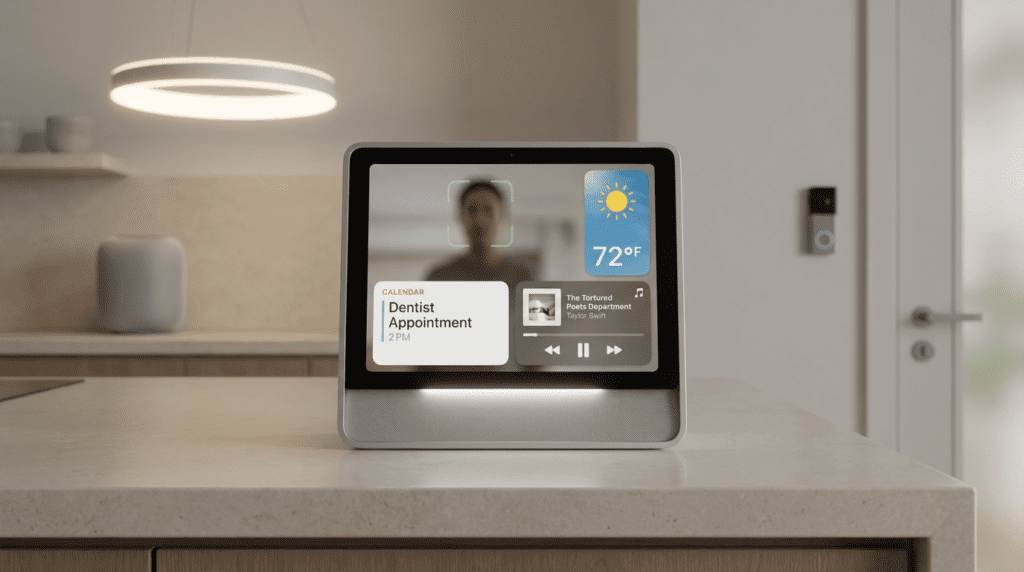
Apple’s long-awaited smart home display keeps getting pushed back. The hardware is ready. The software? Not so much.
The Device That Won’t Launch
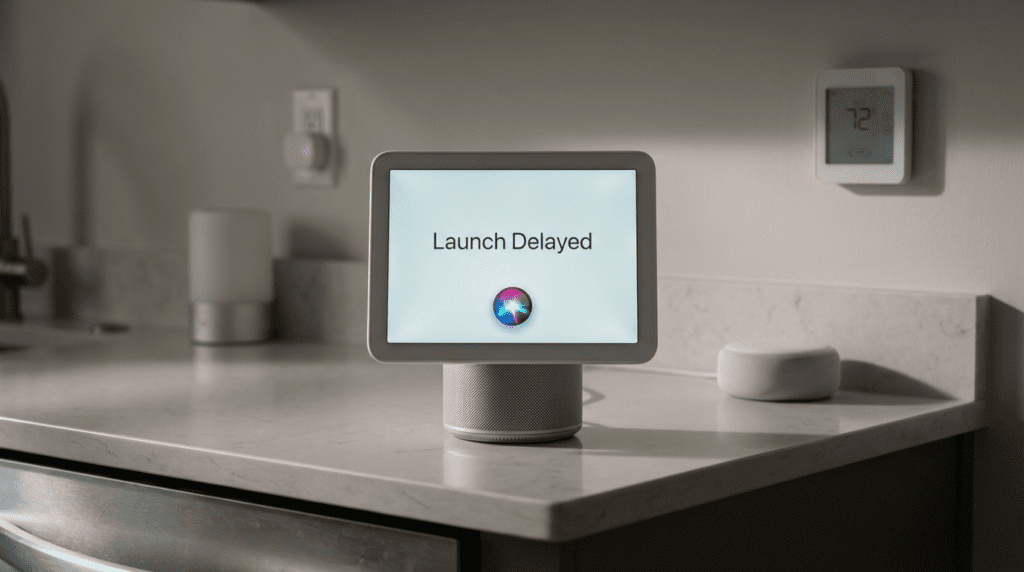
Apple has a problem. It’s not a supply chain problem. nor a chip problem. It’s a Siri problem.
The company’s highly anticipated smart home display, internally codenamed J490 and widely referred to as the “HomePad” has been delayed. Again. According to Bloomberg’s Mark Gurman, the device won’t arrive until fall 2026 at the earliest. That’s a far cry from its original target of spring 2025.
This isn’t a minor slip. This is a product that has now missed two launch windows. And the culprit is the same both times: Apple’s AI-powered Siri upgrade simply isn’t ready.
The delay was first flagged by leaker Kosutami on X on March 5, 2026, who posted simply: “Clearance: HomePad at Fall.” Days later, Gurman confirmed the news with his own reporting, adding that the robot arm-equipped version of the device, a 9-inch display on a robotic arm, has been pushed all the way to 2027.
What Is the HomePad, Exactly?
So what is this device that Apple keeps delaying? Think of it as a square iPad fused with a HomePod speaker, but smaller, smarter, and designed to live in your kitchen or living room.
According to The Verge, the J490 features a 7-inch display housed in a silver aluminum casing, powered via a single USB-C port. It runs a version of tvOS 27 and will launch alongside the iPhone 18 Pro this fall.
The device can sit on a half-dome-shaped speaker base or mount directly to a wall. And here’s where it gets interesting: Apple Insider reports that the wall-mounting system may use a MagSafe-like magnetic mechanism,the same concept Apple uses on iPhones. Stick it anywhere. Move it whenever you want.
The interface looks like an Apple Watch face. Circular app icons. Clean. Minimal. Very Apple.
The Face That Knows You
Here’s the feature that sets this device apart from anything else on the market. The HomePad uses facial recognition to identify who’s standing in front of it.
Walk up to the display, and it knows it’s you. It pulls up your calendar. Your music, reminders, news. Walk away, and someone else walks up, it switches to their profile automatically.
Digital Trends describes it as “a central AI hub for the home,” one that combines voice recognition with facial recognition to deliver a truly personalized experience. It’s not just a smart speaker with a screen. Apple is positioning this as the brain of your entire home.
The device will also integrate with Apple’s home security ecosystem. Leaker Kosutami previously revealed that Apple is developing a smart doorbell with Home Key and Face ID support, and it will even ring a user’s AirPods when someone’s at the door.
The Hardware Is Done. The Software Isn’t.
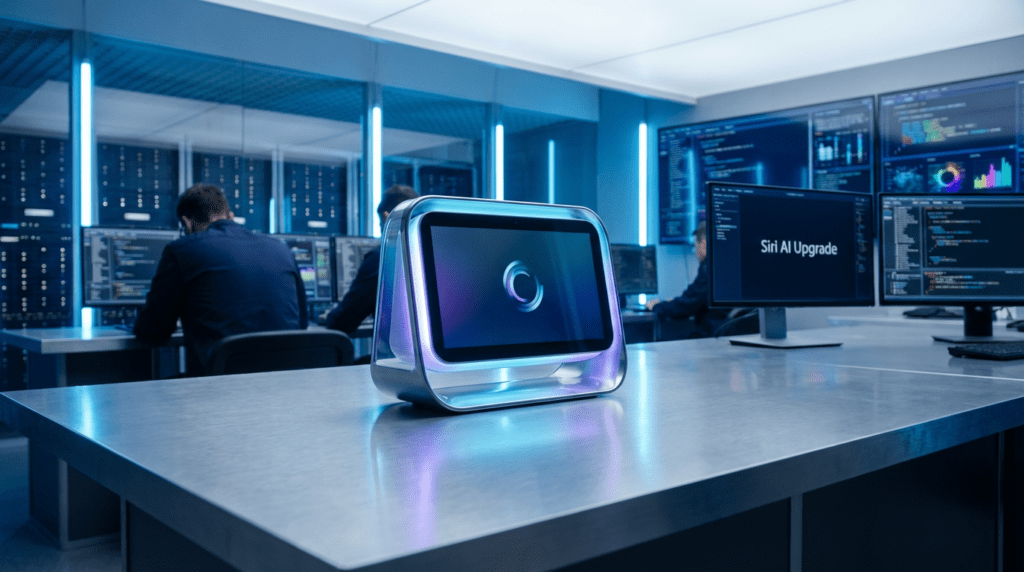
Here’s the frustrating part. The HomePad’s hardware has reportedly been finished for months.
Apple Insider puts it bluntly: “The mind is weak, but the body is willing.” The physical device is ready to ship. Apple just can’t pull the trigger because Siri, the AI assistant that powers the entire experience, keeps falling behind schedule.
FoneArena notes that Apple even updated the device’s operating system from tvOS 26 to tvOS 27 mid-development, just to align it with the new Siri rollout. That’s how serious the software dependency is. The hardware team finished their job. Now everyone is waiting on the AI team.
SVP John Ternus is reportedly leading the effort to get the updated Siri across the finish line. Mark Gurman expects all new Siri features to be ready by September, just in time for the iPhone 18 Pro launch.
Siri’s Long, Painful Reinvention
To understand why this keeps happening, you need to understand what Apple is trying to do with Siri.
The company isn’t just patching the old Siri. It’s rebuilding it from the ground up into a modern, chatbot-style AI assistant one that can handle complex, multi-step requests, understand context, and tap into your personal data to give genuinely useful answers.
Apple inked a deal with Google to use Gemini’s underlying AI technology as the foundation for this new Siri. Spyglass writer M.G. Siegler notes that this gives him cautious optimism: “Google is providing the underlying AI technology and they’ve proven to be more than competent in this regard.”
But swapping out an AI brain isn’t simple. There are, as Siegler puts it, “about a million edge cases that will break.” Amazon learned this the hard way when it rebuilt Alexa into Alexa+. Apple is learning it now.
The result? A Siri that was supposed to debut in 2025 is now expected in late 2026. And every product that depends on it, the HomePad, the new HomePod, the updated Apple TV, is stuck waiting in line.
Apple Is Falling Behind in the AI Home Race
While Apple waits, its competitors are moving fast.
Amazon has already switched millions of Echo devices to the new Alexa+ assistant. Google has upgraded its entire ecosystem to run on Gemini. Both companies now offer smart home displays with conversational AI built in.
Apple? Still waiting.
Digital Trends makes the competitive gap clear: “Apple is pretty far behind in the race for AI home assistants.” The HomePad was supposed to be Apple’s answer to the Amazon Echo Show and Google Nest Hub. Instead, it’s become a symbol of the company’s AI struggles.
Seeking Alpha flagged the delay as a notable business concern for Apple (AAPL), noting that the company intends to complete its Siri upgrade before launching any new smart home hardware. Investors are watching closely.
A Bigger Problem Than One Product
The HomePad delay isn’t an isolated incident. It’s a symptom of a deeper strategic failure.
Spyglass argues that Apple’s AI stumbles in 2023 and 2024 are now costing the company real product launches in 2025 and 2026. “Because Apple so badly bungled their AI strategy,” Siegler writes, “they’re missing shipping targets for actual products.”
There’s also a chip question looming. The HomePad was designed around a specific generation of Apple Silicon. But two generations of chips have now passed since development began. Will Apple need to upgrade the internals before it ships? That has real cost implications.
And then there’s the pressure of expectations. Because Apple has held this product back for so long, waiting to get it right, it now has to be exceptional. A mediocre smart home display won’t cut it. The bar has been raised by the delay itself.
What Comes After the HomePad
The HomePad is just the beginning of Apple’s smart home ambitions. FoneArena reports that Apple is also developing:
- A 9-inch robotic smart display (expected 2027)
- A new HomePod without a display
- An updated Apple TV (hardware unchanged since 2022)
- Camera-equipped AirPods
- Smart glasses
- A smart home sensor/doorbell
All of these products are waiting on the same thing: a working, polished, next-gen Siri. If the fall 2026 timeline holds, the entire ecosystem could start rolling out in waves. If Siri slips again well, we’ve seen how that goes.
The Fall 2026 Bet
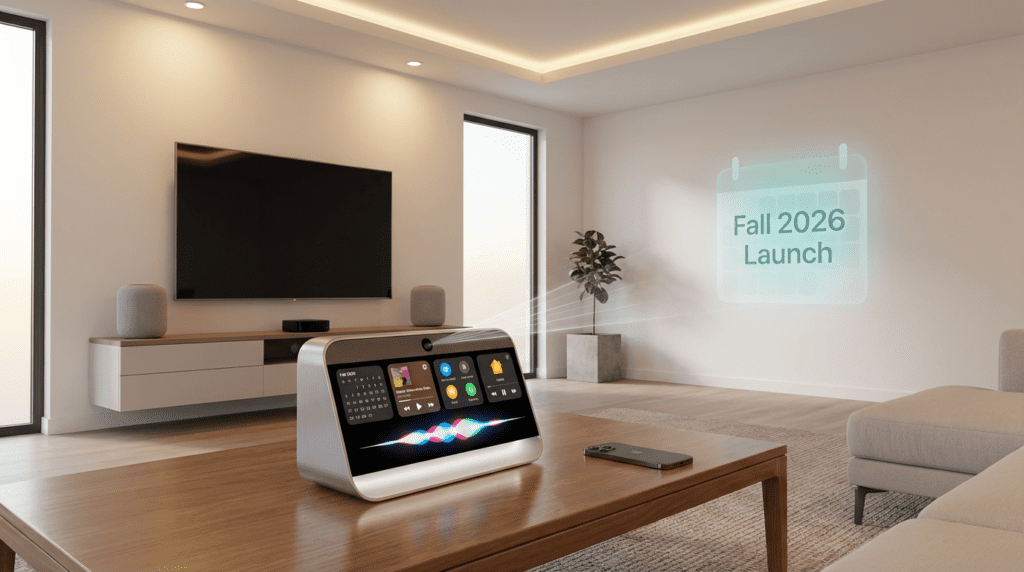
Apple is betting everything on a September launch. The HomePad. The new Siri. The iPhone 18 Pro. All arriving together, all powered by the same AI engine.
It’s an ambitious plan. And if it works, it could redefine Apple’s role in the smart home. A device that knows your face, learns your habits, and connects every Apple product in your house, that’s genuinely compelling.
But Apple has made this bet before. Spring 2025. Then March 2026. Now fall 2026.
The hardware is ready. The vision is clear. The only question left is whether Siri will finally show up.
Sources
- The Verge — Apple smart home display rumors now point to a fall launch with iOS 27
- Digital Trends — Apple’s smart home display is apparently delayed, and Siri’s late AI rebirth is to blame
- Spyglass — Apple is Writing Product Checks That Siri Can’t Cash
- Seeking Alpha — Apple delays release of new smart home device as it continues Siri upgrade
- Apple Insider — Apple’s smart home hub delayed again because updating Siri is hard
- FoneArena — Apple delays smart home display launch due to Siri AI update
The Kingy Brief
Get the next Kingy Brief.
Source-checked AI changes, original tests and one practical thing to try.
Free · Choose your subjects · Double opt-in · Unsubscribe anytime