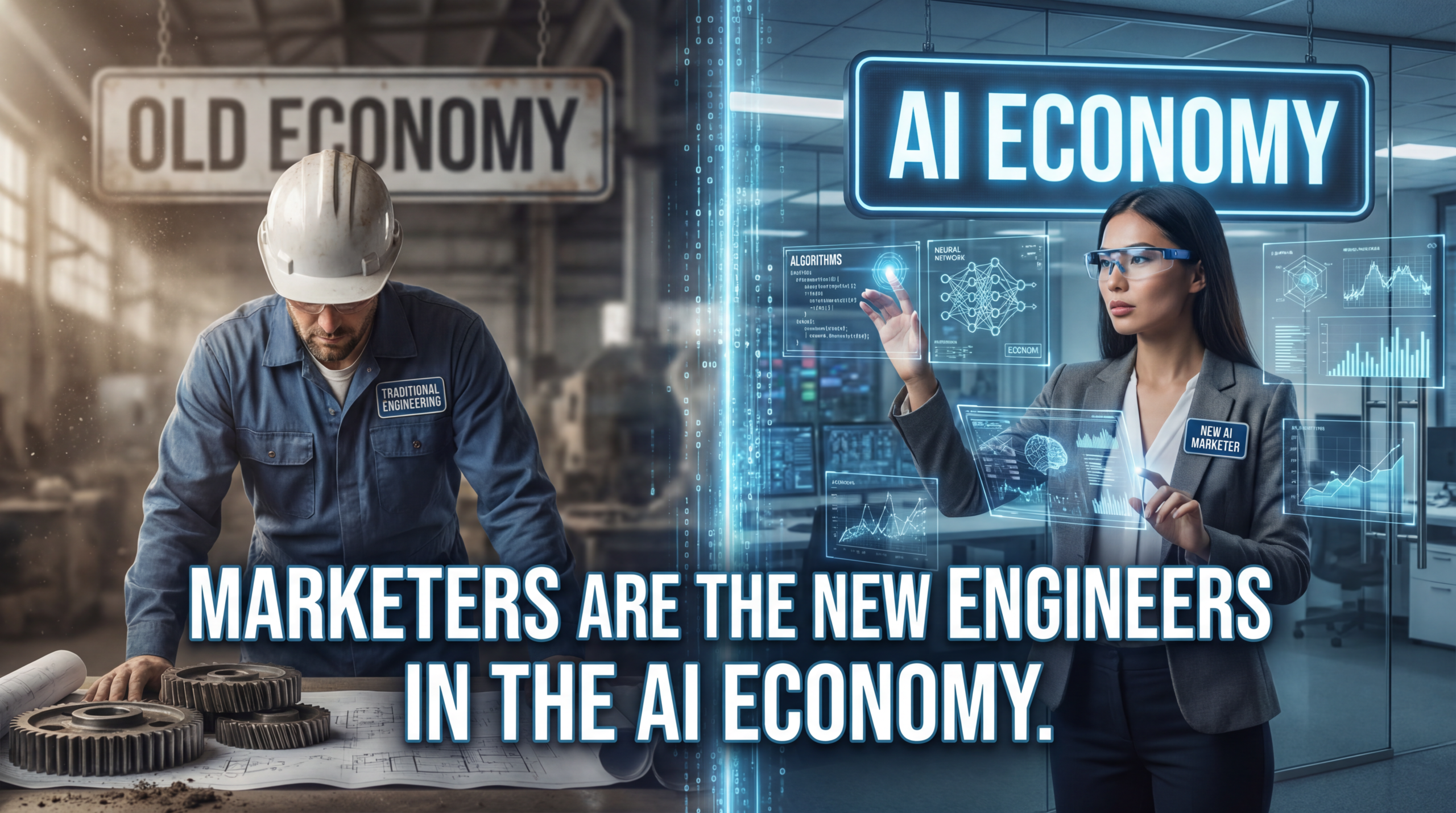
There’s a phrase that has echoed through startup offices, accelerator demo days, and angel investor pitch decks for the better part of two decades: ideas don’t matter, execution does.
It became gospel. The canonical rebuttal to every wide-eyed founder who thought their napkin sketch was worth protecting. The experienced investor would lean back, smile patiently, and explain that ideas are a commodity — cheap, plentiful, and largely irrelevant. What separates winners from losers, the story went, is the relentless, disciplined, often brutal act of building. Shipping. Iterating. Getting it done.
And for a long time, this was true in a way that mattered. The difference between a good idea and a real company was a chasm of engineering hours, product decisions, hiring rounds, and capital deployment. Building software was expensive. It required teams. It required time. It required the kind of focused organizational energy that most people simply couldn’t summon or sustain.
But that world is changing faster than most people realize.
Artificial intelligence is collapsing the cost of execution. The moat that separated “people who can build things” from “people who cannot” is narrowing at a pace that would have seemed absurd even five years ago. What once required a team of five engineers and six months now requires one person and a weekend. What once required a seasoned designer, a content team, and a marketing department can now be scaffolded in hours with the right prompts and the right tools.
This is not a marginal shift. It is a structural one — and it forces us to revisit that old startup mantra with fresh eyes.
If execution is becoming cheap, what becomes expensive?
The answer, increasingly, is this: getting anyone to care.
The Old Gospel of Execution
To understand why this shift matters, it helps to understand just how dominant the execution-over-ideas thesis became.
Paul Graham, in his essays and Y Combinator lore, consistently emphasized that the value of a startup idea was nearly zero in isolation. The idea had to be combined with a team capable of discovering the real idea through the process of building. Execution wasn’t just important — it was the mechanism by which ideas revealed their actual shape.
This framing made sense given the realities of the time. Software startups of the 2000s and 2010s were capital-intensive endeavors. Building a web application meant hiring backend engineers, frontend engineers, DevOps professionals, product managers, and designers. Each hire was expensive, slow to onboard, and risky to let go. Infrastructure had to be managed. Servers had to be provisioned. Scaling was a genuine engineering challenge that required real expertise.
Reid Hoffman’s famous observation — that if you aren’t embarrassed by the first version of your product, you’ve launched too late — was partly a response to how long building took. Shipping fast was a competitive advantage because shipping at all was hard. Getting to market required compressing months of work into weeks, and that compression required extraordinary execution discipline.
The founders who could do this consistently were genuinely rare. They possessed a combination of technical skill, organizational ability, product intuition, and sheer willpower that most people lacked. The execution barrier wasn’t just a cost barrier — it was a talent barrier. And talent barriers, almost by definition, create moats.
That’s why investors placed such a premium on teams over ideas. A great team could discover the right idea. A great idea with a mediocre team would limp across the finish line, or not finish at all. The market rewarded builders because building was hard.
Then the tools got dramatically better.
How AI Compresses the Cost of Building
The shift didn’t happen overnight, and it didn’t happen because of one product or one company. It happened in layers, each one compressing the execution cost a little further, until the cumulative effect became impossible to ignore.
The first layer was cloud infrastructure. Amazon Web Services, launched in 2006, began eliminating the need for companies to manage their own servers. What once required a dedicated infrastructure team and significant capital expenditure became a monthly bill and a few API calls. The operational cost of running software plummeted.
The second layer was the proliferation of open-source software, developer tools, and SaaS components. By the 2010s, an engineer building a new application didn’t have to write authentication from scratch, or build a payment system, or design a database schema for user management. Libraries, frameworks, and services existed for nearly every foundational need. Stripe handled payments. Auth0 handled authentication. Twilio handled communications. The cognitive surface area required to build a functional product shrank dramatically.
The third layer — and the one that is currently rewriting the economics of building entirely — is AI-assisted development.
GitHub Copilot, released in 2021, was an early and visible signal. A tool that could autocomplete code at the function level, suggesting implementations based on natural language comments and contextual patterns. Developers who used it consistently reported meaningful productivity gains — not just in speed, but in the ability to work comfortably across unfamiliar programming languages and frameworks.
But Copilot was just the beginning of a trajectory that has since accelerated dramatically. Large language models, and the coding-focused products built on top of them, have reached a point where substantial portions of a software application can be generated, debugged, and iterated upon by someone with minimal formal engineering background. Tools like Cursor, Replit’s AI features, and a growing ecosystem of AI-native development environments are compressing the time-to-prototype from weeks to hours.
This is not purely a productivity story for professional engineers. It is a story about who can build at all.
A founder with a clear product vision but limited coding ability can now describe what they want in natural language and get working software back. Not perfect software, not production-ready software in all cases, but functional, testable, iterable software. The minimum viable product — already a deliberately stripped-down artifact — has become achievable without the traditional execution resources.
Consider what this means for the classic startup calculus. If a two-person founding team once needed six months and $500,000 to build a product that could be tested with users, and that same product can now be built in four weeks by one person with AI assistance and a few thousand dollars in cloud costs, the execution barrier has not just lowered — it has effectively changed categories.
What was once an obstacle has become a step.
And when something shifts from obstacle to step, the economics of competition shift with it.

The Paradox: Easier Building Creates More Competition, Not Less
Here is where founders and investors who are focused solely on the productivity gains from AI tend to miss something important.
The intuitive response to “building is now cheaper and faster” is: great, we can build more things, faster. And that’s true. But it ignores a symmetrical reality: so can everyone else.
When the barrier to entry for building a product drops, the number of products being built increases. This is not speculation — it’s already visible. The number of products launched on Product Hunt each day has grown substantially. App stores are flooded with new submissions. AI-generated websites, tools, and micro-SaaS products are proliferating at a rate that would have been impossible in the pre-AI era.
This is the paradox of democratized execution: the very thing that makes building easier makes standing out harder.
Think about what happens to market dynamics when execution costs collapse. If building a basic productivity app once required $500,000 and a team of five, then the universe of teams attempting that build was small. The survivors of that execution challenge had already demonstrated something meaningful — a capacity for sustained effort that the market could use as a proxy signal for quality.
Now that same app can be scaffolded in a week. The universe of teams attempting that build is enormous. And because execution is no longer the differentiating variable, the market can no longer use it as a signal. Something else has to separate the products that get attention from the products that get ignored.
Peter Thiel, in Zero to One, makes a related point about distribution that the startup world has historically underweighted. He writes that if you’ve invented something new but you haven’t invented an effective way to sell it, you have a bad business — no matter how good the technology is. The technology chapter and the distribution chapter of a company’s story are not sequential. They are simultaneous. Founders who treat distribution as something you figure out after building are, in Thiel’s framing, making a category error.
This insight has always been true. But it becomes more true as execution costs fall, because the execution story can no longer carry the company narrative the way it once did.
In the old world, you could raise money on the strength of a team’s ability to build. You could attract early users through novelty alone — there simply weren’t many competitors. You could grow on the basis of being one of the few things that worked in a given category.
In the new world, you will have competitors with comparable products within months, sometimes within weeks. The novelty advantage evaporates faster. The technical differentiation is harder to sustain. And the question investors and users ask shifts accordingly: not can you build it, but why will people choose you specifically.
That question has an answer, but it’s not a product answer. It’s a distribution answer.
Attention Is the New Bottleneck
The economist Herbert Simon made an observation in 1971 that has become one of the foundational ideas of the digital age: “a wealth of information creates a poverty of attention.” As the supply of information grows, the scarce resource is not information itself but the human attention required to process it.
Simon was describing a general principle of information economics. What he couldn’t fully anticipate was the degree to which that principle would come to govern the economics of technology products specifically.
Today, the attention economy is not just a concept — it is the operating system on which most consumer technology businesses run. Platforms like TikTok, Instagram, YouTube, and Twitter/X are not selling products in any traditional sense. They are selling time. Their core asset is not their technology stack — it’s the collective attention of their users, measured in hours per day, engagement rates, and return visit frequency.
For startups building products in this environment, the implications are severe.
The average smartphone user has dozens of apps installed and actively uses far fewer. The average professional receives hundreds of emails and newsletters and reads a fraction of them. The average person scrolling a social feed encounters thousands of posts per week and genuinely engages with a tiny percentage. Attention is finite, jealously guarded, and increasingly pre-allocated to existing platforms and habits.
Breaking into that pre-allocated attention is not primarily a product challenge. A technically superior product does not automatically win user attention. In fact, the data consistently shows that users prefer familiar products over better products if the switching cost — which is largely an attention and habit cost — exceeds the perceived benefit of switching.
This is not irrational behavior. It’s the perfectly sensible response of a person operating with limited cognitive bandwidth. Learning a new tool, forming new habits, integrating a new product into existing workflows — all of these require attention investment upfront. Unless the payoff is immediate and obvious, the default choice is to stay with what already has a slot in your mental model.
The implication for founders: the product has to be remarkable enough to justify an attention switch, and you have to find a way to get in front of the right people at the right moment and you have to communicate the value proposition instantly and compellingly. All three of these things are distribution problems as much as they are product problems.
Kevin Kelly’s essay on 1,000 True Fans has been circulating for over fifteen years, and it contains a surprisingly prescient insight for this moment. Kelly’s argument was that a creator didn’t need mass reach — they needed a relatively small number of deeply committed audience members to sustain a meaningful creative career. The math was simple: 1,000 fans who each pay $100 per year equals $100,000 per year, which equals a viable living.
The piece was originally about creators and artists, but it applies with increasing force to software products. A bootstrapped SaaS business doesn’t need millions of users to be sustainable. It needs hundreds or thousands of users who genuinely care about the problem being solved and are willing to pay for the solution. The question isn’t how many people can you reach — it’s how do you find the specific people for whom your product changes something important.
That’s an attention and distribution problem. And it’s the hardest problem in building a company right now.

Why Distribution Is Now a Strategic Asset, Not a Marketing Afterthought
In the traditional startup playbook, distribution was something you thought about after product-market fit. You built, you validated, and then — once you had evidence that the thing worked — you brought in growth people, you hired a marketing team, you ran experiments on acquisition channels.
This sequencing made a certain kind of sense. Resources were limited. Early engineering talent was precious. You couldn’t afford to split focus between building and marketing. You needed to solve the product problem before you solved the distribution problem.
But this sequencing contained a hidden assumption: that once you had a good product, distribution would be solvable. That the channels would be there, the costs would be manageable, and a product that genuinely worked would find its audience through some combination of word of mouth, PR, and paid acquisition.
That assumption is breaking down on multiple fronts.
First, paid acquisition costs have risen dramatically over the past decade. Digital advertising costs on platforms like Google and Facebook/Meta have increased substantially as more advertisers compete for the same inventory. The customer acquisition cost economics that made certain business models viable in 2015 are significantly less favorable today. For many startups, paid acquisition is either not viable as a primary channel or requires a unit economics model that takes years to validate.
Second, the organic distribution channels that fueled the growth of the previous generation of products are increasingly saturated and algorithmically hostile to new entrants. App store discovery, once a genuine growth channel, is dominated by incumbents and paid placement. SEO, once a reliable long-term investment for traffic, is being disrupted by AI-generated content and shifting search behavior. Email open rates have declined as inboxes have become more crowded and spam filters more aggressive.
Third, and most importantly, social media platforms — which became the primary distribution mechanism for the last wave of consumer startups — have become more closed, more algorithm-dependent, and more expensive to build presence on. Organic reach on Facebook reached near-zero for most pages by the mid-2010s. Instagram, TikTok, and other platforms have each followed a similar arc: open and generous to new creators early, then progressively more restrictive as they matured and monetized.
Ben Thompson’s aggregation theory, developed at Stratechery over the past decade, provides a useful framework for understanding why this happens. Thompson’s argument is that internet platforms which achieve scale by aggregating demand gain leverage over both suppliers and users. They become the chokepoint through which distribution flows, and as their market power grows, they can extract more value from the participants on both sides.
For startups trying to build distribution through these platforms, this dynamic is inherently unfavorable over the long term. You are building on rented land. The platform sets the rules. The platform controls the feed. And the platform’s incentives — to maximize its own engagement and revenue — are not aligned with your incentive to build a sustainable, direct relationship with your users.
This is why owned distribution has become so valuable.
Substack, despite being its own platform and subject to some of the same dynamics, has illustrated something important: there is enormous pent-up demand for direct relationships between creators/builders and their audiences. The newsletter renaissance wasn’t primarily about nostalgia for email. It was about the desire for distribution that wasn’t subject to algorithmic caprice. A list of email subscribers is owned distribution. When someone joins your email list, you have a persistent, direct channel to reach them that doesn’t depend on a platform’s willingness to show them your content.
Podcasts function similarly. A podcast feed is direct access to a listener’s time, routed through a subscription relationship that the host controls. The listener opted in. They return each week not because an algorithm surfaced the show but because they chose to.
Communities — whether on Discord, in private forums, or in real-world networks — represent another form of owned and earned distribution. A community of people who trust you, who have opted into a relationship with your work, is a distribution asset of enormous strategic value. It’s the kind of distribution that can’t be bought on day one and can’t be easily replicated by a better-funded competitor.
Naval Ravikant, in one of the formulations that has circulated widely in startup circles, describes the kinds of leverage available to individuals and companies: labor, capital, code, and media. His argument is that code and media are the two forms of leverage that don’t require permission — you can write software and you can publish content without anyone’s approval. But the implication is that while code creates the product, media and distribution are what make the product matter.
This framing is becoming more rather than less relevant as execution costs decline. The leverage from code — from being able to build things — is democratizing. The leverage from distribution — from having an audience that trusts you, a community that engages with your work, a reputation that precedes your products — is accumulating in the hands of founders who understood early that building an audience was as important as building a product.
What This Means for Founders Building Right Now
The practical implications of this shift are significant and, in some ways, counterintuitive.
Start building your audience before you build your product.
This is advice that makes traditional product founders uncomfortable, because it feels like a distraction. The founder wants to build. The impulse is to write code, ship features, and validate the product. But in a world where execution is cheap and competition is fast, the founder who launches into a vacuum is playing a harder game than the founder who has spent the previous year building trust with the specific people they want to serve.
Andrew Chen, a partner at Andreessen Horowitz who has written extensively about growth, has tracked the rising cost of distribution across virtually every major category. His work on what he calls the “Law of Shitty Clickthroughs” — the observation that every new channel or tactic sees declining effectiveness over time as it becomes widely adopted — is a useful frame. The channels that worked for the last generation of startups are less available to the current generation. New distribution channels are premium assets precisely because they haven’t yet been saturated by imitators.
This means founders need to find and develop new channels before the competition discovers them, while simultaneously investing in forms of distribution that compound over time rather than decay.
Build distribution that compounds.
There’s a fundamental difference between distribution channels that are rented and ones that are built. Paid ads are rented. Every day you stop paying, the distribution stops. SEO is somewhere in between — it requires ongoing investment and is subject to platform risk from algorithm changes, but rankings can persist. Email lists, podcast audiences, community memberships, and personal brand are built. They compound with time. They generate new members through word of mouth. They create flywheel effects where distribution quality improves with scale.
The founder who is building distribution that compounds is playing a fundamentally different game than the founder who is relying on paid acquisition or platform-dependent organic reach. Over a one-year horizon, the difference may be hard to see. Over a three-to-five year horizon, it can be decisive.
Product and distribution are not sequential — they are parallel workstreams.
One of the clearest practical implications of this shift is that the old sequencing — build first, distribute second — is increasingly untenable. The founder who waits to think about distribution until after product-market fit has been achieved will find themselves competing in a market where distribution is already expensive and channels are already saturated.
The better frame is to think about product and distribution as parallel workstreams from day one. Not in the sense of splitting attention equally between them, but in the sense of making distribution decisions that are embedded in product decisions. How does this product create word-of-mouth? What kind of person shares this with their network, and why? Is there a distribution mechanism built into the product itself — a viral loop, a network effect, a collaboration feature that naturally invites new users?
Products that grow through their own usage are not accidental. They are designed that way. Slack grew because every new Slack user immediately wanted to bring their colleagues onto the platform. Figma grew because the core feature — collaborative design — required multiple users. Notion grew partly because users shared their setups and templates publicly, creating content that attracted new users organically.
None of these products grew primarily because they were better than their competitors, though they were all genuinely good. They grew because distribution was a feature, not an afterthought.
Niche depth beats broad reach at the start.
In a world where attention is scarce and competition is intensifying, the temptation is to cast the widest possible net — to build something for everyone, to pursue the largest possible market, to optimize for reach at the expense of depth.
But the economics of the attention economy work differently than that instinct suggests. Trying to be meaningful to everyone is the fastest way to be meaningful to no one. The algorithm, the word of mouth, the community — all of these distribution mechanisms work best when they’re propagating a specific signal to a specific audience.
Kevin Kelly’s 1,000 true fans framework is useful here again. The goal is not to reach millions of people who sort of care. The goal is to find the hundreds or thousands of people who deeply care — for whom your product is not an option among many, but the specific answer to a specific need they’ve been aware of for a long time. Those people will become your distribution engine. They will tell other people who share their characteristics. They will write reviews, post testimonials, share content, and bring you into communities you wouldn’t have found on your own.
This is distribution through depth, not breadth. And in the current environment, it is often more durable and more efficient than the alternative.
The Attention Economy Has a Power Law Distribution Problem
There is one more dimension of this shift that deserves explicit attention, because it shapes the strategic landscape in a way that can be easy to miss.
Attention is not distributed evenly. It concentrates. In almost every category of human attention — music, books, social media accounts, YouTube channels, software products — the distribution follows a power law. The top performers capture a disproportionate share of attention, and the long tail captures very little.
This was true before AI, but it will become more true after it, for a counterintuitive reason.
When execution is cheap and products proliferate, the cognitive cost of evaluating options rises. A consumer facing fifty roughly-equivalent productivity tools doesn’t evaluate all fifty carefully — they rely on social proof, brand reputation, recommendations from trusted sources, and familiarity. These factors all concentrate attention at the top of the distribution. The products that already have attention attract more attention. The products trying to break into the market from the long tail face an increasingly steep climb.
This is why distribution assets built before a product’s launch — a newsletter audience, a social media following, a community, a personal brand — are so valuable. They provide a mechanism for bypassing the attention concentration dynamic by routing attention through a trusted intermediary relationship. When a trusted voice recommends a product, the receiver doesn’t need to evaluate it against fifty alternatives. The trust relationship does the cognitive work.
Influencer marketing, affiliate channels, and community-led growth are all expressions of this principle. They are mechanisms for moving attention through pre-existing trust relationships rather than competing in the open market for awareness. The cost of distribution falls dramatically when it travels through a trusted network rather than fighting for space in an undifferentiated attention marketplace.
Founders who understand this will invest heavily in building trust-based relationships — with communities, with creators, with early adopters who have reach — not because it is a clever marketing tactic but because it is the structural response to the attention economy’s power law dynamic.
What Investors Are Starting to Notice
It would be incomplete to discuss this shift without noting that sophisticated investors are beginning to price it in.
For decades, the primary signal that early-stage investors used to evaluate startups was team quality, usually understood as technical and operational execution capability. Could this team build the thing? Did they have the engineering depth, the product intuition, the leadership experience to navigate the execution challenge?
These factors remain relevant. They don’t disappear simply because execution costs have fallen. A team that can build quickly, iterate intelligently, and operate with discipline is still better than one that cannot.
But distribution capability is emerging as a co-equal variable in early-stage investment evaluation. Investors are increasingly asking not just “can this team build?” but “does this team have distribution access?” A founder who has a newsletter with 50,000 engaged subscribers has a distribution asset that is worth more than most people realize. A founder who is deeply embedded in the community of people they’re building for has access to feedback, early users, and word-of-mouth that a better-funded competitor can’t easily replicate.
This is creating a new kind of advantage for certain types of founders — specifically, the founders who have spent years creating content, building communities, and cultivating audiences before they started a company. The “creator-founder” archetype — someone who built a following around a specific topic and then built a product for that following — is increasingly well-positioned in the current environment precisely because they arrive at the starting line with distribution assets that others are trying to acquire from scratch.
Andreessen Horowitz has been among the most explicit about this, building out a significant media operation and creator economy focus that reflects their view that distribution and content capabilities are genuine strategic advantages. Their investment thesis has evolved to weight audience access and brand-building capacity alongside traditional technical execution metrics.
The Honest Reckoning
None of this should be taken to mean that building doesn’t matter anymore. It does. A product that doesn’t work won’t be saved by distribution. A team that can’t execute on product quality will eventually lose to competitors who can. The bar for what “good enough” means is rising, not falling, because there are more alternatives in every category.
But the conversation has to be rebalanced.
For too long, the startup ecosystem’s orthodoxy has functioned as a kind of cultural permission structure: don’t worry about distribution yet, just build. The implication was that distribution was the easy part — something you could always figure out once the product was good enough. Something that money could solve if the product justified investment.
That permission structure is increasingly dangerous advice. Distribution is not easy. It is not just a matter of capital deployment. It is not something you can buy reliably at the scale and efficiency required to build a defensible business in a market where your competitors can build as fast as you can.
Distribution is something you build, slowly, through consistent behavior over time. Through showing up repeatedly in the communities that matter. Through creating content that earns trust. Through making products that are designed to spread. Through building the kind of reputation that means when you launch something new, people pay attention not because you paid for their attention but because you’ve earned it.
The old startup mantra was: ideas don’t matter, execution does.
The new mantra, for the AI era, is something like: execution is table stakes, distribution is the game.
Conclusion: The Scarcest Resource Is Already Clear
The history of technological change is, in some sense, a history of changing scarcity. When something that was once scarce becomes abundant, the value shifts to whatever is now scarce in its place. When physical manufacturing became efficient and broadly accessible, design and brand became the differentiation. When access to information became universal via the internet, curation and trust became the scarce resource. When computing power became cheap and accessible, data and the ability to act on it became the strategic asset.
We are in the middle of another one of these transitions. Execution — the ability to build functional software products — is becoming abundant. Not unlimited, not free in every case, but dramatically cheaper and more accessible than it has ever been. The AI tools enabling this shift are still improving rapidly. The trajectory is clear.
The scarce resource that value will flow toward is attention, and the infrastructure for capturing it: audiences, communities, trusted relationships, brand reputation, and distribution channels that compound over time.
This is not a comfortable transition for many founders, because it requires skills and behaviors that are different from the ones the last generation of startup culture celebrated. Building in public, creating content consistently, cultivating communities, developing a personal brand — these feel less serious, less technical, less real than shipping code. They require a tolerance for ambiguity and a long time horizon that the traditional execution playbook doesn’t demand.
But the economics are what they are. As Ben Thompson has documented across years of analysis at Stratechery, the platforms that control distribution have captured enormous value precisely because distribution is what’s scarce. The founders who internalize this early will build companies that look very different from the ones the startup playbook has been optimized for — but they will also build companies that are far more defensible in a world where anyone can build anything in a week.
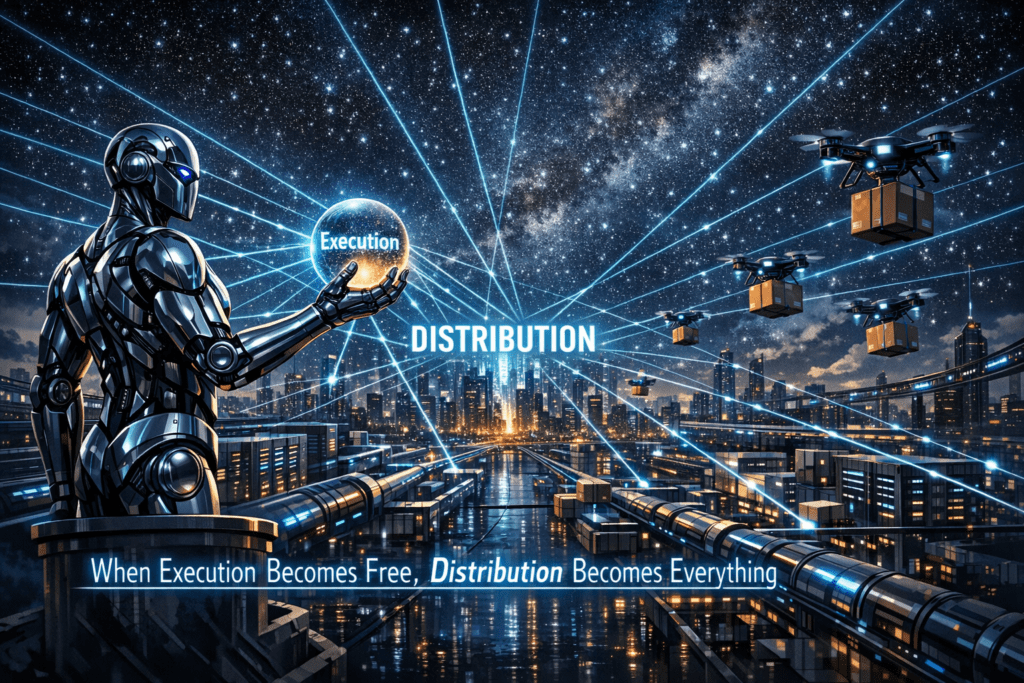
When execution becomes free, distribution becomes everything. That sentence is not quite true yet. But it’s getting truer every month. And the founders who are treating it as already true are likely the ones who will still be here when it is.