A federal judge dismissed Elon Musk’s xAI lawsuit against OpenAI on Tuesday. The ruling is a win for Sam Altman’s company but it’s just one battle in a much bigger war.
The Verdict Is In And OpenAI Wins This Round
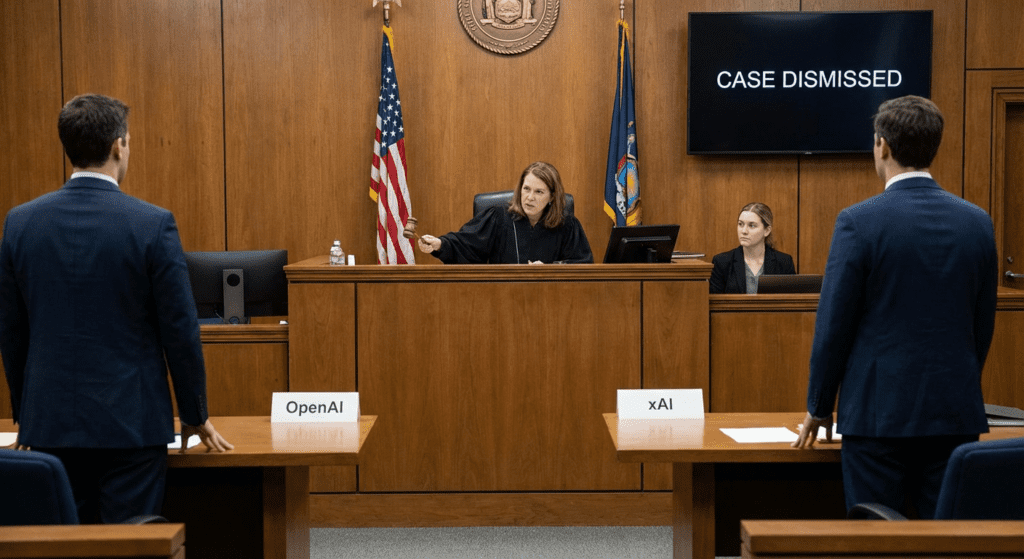
A federal judge handed OpenAI a significant legal victory on Tuesday, February 24, 2026. U.S. District Judge Rita F. Lin dismissed a trade secrets lawsuit filed by Elon Musk’s artificial intelligence startup, xAI. The case had accused OpenAI of orchestrating the theft of proprietary source code and confidential information tied to xAI’s Grok chatbot.
The dismissal wasn’t a full knockout. Judge Lin granted xAI leave to amend, meaning Musk’s company can refile with stronger, more specific claims. But for now? The lawsuit is dead in the water.
The ruling came out of the U.S. District Court in San Francisco. It’s a blow to xAI and a moment of relief for OpenAI, which has been fighting legal battles on multiple fronts. The company wasted no time celebrating. In a post on X, OpenAI wrote: “We welcome the Court’s decision. This baseless lawsuit was never anything more than yet another front in Mr. Musk’s ongoing campaign of harassment.”
Strong words. But what exactly happened here and why does it matter?
What xAI Actually Claimed
Let’s back up. xAI filed this lawsuit in September 2025. The core allegation was serious: former xAI employees allegedly stole source code related to the Grok chatbot and other confidential information when they left to join OpenAI.
Eight former xAI employees were at the center of the case. They all left xAI around the same time. They all ended up at OpenAI. And according to xAI, that wasn’t a coincidence.
The company pointed to specific incidents. Two former employees allegedly “stole source code during their departure” and they were communicating with an OpenAI recruiter at the time. Two others allegedly “retained work chats on their devices after leaving xAI.” One employee reportedly “refused xAI’s demands to provide various certifications about confidential information after his departure.” Another allegedly “unsuccessfully tried to access xAI information about hiring and datacenter optimization after he started working at OpenAI.” And two more, according to xAI, simply left for OpenAI full stop.
On the surface, that sounds like a compelling case. But the judge didn’t see it that way.
Why the Judge Threw It Out
Judge Lin’s reasoning was sharp and direct. She found that xAI’s complaint was missing one critical ingredient: evidence that OpenAI itself did anything wrong.
“Notably absent are allegations about the conduct of OpenAI itself,” Lin wrote in her ruling. She continued: “xAI does not allege any facts indicating that OpenAI induced xAI’s former employees to steal xAI’s trade secrets or that these former xAI employees used any stolen trade secrets once employed by OpenAI.”
That’s a crucial distinction. Employees behaving badly when they leave a company is one thing. A company actively directing or benefiting from that behavior is something else entirely. xAI, according to the judge, failed to connect those dots.
Take the source code allegation. Two employees allegedly took code while communicating with an OpenAI recruiter. But and this is the key part there was “no allegation that the recruiter told them to do so,” Lin noted. The timing looked suspicious. The proof, however, wasn’t there.
The same logic applied across the board. Retained work chats, refused certifications, attempted unauthorized access none of it pointed back to OpenAI as a directing force. The judge wasn’t saying the employees were innocent. She was saying xAI hadn’t proven OpenAI was pulling the strings.
This is why the case was dismissed with leave to amend rather than dismissed outright. xAI has until March 17 to file an amended complaint. If they can find stronger evidence tying OpenAI directly to the alleged misconduct, the case could live again.
The Grok Connection And What’s Really at Stake
Why does this case matter beyond the courtroom drama? Because it’s really about the AI arms race.
Grok is xAI’s flagship chatbot. It’s Musk’s answer to ChatGPT. And according to OpenAI’s court filings, the trade secrets lawsuit was filed precisely because “Grok could not keep up with ChatGPT.” OpenAI framed the entire legal action as a “campaign to harass a competitor with unfounded legal claims.”
That’s a pointed accusation. It suggests OpenAI believes xAI turned to the courts not because it had a strong legal case, but because it was losing the product battle. Whether that’s true or not, the judge’s ruling lends some credibility to that framing.
The AI industry is moving at a breakneck pace. Talent is the most valuable resource. Engineers, researchers, and developers are constantly being recruited away from one company to another. That’s just how Silicon Valley works. But when those employees carry sensitive information with them intentionally or not it creates legal landmines.
xAI also filed a separate lawsuit against a former engineer named Xuechen Li, specifically accusing him of taking trade secrets to OpenAI. That case is still active. So even as Tuesday’s ruling went against xAI, the company is still pursuing individual accountability.
Musk vs. Altman: A Feud That Just Won’t Quit

To understand this lawsuit, you have to understand the broader war between Elon Musk and Sam Altman. It’s personal. It’s professional. And it’s been playing out very publicly for years.
Musk co-founded OpenAI back in 2015. He left the board in 2018. Since then, the relationship between him and Altman has deteriorated dramatically. They’ve traded insults in public statements. They’ve gone after each other on social media. And they’ve sued each other repeatedly.
The most consequential legal battle between them involves OpenAI’s transition from a nonprofit to a for-profit entity. Musk has argued that this conversion betrays the original mission of the organization to develop AI for the benefit of humanity, not shareholders. He’s seeking a staggering $134.5 billion in damages from OpenAI and Microsoft in that case. Jury selection is currently scheduled for April 27.
That’s the big one. The trade secrets case was, in many ways, a sideshow one front in a multi-front legal war. But it still matters. Every legal victory or defeat shapes the narrative. And right now, OpenAI is winning the narrative battle.
OpenAI’s Response: Confident, Combative
OpenAI didn’t hold back after Tuesday’s ruling. The company’s post on X was blunt: the lawsuit was “baseless” and part of Musk’s “ongoing campaign of harassment.”
That kind of language is deliberate. OpenAI isn’t just defending itself in court it’s defending its reputation. Every time Musk files a lawsuit, it generates headlines. It raises questions. It creates uncertainty. OpenAI wants to make clear, loudly and publicly, that it sees these legal actions as bad-faith attacks rather than legitimate grievances.
The company also made a pointed argument in its court filings: xAI filed this lawsuit because Grok couldn’t compete with ChatGPT. That’s a bold claim. It essentially accuses Musk of using the legal system as a competitive weapon. And with Tuesday’s dismissal, a federal judge at least implicitly gave that argument some weight.
What Happens Next for xAI
xAI now faces a choice. Walk away from this particular lawsuit, or come back swinging with a stronger amended complaint by March 17.
Walking away would be a quiet admission that the case was weak. Refiling means doubling down and potentially exposing xAI to further scrutiny if the amended complaint still falls short.
The separate lawsuit against Xuechen Li continues regardless. That case focuses on individual misconduct rather than corporate liability, which may be an easier legal path. If xAI can prove that Li specifically took trade secrets and that OpenAI benefited from them, it could build a stronger foundation for a renewed corporate claim.
But the clock is ticking. March 17 isn’t far away. And the legal team at xAI will need to find something more concrete than circumstantial timing and suspicious behavior if they want Judge Lin to take a second look.
The Bigger Picture: AI, Talent Wars, and Legal Battles
This case is a window into something much larger. The AI industry is in the middle of a talent war unlike anything Silicon Valley has seen before. Companies are poaching each other’s best people constantly. Signing bonuses are enormous. Non-disclosure agreements are standard. And yet, trade secrets still walk out the door.
The legal framework for handling this is still catching up to the speed of the industry. Courts are being asked to draw lines between legitimate recruitment and illegal inducement. Between an employee’s general knowledge and a company’s proprietary secrets. Between competitive intelligence and outright theft.
Tuesday’s ruling didn’t resolve those questions. It just said xAI hadn’t made its case yet. The broader legal and ethical questions about talent mobility in AI remain wide open.
What’s clear is that the Musk-Altman feud isn’t going anywhere. The April jury trial over OpenAI’s nonprofit-to-for-profit conversion will be the next major flashpoint. That case involves billions of dollars, the future structure of one of the world’s most powerful AI companies, and the personal legacies of two of tech’s most polarizing figures.
Tuesday was a win for OpenAI. But in this war, no single battle is decisive.
The Bottom Line

A federal judge dismissed xAI’s trade secrets lawsuit against OpenAI on February 24, 2026. Judge Rita Lin found that xAI failed to allege any direct misconduct by OpenAI itself. xAI has until March 17 to refile with an amended complaint. The case is part of a sprawling legal conflict between Elon Musk and Sam Altman that includes a separate $134.5 billion lawsuit over OpenAI’s corporate restructuring, with jury selection set for April 27.
OpenAI called the lawsuit baseless. xAI has not yet responded publicly to the ruling. The fight, in one form or another, will continue.