


The world’s most valuable private company just got created and it’s betting big on orbital computing.
A Marriage of Necessity and Ambition

Elon Musk just pulled off one of the most audacious corporate maneuvers in tech history. On Monday, SpaceX officially announced it has acquired xAI, Musk’s artificial intelligence startup, creating a combined entity valued at a staggering $1.25 trillion. That’s not a typo. We’re talking about the world’s most valuable private company one that’s now laser-focused on a sci-fi dream that sounds ripped from the pages of a Neal Stephenson novel: building data centers in space.
But here’s the thing. While Musk’s public memo waxes poetic about “becoming a Kardashev II-level civilization” and harnessing the sun’s full power, the reality is far more grounded. xAI desperately needs cash. Like, burning-through-$1-billion-per-month kind of desperate. And SpaceX? It’s got a revenue problem of its own, with roughly 80% of its income coming from launching its own Starlink satellites.
This isn’t just a merger. It’s a lifeline wrapped in a moonshot.
The Space Data Center Dream
Let’s talk about what Musk is actually proposing here. In a memo posted to SpaceX’s website, he laid out his vision with characteristic grandiosity. “Current advances in AI are dependent on large terrestrial data centers, which require immense amounts of power and cooling,” Musk wrote. “Global electricity demand for AI simply cannot be met with terrestrial solutions, even in the near term, without imposing hardship on communities and the environment.”
He’s not entirely wrong. AI data centers are environmental nightmares. They guzzle water for cooling, drive up local electricity bills, and have become increasingly unwelcome in communities across America. xAI itself has been accused of imposing hardship on neighborhoods near its Memphis, Tennessee facilities.
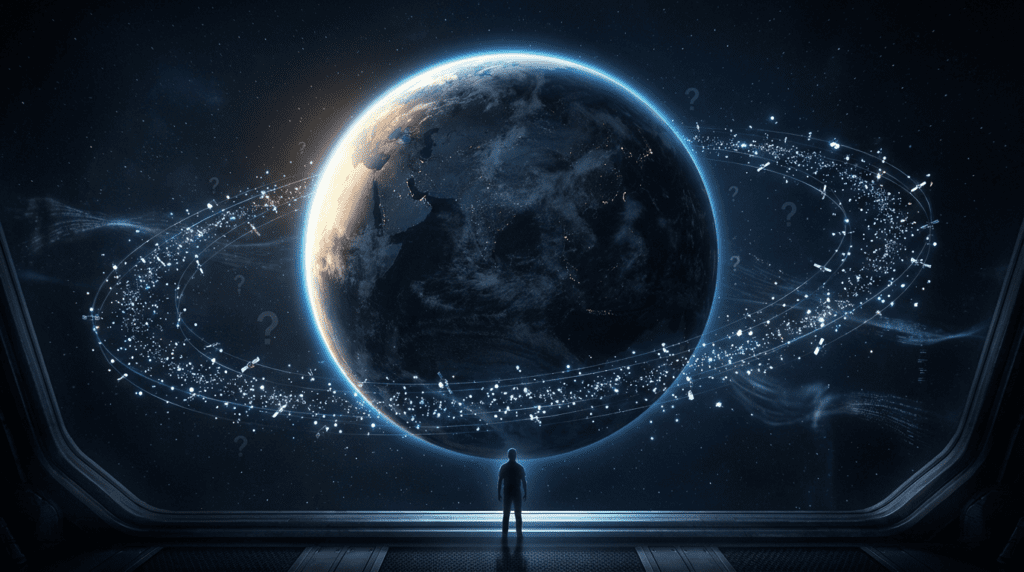
Enter the orbital solution. According to SpaceX’s FCC filing, the company wants permission to launch up to one million solar-powered data center satellites into low Earth orbit. These satellites would communicate with each other via lasers, radiate heat directly into the vacuum of space, and run almost exclusively on real-time solar power with minimal battery backup.
It’s an elegant solution to a very real problem. No water consumption also no angry neighbors. and no strain on local power grids. Just satellites doing their thing in the cold, silent expanse of space.
The Numbers Don’t Lie
But let’s pump the brakes for a second. One million satellites? Really?
The European Space Agency estimates there are currently around 15,000 satellites orbiting Earth. Over 9,600 of those are Starlink satellites. If SpaceX actually got approval for a million data center satellites even a fraction of that number we’d be looking at an unprecedented explosion of objects in orbit. Space junk concerns? Collision risks? Those problems would multiply exponentially.
Of course, SpaceX has a history of asking for the moon (literally and figuratively) and settling for something more reasonable. Industry insiders suggest the one-million figure is a negotiating tactic a starting point designed to give the FCC room to approve a smaller, more manageable constellation.
Still, even a “smaller” network of tens of thousands of orbital data centers would represent a massive undertaking. And that’s where the financial realities of this merger start to make sense.
Follow the Money
Here’s what nobody’s saying out loud: xAI is hemorrhaging cash at an alarming rate. According to The Information, the company burned through approximately $9.5 billion in just the first nine months of 2025. That’s roughly $1 billion per month going up in smoke as xAI races to compete with industry giants like OpenAI, Google, and Anthropic.
In early January, xAI managed to close a $20 billion funding round at a $230 billion valuation. Impressive, right? Not when you compare it to OpenAI’s $500 billion valuation or Anthropic’s recent $350 billion term sheet. xAI is playing catch-up in a market where being second or third place might as well be last.
SpaceX, meanwhile, is reportedly preparing for an IPO as early as June 2026, with a potential valuation reaching $1.5 trillion. That IPO could raise up to $50 billion money that SpaceX can’t easily deploy into its existing business model because there are only so many rocket launches available each year to get Starlink satellites into orbit.
“People are throwing tens of billions of dollars at AI companies right now, and in six months or 12 months time, they might have changed their mind about it,” Tim Farrar, president of satellite and telecom research firm TMF Associates, told CNBC. “Getting the money is feasible now but may not be forever.”
Translation? Musk is capitalizing on the AI hype cycle while the getting’s good.
The Muskonomy Expands
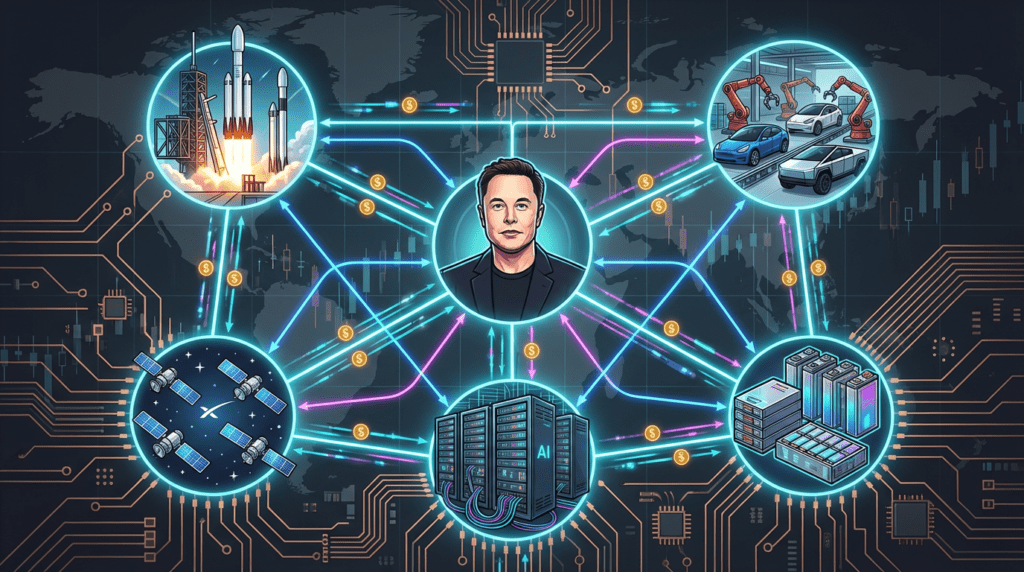
This isn’t Musk’s first rodeo when it comes to intermingling his various business ventures. In 2016, Tesla acquired SolarCity for $2.6 billion, rescuing the solar company from a liquidity crisis. Musk was chairman of SolarCity and a major investor a classic related-party transaction that raised eyebrows but ultimately went through.
More recently, Tesla sold $430 million worth of Megapack batteries to xAI in 2025, accounting for 3.4% of Tesla’s energy business revenue. Those batteries now power xAI’s data infrastructure in Memphis. And just before that deal, Tesla invested $2 billion into xAI’s latest funding round. SpaceX reportedly kicked in another $2 billion.
Bloomberg has dubbed this tangled web of transactions the “Muskonomy” a sprawling empire where money, resources, and personnel flow freely between Musk’s various companies. Tesla employees get pulled into Twitter/X projects. SpaceX develops special alloys for Tesla’s Cybertruck. xAI buys batteries from Tesla while Tesla invests in xAI.
“The whole thing relies on confidence in him,” Farrar explained to CNBC. “If any piece of his empire was to fall by the wayside or go bankrupt, then it would undermine everything.”
It’s a house of cards, but it’s a house of cards built by the world’s richest man with a loyal base of investors who’ve made fortunes betting on his vision.
Regulatory Tailwinds
Timing, as they say, is everything. And Musk’s timing here couldn’t be better.
The Trump administration has rolled back environmental regulations, antitrust enforcement, and other oversight mechanisms that might have complicated this merger. Nowhere in Monday’s announcement was there any mention of regulatory approval Musk simply stated the deal was done. Public records from Nevada confirm that Space Exploration Technologies Corp. is now listed as the “managing member” of X.AI Holdings as of February 2, 2026.
Compare that to the regulatory environment under the Biden administration, when FTC Chair Lina Khan was known for aggressively blocking big tech mergers. Now, with Trump appointee Andrew Ferguson running the FTC, the landscape has shifted dramatically.
Musk also benefits from having friends in high places. Jared Isaacman, a former SpaceX investor and customer, now heads NASA and has been pushing to expand the agency’s contracts with SpaceX. At the FCC, Chairman Brendan Carr has been a vocal Starlink supporter, recently approving SpaceX’s plan to deploy another 7,500 satellites.
And then there’s David Sacks, Musk’s longtime friend who now serves as the White House crypto and AI czar. In December, President Trump signed an executive order establishing a single federal framework for AI regulation, effectively neutering individual states’ ability to impose their own rules.
“To win, United States AI companies must be free to innovate without cumbersome regulation,” the order declared.
Musk is moving fast, and he’s got the political winds at his back. But that window might be closing. Midterm elections are just nine months away, and Trump’s favorability numbers are sinking. If Republicans lose control of Congress, the regulatory environment could shift again.
The Space Junk Problem
Let’s circle back to those orbital data centers for a moment. Because while the concept is undeniably cool, it raises some serious questions about space sustainability.
Experts are already concerned about the proliferation of satellites and space debris. Every object in orbit represents a potential collision risk, and the more satellites we launch, the higher the probability of catastrophic chain reactions what’s known as Kessler Syndrome, where one collision creates debris that causes more collisions in an exponential cascade.
SpaceX argues that orbital data centers would actually be more environmentally friendly than their terrestrial counterparts. No water consumption. No local pollution. Heat dissipates naturally into space. And satellites are required by the FCC to de-orbit every five years, which means a constant refresh cycle that keeps the technology current.
But that five-year de-orbit requirement also means SpaceX would need a constant stream of launches to maintain the constellation which, conveniently, ensures a steady revenue stream for the company’s rocket business. It’s a self-sustaining ecosystem, assuming the whole thing works as advertised.
The Reality Check
Here’s the uncomfortable truth: space-based data centers are still largely theoretical. Musk himself admitted in his memo that it will take “2 to 3 years” before orbital computing becomes cost-competitive with ground-based solutions. That’s an optimistic timeline for technology that hasn’t been proven at scale.
Meanwhile, xAI has immediate, pressing needs. The company is competing in a brutally competitive AI market against well-funded rivals with years of head start. OpenAI’s ChatGPT has become a household name. Google’s Gemini is integrated across the company’s entire product ecosystem. Anthropic’s Claude is winning over enterprise customers with its focus on safety and reliability.
xAI’s Grok chatbot, by contrast, has been mired in controversy. The Washington Post reported that Musk loosened restrictions on Grok, which contributed to it becoming a tool for generating AI-created nonconsensual sexual imagery including images of children. That’s not exactly the kind of press that attracts enterprise customers or builds public trust.
So while the space data center vision is compelling, the near-term reality is that xAI needs SpaceX’s financial resources and upcoming IPO to stay competitive. And SpaceX needs xAI to justify raising massive amounts of capital that it can’t easily deploy into its existing business.
What Happens Next?
The combined SpaceX-xAI entity is now the world’s most valuable private company at $1.25 trillion. That’s larger than most countries’ GDP. It’s a testament to investor confidence in Musk’s vision or at least their willingness to bet on his track record of turning seemingly impossible ideas into reality.
The planned IPO could happen as soon as June, potentially coinciding with Musk’s birthday (because of course it would). If successful, it would be the largest IPO in history, dwarfing Saudi Aramco’s $29.4 billion offering in 2019.
But success is far from guaranteed. SpaceX still needs to prove that Starship can reliably transport astronauts to the moon and Mars. xAI needs to demonstrate that it can compete with the AI industry’s established players. And the orbital data center concept needs to move from science fiction to engineering reality.
There’s also the question of how long the AI investment boom will last. We’ve seen this movie before with crypto, with the metaverse, with countless other “next big things” that attracted billions in investment before reality set in. If the AI bubble bursts before SpaceX can complete its IPO, the entire house of cards could come tumbling down.
The Bigger Picture
Love him or hate him, Musk has an uncanny ability to capture the public imagination and attract capital to ambitious projects. SpaceX revolutionized the space industry with reusable rockets. Tesla made electric vehicles cool and commercially viable. Starlink is bringing internet access to remote corners of the globe.
The SpaceX-xAI merger represents Musk’s latest bet that he can solve two problems simultaneously: xAI’s cash burn and SpaceX’s need for new revenue streams. If orbital data centers become reality, they could genuinely address the environmental concerns around AI infrastructure while opening up an entirely new industry.
But that’s a big if. And in the meantime, we’re watching one of the most complex corporate structures in history get even more tangled, with billions of dollars flowing between related entities in ways that would make traditional corporate governance experts’ heads spin.
Tim Farrar’s observation about the Muskonomy is worth repeating: “The whole thing relies on confidence in him.” As long as investors believe in Musk’s vision and as long as the regulatory environment remains favorable this audacious gamble might just pay off.
But if confidence wavers, if the technology doesn’t pan out, or if the political winds shift, we could be looking at one of the most spectacular corporate implosions in history.
For now, though, Musk is all-in on his space data center dream. And with $1.25 trillion in combined valuation and a potential $50 billion IPO on the horizon, he’s got the resources to make a serious run at it.
The question isn’t whether Musk will try to build data centers in space. He absolutely will. The question is whether the rest of us are ready for what happens when he does.
Sources
- SpaceX wants to put 1 million solar-powered data centers into orbit – The Verge
- Elon Musk’s SpaceX officially acquires Elon Musk’s xAI, with plan to build data centers in space – TechCrunch
- Musk’s xAI needs SpaceX deal for the money. Data centers in space are still a dream – CNBC
- SpaceX Official Announcement – SpaceX
- ProPublica: Memphis xAI Colossus Impact – ProPublica
- Bloomberg: SpaceX-xAI Merger Report – Bloomberg
- Reuters: SpaceX IPO Plans – Reuters
- CNBC: xAI Funding Round – CNBC
- Tesla SEC Filing – SEC
- Bloomberg: The Muskonomy – Bloomberg







Comments 3