Electric vehicle manufacturer unveils groundbreaking in-house chip technology and AI assistant as it charts course toward self-driving future

PALO ALTO, Calif. — In a bold demonstration of vertical integration and technological ambition, electric vehicle manufacturer Rivian has unveiled a suite of cutting-edge innovations that signal the company’s determination to compete at the forefront of automotive artificial intelligence and autonomous driving. At its inaugural Autonomy & AI Day held at the company’s Silicon Valley headquarters, Rivian Founder and CEO RJ Scaringe presented a comprehensive roadmap that includes custom-designed silicon chips, next-generation autonomy platforms, and deep AI integration across the entire vehicle ecosystem.
The announcements represent a significant milestone for the American automotive technology company, which has been quietly building its capabilities in advanced computing and artificial intelligence while simultaneously ramping up production of its R1T electric truck and R1S SUV. The event showcased Rivian’s commitment to controlling its technological destiny through in-house development rather than relying solely on third-party suppliers a strategy that mirrors the approach taken by industry leaders like Tesla but with Rivian’s own distinctive approach.
Custom Silicon: The Foundation of Rivian’s AI Future
At the heart of Rivian’s technological evolution lies a remarkable achievement: the development of its own custom silicon chip designed specifically for automotive artificial intelligence applications. The Rivian Autonomy Processor 1 (RAP1) represents a significant departure from the company’s previous reliance on off-the-shelf solutions from suppliers like Nvidia.
The RAP1 is a custom 5-nanometer processor that integrates processing and memory onto a single multi-chip module, delivering what Rivian describes as “bar-setting performance” in automotive computing. The chip powers the company’s third-generation Autonomy Compute Module (ACM3), which boasts impressive specifications that underscore the company’s ambitions in autonomous driving and AI-powered features.
The ACM3 delivers 1,600 sparse INT8 TOPS (trillion operations per second) and can process 5 billion pixels per second. To put these numbers in perspective, Rivian claims this new setup will quadruple the capabilities of the Nvidia-chip-centered system currently deployed in its vehicles. This dramatic increase in computing power is essential for processing the massive amounts of data generated by the vehicle’s sensor array and running sophisticated AI models in real-time.
“I couldn’t be more excited for the work our teams are driving in autonomy and AI,” Scaringe said during the event. “Our updated hardware platform, which includes our in-house 1,600 sparse TOPS inference chip, will enable us to achieve dramatic progress in self-driving to ultimately deliver on our goal of delivering L4. This represents an inflection point for the ownership experience—ultimately being able to give customers their time back when in the car.”
The development of custom silicon represents a significant technical and financial commitment for Rivian. Designing semiconductors requires specialized expertise, substantial investment, and years of development time. However, Vidya Rajagopalan, Rivian’s senior vice president of electrical hardware, emphasized that the company has taken a pragmatic approach to chip development that leverages partnerships while maintaining control over the most critical components.
“We’re cognizant of the fact that we are a car company, not a full-time chip company,” Rajagopalan explained. The company works with ARM, using that company’s microprocessor architecture while Rivian designed the core neural engine the most important part of the chip for AI processing. “That’s where Rivian adds the most value,” Rajagopalan noted.
Rajagopalan, who previously worked on Tesla’s Model 3 and for several silicon and systems companies before joining Rivian in 2020, brings deep expertise to the effort. She outlined the strategic advantages of custom silicon development: “Building a chip is time consuming and requires a world-class team, but the benefits are velocity, performance, and cost. This means we’re able to get to market sooner with a cutting-edge AI product and we can optimize our silicon for our use cases with room for models of the future. We don’t carry the overhead with a design that was designated for another purpose.”
In other words, by designing its own chip, Rivian can customize the system throughout the development process rather than receiving a universal chip and figuring out how to adapt it to the company’s specific needs. This approach provides greater flexibility and allows Rivian to optimize performance for its particular use cases while maintaining the ability to evolve the design as AI models and requirements change.
The RAP1 also features RivLink, a proprietary low-latency interconnect technology that allows multiple chips to be connected together to multiply processing power. This inherently extensible architecture means Rivian can scale computing capabilities as needed for future applications without requiring a complete redesign of the system.
Middleware and Software Architecture: The Glue That Binds
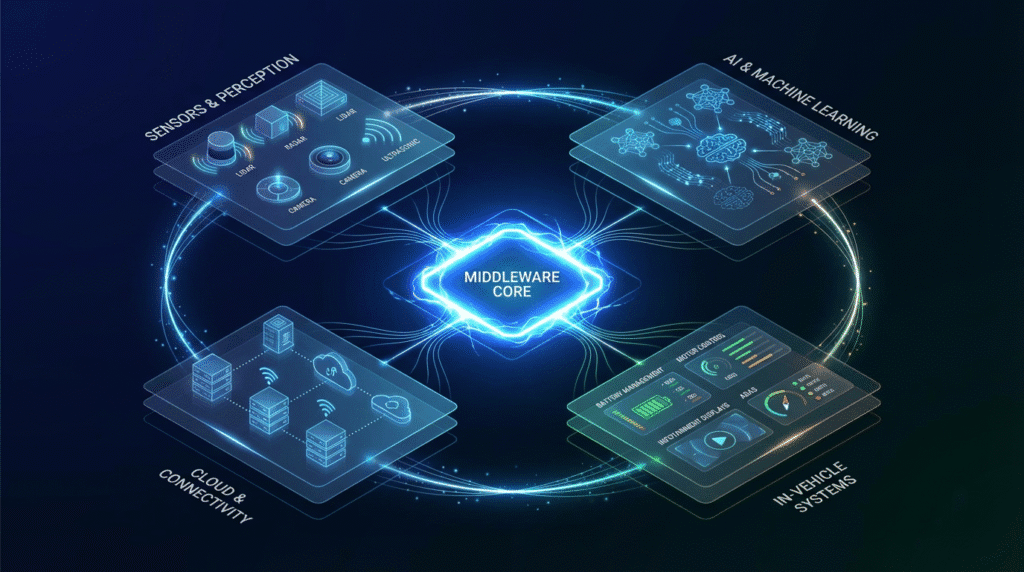
Beyond the silicon itself, Rivian has developed a new middleware stack entirely in-house. Middleware serves as the connective tissue between different software components, acting as a bridge to connect various applications, databases, and services. This software layer is crucial for maximizing flexibility and speeding up testing and development while enabling the system to scale across various platforms and computing hardware.
The middleware development represents another aspect of Rivian’s vertical integration strategy, giving the company greater control over how different systems communicate and work together. This level of integration is essential for delivering the seamless user experiences that modern consumers expect from their vehicles.
Rivian Unified Intelligence: AI Across the Ecosystem
Rivian’s AI ambitions extend far beyond autonomous driving. The company introduced Rivian Unified Intelligence (RUI), described as “the connective tissue that runs through the very heart of Rivian’s digital ecosystem.” This platform-agnostic architecture uses custom large language models and serves as the foundation for AI applications across the entire vehicle lifecycle and business operations.
“The Rivian Unified Intelligence is the connective tissue that runs through the very heart of Rivian’s digital ecosystem,” said Wassym Bensaid, Rivian’s software development chief, during the event. “This platform enables targeted agent solutions that drive value across our entire operation and our entire vehicle life cycle.”
RUI represents a hybrid approach that includes Rivian’s own custom models alongside an “orchestration layer” that ensures various AI models work together seamlessly. The company has also partnered with other firms for specific agentic AI functions, creating a flexible system that can leverage the best available technologies while maintaining Rivian’s control over the overall architecture.
The applications of RUI extend well beyond consumer-facing features. The platform will be used to improve vehicle diagnostics, serving as “an expert assistant for technicians, scanning telemetry and history to pinpointing complex issues,” according to the company. This same advanced intelligence will soon power Rivian’s mobile app, enabling improved self-service diagnostics for customers.
Rivian Assistant: A New Voice in the Vehicle
One of the most immediately tangible manifestations of Rivian’s AI investments is the Rivian Assistant, a next-generation voice interface that will launch in early 2026. Unlike many automotive voice assistants that rely heavily on cloud-based processing, Rivian Assistant is built on the company’s edge models AI systems that run directly on the vehicle’s hardware to understand the vehicle, the driver’s digital life, and the world around them.
The two-year development effort has resulted in a system that Rivian claims can handle complicated, multi-part requests, interruptions, and even text-based interactions. Users will activate the system by saying “Hey Rivian,” and the assistant will be capable of controlling climate systems, managing infotainment functions, and integrating with third-party applications.
“The beauty here is we can integrate third-party agents, and this is completely redefining how apps in the future will integrate in our cars,” Bensaid explained during the event. Google Calendar will be the first third-party app to launch within the AI assistant, with more integrations expected to follow.
The Rivian Assistant will be augmented by frontier large language models including Google Vertex AI and Gemini for grounded data, natural conversation, and powerful reasoning. This hybrid approach allows Rivian to leverage the latest advances in AI while maintaining privacy and responsiveness through on-device processing for many functions.
Significantly, when the AI assistant launches in early 2026, it will roll out to every existing vehicle in Rivian’s lineup through over-the-air software updates, not just the next-generation versions of the R1T truck and R1S SUV. This backward compatibility demonstrates the flexibility of Rivian’s software architecture and represents a significant value addition for existing customers.
The assistant’s text-based interface capabilities could potentially circumvent the need for Apple CarPlay and Android Auto, giving Rivian greater control over the user experience while reducing dependence on external platforms. This approach aligns with the company’s broader vertical integration strategy and could provide competitive advantages in terms of feature development and user experience optimization.
Autonomous Driving: The Road to Level 4
Rivian’s autonomy roadmap represents an ambitious multi-year journey toward fully autonomous driving. The company detailed its software-first approach to autonomy, powered by the Rivian Autonomy Platform and an end-to-end data loop used for training AI models.
Central to this effort is Rivian’s Large Driving Model (LDM), a foundational autonomous driving model trained similarly to Large Language Models used in natural language processing. Utilizing Group-Relative Policy Optimization (GRPO), the LDM distills superior driving strategies from massive datasets into the vehicle’s decision-making systems.
In the near term, software advancements are coming to the company’s second-generation R1 vehicles with the addition of Universal Hands-Free (UHF), bringing hands-free assisted driving for extended periods to significantly more locations. The system will be available on over 3.5 million miles of roads across the United States and Canada and will be capable of operating off-highway on roads with clearly painted lines.
Scaringe’s updated vision for self-driving Rivians kicks off in 2026, when the automaker will roll out point-to-point navigation in the R2 and via over-the-air updates for its second-generation vehicles. The company is clearly aiming for autonomous driving capabilities that don’t require drivers to keep their eyes on the road or remain engaged in vehicle operation. Beyond that, Scaringe indicated, lies Level 4 autonomy the capability for the vehicle to handle all driving tasks in specific conditions without human intervention.
“If we look three or four years into the future, the rate of change is an order of magnitude greater than all the experience from the last three or four years,” Scaringe predicted, emphasizing his belief that the automotive industry is at a technological inflection point.
The upcoming R2 model will feature the Rivian Autonomy Processor 1 chips along with new LiDAR sensors combined with cameras and radar technology. Unlike Waymo’s driverless rideshare vehicles, which use LiDAR sensors mounted in a distinctive dome on the vehicle’s roof, Rivian’s main LiDAR sensor is integrated into the car above the windshield, maintaining a more conventional vehicle appearance.
LiDAR (Light Detection and Ranging) technology sends laser pulses in all directions to detect objects, providing detailed three-dimensional spatial data and redundant sensing capabilities. This multi-modal sensor strategy improves real-time detection for edge cases unusual or rare driving scenarios that are particularly challenging for autonomous systems.
The Gen 3 Autonomy hardware, including ACM3 and LiDAR, is currently undergoing validation, and Rivian expects it to ship on R2 models starting at the end of 2026. The company detailed plans to continuously improve the autonomy capabilities of its Gen 2 R1 and future R2 vehicles, with a clear trajectory including point-to-point navigation, eyes-off capability, and eventually personal Level 4 autonomy.
Rivian engineers acknowledge that the autonomy system is a work in progress. Nick Nguyen, director of product and programs of autonomy, emphasized that at Level 2 autonomy where the driver must remain attentive and ready to take control the human driver remains responsible for the vehicle’s operation.
“We will not be able to handle every single situation the car can encounter, but if the person is looking at the road [which is required at this level], in that situation the driver should take over,” Nguyen explained, addressing concerns about autonomous vehicle safety following incidents involving other companies’ systems.
Monetization and Market Positioning
Rivian announced that it will begin charging for its Autonomy+ software platform next year, offering customers two payment options: $2,500 upfront or a $49.99 monthly subscription. This pricing is notably less expensive than Tesla’s Full Self-Driving system, which requires either $8,000 in a lump sum or $99 per month.
The subscription model represents an important revenue stream for Rivian as the company works toward profitability. Software and services revenue has become increasingly important in the automotive industry, providing ongoing income beyond the initial vehicle sale while enabling continuous improvement of vehicle capabilities through over-the-air updates.
The AI Debate and Environmental Concerns
Rivian’s aggressive push into AI comes at a time when the technology faces increasing scrutiny. As the market debates a potential “AI bubble” that could crash like the dot-com bubble of the late 1990s, technologists, politicians, and environmental specialists have expressed concerns about AI’s implications.
“The integration and adoption of AI in real-world settings can be complex and create unwanted outcomes as we pave our way forward,” noted Ali Shojaei, a professor at Virginia Tech. “For example, the environmental impact and energy consumption of AI cannot be overlooked. Data privacy and security are also valid concerns with the increased use of AI and automation of sensitive information.”
The environmental impact of AI is particularly relevant for an electric vehicle company whose mission centers on sustainability. Training large AI models and running inference at scale requires substantial computing power and energy consumption. However, Rivian’s approach of running many AI functions on edge devices within the vehicle rather than relying entirely on cloud-based processing may help mitigate some of these concerns.
Despite these concerns, Scaringe remains convinced that the industry is at a transformative moment. “AI is enabling us to create technology and customer experiences at a rate that is completely different from what we’ve seen in the past,” he said. “The way that we approach AI in the physical world has shifted dramatically, and the idea of not having fully capable artificial intelligence across every domain of our lives will be almost impossible to even imagine.”
Scaringe explained that until about five years ago, the approach to autonomous driving was centered on a rules-based environment with perception sensors designed to identify and classify objects. However, it became clear that the approach needed to shift to a neural network-based understanding of how to drive a paradigm shift that has enabled the rapid progress in autonomous driving capabilities seen across the industry.
Vertical Integration as Competitive Advantage
The announcements at Autonomy & AI Day underscore Rivian’s commitment to vertical integration controlling as much of the technology stack as possible rather than relying on external suppliers. This strategy, while capital-intensive and technically challenging, provides several potential advantages.
First, it allows for faster iteration and development cycles. When a company controls both hardware and software, it can optimize the entire system and make changes more quickly than when coordinating with multiple external suppliers. Second, it can provide cost advantages over time, even if the initial development investment is substantial. Third, it enables differentiation Rivian can create unique features and capabilities that competitors using off-the-shelf components cannot easily replicate.
“Rivian’s unique, vertically integrated strategy allows the company to rapidly evolve the entire vehicle experience from user-facing features to foundational technology,” the company stated. “In the company’s next stage of growth, integration meets acceleration as this next-generation hardware and software come to market.”
This approach reflects lessons learned from Tesla, which has long emphasized vertical integration as a key competitive advantage. However, Rivian is charting its own course, making different choices about which components to develop in-house and which to source from partners.
Looking Ahead
As Rivian moves forward with its ambitious AI and autonomy roadmap, the company faces significant challenges. Developing autonomous driving systems that are safe, reliable, and capable of handling the infinite variety of real-world driving scenarios remains one of the most difficult technical challenges in the automotive industry. The regulatory landscape for autonomous vehicles continues to evolve, and consumer acceptance of self-driving technology varies widely.
Additionally, Rivian must execute on these technological ambitions while simultaneously scaling production, managing costs, and working toward profitability a challenging balancing act for any automotive manufacturer, particularly one that is still relatively young.
However, the company’s progress to date suggests that it has assembled the talent and resources necessary to compete at the highest levels of automotive technology. The development of custom silicon, sophisticated AI systems, and advanced autonomy platforms demonstrates technical capabilities that few automotive companies possess.
As the automotive industry continues its transformation toward electrification, connectivity, and autonomy, Rivian’s investments in AI and custom silicon position the company to be a significant player in shaping the future of transportation. Whether these technologies will provide the competitive advantages necessary to succeed in an increasingly crowded electric vehicle market remains to be seen, but Rivian has clearly signaled its intention to compete on the basis of technological innovation and vertical integration.
For consumers, the promise is compelling: vehicles that become more capable over time through software updates, AI assistants that genuinely understand context and can handle complex requests, and eventually, autonomous driving capabilities that could fundamentally change the relationship between people and their vehicles. If Rivian can deliver on these promises, the company’s inaugural Autonomy & AI Day may be remembered as a pivotal moment in the evolution of the electric vehicle industry.
Sources
Popular Science – “Rivian announces AI chip in move towards self-driving future”
TechCrunch – “Rivian’s AI assistant is coming to its EVs in early 2026”