


In a dramatic escalation of the artificial intelligence arms race, OpenAI has unveiled its latest weapon: ChatGPT Images, powered by the new GPT Image 1.5 model. The release, announced on December 16, 2025, represents the company’s most aggressive response yet to Google’s surging momentum in the AI image generation space, particularly following the viral success of Google’s Nano Banana Pro model.
The timing of this launch is no coincidence. According to multiple reports, OpenAI CEO Sam Altman issued an internal “code red” memo following Thanksgiving, urging staff to accelerate improvements to ChatGPT over an eight-week sprint. The memo came amid growing concerns that OpenAI was losing ground to competitors, especially Google, whose Gemini 3 model and Nano Banana image generator had been capturing both consumer attention and market share.
A New Creative Powerhouse
The new GPT Image 1.5 model promises to deliver what users have long demanded: precision, speed, and consistency. According to OpenAI’s announcement, the model generates images up to four times faster than its predecessor while maintaining unprecedented control over edits and transformations.
“Whether you’re creating something from scratch or editing a photo, you’ll get the output you’re picturing,” OpenAI stated in its blog post. “It makes precise edits while keeping details intact, and generates images up to 4x faster.”
The company is positioning the update as more than just an incremental improvement. Fidji Simo, OpenAI’s CEO of Applications, described it as “a shift from novelty image generation to practical, high-fidelity visual creation,” effectively turning ChatGPT into “a fast, flexible creative studio for everyday edits, expressive transformations, and real-world use.”
Technical Breakthroughs and Capabilities
What sets GPT Image 1.5 apart from its predecessor is its ability to preserve what matters most in an image while making targeted changes. When users request edits, the model now adheres to instructions more reliably, changing only what’s specified while maintaining consistency in lighting, composition, and even facial features across multiple iterations.
This addresses one of the most persistent frustrations with AI image generators: the tendency to completely reimagine an entire image when asked for a simple adjustment. Previously, asking an AI to “adjust the facial expression” or “make the lighting colder” would often result in a wholesale transformation that bore little resemblance to the original.
The new model excels at various types of editing operations, including adding, subtracting, combining, blending, and transposing elements. OpenAI demonstrated this capability with an elaborate example showing how users could combine multiple photos, add chaotic elements to the background, apply different artistic styles to individual subjects, and even place characters into entirely new contexts all while maintaining visual coherence.
Text rendering, long a weakness of AI image generators, has also seen significant improvement. GPT Image 1.5 can now handle dense, small text with greater accuracy, making it suitable for creating realistic newspaper layouts, infographics, and other text-heavy visual content.
The model’s instruction-following capabilities have been substantially enhanced as well. In one demonstration, OpenAI showed the new model successfully creating a precise 6×6 grid containing 36 different specified objects, each in its correct position a task that would have confounded earlier versions.
The Battle for AI Supremacy
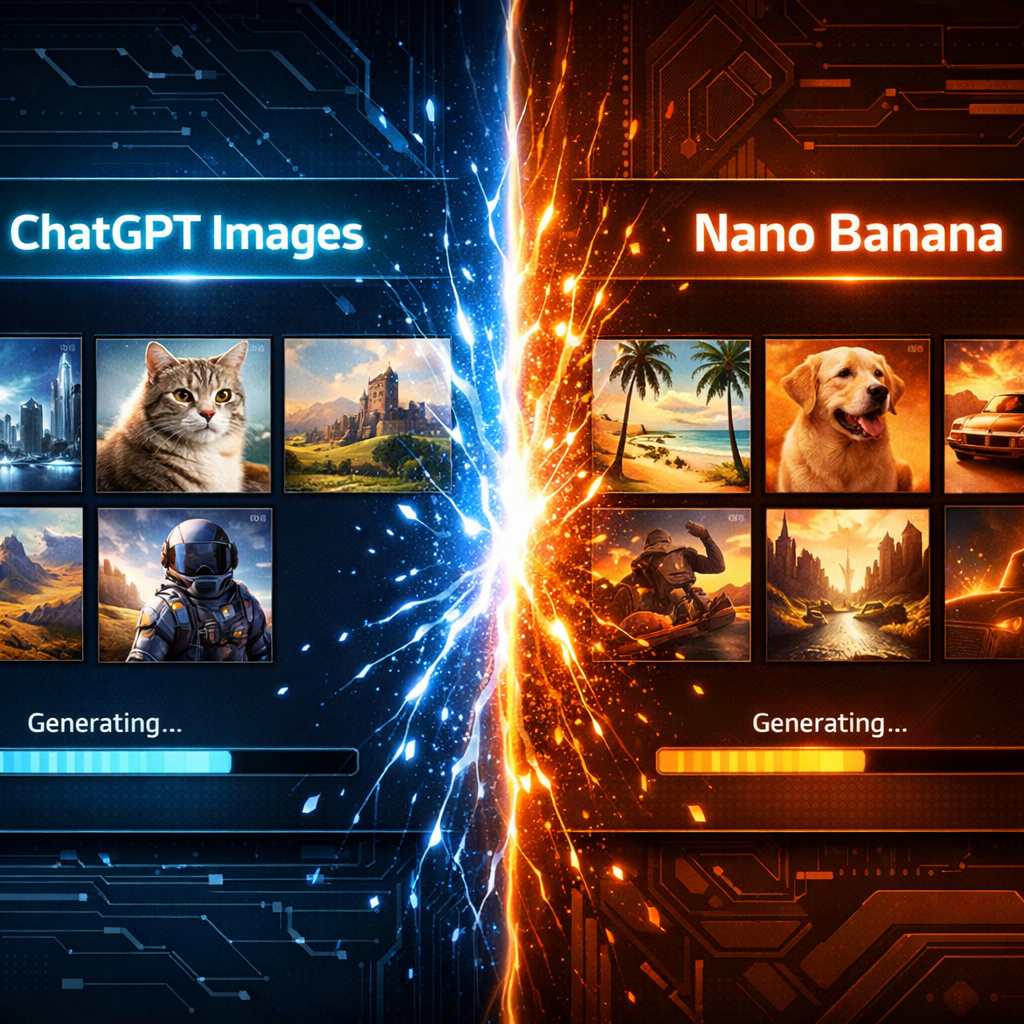
To understand the significance of this release, one must look at the competitive landscape that prompted it. Google’s Nano Banana (the nickname for Gemini 2.5 Flash Image) launched in August 2025 and quickly became a cultural phenomenon. The model’s ability to handle text in images cleanly solving a problem that had plagued AI image generators for years combined with its capacity to produce diagrams and infographics that actually made sense, captured the public imagination.
When Google released Nano Banana Pro in November 2025 alongside its flagship Gemini 3 model, the response was overwhelming. The upgraded version offered even better text rendering, enhanced world knowledge, and an uncanny ability to produce images with a realistic, unedited quality. Users embraced it enthusiastically, with some even using it over Thanksgiving to create convincing images of celebrities at their holiday dinner tables.
The impact on Google’s business was substantial. The company reported that monthly active users of Gemini grew from 450 million in July to 650 million in October 2025. This surge in adoption, combined with Google’s tight integration of Nano Banana Pro across its product ecosystem including Google Photos, Search, Messages, and tools like Google Labs Mixboard represented a serious threat to OpenAI’s market position.
Allie Miller, an AI advisor and investor, recently shared an anecdote that illustrates Nano Banana’s cultural penetration. At a Shark Tank-style event hosted by Mark Cuban, she expected the mention of “Nano Banana” to confuse an audience largely new to AI. Instead, the crowd nodded in recognition. “There are certain AI tools or models that you just start hearing over and over and over again that gain such a big pop culture moment,” Miller explained, comparing it to ChatGPT’s own breakthrough into mainstream consciousness.
Early Performance Indicators
Initial benchmarks suggest OpenAI’s new model is highly competitive. Within hours of its release, GPT Image 1.5 topped LMArena’s Text-to-Image leaderboard with 1,264 points, establishing a 29-point lead over the second-place competitor. In image editing, the model scored 1,409 points on LM Arena, narrowly edging out Nano Banana Pro (2K) by just three points.
On Artificial Analysis’ image editing leaderboard, ChatGPT Images holds a six-point lead over Nano Banana Pro. Compared to its predecessor, GPT Image 1.0, the new model shows improvements of 147 points in text-to-image generation and 245 points in editing capabilities.
However, real-world testing has produced mixed results. Joe Hindy, writing for Mashable, conducted a side-by-side comparison, asking both Nano Banana and ChatGPT Images to edit the same photo of his car from nighttime to daytime. While both models produced acceptable results, Hindy noted that Google’s version looked better to his eye, suggesting that benchmark performance doesn’t always translate directly to subjective quality assessments.
Yuchen Jin, cofounder and CTO of startup Hyperbolic Labs, offered a more positive assessment, calling OpenAI’s new model “Nano Banana Pro level in my tests,” indicating that the two systems are now closely matched in capability.
A New Creative Studio Experience
Beyond the model improvements, OpenAI has redesigned the user experience for image generation. The company introduced a dedicated Images tab within ChatGPT, accessible through both the mobile app and web interface at chatgpt.com/images.
This new interface functions as a creative studio, offering preset filters, trending prompts, and curated ideas to spark inspiration. Users can also upload their likeness once and reuse it across future creations without repeatedly searching through their camera roll a feature similar to Sora Cameos.
Simo emphasized that ChatGPT’s original chat interface wasn’t designed for visual creation, making this dedicated space a necessary evolution. “The new image viewing and editing screens make it easier to create images that match your vision or get inspiration from trending prompts and preset filters,” she wrote in a Substack post.
The interface also allows users to continue generating new images while others are still in progress, eliminating wait times and enabling more fluid creative exploration.
Enterprise and API Applications
While consumer applications have garnered the most attention, OpenAI is clearly targeting enterprise users with GPT Image 1.5. The company highlighted use cases in marketing, e-commerce, and brand work, noting that the model’s improved preservation of branded logos and key visuals makes it well-suited for generating product image catalogs with multiple variants, scenes, and angles from a single source image.
The model is available through OpenAI’s API as GPT Image 1.5, with pricing that’s 20% cheaper than GPT Image 1.0 for both inputs and outputs. This cost reduction, combined with improved performance, makes it more economically viable for businesses to generate and iterate on large volumes of images.
Wix, the website building platform, has already begun integrating the technology. Hila Gat, Head of AI Research and Data Science at Wix, praised the model’s capabilities: “GPT Image 1.5 generates high-fidelity images with strong prompt adherence, preserving composition, lighting, and fine-grained detail. The results are clean, realistic, and reliable, supporting faster concept-to-production workflows on platforms like Wix.”
The Broader Context: OpenAI’s Code Red
The release of GPT Image 1.5 is just one component of OpenAI’s broader response to competitive pressures. Last week, the company launched GPT-5.2, its latest flagship language model, positioning it as the most advanced model yet for developers and professional use.
The “code red” memo that prompted this flurry of activity reportedly called for a shift in priorities, including stalling on plans to introduce advertising and instead focusing on creating a better overall ChatGPT experience. The memo acknowledged that ChatGPT traffic had declined and that the company was losing consumer market share to Google.
This represents a significant moment for OpenAI, which had enjoyed first-mover advantage in the generative AI space following ChatGPT’s explosive launch in late 2022. Google’s resurgence, powered by its vast resources, extensive product ecosystem, and deep AI research capabilities, has forced OpenAI to accelerate its development timeline and sharpen its competitive focus.
The stakes are enormous. OpenAI has committed approximately $1.4 trillion to AI infrastructure buildouts over the coming years—commitments made when the company still dominated the field. With Google now mounting a serious challenge, those investments carry greater risk.
The company’s focus on reasoning models like GPT-5.2 Thinking and tools like Deep Research also presents financial challenges. These systems consume significantly more computational resources than standard chatbots, making them more expensive to operate at scale. Recent reports suggest OpenAI is spending more on compute than previously disclosed, with most inference costs now paid in cash rather than through cloud credits, indicating that expenses have grown beyond what partnerships can subsidize.
Limitations and Future Directions
Despite the improvements, OpenAI acknowledges that GPT Image 1.5 remains imperfect. The company reran many examples from its initial image generation launch to evaluate performance, noting that while the model shows “clear improvements across a range of cases,” results are not flawless and “there is still significant room for improvement in future iterations.”
OpenAI indicated that future updates will focus on “finer-grained edits” and “richer, more detailed outputs across languages,” suggesting that the company views this release as a foundation for continued development rather than a final destination.
The Consumer Mindshare Battle
What makes this competition particularly fascinating is that it’s not purely about technical superiority. As multiple observers have noted, the AI race has evolved into a battle for consumer hearts and minds, where brand recognition, ease of use, and cultural resonance matter as much as benchmark scores.
Google’s “Nano Banana” branding proved remarkably effective, creating a memorable, shareable name that helped the technology spread virally. OpenAI’s “GPT Image 1.5” designation, while technically descriptive, lacks the same cultural catchiness though the company may be betting that the ChatGPT brand itself carries sufficient recognition.
The integration strategies also differ significantly. Google has woven Nano Banana Pro throughout its ecosystem, making it accessible across multiple touchpoints where users already spend time. OpenAI, lacking a comparable product ecosystem, must rely on ChatGPT’s standalone appeal and API partnerships to reach users.
Implications for the Industry
The rapid-fire releases from both OpenAI and Google signal that AI image generation has matured from experimental technology to production-ready tool. The improvements in precision, consistency, and speed make these systems increasingly viable for professional workflows in design, marketing, e-commerce, and content creation.
This maturation also raises important questions about the creative industries. As AI image generators become more capable and accessible, they will inevitably disrupt traditional workflows and business models in photography, illustration, graphic design, and related fields. The technology’s ability to rapidly iterate on concepts and generate variations could democratize visual creation while simultaneously threatening established professionals.
The competition between OpenAI and Google also benefits consumers and businesses, driving rapid innovation and price reductions. OpenAI’s 20% price cut for API access, combined with 4x speed improvements, represents substantial value creation in a remarkably short timeframe.
Conclusion
OpenAI’s release of ChatGPT Images powered by GPT Image 1.5 represents a significant salvo in the escalating AI wars. Whether it successfully counters Google’s Nano Banana momentum remains to be seen, but the release demonstrates OpenAI’s determination to defend its position as an AI leader.
The coming months will reveal whether OpenAI’s technical improvements and redesigned user experience can recapture consumer attention and market share. With both companies now offering highly capable image generation systems, the competition will likely shift to factors like ecosystem integration, pricing, ease of use, and continued innovation.
For users, this competition is unambiguously positive, delivering increasingly powerful creative tools at decreasing costs. For OpenAI and Google, the stakes couldn’t be higher, as leadership in AI image generation represents not just a product category but a crucial front in the broader battle to define the future of artificial intelligence.
As Simo noted in her announcement, “We believe we’re still at the beginning of what image generation can enable.” If that’s true, then the current competition between OpenAI and Google is merely the opening act of a much longer drama one that will reshape how we create, consume, and interact with visual content in the digital age.
The question now is not whether AI image generation will transform creative work, but which company will lead that transformation and capture the economic value it creates. OpenAI’s latest release ensures that the answer remains very much in doubt.
Sources:
- OpenAI. (2025, December 16). The new ChatGPT Images is here.
- Field, H. (2025, December 16). OpenAI’s new flagship image generator AI is here. The Verge.
- Hindy, J. (2025, December 17). OpenAI launches new ChatGPT Images tool to rival Nano Banana: How to try it. Mashable.
- Tweedie, S. (2025, December 16). OpenAI’s answer to Google’s viral Nano Banana Pro image model is here. Business Insider.
- Goldman, S. (2025, December 16). OpenAI releases new image model as it races to outpace Google’s Nano Banana amid company code red. Fortune.



Comments 3