


The chip giant just dropped its most powerful AI platform yet and it’s arriving months ahead of schedule
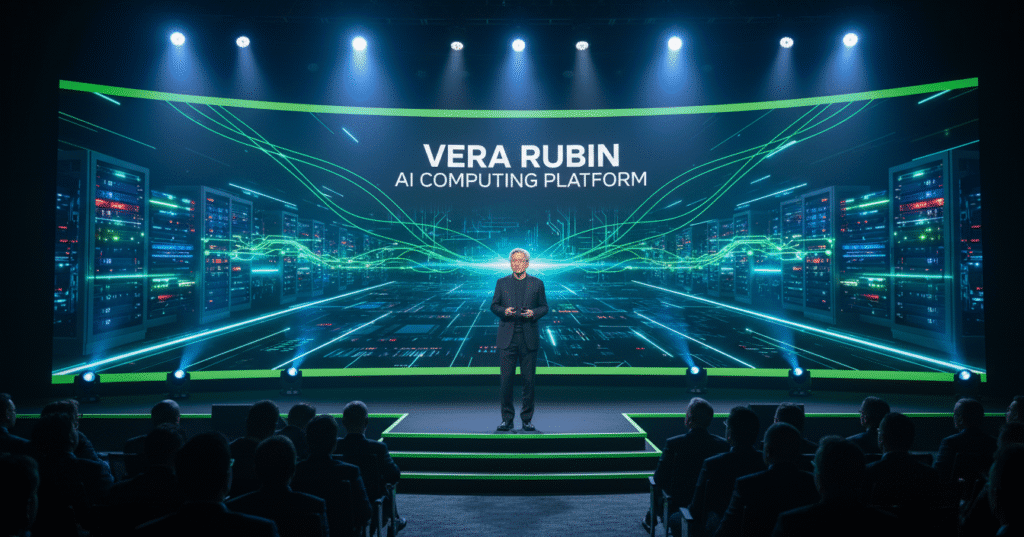
When NVIDIA CEO Jensen Huang took the stage at CES 2026 in Las Vegas, he didn’t mince words. “Demand for AI computing is going through the roof,” he declared, setting the tone for what would become one of the most significant hardware announcements in recent memory. The company has officially launched its Rubin platform, headlined by the Vera Rubin superchip a beast of a processor that’s already turning heads in the tech world.
This isn’t just another incremental upgrade. It’s a statement.
What Makes Vera Rubin Different?
Let’s cut to the chase: the Vera Rubin superchip is essentially six chips masquerading as one AI supercomputer. That’s how Dion Harris, NVIDIA’s senior director of HPC and AI infrastructure solutions, described it during a press briefing ahead of the keynote. And he’s not exaggerating.
The architecture integrates one Vera CPU with two Rubin GPUs into a single processor. But that’s just the beginning. The complete Rubin platform comprises six distinct components working in harmony: the Vera CPU, Rubin GPU, NVLink 6th-generation switch, Connect-X9 NIC, BlueField4 DPU, and Spectrum-X 102.4T CPO. Each piece plays a critical role in what NVIDIA is positioning as its most advanced AI system architecture to date.
Think of it as a symphony where every instrument matters. The tight hardware co-design across compute, memory, and interconnect isn’t just clever engineering it’s become NVIDIA’s signature move. This approach enables performance gains that go way beyond what you’d get from simply improving the silicon.
The Numbers Are Staggering
Here’s where things get really interesting. NVIDIA claims the Rubin GPU delivers five times as much AI training compute power as its predecessor, Blackwell. Five times. Let that sink in for a moment.
But wait, there’s more. The Vera Rubin architecture as a whole can train a large “mixture of experts” (MoE) AI model in the same amount of time as Blackwell while using just a quarter of the GPUs. And it does this at one-seventh the token cost.
Those aren’t just impressive numbers on a spec sheet. They represent a fundamental shift in how AI infrastructure can be deployed and scaled. For companies racing to build more sophisticated AI systems, this could be a game-changer.
Built for the Next Wave of AI
NVIDIA isn’t just throwing more power at the problem. The Rubin platform has been purpose-built for what the company sees as the next generation of artificial intelligence workloads. We’re talking about agentic AI, advanced reasoning models, and those increasingly popular mixture-of-experts architectures.
What makes these workloads different? They’re demanding. Really demanding.
MoE models work by routing tasks dynamically across specialized “expert” systems. It’s like having a team of specialists rather than one generalist trying to do everything. But this approach places enormous demands on compute efficiency, memory bandwidth, and inter-chip communication. The Rubin platform’s integrated design addresses these challenges head-on, accelerating both AI training and inference at scale.
The platform will also support third-generation confidential computing. According to NVIDIA, it’ll be the first rack-scale trusted computing platform. That’s a big deal for enterprises worried about data security and privacy in their AI deployments.
An Early Arrival That Speaks Volumes

Here’s something that caught everyone off guard: the Rubin launch was originally expected for late 2026. Instead, NVIDIA pulled it forward by several months, announcing it at the start of the year.
Why the rush? The timing tells us a lot about where NVIDIA sees the market heading.
The early launch comes just a couple of months after NVIDIA reported record-high data center revenue, up 66 percent over the prior year. That growth was driven by demand for Blackwell and Blackwell Ultra GPUs, which have been flying off the shelves faster than NVIDIA can make them. The AI boom or bubble, depending on who you ask shows no signs of slowing down.
By accelerating the Rubin launch, NVIDIA is reinforcing its strategy of delivering annual generational upgrades to meet surging AI demand. It’s also sending a clear message to competitors: we’re not slowing down.
More Than Just Raw Power
The Rubin platform represents NVIDIA’s view that the next phase of AI growth won’t be driven solely by larger models. Sure, bigger is sometimes better. But the real action is happening in more sophisticated reasoning, orchestration, and real-world deployment.
These workloads demand an entirely new class of AI supercomputing platforms. They need systems that can handle complex decision-making, coordinate multiple AI agents working together, and deploy models that can actually function in messy, real-world environments rather than controlled lab settings.
That’s where Vera Rubin comes in. By combining multiple high-performance components into a unified superchip, NVIDIA has created a platform designed specifically for these emerging use cases.
The Broader Context
CES has increasingly become NVIDIA’s venue of choice for outlining long-term strategic direction rather than simply showcasing consumer-facing technology. The Rubin announcement fits that pattern perfectly, highlighting the company’s laser focus on AI infrastructure rather than end-user devices.
This makes sense when you consider NVIDIA’s position in the market. The company has become the backbone of the global AI build-out, supplying the picks and shovels in what many are calling the new gold rush. Governments, cloud providers, and enterprises are racing to deploy more capable and efficient AI systems, and they all need NVIDIA’s hardware to do it.
The launch also reinforces expectations of sustained AI infrastructure spending. For investors and industry watchers, this is crucial. The Rubin platform supports long-term demand for high-performance compute as workloads shift toward agentic and reasoning-heavy models. It’s not just about today’s needs it’s about positioning for where the market is heading.
What This Means for the Industry
NVIDIA’s annual hardware cadence has become a defining feature of the AI landscape. Every year, like clockwork, the company delivers a new generation of chips that push the boundaries of what’s possible. This predictability has made NVIDIA the safe bet for companies planning their AI infrastructure investments.
But it also puts enormous pressure on competitors. How do you compete with a company that’s consistently delivering 5x performance improvements year over year? The answer, for many, is that you don’t at least not directly. Instead, we’re seeing competitors focus on specific niches or alternative approaches to AI computing.
The Rubin launch also signals that AI compute demand remains structurally strong. Despite occasional hand-wringing about an AI bubble, NVIDIA’s actions suggest the company sees sustained, long-term growth ahead. You don’t accelerate a major product launch unless you’re confident the market will be there to receive it.
The Road Ahead
Products and services running on Rubin will be available from NVIDIA’s partners starting in the second half of 2026. That’s not far off, and it means we’ll soon see real-world deployments that can put NVIDIA’s claims to the test.
The big question is whether Rubin can live up to the high bar set by Blackwell. The previous generation has been a massive success, serving as a bellwether for the entire AI industry. If Rubin delivers on its promises, it could cement NVIDIA’s dominance for another generation.
But there are challenges ahead. The AI market is evolving rapidly, and what works today might not work tomorrow. New model architectures, changing regulatory landscapes, and shifting customer priorities could all impact how Rubin is received.
Why This Matters

At its core, the Vera Rubin launch is about more than just faster chips or better performance metrics. It’s about enabling a new generation of AI applications that weren’t possible before.
We’re moving beyond simple pattern recognition and prediction into AI systems that can reason, plan, and act autonomously. These systems need fundamentally different hardware than what came before. They need platforms that can handle the complexity of coordinating multiple AI agents, processing vast amounts of data in real-time, and making decisions with real-world consequences.
That’s the promise of Vera Rubin. Whether it delivers on that promise remains to be seen, but NVIDIA has certainly set the stage for an interesting year ahead.
The Bottom Line
NVIDIA’s launch of the Vera Rubin superchip at CES 2026 marks a significant milestone in the evolution of AI computing. With five times the training compute power of Blackwell, support for next-generation AI workloads, and an early arrival that underscores strong market demand, Rubin represents NVIDIA’s bet on where AI is heading.
The platform’s integrated design, combining six chips into one cohesive system, addresses the specific challenges of modern AI workloads. From agentic AI to mixture-of-experts models, Rubin is built for the sophisticated applications that are defining the next wave of artificial intelligence.
As Jensen Huang noted, demand for AI computing is “going through the roof.” With Vera Rubin, NVIDIA is making sure it has the hardware to meet that demand and then some. The company’s ability to maintain its annual cadence of major hardware releases, each delivering substantial performance improvements, continues to set the pace for the entire industry.
For enterprises, cloud providers, and anyone building AI infrastructure, the message is clear: the future of AI computing is here, and it’s more powerful than ever. The only question now is how quickly the industry can adapt to take advantage of it.







Vera Rubin superchip, what a name! When Jensen Huang said ‘Demand for AI computing is going through the roof,’ I felt that urgency through my phone on the subway