The French AI startup is building a massive data center near Paris, and it’s not playing small.
Wait, Who Is Mistral Again?

If you haven’t been paying close attention to the European AI scene, let’s get you up to speed, fast.
Mistral AI is a French artificial intelligence startup founded in 2023. Yes, just three years ago. And already, it’s making moves that are turning heads across the global tech industry. The company builds foundational AI models, think large language models (LLMs) that power things like its ChatGPT competitor, Le Chat. It’s scrappy, it’s ambitious, and it’s very, very French.
Mistral sits in a rare category: a European startup genuinely trying to compete with the likes of OpenAI and Anthropic. That’s a bold goal. But here’s the thing, Mistral isn’t just talking about it. It’s building the infrastructure to back it up.
And on March 30, 2026, the company dropped a bombshell announcement that made the entire AI world sit up and take notice.
$830 Million. Yes, You Read That Right.
Mistral just secured $830 million in debt financing. Not equity. Debt. That’s a significant distinction, and we’ll get to why in a moment.
The money has one clear purpose: fund a brand-new AI data center near Paris. Specifically, the facility is located in Bruyères-le-Châtel, a commune south of the French capital. The site is owned and operated by French data center firm Eclairion, and Mistral plans to have it up and running by the end of Q2 2026, that’s June, folks. Soon.
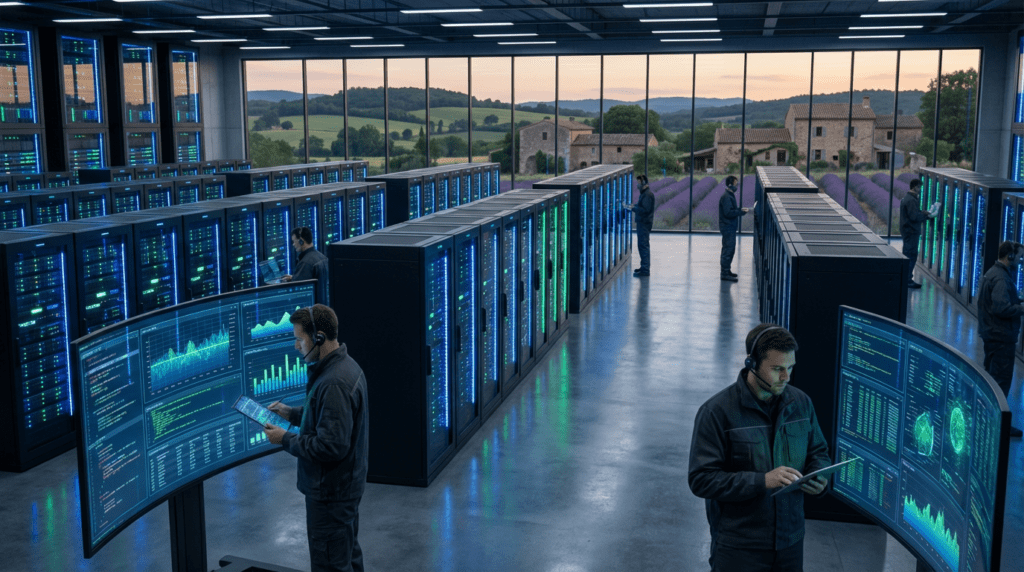
So what exactly does $830 million buy you in the AI world? Quite a lot, actually. The financing will go toward purchasing 13,800 Nvidia GB300 GPUs, the latest generation of Nvidia’s Grace Blackwell architecture. That’s a serious amount of computing firepower. The data center will deliver 44 megawatts (MW) of powered capacity, enough to train large AI models and run inference services at scale.
This isn’t a vanity project. This is Mistral planting its flag and saying: we’re here, we’re serious, and we’re not going anywhere.
Seven Banks Walk Into a Room…
Here’s where it gets interesting. Mistral didn’t just walk up to one bank and ask for nearly a billion dollars. It assembled a consortium of seven global banks to make this deal happen.
The lenders include:
- Bpifrance — France’s public investment bank
- BNP Paribas — one of Europe’s largest banks
- Crédit Agricole CIB
- HSBC
- La Banque Postale
- MUFG — Japan’s largest bank
- Natixis Corporate & Investment Banking
That’s a diverse, international group of financial heavyweights. And the fact that they all said yes? That tells you something. Banks don’t hand out $830 million on a whim. They did their homework, they looked at Mistral’s trajectory, and they decided this was a bet worth making.
As Mistral stated on LinkedIn, the financing “underscores confidence in our vision: Europe needs an ambitious AI cloud infrastructure and an independent AI stack.” That’s not just corporate speak. That’s a mission statement.
What Arthur Mensch Had to Say
Mistral’s CEO, Arthur Mensch, didn’t mince words when the announcement dropped. He came out swinging.
“Scaling our infrastructure in Europe is critical to empower our customers and to ensure AI innovation and autonomy remain at the heart of Europe,” Mensch said in a statement shared with CNBC.
He went further: “We will continue to invest in this area, given the surging and sustained demand from governments, enterprises and research institutions seeking to build their own customized AI environment, rather than depend on third-party cloud providers.”
Read that last part again. Rather than depend on third-party cloud providers. That’s a direct shot at the hyperscalers, Amazon Web Services, Microsoft Azure, Google Cloud. Mistral is positioning itself as the sovereign alternative. The European option. The one that keeps your data and your AI on home turf.
That’s a powerful message, especially in a political climate where digital sovereignty is becoming a top priority for European governments.
Why Debt Financing? Here’s the Smart Play.
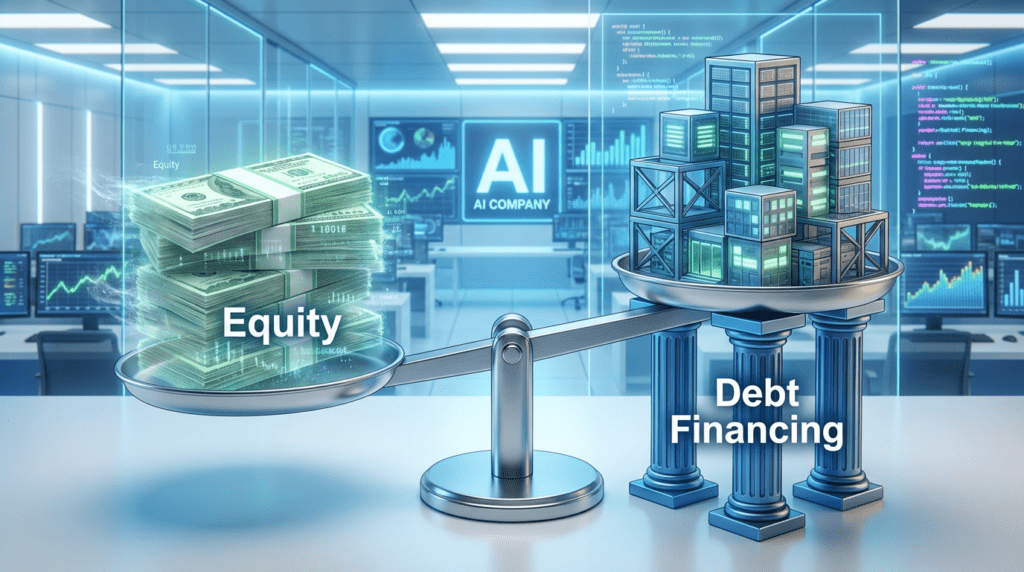
You might be wondering, why debt and not equity? Raising equity means giving up ownership. Raising debt means you borrow money and pay it back, but you keep control of your company.
Mistral has already raised $2.9 billion in equity funding, according to deal-tracking platform Dealroom. That includes a massive €1.7 billion ($1.99 billion) equity round led by ASML, which valued the company at €11.7 billion ($13.67 billion). That’s a serious valuation for a three-year-old startup.
By going the debt route for this infrastructure build, Mistral preserves its equity. It keeps its cap table clean. It signals to investors that it has enough confidence in its revenue streams to take on debt and pay it back. That’s a mature financial move, the kind you’d expect from a company that’s thinking long-term.
It’s also worth noting: infrastructure is exactly the kind of asset that makes sense to finance with debt. Data centers generate predictable, recurring revenue. Banks love that. It’s a much safer bet than, say, funding a moonshot research project.
The 200 MW Dream: Mistral’s European Expansion
The Paris data center is just the beginning. Mistral has set an ambitious target: 200 MW of capacity across Europe by the end of 2027.
To put that in perspective, the Paris facility alone will deliver 44 MW. That means Mistral needs to build out roughly four to five more facilities of similar scale, or a combination of smaller and larger ones, over the next 18 months or so. That’s aggressive. But Mistral has already started.
In February 2026, the company announced a €1.2 billion partnership with EcoDataCenter to build an AI-focused data center at EcoDataCenter’s Borlänge site in Sweden. That project is set to open in 2027 and marks Mistral’s first AI infrastructure investment outside France. EcoDataCenter is known for its sustainable operations, which aligns nicely with Europe’s green energy goals.
So the picture is becoming clearer. Mistral isn’t just building one data center. It’s building a European AI infrastructure network, a distributed, sovereign cloud for AI workloads that governments and enterprises can trust.
David vs. Goliath: Mistral vs. the American Giants
Let’s be honest about the scale gap here, because it’s enormous.
OpenAI has raised $180 billion. Anthropic has pulled in $59 billion. Mistral, with its $2.9 billion in equity, is operating on a fraction of that budget. It’s not even close.
But here’s the thing, Mistral isn’t trying to out-spend OpenAI. It’s trying to out-maneuver it. The strategy is different. Mistral targets a specific, underserved market: European governments, enterprises, and research institutions that want AI capabilities without handing their data over to American companies.
That’s a real market. A growing one. And Mistral is the best-positioned player to capture it.
The company also benefits from something money can’t easily buy: European trust. It’s headquartered in Paris. It operates under EU regulations. It speaks the language, literally and figuratively, of European institutions. That’s a competitive moat that OpenAI and Anthropic simply can’t replicate overnight.
Europe’s AI Moment Is Now
Mistral’s announcement doesn’t exist in a vacuum. It’s part of a broader wave of European AI investment that’s been building momentum throughout 2026.
Just look at the numbers. Nscale, a U.K.-based AI data center company, raised $2 billion earlier this year. Wayve, a British autonomous driving startup, pulled in $1.2 billion. France’s own AMI Labs secured $1 billion. The money is flowing into European AI at a pace we haven’t seen before.
This isn’t a coincidence. It’s a response to a geopolitical reality. Europe has watched the United States dominate the AI landscape for years. It’s watched its data flow into American cloud servers. It’s watched its companies depend on American AI tools. And it’s decided: enough.
The EU’s push for digital sovereignty, combined with massive public and private investment, is creating a genuine ecosystem. Mistral sits at the center of that ecosystem. It’s the flagship. The standard-bearer. The company that Europe is betting on to prove that you don’t have to be American to build world-class AI.
What Happens Next at Bruyères-le-Châtel?
The data center at Bruyères-le-Châtel is the immediate focus. Mistral selected the site back in 2025, and the facility has been in development since then. Originally, the company had planned to procure 18,000 Nvidia GB200 GPUs from French AI cloud provider Scaleway, with a target opening in summer 2025 at 40 MW capacity.
That timeline slipped. But the delay came with an upgrade. Mistral switched to the newer Nvidia GB300 GPUs, the latest and most powerful generation of Grace Blackwell hardware. So while the project took longer than expected, it’s arriving with better technology. Sometimes a delay is actually a win.
The facility will handle two critical workloads: training Mistral’s AI models and running inference services, meaning it will serve real-time AI responses to customers. Both are computationally intensive. Both require the kind of high-end GPU infrastructure that Mistral is now building.
Whether the original deal with Scaleway remains in place hasn’t been confirmed. But what is clear is that Mistral now has the financing, the hardware plan, and the timeline to make this data center a reality.
The Bigger Picture: Why This Matters to You
Okay, so Mistral is building a data center. Why should you care?
Here’s why. The AI tools you use every day, the chatbots, the writing assistants, the code generators, all run on infrastructure like this. The question of who owns that infrastructure is actually a question about who controls the AI you depend on.
If all the world’s AI runs on American servers, governed by American companies, subject to American laws and American business decisions, that’s a concentration of power that makes a lot of people nervous. Not just in Europe. Everywhere.
Mistral’s bet is that there’s a better way. A more distributed way. A way where Europe, and eventually other regions, can build and control their own AI stack. The $830 million data center near Paris is a concrete, physical manifestation of that bet.
It’s a server farm. But it’s also a statement.
Final Thoughts: Don’t Sleep on Mistral
Three years old. $2.9 billion raised. $830 million in fresh debt financing. A data center coming online in Q2 2026. A 200 MW European expansion target for 2027. A CEO who talks about AI sovereignty like he means it.
Mistral is not a company you can dismiss anymore, if you ever could. It’s building something real, something ambitious, and something that the European tech ecosystem desperately needs.
The AI race isn’t just between OpenAI and Google and Anthropic. It’s also between continents. And Europe just made its move.
Watch this space.