Meta just dropped its biggest AI bet yet. But the move comes with a twist nobody saw coming.

The Comeback Kid Nobody Expected
Let’s be honest. A year ago, Meta was the butt of a lot of AI jokes.
Llama 4 stumbled out the gate. Benchmarks were manipulated. Developers were disappointed. The company that once positioned itself as the champion of open-source AI looked like it was falling behind — fast.
Then Mark Zuckerberg did what Zuckerberg does. He threw money at the problem. A lot of money.
He spent US$14.3 billion acquiring a 49% stake in Scale AI, brought in Scale AI’s co-founder and former CEO Alexandr Wang — a 29-year-old Silicon Valley prodigy — and handed him the keys to a brand-new division called Meta Superintelligence Labs (MSL). Then, for nine months, the team tore down Meta’s entire AI stack and rebuilt it from scratch.
New infrastructure, New architecture, New data pipelines. Everything.
On April 8, 2026, the world got to see what came out the other side. Meet Muse Spark — Meta’s first major AI model in over a year, and the first product born from the Meta Superintelligence Labs. According to The Seattle Times, the model had been referred to internally as “Avocado.” Yes, really.
So What Exactly Is Muse Spark?
Muse Spark isn’t just another chatbot upgrade. It’s a natively multimodal reasoning model — meaning it can handle text, images, and complex tasks all at once, right out of the box.
It comes packed with:
- Tool-use capabilities — it can call on external tools to get things done
- Visual chain of thought — it can reason through problems using visual context
- Multi-agent orchestration — it can coordinate multiple AI agents working in parallel
And it runs at a fraction of the compute cost of its predecessors. That’s a big deal. At Meta’s scale — we’re talking billions of daily interactions — compute costs add up fast. Building a frontier-class model that costs significantly less to run changes the entire economics of deployment.
Muse Spark now powers Meta AI, which reaches over three billion users across Facebook, Instagram, WhatsApp, and Messenger. It’s also heading to Meta’s Ray-Ban AI smart glasses. That’s not a small rollout. That’s a planetary-scale deployment.
Three Modes, One Model
One of the cooler things about Muse Spark is how it adapts to what you need. Meta built three distinct interaction modes into the model:
Instant Mode — Quick answers. Fast. No fuss. Perfect for when you just need a straight response.
Thinking Mode — Multi-step reasoning for more complex tasks. This is where Muse Spark slows down and actually thinks through a problem.
Contemplating Mode — The heavy hitter. This mode orchestrates multiple AI agents reasoning in parallel, designed to go toe-to-toe with the most demanding reasoning modes from Google’s Gemini Deep Think and OpenAI’s GPT Pro.
It’s a smart design. Not every question needs a supercomputer. Sometimes you just want to know what the weather is. Other times, you’re asking it to help you solve a multi-step scientific problem. Muse Spark handles both.
How Does It Stack Up Against the Competition?
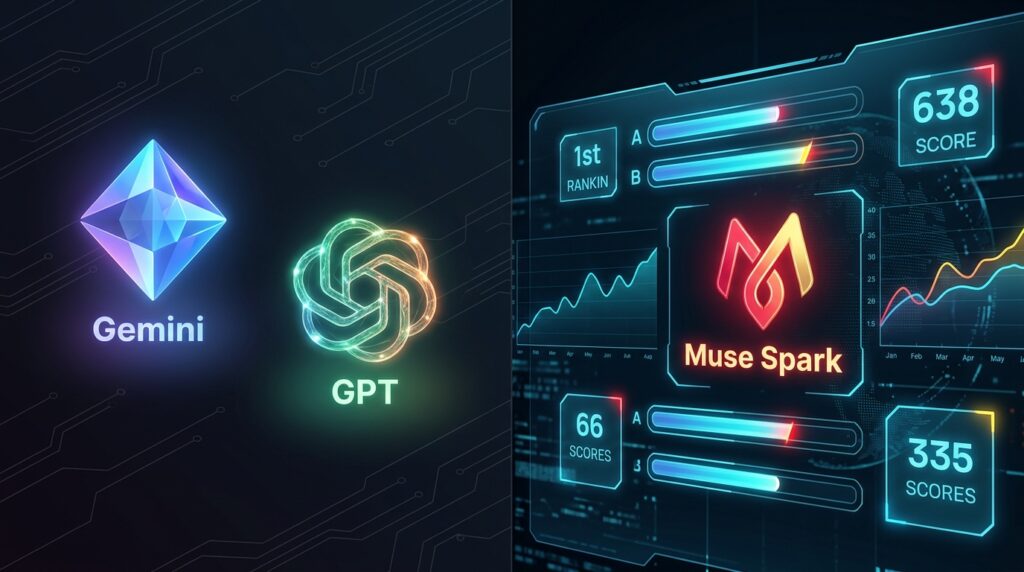
Here’s where things get interesting — and a little humbling for Meta.
On the Artificial Intelligence Index v4.0, Muse Spark scores 52, placing it fourth overall behind:
- Gemini 3.1 Pro
- GPT-5.4
- Claude Opus 4.6
Fourth place isn’t first. But here’s the thing — Meta isn’t claiming to have built the best model in the world. That’s actually a refreshing change from the over-hyped Llama 4 launch that burned bridges with the developer community.
Where Muse Spark genuinely shines is in health. On HealthBench Hard — a benchmark testing open-ended health queries — Muse Spark scores 42.8. That’s a massive lead over:
- Gemini 3.1 Pro: 20.6
- GPT-5.4: 40.1
- Grok 4.2: 20.3
That’s not a small gap, That’s a statement. Meta worked with over 1,000 physicians to curate training data specifically for health-related queries. The result is a model that genuinely outperforms its rivals in one of the most important domains imaginable.
The weak spot? Coding. Muse Spark still lags behind competitors in coding ability — which has become a major battleground in the AI race, especially for Anthropic. Meta acknowledged this openly and said larger, more powerful models are already in development. The next one, known internally as “Watermelon,” is already underway.
The Open-Source Bombshell
Now here’s the part that has the developer community buzzing — and not entirely in a good way.
Meta built its reputation on open-source AI. The Llama ecosystem reached 1.2 billion downloads by early 2026, averaging about 1 million downloads per day. Developers loved it. They built on it. They trusted it.
Muse Spark? Completely proprietary.
No free download, No open weights, No building on it unless Meta decides you can. The model is available only through a private API preview for select partners. That makes it more closed than even the paid models from Meta’s rivals.
According to Heise, Meta is planning a hybrid AI strategy going forward. The most powerful models will likely stay closed. Others may be released as open-source. Wang addressed the shift directly, saying:
“Nine months ago, we rebuilt our AI stack from scratch. New infrastructure, new architecture, new data pipelines. This is step one. Bigger models are already in development with plans to open-source future versions.”
The developer community’s response? Skeptical. Some see it as a necessary pivot after Llama 4 failed to gain expected traction. Others see it as Meta closing the gates now that it finally has something worth protecting.
As AI News put it bluntly: “The developer community that made Llama what it was is now being asked to wait for a future open-source version that may or may not arrive on any predictable timeline.”
That’s a tough pill to swallow for a community that showed up for Meta when it needed them most.
The Alexandr Wang Effect
You can’t talk about Muse Spark without talking about the man behind it.
Alexandr Wang is 29 years old. He co-founded Scale AI — a company that sells annotated training data for AI applications — and built it into a multi-billion dollar enterprise. Zuckerberg didn’t just hire him. He acquired 49% of Scale AI to get him.
Wang only joined Meta in mid-2025. Within nine months, his team had rebuilt the entire AI stack and shipped a frontier-class model. That’s a remarkable pace by any standard.
His vision for Meta’s AI strategy is clear: open up where it makes sense, close off where it matters competitively, and focus on end consumers rather than chasing enterprise contracts. That last point is a deliberate jab at Anthropic and OpenAI, both of which have increasingly pivoted toward big corporate and government clients.
Meta is going the other direction. It’s going straight to the people — all three billion of them.
Distribution Is the Real Superpower
Here’s the thing that often gets lost in all the benchmark talk: Meta’s real advantage isn’t the model. It’s the distribution.
OpenAI and Anthropic sell to developers and enterprises. They build great models and hope businesses integrate them. Meta skips that entire step. It deploys directly to over three billion people who are already inside its apps every single day.
Think about that for a second. Muse Spark doesn’t need to win a benchmark to win the market. It just needs to be good enough — and then show up in the apps that billions of people already use without thinking twice.
Facebook. Instagram. WhatsApp. Messenger. Ray-Ban glasses. That’s an unprecedented distribution network for an AI model. No competitor comes close.
Mike Proulx, a research director at Forrester VP, summed it up well in The Seattle Times: “The new model and how it performs is really at the center of Meta’s AI credibility. It’s the first real test of whether its massive AI investment can translate into a model that can stand alongside competition.”
The Privacy Question Nobody Wants to Ask
Let’s not skip over this one.
Muse Spark users need to log in with an existing Meta account to use it. Meta hasn’t explicitly said it will use personal account data to train or personalize the AI. But Meta has a long history of training on public user data — and it’s positioning Muse Spark as a personal superintelligence product.
That combination raises real questions. When your AI assistant lives inside the same app where you share photos of your kids, message your friends, and scroll through your news feed — where exactly does the data boundary sit?
These are questions worth watching closely as the rollout expands.
Wall Street Loved It
Whatever the developer community thinks, investors were thrilled.
Meta stock rose more than 9% on the day of the Muse Spark launch. That’s a clear signal that Wall Street read the release as proof that the US$14.3 billion bet on Wang and the nine-month rebuild actually produced something real and competitive.
Zuckerberg has also pledged to invest $600 billion in new data centers to win the AI race. This year alone, Meta forecasts spending up to $135 billion — nearly double the $72 billion it spent last year — with the bulk going toward AI infrastructure.
That’s not a company hedging its bets. That’s a company going all in.
What Comes Next?

Muse Spark is explicitly described as a starting point, not a finish line. Meta said it clearly: “This initial model is small and fast by design, yet capable enough to reason through complex questions in science, math and health. It is a powerful foundation, and the next generation is already in development.”
That next generation — codenamed Watermelon internally — is already in the works. Bigger. More powerful. And presumably, better at coding.
The open-source question will define how this chapter of Meta’s story is remembered. If the promised open-source versions materialize, the developer community may forgive the detour. If they don’t, Meta risks losing the goodwill that made Llama a phenomenon in the first place.
One thing is certain: the AI race just got a lot more interesting.
Sources
- AI News — Meta has a competitive AI model but loses its open-source identity
- Heise — Meta: New AI models to be partly open-source
- The Seattle Times — Meta Unveils New AI Model, Its First From the Superintelligence Lab
The Kingy Brief
Get The Kingy Brief.
Every week: what launched, what changed price, and what scored well — built on KALI.
Weekly · Double opt-in · Unsubscribe anytime