Wait, Did Meta Just Clone Their CEO?
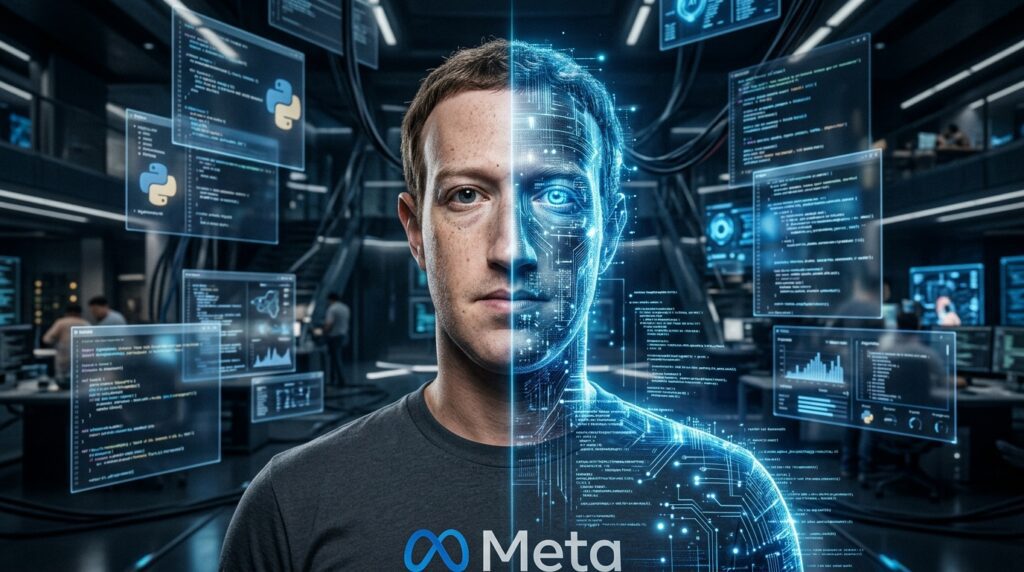
Okay, let’s just say it out loud. Meta is building a digital version of Mark Zuckerberg. Not a cartoon. Not a meme. A photorealistic, AI-powered, voice-mimicking clone of the actual CEO — and it’s designed to talk to employees like it’s the real deal.
Yes, you read that right.
According to a report from the Financial Times, Meta is developing an AI avatar of Zuckerberg that can hold real-time conversations with staff. It answers questions, gives feedback and It represents the boss in discussions he can’t personally attend. And it’s trained on his actual voice, tone, mannerisms, and public statements.
This isn’t a side project buried in some forgotten R&D lab. This is a full-on, Zuckerberg-approved initiative. The man himself is reportedly involved in testing and fine-tuning the AI to make sure it sounds — and feels — like him.
Wild? Absolutely. But also? Kind of fascinating.
So What Exactly Is This Thing?
Let’s break it down. The AI Zuckerberg isn’t just a chatbot that spits out generic corporate answers. According to Quartz, the system is being trained on his speech patterns, tone, and public statements. It’s also been fed his current views on company direction and strategy.
The goal, as Meta describes it, is to make employees “feel more connected to the founder through interactions with it.”
Think about that for a second. Meta has over 70,000 employees. Most of them will never sit in a room with Zuckerberg. They’ll never get direct feedback from him. They’ll never ask him a question and hear his answer in real time.
This AI changes that — at least in theory.
FoneArena reports that the digital CEO is designed to hold conversations with staff, provide feedback on internal work, and represent Zuckerberg in certain discussions. It’s a 3D, photorealistic character. It responds in real time. And it’s being built under Meta’s newly formed Superintelligence Labs division.
That’s not a small operation. That’s a serious, well-funded push.
The Man Behind the Machine
Here’s something that makes this story even more interesting. Zuckerberg isn’t just signing off on this project from a distance. He’s actually getting his hands dirty.
The Verge reports that Zuckerberg has started spending five to ten hours per week coding on Meta’s AI projects. He’s also dropping into engineering review sessions. For a CEO running one of the most valuable companies on the planet, that’s a significant time commitment.
He’s not just the face of the AI clone. He’s actively shaping the technology behind it.
And there’s more. Separate from the employee-facing AI avatar, Zuckerberg is also building a private “CEO agent” — a personal AI assistant designed to help him manage tasks, pull up information on demand, and support decision-making. Quartz confirms this is a completely different project from the employee-facing clone.
So to recap: there’s an AI Zuckerberg for employees, and a separate AI assistant for Zuckerberg himself. The man is building his own digital army.
This Isn’t Meta’s First Rodeo With AI Characters
Before you think this came out of nowhere, let’s rewind a bit. Meta has been experimenting with AI personas for a while now.
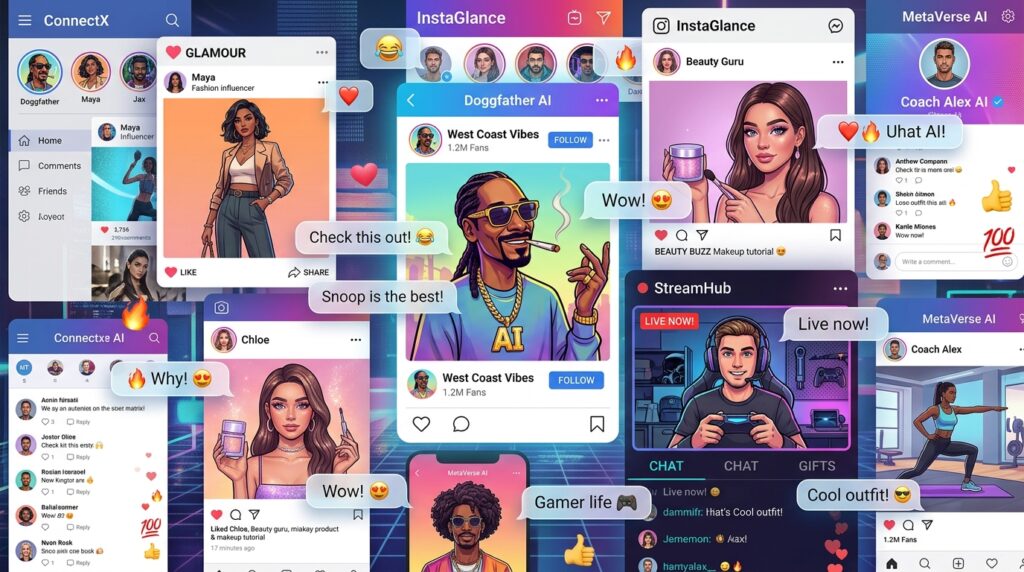
Back in September 2023, Meta launched AI chatbots based on celebrity personalities. One of them was styled after Snoop Dogg, who licensed his voice and likeness for the project. Quartz notes that these celebrity-based bots debuted on the platform as part of a broader push into AI-driven social experiences.
Then came AI Studio — a tool that let regular users and creators build their own AI characters. Creators could deploy AI versions of themselves to interact with followers’ comments on Instagram. It was a big deal. It showed Meta was serious about making AI personas mainstream.
But it hit a snag. Some users created sexually explicit personas using the tool, which drew concern from regulators and child safety advocates. Meta responded in January by blocking teenagers from accessing AI characters entirely.
Now, with the Zuckerberg clone, Meta is essentially testing the most high-profile version of this concept yet. If it works with the CEO, the plan is to open it up to creators at scale. The Verge confirms that Meta may start allowing creators to make AI avatars of themselves if the Zuckerberg experiment succeeds.
The Bigger Picture: Meta’s All-In on AI
Here’s the thing — the AI Zuckerberg clone isn’t just a quirky experiment. It’s a symptom of something much larger happening inside Meta.
The company is going all-in on artificial intelligence. And we mean all-in.
FoneArena reports that Meta has budgeted an estimated $115–$135 billion in capital expenditure for 2026 alone. Long-term plans reportedly include investing up to $600 billion in AI infrastructure by 2028. That covers data center expansion, AI talent acquisition, and next-generation model development.
For context, that’s not a bet. That’s a full-scale transformation.
Meta is also restructuring internally. The company is moving toward a “pod” structure with fewer managers. In some cases, up to 50 engineers report to a single manager. AI-generated reporting systems are replacing multiple layers of middle management. The message is clear: AI isn’t just a product at Meta. It’s becoming the operating system of the entire company.
And then there’s Muse Spark — Meta’s latest AI model, released just this week. Quartz reports that the model was developed under the internal codename “Avocado” and is optimized for speed. Unlike Meta’s previous open-source approach with Llama, Muse Spark will be kept proprietary. Investors loved it. Meta stock jumped 7% on the day of the announcement.
What Do Employees Actually Think?
This is where it gets a little complicated.
On one hand, the idea of having 24/7 access to a CEO-level AI that can answer your questions and give feedback sounds genuinely useful. Especially in a company as large and fast-moving as Meta.
On the other hand, TipRanks notes that employees are also being asked to complete a “skills baseline exercise” that includes system design challenges and what Meta calls “vibe coding.” While the company frames it as a training initiative, some staff worry it could be a precursor to job cuts.
That anxiety isn’t unfounded. Meta’s AI-driven restructuring is already reducing reliance on middle management. And as automation takes over more workflows, the question of what happens to human roles becomes harder to ignore.
FoneArena points out that while these tools are expected to improve efficiency, they could also lead to a leaner workforce over time. That’s a polite way of saying: some jobs may not survive the transition.
A Modern-Day Charlie Chaplin Moment
TipRanks draws a fascinating parallel between the AI Zuckerberg and Charlie Chaplin’s 1936 film Modern Times. In that movie, the factory boss appears on screens to watch and direct workers — even in their private moments. The tone here is friendlier, sure. But the idea of a constant digital presence watching over the workforce? Not that far off.
It’s a reminder that the questions AI raises aren’t entirely new. Automation has always disrupted work. The difference now is the speed, the scale, and the sophistication.
A digital CEO that sounds like the real thing, responds in real time, and never sleeps? That’s a new kind of presence in the workplace. And it’s coming whether we’re ready or not.
What This Means for the Rest of Us
Here’s the part that should really grab your attention. This isn’t just a Meta story.
If the AI Zuckerberg experiment works, it opens the door for something much bigger. Influencers, creators, executives, and public figures could all build AI versions of themselves. Imagine your favorite YouTuber having an AI clone that responds to every comment. Or a startup founder whose AI avatar mentors employees around the clock.
The Verge confirms that Meta is already considering expanding this capability to creators if the internal test succeeds. The infrastructure is being built. The technology is being refined. The only question is how fast it scales.
We’re entering an era where digital identity becomes something you can deploy, replicate, and automate. That’s exciting. It’s also a little unsettling. And it’s very, very real.
The Bottom Line
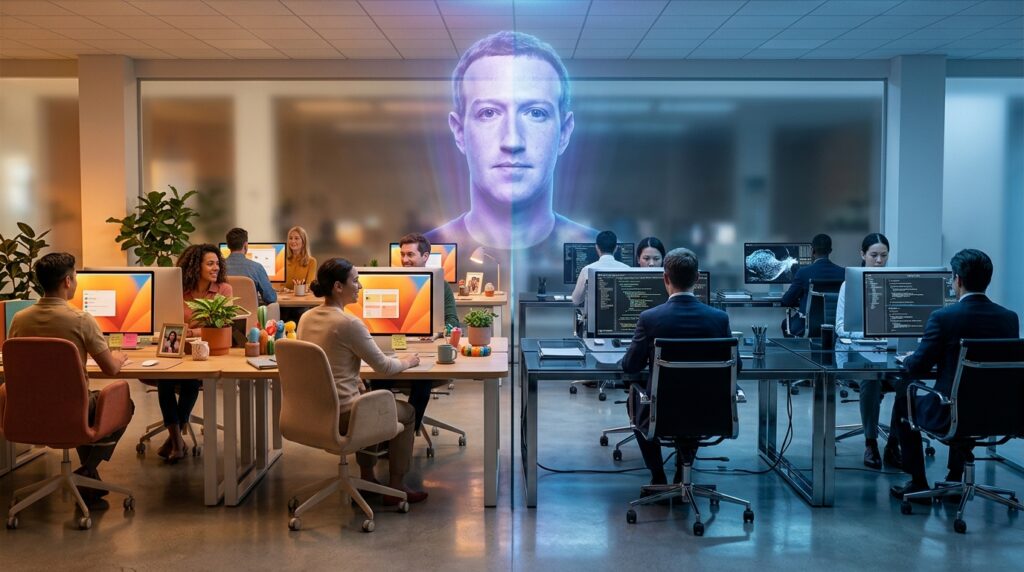
Meta is building an AI clone of Mark Zuckerberg. It talks like him It thinks like him. It gives feedback like him. And it’s designed to make 70,000+ employees feel like they have a direct line to the founder.
Is it weird? Yes. Is it ambitious? Absolutely. Is it the future of how large organizations operate? Quite possibly.
One thing is certain: the line between human leadership and artificial intelligence just got a whole lot blurrier. And Meta is the one holding the eraser.
Sources
- The Verge — Mark Zuckerberg is reportedly building an AI clone to replace him in meetings
- Quartz — Meta is making an AI Mark Zuckerberg to talk to employees, report says
- FoneArena — Meta develops AI version of Mark Zuckerberg for employees: Report
- TipRanks — Meta Turns Zuckerberg Into AI to Guide Employees in Real Time