The Factory of the Future Is Already Being Built
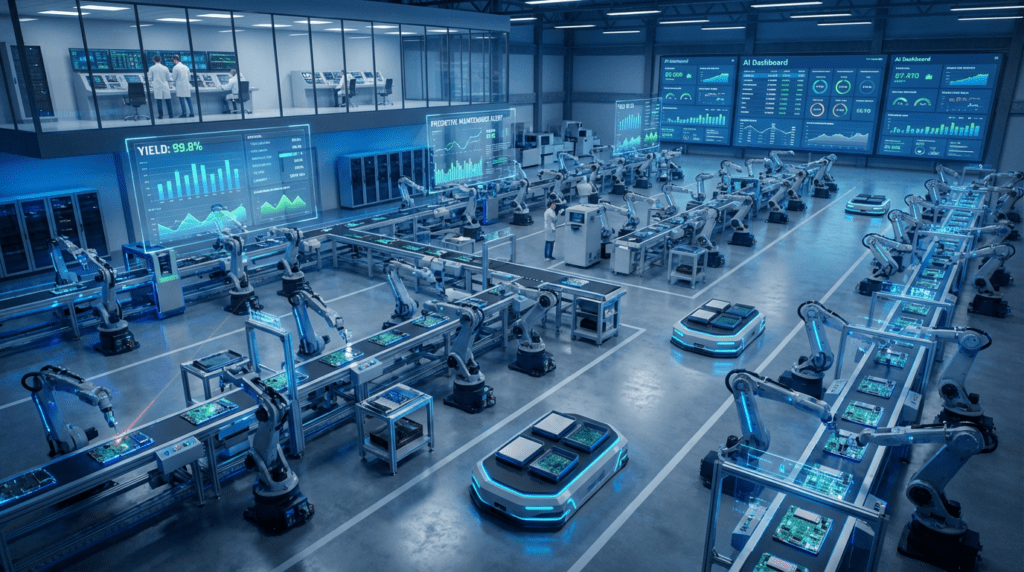
Imagine a factory that never sleeps. One that doesn’t just run on schedules and human oversight but thinks. It detects problems before they happen, It reroutes materials on the fly and It makes decisions in real time, without waiting for a manager to sign off.
That’s not science fiction anymore. That’s Samsung’s plan.
Samsung Electronics officially announced on March 1, 2026, that it intends to transform all of its domestic and overseas production facilities into fully AI-driven, autonomous factories by 2030. It’s a bold move. And it signals something much bigger than one company’s upgrade cycle it’s a preview of where global manufacturing is heading.
The announcement came straight from Seoul. And the world is paying attention.
What Samsung Actually Announced
Let’s break it down. Samsung isn’t just adding a few robots to an assembly line. This is a full-stack transformation.
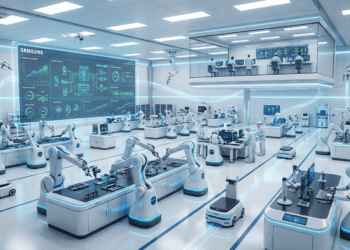
The company plans to deploy AI agents across every stage of manufacturing from the moment raw materials arrive at the warehouse, all the way through production, quality control, and final shipment. These aren’t passive monitoring tools. They’re autonomous systems that set goals, make decisions, and execute plans independently.
At the heart of the strategy is something called digital twin technology. A digital twin is a virtual replica of a physical system. Samsung will use these simulations to model its entire manufacturing process testing changes, predicting failures, and optimizing performance before anything touches the actual factory floor.
Think of it like a flight simulator for manufacturing. Pilots train in simulators so they don’t crash real planes. Samsung’s engineers will test process changes in virtual environments so they don’t disrupt real production lines.
According to Yonhap News Agency, the company will introduce these digital twin-based simulations across the entire manufacturing process from materials warehousing to production and shipment while deploying dedicated AI agents for quality control, production, and logistics.
Agentic AI: The Tech Behind the Transformation
Here’s where it gets really interesting. Samsung isn’t building this from scratch.
The company is taking AI technology it already developed for its consumer devices specifically the Galaxy S26 and applying it to industrial manufacturing. The tech is called agentic AI.
What makes agentic AI different? Traditional AI responds to inputs. Agentic AI acts. It sets its own sub-goals, plans sequences of actions, and executes them to achieve a larger objective all without constant human direction.
On a smartphone, that might mean the AI books your dinner reservation, checks traffic, and sets a reminder all from a single voice command. In a factory, it means the AI monitors a production line, detects an anomaly, reroutes materials, adjusts machine parameters, and flags the issue for review all in seconds.
Complete AI Training reports that Samsung’s agentic AI will orchestrate schedules, routes, setpoints, inspections, and maintenance windows closing the loop between plan and action. Simulations run upstream to test changes before deployment, reducing unplanned downtime and scrap.
This is a massive leap. And Samsung is betting its entire manufacturing future on it.
Robots Are Coming to the Production Line
AI agents are only part of the story. Samsung is also rolling out humanoid manufacturing robots across its production lines in phases.
This isn’t a single robot doing a single task. Samsung envisions four distinct categories of robots working in concert:
- Operating Robots — handling line operations and facility tasks
- Logistics Robots — managing material flow and transport
- Assembly Robots — performing precision tasks that require fine motor control
- Environmental Safety Robots — working in high-risk areas where human exposure should be minimized
The goal is a factory where humans and machines collaborate seamlessly. Workers won’t be replaced overnight. But their roles will shift from doing repetitive tasks to overseeing, training, and managing AI systems and robots.
It’s a transition that will require serious investment in workforce development. Samsung knows this. The company is already planning change management programs to upskill technicians and supervisors on agent handoffs, exceptions, and robot collaboration.
Safety Gets Smarter Too
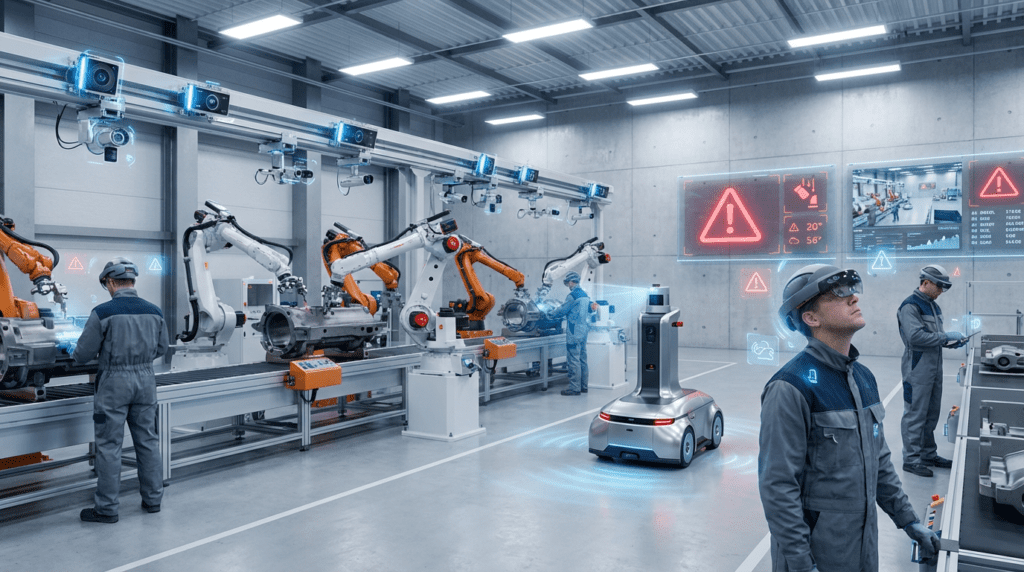
One of the most underreported aspects of this announcement is what it means for workplace safety.
Manufacturing environments carry real risks. Heavy machinery, hazardous materials, high temperatures, and repetitive motion injuries are constant concerns. Traditional safety systems are reactive they respond after something goes wrong.
Samsung’s AI-driven approach flips that model entirely.
The company plans to integrate Environmental Health and Safety (EHS) management directly into its AI systems. That means continuous sensing across the factory floor, real-time anomaly detection, and automated interventions before accidents happen.
Yonhap reports that broader AI applications in EHS management will help improve workplace safety a benefit that goes beyond productivity metrics and directly impacts the lives of Samsung’s hundreds of thousands of factory workers worldwide.
Proactive hazard prevention, built into the facility’s nervous system. That’s a meaningful shift.
The Numbers Behind the Vision
Why is Samsung doing this? Because the performance gains are enormous.
Complete AI Training’s analysis outlines the specific operational improvements Samsung is targeting:
- Higher Overall Equipment Effectiveness (OEE) — fewer micro-stops, faster changeovers, tighter process control
- Shorter cycle times and lower work-in-progress (WIP) — through dynamic routing and smarter lot sizing
- Better First Pass Yield (FPY) — fewer defects escaping the line through adaptive inspection and root-cause feedback
- Improved Mean Time Between Failures / Mean Time to Repair (MTBF/MTTR) — with predictive maintenance and guided repair workflows
- Reduced EHS incidents — through continuous sensing and automated interventions
- Lower energy and consumables per unit — through parameter optimization in digital twins
These aren’t marginal improvements. In high-volume semiconductor and electronics manufacturing, even a 1% gain in yield or a few minutes shaved off cycle time translates to hundreds of millions of dollars annually.
Samsung produces chips, displays, smartphones, and home appliances at massive scale. The compounding effect of these efficiency gains across its global network is staggering.
MWC 2026: Where Samsung Will Show the World
Samsung isn’t keeping this vision behind closed doors. The company plans to unveil its full industrial AI strategy and digital twin-based manufacturing innovation vision at Mobile World Congress (MWC) 2026 in Barcelona this month.
MWC is the world’s largest mobile technology conference. Billions of dollars in deals get made there. Industry leaders, investors, and policymakers all converge in one place. Choosing MWC as the stage for this announcement is deliberate Samsung wants the world to see it as a technology leader, not just a manufacturer.
Alongside the main event, Samsung will host the Samsung Mobile Business Summit (SMBS) an invite-only gathering for key partners. There, the company will present its governance strategy for scaling agentic AI responsibly. That includes oversight mechanisms, safety boundaries, audit trails, and escalation rules for autonomous decision-making.
Governance matters here. As AI systems gain more autonomy in high-stakes environments, the question of who is responsible when something goes wrong becomes critical. Samsung is getting ahead of that conversation.
The Voice of Samsung’s Leadership
Senior company official Lee Young-soo, Executive Vice President and Head of Global Technology Research, put it plainly:
“The future of manufacturing innovation lies not only in automation but in autonomous production sites, where AI understands on-site conditions and independently makes optimal decisions. We will become a global leader in manufacturing innovation powered by AI.”
That’s a clear statement of intent. Samsung isn’t positioning this as an experiment. It’s a commitment to its investors, its customers, and its workforce that the company is going all-in on AI-driven manufacturing.
The Challenges Samsung Must Overcome
This vision is ambitious. And ambition always comes with risk.
Complete AI Training identifies several key challenges that Samsung and any company pursuing this path must navigate:
Data drift and model decay. AI models trained on today’s factory conditions may become inaccurate as processes evolve. Without rigorous retraining discipline, autonomous systems can make increasingly poor decisions over time.
Interoperability. Samsung’s factories run on a mix of legacy equipment, modern systems, and third-party vendor tools. Getting all of these to communicate cleanly with AI agents is a massive integration challenge.
Safety cases for autonomy. When an AI system makes a decision that causes a safety incident, who is accountable? Defining fail-safes and human-in-the-loop triggers is essential and complex.
Labor readiness. The workforce needs new skills. Robot technicians, AI operations specialists, and reliability engineers don’t grow on trees. Samsung will need to invest heavily in training and hiring.
Cybersecurity. Autonomous factories are also high-value targets. Network segmentation, endpoint hardening, and model access monitoring will be critical to prevent disruptions or worse, sabotage.
None of these challenges are insurmountable. But they require serious, sustained investment. The 2030 deadline gives Samsung four years. That’s tight.
What This Means for the Industry
Samsung’s announcement doesn’t exist in a vacuum. It’s part of a broader wave of industrial AI adoption sweeping through global manufacturing.
Companies like Siemens, Foxconn, and TSMC are all investing heavily in smart factory technologies. Governments in South Korea, Germany, Japan, and the United States are funding industrial AI initiatives as part of national competitiveness strategies.
But Samsung’s scale is different. The company operates factories across South Korea, Vietnam, China, India, and beyond. If it successfully deploys this vision across its entire global network by 2030, it will set a new benchmark for what a modern factory looks like and put enormous pressure on competitors to keep up.
The ripple effects will reach suppliers, logistics partners, and entire regional economies built around Samsung’s manufacturing presence.
The Bottom Line
Samsung is making a bet. A big one.
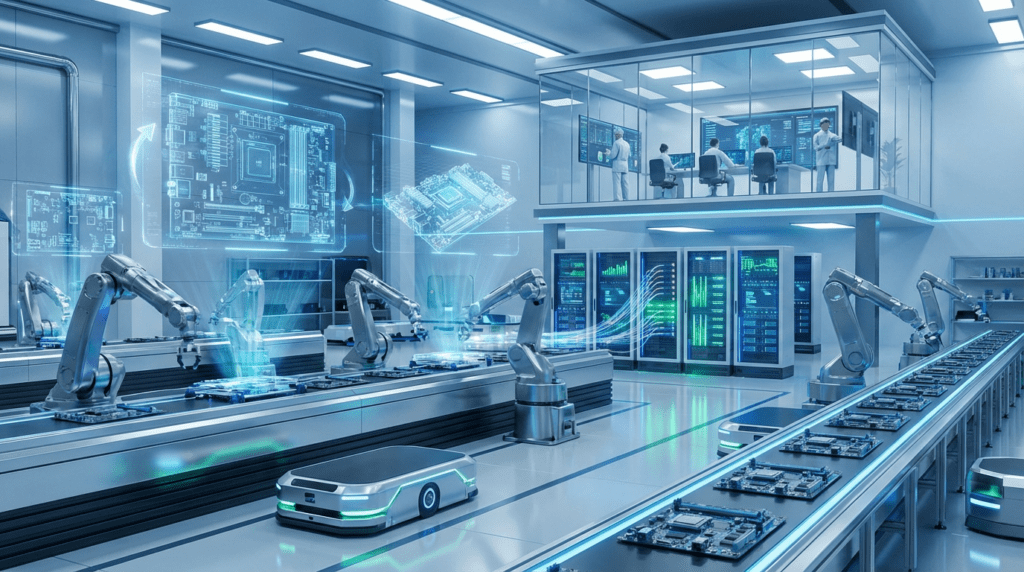
By 2030, the company wants its factories to think for themselves. AI agents will plan production. Digital twins will simulate every change before it happens. Robots will handle the dangerous, repetitive, and precision-critical work. And humans will step into higher-level roles overseeing, guiding, and improving the systems that run the floor.
It’s a vision that’s equal parts exciting and challenging. The technology is real. The business case is compelling. The risks are significant but manageable.
What’s clear is this: the factory of the future isn’t coming someday. Samsung just put a date on it.