A Growing Movement Rejects Corporate Push for Generative AI in Gaming
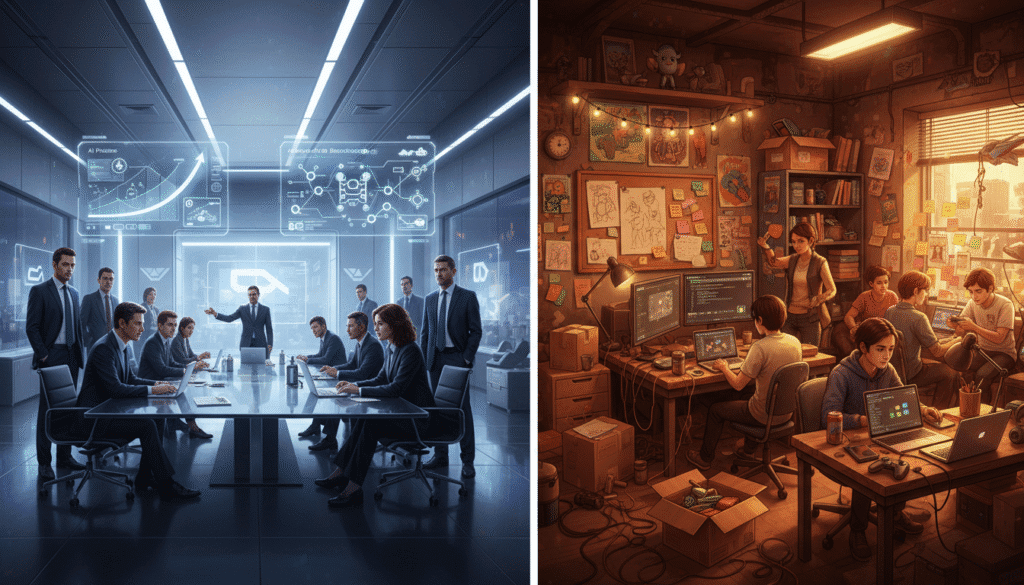
The gaming industry is witnessing an unprecedented divide. On one side stand major publishers and corporate executives championing generative AI as the inevitable future of game development. On the other, a passionate coalition of indie developers and voice actors is drawing a firm line in the digital sand, declaring their work proudly and defiantly human-made.
This cultural clash reached a boiling point earlier this month when Junghun Lee, CEO of Nexon the parent company behind the popular live-service shooter Arc Raiders made a statement that reverberated throughout the development community. “It’s important to assume that every game company is now using AI,” Lee declared, presenting the technology’s adoption as a foregone conclusion.
The response from independent developers was swift and unequivocal. “It’s just not true,” Alex Kanaris-Sotiriou, cofounder of Röki and Mythwrecked developer Polygon Treehouse, told The Verge. His reaction encapsulated the frustration felt by countless creators who see generative AI not as progress, but as a fundamental threat to the craft they’ve dedicated their lives to perfecting.
The Human Touch Becomes a Selling Point
In an industry increasingly dominated by algorithms and automation, something remarkable is happening. Indie developers are turning their rejection of AI into a unique selling proposition, marketing their games as bastions of human creativity in a sea of machine-generated content.
Kanaris-Sotiriou didn’t just voice his opposition he took action. Earlier this year, he teamed up with fellow developers to craft a simple but striking symbol: a golden cog-shaped seal that reads, “This developer assures that no gen AI was used in this indie game.” They designed the image with care—authoritative enough to feel official, but different enough not to poke the Nintendo lawyers—and then released it freely for any studio that wanted to use it.
The seal has already appeared on store pages for games like Rosewater, Astral Ascent, and Quarterstaff. It serves as the antithesis to Steam’s gen AI disclosure rules, transforming what could be seen as a limitation into a badge of honor. In the Bluesky thread announcing the seal’s creation, multiple indie developers shared that they’d placed it on their Itch.io pages and Steam storefronts, proudly advertising their commitment to human artistry.
“Every Moment Flawed and Messy”
Perhaps no statement has captured the philosophical heart of this movement better than the one issued by D-Cell Games, developers of the critically acclaimed rhythm game Unbeatable. In direct response to Lee’s comments, the studio posted a graphic on Bluesky that read like a manifesto for human creativity.
“Absolutely everything in Unbeatable was created by human beings without any generative assistance,” the statement declared. “Every frame drawn, every word written, every model sculpted, every line of code typed, every song sung with a real voice, every guitar played with a real hand, every moment flawed and messy because we are, also.”
The passion in D-Cell’s words is palpable, reading almost as a challenge to those who would embrace AI tools. Studio producer Jeffrey Chiao elaborated on this stance in an email to The Verge, cutting through the hype surrounding generative AI with remarkable clarity. “Ignoring all of the ethical, moral, and legal concerns of using generative AI, it’s a huge waste of effort,” Chiao explained. “We can produce results that meet our quality standards without its assistance.”
This sentiment reflects a broader truth that many indie developers are discovering: the constraints they face don’t require AI solutions. They require creativity, collaboration, and the kind of problem-solving that makes game development rewarding in the first place.
The Corporate Counterpoint

The enthusiasm for generative AI among major publishers stands in stark contrast to indie skepticism. Lee’s comments are merely the latest in a string of declarations from gaming CEOs positioning AI as the industry’s inevitable future.
Ubisoft CEO Yves Guillemot has compared generative AI’s impact on gaming to the revolutionary shift from 2D to 3D graphics. The company is already deploying internal tools like Ghostwriter, which generates short snippets of dialogue called “barks,” and experimenting with Neo NPCs that players can converse with using AI-powered systems.
EA has announced a partnership with Stability AI to explore generative tools for art and asset creation. Microsoft is openly using AI to generate gameplay elements and assist with level design. Meanwhile, publisher Krafton suggested employees voluntarily resign if they couldn’t adapt to the company’s new “AI-first” reorganization a move that sent shockwaves through the development community.
The corporate logic is straightforward: video game development budgets are ballooning, production timelines are stretching longer, and investors demand predictable returns. A technology that promises to accelerate production while reducing costs is, from a purely business perspective, an attractive proposition.
Generative AI assets have already appeared in major releases including Call of Duty: Black Ops 6 (and the upcoming Black Ops 7), Anno 117: Pax Romana, The Alters, The Finals, InZoi, and of course, Arc Raiders. For executives managing nine-figure budgets and shareholder expectations, AI represents a potential solution to the industry’s escalating cost crisis.
The Ethical Foundation
For developers like Kanaris-Sotiriou, the decision to reject generative AI wasn’t difficult. “The foundations that it’s built upon, the idea of using other people’s work without permission to generate artwork […] are unfair,” he explained. This ethical concern sits at the heart of the anti-AI movement.
Generative AI models are trained on vast datasets of existing artwork, writing, music, and other creative works—often without the original creators’ knowledge or consent. When these systems generate new content, they’re essentially remixing and recombining the labor of thousands of artists who never agreed to have their work used this way and receive no compensation for its use.
Tom Eastman, president of Battle Suit Aces developer Trinket Studios, offered another perspective on why AI solutions miss the point. He recalled how, in the final days of working on the studio’s previous title Battle Chef Brigade, several key locations lacked finished art. Rather than using AI or rushing through their established hand-drawn aesthetic, the team made a creative decision: they switched to less time-consuming watercolors for those scenes.
“Those are the interesting creative decisions that are fun to work through,” Eastman explained, “instead of ‘please magic box solve my problems.'” His words highlight what many indie developers instinctively understand: the constraints and challenges of game development aren’t obstacles to overcome with automation they’re opportunities for creative problem-solving that make the work meaningful.
Voice Actors Join the Fight
The pushback against AI isn’t limited to visual artists and developers. Voice actors are increasingly vocal about the technology’s threat to their livelihoods, particularly as their voices are cloned without consent.
Earlier this year, Aspyr used AI to reproduce a French vocal performance for Lara Croft in their Tomb Raider remake without informing the original voice actor she’d been replaced. The incident sparked outrage and highlighted the casual disregard some companies show for performers’ rights.
In Germany, Bodo Henkel beloved by Gothic fans as the voice of the demonic sorcerer Xardas has used his YouTube channel to politely but firmly ask fans and modders to stop feeding his performances into text-to-speech and voice-cloning systems. For Henkel, even non-commercial mod projects cross an ethical line when they replicate his voice without permission. The issue isn’t just professional it’s about basic control over one’s own voice and likeness.
Similar concerns have been raised by the voice actress behind Serena in The Elder Scrolls V: Skyrim‘s Dawnguard DLC. The fear is understandable: once a voice is cloned, that actor can be made to say anything, in any context, without their knowledge or approval.
Reuters recently reported on French and German voice actors pushing national and EU regulators for clear rules around AI dubbing, focusing on consent, compensation, and protection of their back catalogues from being transformed into training data. Industry groups have collected tens of thousands of signatures, arguing that while AI voices may be cheap and convenient, they’re eroding both the craft and the livelihoods that sustain it.
The Indie Advantage
Paradoxically, indie developers who ostensibly have the most to gain from cost-cutting AI tools are leading the resistance. This isn’t as contradictory as it might seem. Small teams often wear multiple hats out of necessity, but this versatility breeds creative problem-solving rather than dependence on automated solutions.
“Constraints we face as indies inspire us to develop with really creative solutions,” Kanaris-Sotiriou noted. Investment in indie games has significantly dried up in recent years, forcing smaller studios to be resourceful. But rather than turning to AI as a crutch, many are doubling down on what makes their work distinctive: the human touch.
Other developers have joined the chorus. Necrosoft Games, creators of Demonschool, publicly stated they “would rather cut off our own arms” than use generative AI in their development pipeline. Strange Scaffold, Trinket Studios, and numerous other indie studios have made similar declarations, treating human-only production as both principle and brand identity.
Can This Movement Survive?
The question facing anti-AI developers isn’t whether their stance is principled it clearly is. The question is whether it’s sustainable. Right now, taking a hard line against AI might even be profitable, as player frustration with soulless, corporate-driven live-service games reaches new heights. The seal of “AI-free” could become as valuable as “organic” labels in the food industry.
But the technology is improving rapidly, and the economic pressures aren’t diminishing. The same AI tools that make executives salivate will eventually arrive as off-the-shelf solutions for smaller studios, promising to cut months from their development timelines. If competing studios even formerly indie ones can ship games faster while maintaining quality, how long can holdouts resist?
Developers acknowledge this pressure. “It’s almost definitely going to be all around us at this current rate,” Chiao admitted, “but I think the things people want in our works aren’t going to change because of it. So we’ll hold on our own and continue doing things our way it’s more fun that way.”
The Battle for Gaming’s Soul
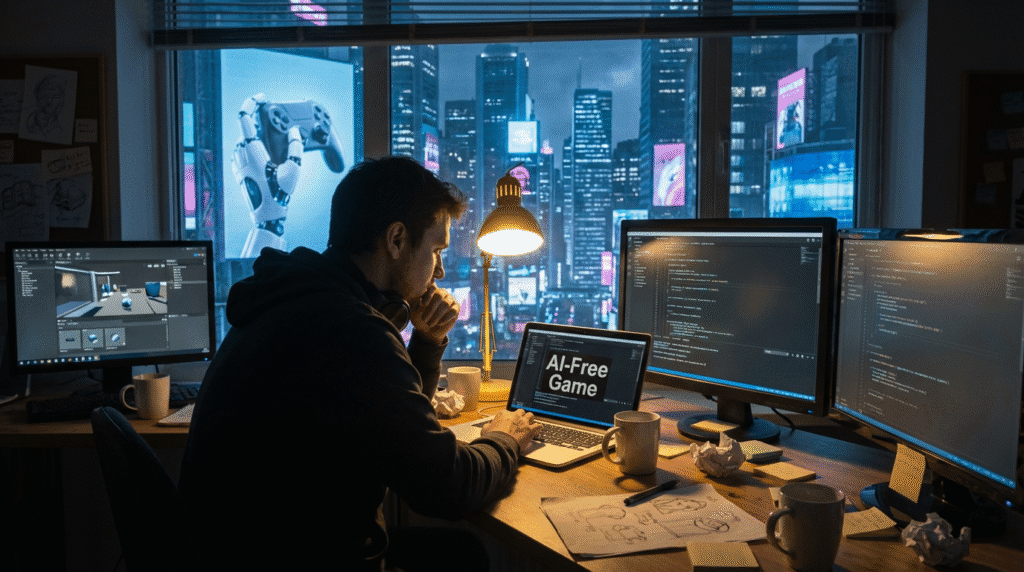
What’s unfolding in the gaming industry is more than a technical debate about tools and efficiency. It’s a fundamental clash over what games are and should be. Should they optimize and streamline them for maximum profit? Or are they art forms that require human creativity, imperfection, and soul?
The indie developers leading this resistance believe passionately in the latter.They regard the flaws, the messy moments, and the creative compromises born of constraint not as problems for AI to fix, but as essential elements that make games meaningful. Every hand-drawn frame, every line of code typed by human fingers, every guitar played by a real hand none of these count as inefficiencies to automate away. They’re the heart of the medium.
As the industry continues its rapid evolution, this movement of AI-free developers represents something increasingly rare: a principled stand for craft over convenience, for artistry over automation, for the beautifully flawed human touch in an age of algorithmic perfection. Whether they can maintain this position remains uncertain, but they make their message clear: not every game company uses AI, and some never will.
Sources
- The Verge: Indie game developers have a new sales pitch: being ‘AI free’
- PC Gamer: ‘Every moment flawed and messy because we are, also’: Indie developer rallies against big studios’ increasingly flippant remarks about generative AI
- GamesHub: Indie Developers and Voice Actors Are Drawing a Line When it Comes to AI in Gaming