Wait, What Even Is Terafab?
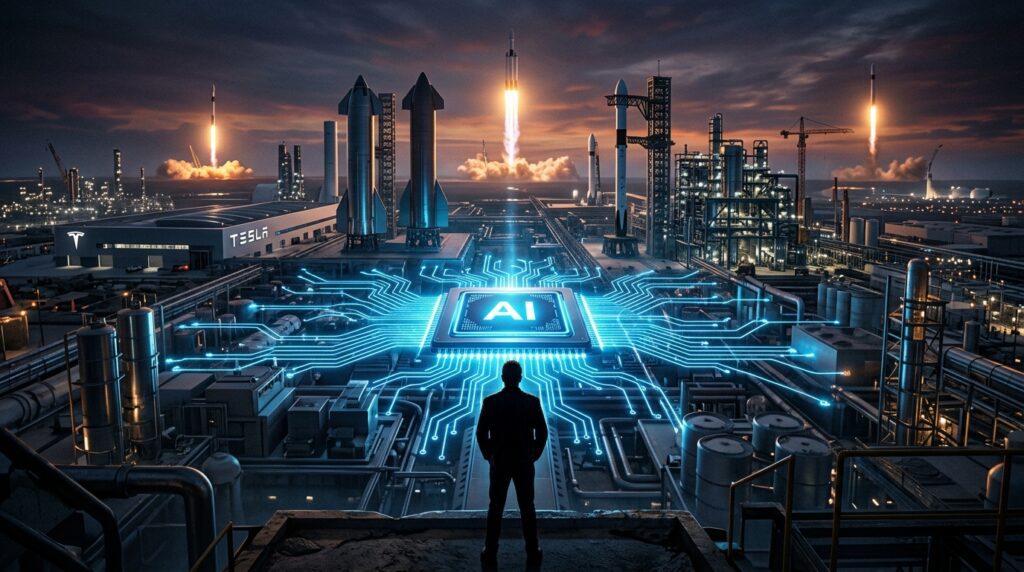
Let’s start at the beginning. Elon Musk has a problem. A big one.
His companies — Tesla, SpaceX, and xAI — are hungry for AI chips. Not just a little hungry. We’re talking ravenous. Musk needs chips to power self-driving robotaxis, humanoid robots called Optimus, and space-based data centers that he literally wants to launch into orbit. That’s a lot of silicon.
So what does Elon Musk do when the world can’t keep up with his demands? He decides to build his own chip factory. Of course he does.
Enter Terafab — a massive semiconductor complex planned for Austin, Texas. The goal? Produce one terawatt per year of AI computing power. That’s not a typo. One. Terawatt. Per. Year. The Terafab website puts it poetically: “Terafab will close the gap between today’s chip production and the future’s demand — a future among the stars.”
Analysts at Bernstein estimate the whole thing could cost up to $5 trillion — which, for context, is more than 70% of the entire yearly U.S. government budget. So yeah. This is not a small weekend project.
Intel Steps Into the Ring
Here’s where things get really interesting. On April 7, 2026, Intel made a surprise announcement: it’s joining Terafab.
Intel CEO Lip-Bu Tan and Elon Musk reportedly discussed the plans over the weekend. Then Intel went public with it, posting on X: “Intel is proud to partner with SpaceX, xAI and Tesla on the Terafab project to redefine semiconductor manufacturing technology.”
The chipmaker didn’t stop there. Intel added that its “ability to design, fabricate, and package ultra-high-performance chips at scale will help accelerate Terafab’s aim to produce 1 TW/year of compute to power future advances in AI and robotics.”
That’s a bold statement. And it’s a big deal — for both sides.
Read the full announcement coverage at The Verge.
Why Intel? And Why Now?
Okay, so why Intel specifically? Good question.
Building a chip fab from scratch is insanely hard. It takes billions of dollars, years of development, and a mountain of specialized expertise. Musk knows how to build rocket factories and car plants. But silicon? That’s a different beast entirely.
During an earnings call earlier this year, Musk sounded almost desperate: “Can someone else build these things? I mean, it’s very hard to build these things.”
That’s where Intel comes in. When it comes to designing, fabricating, and packaging advanced chips, only three players in the world can really do it at the cutting edge: TSMC, Samsung, and Intel Foundry. And of those three, Intel is arguably the most motivated to say yes.
Intel’s Foundry division has been struggling. It’s been desperately searching for major customers for its semiconductor plants. Without big clients, Intel is reportedly considering shutting down the Foundry division entirely — especially if its next-generation 14A process fails to attract external customers.
So for Intel, Terafab isn’t just a cool project. It could be a lifeline.
Heise Online put it bluntly: “Even if nothing comes of the construction, Intel could welcome Musk’s companies as customers in the future.”
The Robot Army Needs Fuel
Let’s zoom out for a second and talk about why Musk needs this much compute in the first place.
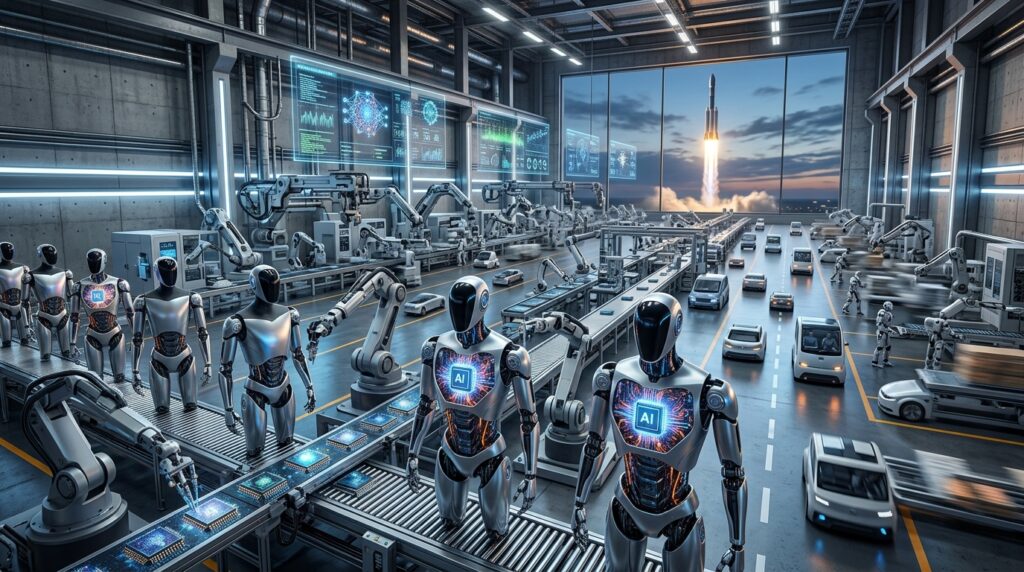
Tesla is building robotaxis. SpaceX (now merged with xAI) is building space-based data centers. And Musk’s humanoid robot, Optimus, needs AI brains to function. All of this requires an enormous, almost incomprehensible amount of chip power.
At Terafab’s unveiling last month, Musk told investors that existing semiconductor suppliers “simply could not make enough chips” to support his roadmap for autonomous vehicles and robots. That’s why he’s going vertical — bringing logic chips, memory, and advanced packaging all under one roof.
Think of it like this: instead of ordering pizza from a restaurant, Musk is building his own pizza farm, wheat mill, cheese factory, and delivery fleet. All in Texas.
Seeking Alpha reports that Intel will help “refactor silicon fab technology” for the project — essentially rethinking how chip factories are designed and operated from the ground up.
The Memory Problem Nobody’s Talking About
Here’s a wrinkle in the plan that doesn’t get enough attention.
Terafab doesn’t just want to make logic chips — the kind Intel specializes in. Musk also wants to manufacture memory chips (DRAM) in-house. And that’s a completely different manufacturing process.
For memory, you’d need to partner with the world’s memory leaders: Samsung, SK Hynix, or Micron. But here’s the catch — those companies are currently swimming in cash thanks to the ongoing memory boom. They’re not exactly desperate for a new customer.
So while Intel’s involvement solves a big piece of the puzzle, the memory side of Terafab remains an open question. It’s the elephant in the fab, so to speak.
Intel’s Stock Loved the News
Markets reacted fast. Intel shares jumped after the announcement. Investors clearly see this as a potential turning point for a company that’s been fighting an uphill battle for years.
And it makes sense. If Terafab actually gets built — and that’s still a big “if” — Intel Foundry becomes a core supplier to some of the most ambitious AI and robotics projects on the planet. That’s not just good for Intel’s bottom line. It repositions the company as a critical player in the AI hardware race.
Right now, Nvidia dominates AI chip supply. TSMC dominates manufacturing. Intel has been trying to carve out its own space. Terafab could be the project that finally gives Intel Foundry a reason to exist at scale.
SpaceX Is Going Public — And That Changes Everything
Now let’s talk about the bigger picture. Because Terafab doesn’t exist in a vacuum.
SpaceX is planning its initial public offering (IPO) later this year. Musk has confirmed it. Reports suggest SpaceX has confidentially filed for what could be a $1.7 trillion listing — one that potentially folds in xAI and X (formerly Twitter) into a single mega-entity. Some are calling it a “three X’s in one” vehicle spanning rocket launches, satellite broadband, and AI-driven social media.
That’s a staggering number. And it changes how investors think about everything connected to Musk — including Intel.
If SpaceX goes public at that valuation, it could drain liquidity from smaller tech stocks as institutions rotate into what would become the world’s largest AI-space platform. Intel, as a core Terafab partner, would essentially become a derivative play on Musk’s execution.
Crypto.news frames it well: “Intel’s pledge to ‘refactor’ silicon fab technology for Terafab underscores how vertically integrated AI hardware may crowd capital away from legacy tech and into Musk-linked and crypto-exposed assets.”
Could Crypto Get Pulled Into This?
Speaking of crypto — yes, even Bitcoin and Dogecoin are part of this conversation now.
Here’s the logic: a consolidated SpaceX–X–xAI entity with massive AI and satellite capacity would be perfectly positioned to push censorship-resistant payments and on-chain functionality globally. X is already experimenting with crypto tipping and financial features through X Money. If that expands, large-cap crypto assets like Bitcoin and Ethereum could increasingly trade as macro proxies on Musk’s execution.
It’s a wild idea. But then again, so was building a chip factory that costs $5 trillion.
The Terafab build-out will also intensify competition for high-end GPUs and fabrication capacity — likely benefiting incumbent chip leaders while squeezing smaller AI startups that rely on third-party cloud providers. Capital is concentrating fast. And wherever Musk goes, markets follow.
The Bottom Line: This Is Either Genius or Madness (Maybe Both)
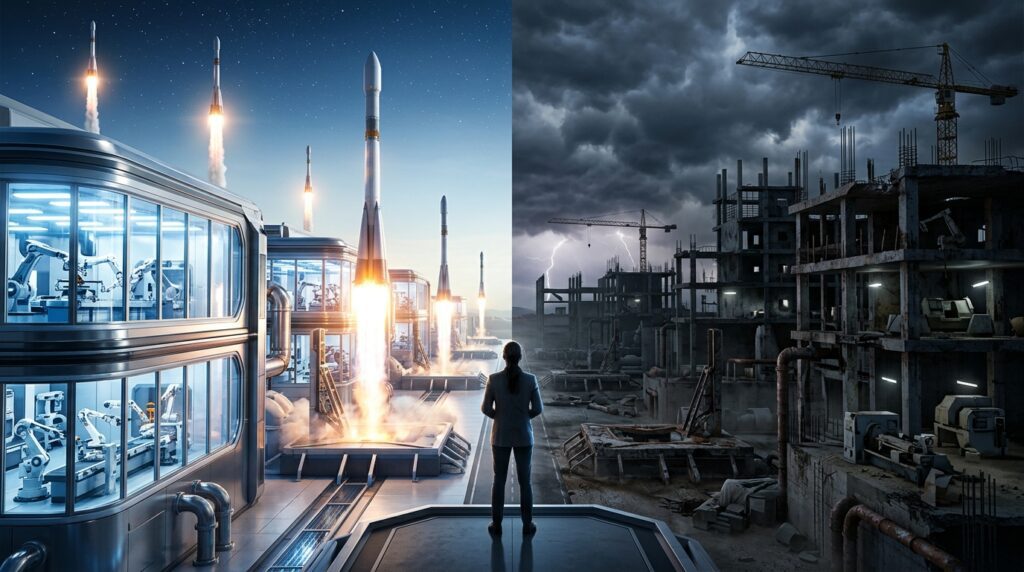
Let’s be real. Terafab is an audacious bet. Building a semiconductor complex capable of producing one terawatt per year of AI compute has never been done before. The costs are astronomical. The technical challenges are enormous. And the timeline is… optimistic, to put it kindly.
But here’s the thing: Musk has a track record of doing things people said were impossible. SpaceX landed reusable rockets when everyone said it couldn’t be done. Tesla scaled electric vehicles when the industry laughed. And now he’s building a chip factory that could reshape the entire AI hardware landscape.
Intel is betting on him. The markets are watching. And the rest of the tech world is holding its breath.
Whether Terafab becomes the most epic chip-building effort in history — as Musk himself has called it — or a cautionary tale about overreach, one thing is certain: the AI chip race just got a whole lot more interesting.
Sources
- The Verge — “Intel will help build Elon Musk’s Terafab AI chip factory”
- Heise Online — “Intel to join Elon Musk’s Terafab”
- Seeking Alpha — “Intel joins SpaceX, Tesla and xAI in Terafab chip production project”
- Crypto.news — “Musk’s Terafab gambit with Intel sharpens focus on looming SpaceX–X public listing”