The Billion-Dollar Build-Out Nobody Saw Coming — Until Now
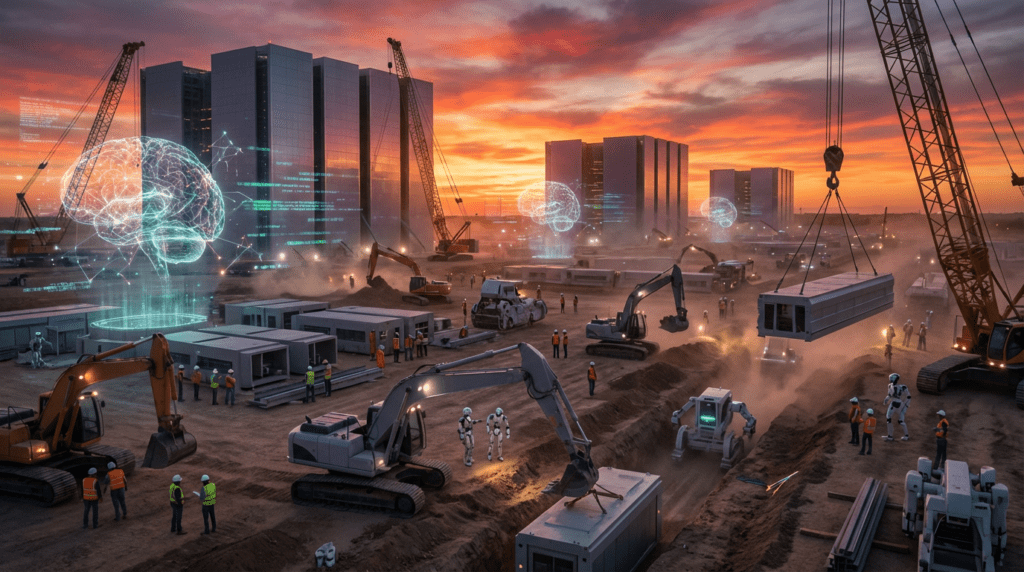
Picture this. It’s 2026. Tech giants are throwing money at AI like it’s going out of style. Alphabet, Amazon, Meta, and Microsoft have collectively committed over $650 billion this year alone to build out AI infrastructure. The ambition is sky-high. The hype is real. And somewhere in the red dirt of Abilene, Texas, more than 6,000 workers are buzzing around on electric buggies, day and night, racing to finish one of the most ambitious data center campuses on the planet.
It’s the kind of scene that makes you think: America is winning the AI race. Full stop.
Except — not quite. Because right now, the biggest threat to America’s AI dominance isn’t a rival algorithm or a smarter chip. It’s a transformer. The electrical kind. And there aren’t enough of them.
Half the Plan Is Already Falling Apart
Here’s the number that should make every tech CEO sweat: nearly half of all U.S. data centers planned for 2026 are expected to be delayed or outright canceled. That’s not a rounding error. That’s a crisis.
According to market intelligence firm Sightline Climate, the U.S. was supposed to bring 12 gigawatts of new data center capacity online this year. That’s a staggering amount of power — enough to light up millions of homes. But only about a third of that capacity is currently under active construction. The rest? Stuck. Waiting. Delayed.
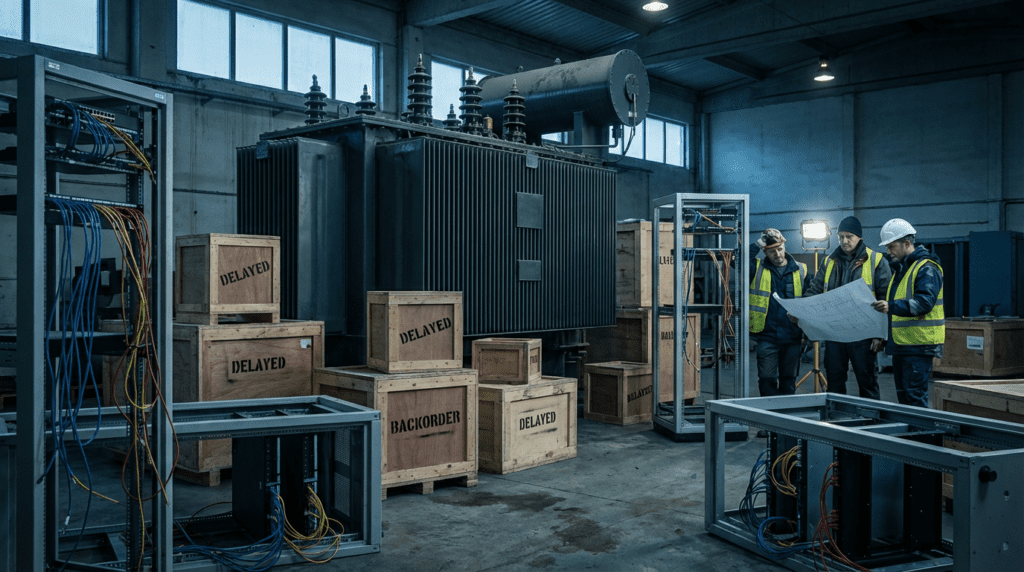
The culprit isn’t a lack of money. It isn’t a shortage of brilliant engineers. It’s something far more boring — and far more consequential. The country simply can’t get its hands on enough transformers, switchgear, and batteries to keep the lights on.
These aren’t glamorous components. Nobody’s writing breathless op-eds about switchgear. But without them, even the most cutting-edge GPU cluster is just an expensive paperweight.
The Quiet Chokehold Nobody Talked About
So how did we get here? Let’s break it down.
Electrical infrastructure — transformers, switchgear, power regulators — makes up less than 10% of a data center’s total cost. Small slice of the pie, right? Wrong. Because that small slice is the one that determines whether the whole project moves forward or grinds to a halt.
As Bloomberg reports, before 2020, getting a high-power transformer delivered took about 24 to 30 months. That was already a long wait. Today? You’re looking at up to five years. Five years. For a single piece of equipment.
Now consider that most AI data center deployment cycles run under 18 months. You do the math. The timeline doesn’t work. It simply doesn’t add up.
“Even a small delay in getting any of the components you need to construct your well can stall your entire project,” said Andrew Likens, head of energy and infrastructure at Crusoe. “It’s a really wild puzzle right now.”
Wild puzzle is an understatement.
Why Can’t America Just Make Its Own?
Great question. And the answer is uncomfortable.
The U.S. has spent the better part of a decade pushing reshoring initiatives — policies designed to bring manufacturing back home and reduce dependence on foreign suppliers. Companies like GE Vernova and Siemens Energy have poured investment into expanding domestic production capacity. The effort is real. The intent is genuine.
But it hasn’t worked fast enough. Not even close.
According to Tom’s Hardware, despite a decade of reshoring initiatives, U.S. manufacturing capacity for electrical equipment remains woefully insufficient. The demand surge from AI has simply outpaced every effort to catch up. And it’s not just AI competing for these components — electric vehicles, heat pumps, and grid modernization projects are all fighting for the same limited supply.
“There’s not enough domestic capacity to go around, so people are pretty much forced to go to the export market,” said Benjamin Boucher, senior analyst at Wood Mackenzie.
So where does America turn? The answer, awkwardly, is China.
The China Paradox: Enemy, Supplier, Lifeline
Here’s where the story gets genuinely ironic — and a little uncomfortable for Washington.
The same country that U.S. policymakers have spent years trying to “decouple” from? It turns out America desperately needs it to build the very AI infrastructure meant to compete against it.
Bloomberg data shows that imports of high-power transformers from China surged from fewer than 1,500 units in 2022 to more than 8,000 units in 2025 through October alone. That’s not a trickle. That’s a flood. And it’s not just transformers — China accounts for over 40% of U.S. battery imports, while its share in certain transformer and switchgear categories hovers near 30%.
Total U.S. imports rose $14 billion in February 2026. About half of that increase? AI-related equipment. The numbers tell a story that no amount of political rhetoric can paper over.
China controls virtually the entire supply chain for electrical equipment — from raw material extraction to finished product manufacturing. As the Global Times editorial pointedly noted, this isn’t an accident. It reflects China’s comprehensive advantages across the entire industrial chain — a complete ecosystem that few other nations can rival.
The irony is sharp. The U.S. has imposed tariffs, launched security reviews, and pushed “small yard, high fences” policies to keep Chinese tech out of critical supply chains. And yet, the builders of America’s most strategic AI infrastructure are quietly — and urgently — ordering parts from Chinese factories.
Tariffs Are Making It Worse
Let’s talk about the elephant in the room: tariffs.
President Trump has made AI dominance a centerpiece of his agenda. In December 2025, he declared, “There will be only one winner, and that will most likely be the US or China.” Bold words. But his administration’s aggressive tariff policies on Chinese imports are, according to multiple reports, actively making the data center crisis worse.
Ars Technica reported that Trump’s tariffs on Chinese imports are hindering most data center projects — the very projects his executive orders were meant to accelerate. In March 2026, Trump ordered tech companies to “build, bring, or buy” the power for their data centers. But as analysts noted, it doesn’t matter where the power comes from if there’s nothing to plug in.
Companies are caught in a bind. They’re willing to pay tariff premiums and absorb alleged national security risks just to get components from China on faster timelines. That’s how desperate the situation has become.
The Builders Are Getting Creative
To be fair, the industry isn’t just sitting on its hands. Builders are adapting — fast.
Some companies are ordering equipment well before projects receive final approval, betting on future demand to justify the early spend. Others are refurbishing old transformers salvaged from decommissioned power plants. Crusoe, for example, has leaned into domestic procurement and assembly to insulate itself from supply chain disruptions.
Canada, Mexico, and South Korea have stepped up as alternative suppliers of high-power transformers. The global sourcing map is expanding. But none of these workarounds fully close the gap. They’re patches on a structural problem.
As Firstpost noted, developers who secured equipment early are progressing faster, while latecomers are scrambling amid tightening global inventories and evolving trade restrictions. Timing, in this race, is everything.
The Bigger Picture: Power Is the New Chip
Here’s the thing that often gets lost in all the AI hype. Everyone talks about chips. Nvidia. TSMC. The semiconductor race. And yes, chips matter enormously.
But the real bottleneck in 2026 isn’t silicon. It’s electricity. And the infrastructure to deliver it.
The Japan Times put it well: America’s AI build-out hinges on Chinese electrical parts. The U.S. may lead in advanced chip design and cutting-edge large language models. But without a robust energy infrastructure to support them, those advantages struggle to translate into real-world computing capacity.
The AI industry chain is deeply global. It spans chip design, equipment production, computing infrastructure, power supply, and application deployment. Every link matters. And right now, the power link is the weakest one.
As the Global Times editorial argued — and it’s worth acknowledging even from a geopolitical rival — “the ultimate limit of computing power is electricity, while the ultimate limit of electricity is energy strategy.” That’s not propaganda. That’s physics.
What Happens Next?
The path forward isn’t simple. But it’s not a mystery either.
The U.S. needs to dramatically accelerate domestic manufacturing of electrical equipment. That means sustained investment, streamlined permitting, and long-term policy consistency — not just executive orders that shift with the political winds.
It also means having an honest conversation about supply chains. Decoupling from China sounds great in a speech. But in practice, the global AI supply chain is deeply interwoven. Transformers, switchgear, batteries — these aren’t things you rebuild overnight. They require years of industrial development.
Meanwhile, the clock is ticking. AI deployment cycles are under 18 months. Transformer lead times are up to five years. That gap doesn’t close itself.
The OpenAI campus in Abilene, Texas — those eight sprawling buildings consuming 1.2 gigawatts of power — represents what’s possible when everything goes right. But for every Abilene, there are dozens of projects stuck in limbo, waiting for a transformer that’s still sitting in a factory queue.
America’s AI ambitions are real. The money is real. The talent is real. But the infrastructure gap is also very real — and it’s not going away until policymakers, builders, and supply chain strategists start treating electrical equipment with the same urgency they give to chips.
The AI race isn’t just won in the lab. It’s won in the supply chain. And right now, that’s where America is losing ground.
Sources
- Bloomberg — US AI Data Center Expansion Relies on Chinese Electrical Equipment Imports
- Bloomberg — US Data Center Boom Relies on Hard-to-Find Electrical Equipment
- Global Times — Who Is to Blame for the Repeated ‘Difficult Birth’ of US AI Data Centers?
- Tom’s Hardware — Half of Planned US Data Center Builds Have Been Delayed or Canceled
- Firstpost — US AI Data Centre Buildout Slows Sharply as Equipment Shortages Bite
- The Japan Times — America’s AI Build-Out Hinges on Chinese Electrical Parts
- Semafor — US Data Center Buildout Slows on Supply Hurdles
- The Outpost AI — AI Build-Out Faces Electrical Parts Shortage