The factory floor is getting a serious upgrade. And it’s not just about robots or automation anymore it’s about intelligence.
While most people think of AI as something that writes emails or generates images, companies like PepsiCo are using it to solve problems that actually cost millions when they go wrong. We’re talking about factory layouts, production lines, and the kind of physical operations where mistakes aren’t just inconvenient they’re expensive.
This isn’t your typical AI hype story. This is about real-world applications that are changing how some of the world’s biggest manufacturers design, build, and operate their facilities. And it’s happening right now.
PepsiCo’s Bold Bet on Digital Twins
Here’s the thing about making changes to a factory: it’s slow, risky, and incredibly costly if you get it wrong. Even small adjustments like reconfiguring a packaging line or upgrading equipment can take weeks or months to validate. Every delay ripples through supply chains and affects product availability.
PepsiCo found a way around this bottleneck. They’re using AI-powered digital twins.
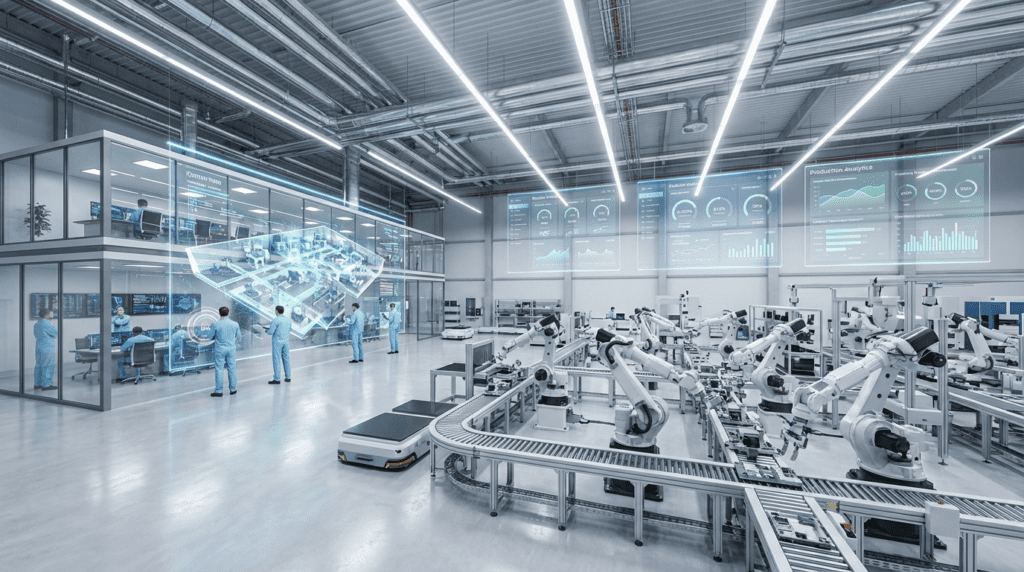
Digital twins are virtual replicas of physical systems. Think of them as incredibly detailed simulations that mirror real-world factories down to every machine, conveyor belt, and operator pathway. When you combine these digital models with AI, something remarkable happens: you can test thousands of scenarios that would be impractical or prohibitively expensive to try in real life.
The goal isn’t automation for its own sake. It’s about cycle time. Instead of spending months validating changes through physical trials, teams can test configurations virtually, spot problems early, and move faster when updates are needed.
According to AI News, PepsiCo’s early pilots showed faster validation times and signs of throughput improvement at initial sites. While the company hasn’t published detailed metrics yet, the pattern is clear: AI is being used to compress decision cycles in physical operations, not to replace workers or remove human judgment.
The Siemens-NVIDIA Partnership: Building an Industrial AI Operating System
If PepsiCo’s work represents the practical application, then the Siemens-NVIDIA partnership represents the infrastructure making it all possible.
At CES 2026, Siemens and NVIDIA announced an expanded partnership that’s nothing short of ambitious. They’re not just building AI tools they’re creating what they call an “Industrial AI operating system.”
Roland Busch, President and CEO of Siemens, put it this way: “Together, we are building the Industrial AI operating system redefining how the physical world is designed, built, and operated to scale AI and make a real-world impact.”
Jensen Huang, founder and CEO of NVIDIA, went even further. He described AI as transforming “digital twins from passive simulations into the active intelligence of the physical world.”
Those aren’t just marketing buzzwords. They signal a fundamental shift in how AI fits into manufacturing. We’re moving from AI as an enhancement to AI as an operating system a coordination layer that senses operational states, reasons about constraints, and orchestrates actions across design, manufacturing, and supply chain systems.
Three Major AI Initiatives from Siemens
According to Automation World, Siemens unveiled three significant moves:
1. Physical AI Deployment with NVIDIA
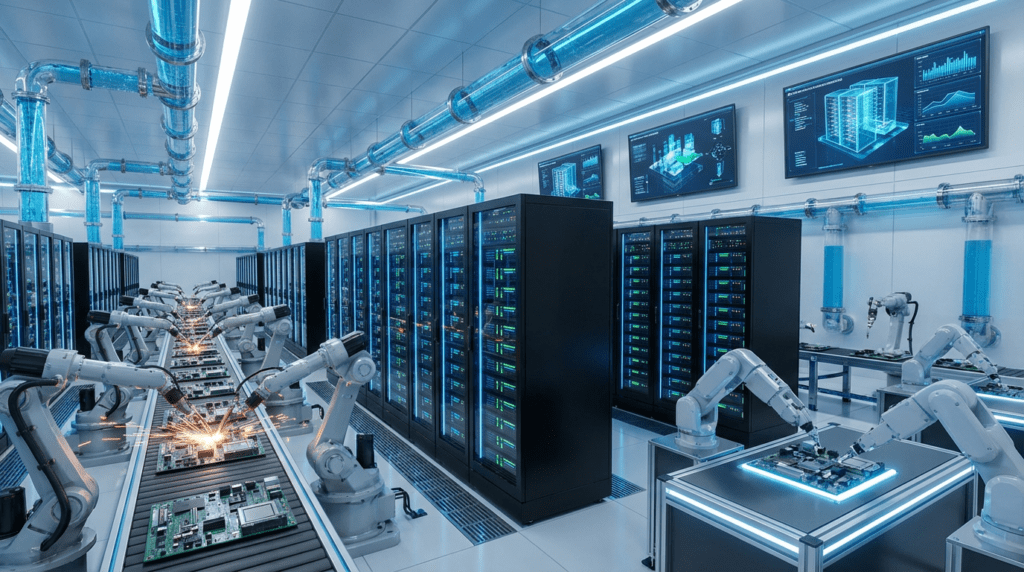
The companies plan to build what they claim will be the world’s first fully AI-driven, adaptive manufacturing sites. NVIDIA provides AI infrastructure, simulation libraries, models, frameworks, and blueprints. Siemens commits hundreds of industrial AI experts and relevant hardware and software.
The project begins this year at the Siemens Electronics Factory in Erlangen, Germany. This factory will serve as the first blueprint, focusing on balancing next-generation, high-density computing demands for power, cooling, and automation.
Several major companies are already evaluating these capabilities, including Foxconn, HD Hyundai, Kion Group, and you guessed it PepsiCo.
2. Digital Twin Composer Release
This is where things get really interesting. Siemens’ new Digital Twin Composer software builds industrial metaverse environments at scale. It allows manufacturers to combine 2D and 3D digital twin data with physical real-time information in a managed, secure, photorealistic visual scene.
The technology enables companies to visualize, interact with, and iterate on any product, process, or factory in its real-world context before physical design or construction. It’s like having a crystal ball for your factory except this one actually works.
3. Nine New AI-Powered Copilots
Siemens deployed nine AI-powered copilots across its Teamcenter, Polarion, and Opcenter software platforms. These copilots streamline product data navigation, reduce errors, accelerate time to market, and automate compliance to ensure faster regulatory approvals and lower risk.
PepsiCo’s Real-World Results
Let’s get specific about what PepsiCo is achieving with this technology.
The company is using Digital Twin Composer in select U.S. manufacturing and warehouse facilities. They’re converting these facilities into high-fidelity 3D digital twins that simulate plant operations and the end-to-end supply chain to establish a performance baseline.
Here’s what makes this impressive: within weeks of using Digital Twin Composer, teams optimized and validated new configurations to boost capacity and throughput. PepsiCo now has a unified, real-time view of operations with the flexibility to integrate AI-driven capabilities over time.
The results speak for themselves:
- PepsiCo can recreate every machine, conveyor, pallet route, and operator path with physics-level accuracy
- AI agents can simulate, test, and refine system changes
- The system identifies up to 90% of potential issues before any physical modifications occur
- Initial deployment delivered a 20% increase in throughput
- The approach is driving faster design cycles and nearly 100% design validation
- Capital expenditure has been reduced by 10-15% by uncovering hidden capacity and validating investments virtually
That last point is crucial. We’re not just talking about efficiency gains we’re talking about millions of dollars in capital savings.
Why This Matters Beyond PepsiCo
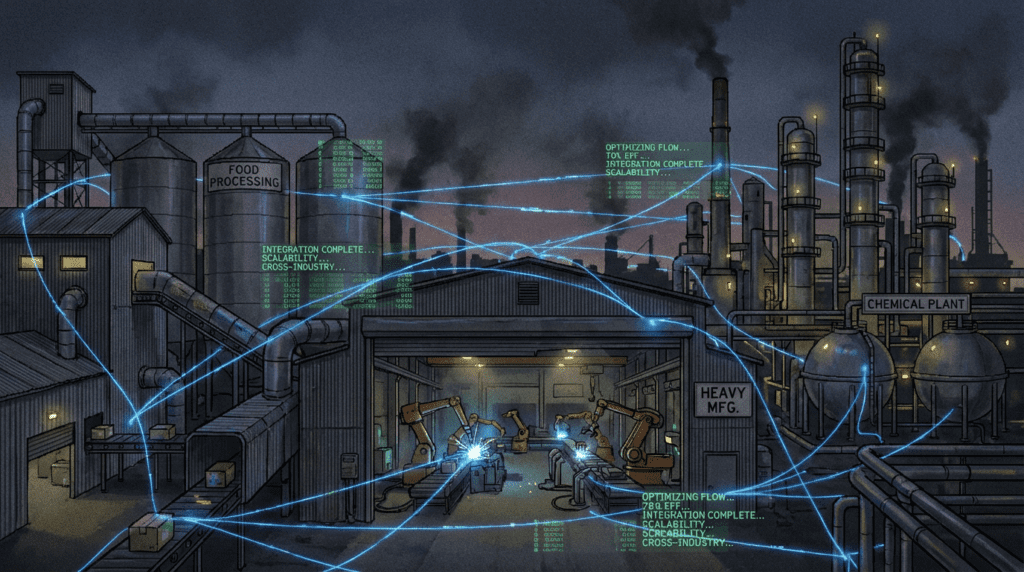
PepsiCo’s digital-twin work won’t be unique for long. Large manufacturers across food, chemicals, and industrial goods face similar planning constraints and cost pressures. Many already use simulation software. AI just adds speed and scale to those models.
But there’s something deeper happening here. As Engineering.com points out, this represents a shift in where decisions are made and who ultimately bears the consequences.
From Engineering Tools to Operational Control
Engineering software has traditionally been a collection of specialized systems. CAD manages geometry. CAE assesses performance. PLM handles product innovation. ERP manages finance. MES supervises production. SCADA monitors control systems.
Engineers act as intermediaries, interpreting data and making decisions together with other business functions.
An industrial AI operating system changes this dynamic. It’s not just a feature within tools it’s a coordination layer across systems. It senses operational states, reasons about constraints, and orchestrates actions across design, manufacturing, and supply chain systems.
When AI operates at this level, it affects decisions that were once human-driven: when to reconfigure a line, how to handle a supply disruption, which trade-offs to make between cost, yield, energy, and time.
The New Role of Operations Engineers
This doesn’t mean engineers are being replaced. Far from it. But their role is changing significantly.
Currently, MES and planning systems follow pre-defined logic, with exceptions escalated to humans. Engineers analyze, decide, and intervene. In an AI-enabled environment, the system continuously adapts itself. Schedules are re-optimized. Maintenance windows shift. Production flows are rerouted.
Engineers increasingly set decision boundaries and governance rules rather than handle individual actions. The key questions become:
- What is the AI allowed to optimize?
- Which constraints are non-negotiable?
- When must human judgment and approval be required?
These are engineering decisions, not IT ones. They determine whether AI-driven operations are resilient or dangerously opaque.
The Data Foundation Challenge
Here’s something that doesn’t get talked about enough: AI is only as good as the data feeding it.
Across all these AI initiatives, one key constraint emerges: data discipline. AI operating systems improve the foundations on which they’re built. Inconsistent bills of materials, poor change traceability, fragmented operational data, and unclear ownership of “the truth” will limit AI’s value long before you hit compute limits.
For engineers, this shifts data governance from an IT hygiene issue to an operational necessity. If AI is going to lead operations, engineering data must be consistent, contextualized, and trusted across all systems.
This is harder than it sounds. Many manufacturers have decades of legacy systems, inconsistent data standards, and siloed information. Getting this right requires cross-team coordination and deep knowledge of physical systems. The payoff comes from repeated use, not one-off wins.
Why This Approach Works: Operations Engineering, Not Office Productivity
PepsiCo’s approach highlights a quieter shift in how AI programs are being justified inside large firms. The value is tied to operational outcomes time saved, fewer disruptions, better planning rather than general claims about productivity.
That distinction matters. Many enterprise AI efforts stall because they struggle to connect usage with measurable impact. Tools get deployed, but workflows stay the same.
Digital twins change that dynamic because they sit directly inside planning and engineering processes. If a simulated change cuts weeks off a factory upgrade, the benefit is visible. If it reduces downtime risk, operations teams can measure that over time.
This focus on process change, rather than tools, mirrors what’s happening in other sectors. In healthcare, for example, Amazon is testing an AI assistant inside its One Medical app that uses patient history to reduce repetitive intake and support care interactions. The assistant is embedded in the care workflow, not offered as a standalone feature.
Both cases point to the same lesson: AI adoption moves faster when it fits into how work already gets done, instead of asking teams to invent new habits.
Supply Chains Stop Running on Fixed Plans
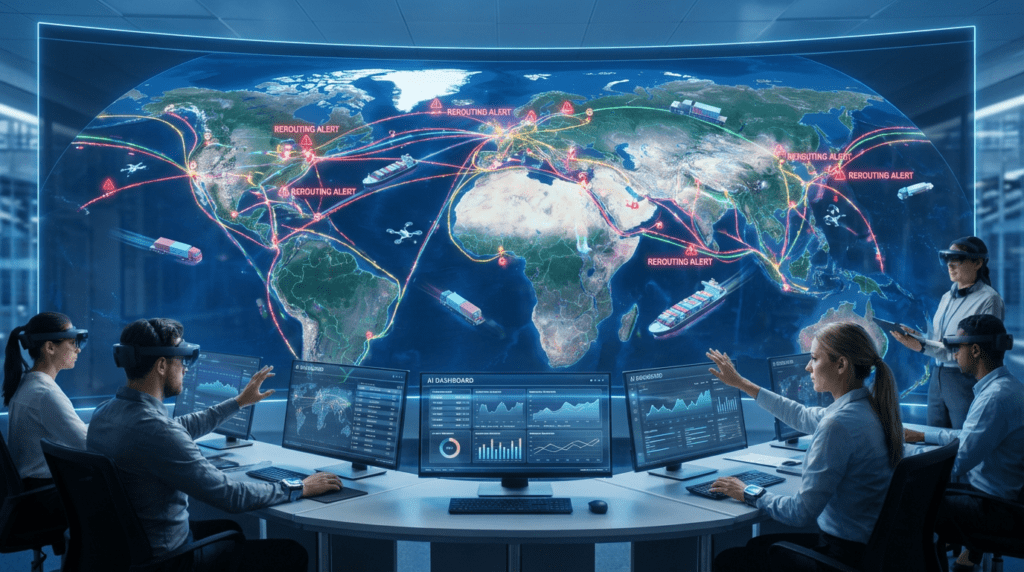
Another implication of AI-driven orchestration is the reduction of static planning. Traditional supply chains depend on fixed plans with periodic updates. An AI operating system allows for continuous adjustments based on real-time signals.
For supply chain, industrialization, and manufacturing engineers, this means managing flow amid uncertainty rather than strict adherence to plans. Trade-offs among cost, service, risk, and resilience become more flexible rather than fixed.
This is particularly relevant in today’s volatile global environment. Supply chain disruptions have become the norm, not the exception. Having systems that can adapt in real-time isn’t just nice to have it’s essential for competitiveness.
The Accountability Question
Here’s a common myth about AI-driven operations: that responsibility shifts to the algorithm. In reality, the opposite is true.
When AI suggests a schedule change that impacts yield or reroutes production in a regulated setting, someone still needs to explain the decision, verify compliance, and defend the outcome. That responsibility clearly falls on engineers especially those in quality, compliance, and validation roles.
As AI approaches implementation, explainability, traceability, and auditability aren’t just “nice to have” anymore. They become crucial operational requirements. Without them, AI systems will be limited to low-risk optimization scenarios.
This is why the Siemens-NVIDIA partnership emphasizes not just performance but also governance, security, and compliance. These aren’t afterthoughts they’re fundamental to making industrial AI work at scale.
What This Means for Other Enterprises
If you’re a manufacturing leader, here’s what you should take away from PepsiCo’s experience:
First, the center of gravity is shifting away from broad, generic AI tools toward focused systems tied to specific decisions. Don’t chase AI for AI’s sake. Look for friction points where planning delays, validation cycles, or operational risk slow your business down.
Second, success depends less on model quality and more on data quality, process ownership, and governance. Get your data house in order before you worry about which AI model to use.
Third, this kind of AI work tends to stay out of the spotlight. It doesn’t generate flashy demos, but it can reshape how you plan capital spending and manage risk. Don’t underestimate the value of unglamorous but effective applications.
Fourth, building and maintaining accurate digital twins takes time, cross-team coordination, and deep knowledge of physical systems. This isn’t a quick win. It’s a strategic investment that pays off through repeated use.
The Quiet Revolution on the Factory Floor
In AI coverage, it’s easy to focus on new models, agents, or interfaces. Stories like PepsiCo’s point in a different direction. They show AI being treated as infrastructure something that sits underneath daily decisions and gradually changes how work flows through an organization.
The factory floor may be one of the most practical testing grounds for AI today not because it’s trendy, but because the impact is easier to see when time and mistakes have a clear cost.
As AI Market Trends notes, PepsiCo’s digital-twin pilots suggest that manufacturing may be where AI proves its real-world value most convincingly. The benefits are tangible, measurable, and directly tied to business outcomes.
Looking Ahead: Is Manufacturing Ready?
The question posed by Engineering.com is worth considering: Is manufacturing ready for NVIDIA and Siemens’ AI operating system?
The answer isn’t simple. The technology is clearly advancing rapidly. Companies like PepsiCo are proving that real-world applications can deliver significant value. The infrastructure from Siemens and NVIDIA is becoming more sophisticated and accessible.
But readiness isn’t just about technology. It’s about organizational change, data discipline, process redesign, and cultural adaptation. It’s about engineers learning to work alongside AI systems, setting appropriate boundaries, and maintaining accountability.
The real question isn’t whether AI will become part of the operational command chain it already is. The question is whether engineering organizations are prepared to manage it: to set constraints, verify outcomes, and intervene when optimization conflicts with safety, compliance, ethics, or long-term system health.
Faster models or bigger GPUs alone won’t solve that challenge. It will be up to engineers to solve or not.
The Bottom Line
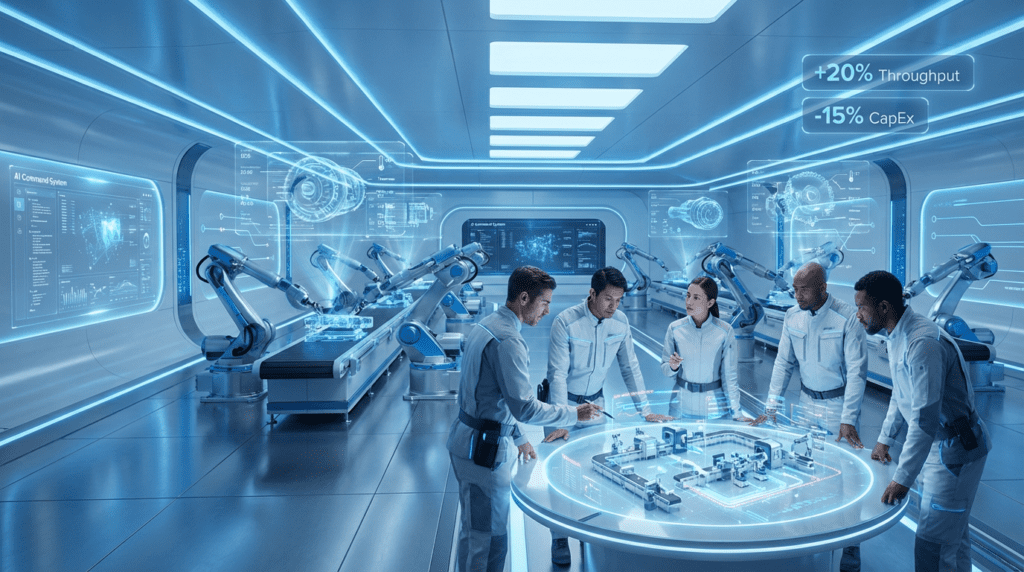
PepsiCo’s work with AI and digital twins represents more than just a technology upgrade. It’s a fundamental rethinking of how factories are designed, updated, and operated.
By using AI to compress decision cycles, validate changes virtually, and optimize operations in real-time, PepsiCo is achieving results that would have been impossible just a few years ago: 20% throughput increases, 90% issue identification before physical changes, 10-15% capital expenditure reductions, and nearly 100% design validation.
The Siemens-NVIDIA partnership is building the infrastructure to make this kind of transformation accessible to more manufacturers. Their industrial AI operating system, Digital Twin Composer, and AI-powered copilots are creating a new paradigm for how the physical world is designed, built, and operated.
This isn’t the future of manufacturing. It’s the present. And it’s happening on factory floors around the world, one digital twin at a time.
For manufacturers willing to invest in data quality, process change, and organizational adaptation, the opportunity is enormous. For those who wait, the competitive gap may soon become insurmountable.
The quiet revolution on the factory floor is underway. The question is: are you ready to join it?
Sources
- AI News – PepsiCo is using AI to rethink how factories are designed and updated
- Automation World – Siemens Unveils Three Major AI Initiatives
- Engineering.com – Is manufacturing ready for NVIDIA and Siemens’ AI operating system
- AI Market Trends – PepsiCo is using AI to rethink how factories are designed and updated