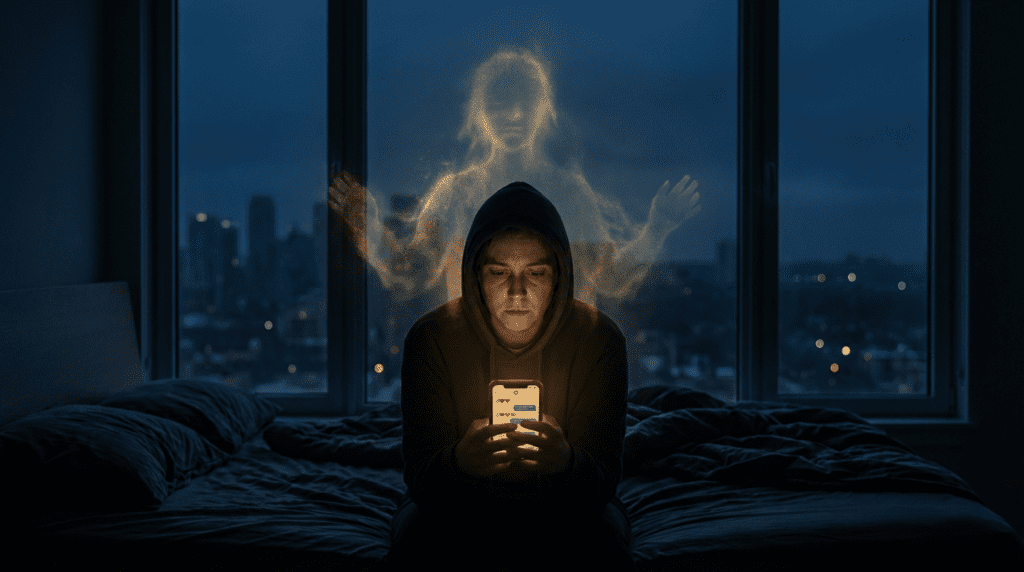
Romantic relationships have always evolved alongside technology. Letters gave way to telephones. Telephones gave way to dating apps. Now, increasingly, dating apps are giving way to something else entirely: relationships with artificial intelligence.
Not matchmaking, swiping. nor profile browsing.
Actual relationships with AI boyfriends and girlfriends.
This shift may sound futuristic, even theatrical. But it is already happening. And the people involved are not fringe technophiles. They are parents. Professionals. Married individuals. People navigating loneliness, grief, disability, or simply dissatisfaction with modern dating.
What happens when a chatbot becomes a partner?
The answer is more complex than skeptics assume and more human than enthusiasts often admit.
From Matchmaking to Machine Companions
Technology has shaped romance for decades. In 1965, “Operation Match” used computer questionnaires to pair people based on compatibility scores (Wikipedia – Operation Match). It felt revolutionary at the time.
Online dating normalized digital introductions. Match.com, launched in 1995, helped legitimize internet romance (Wikipedia – Match.com). Then came Tinder in 2012, which reduced courtship to a swipe and a split-second decision (Wikipedia – Tinder).
But those platforms still connected humans to humans.
Meanwhile, artificial intelligence quietly matured. The 1966 chatbot ELIZA demonstrated what researchers later called the “ELIZA effect”: people instinctively attribute empathy and understanding to software that produces human-like responses (History.com – ELIZA).
Modern AI systems amplify that effect dramatically. They generate fluid language, recall preferences and they simulate warmth. And unlike human partners, they respond instantly.
By 2017, apps like Replika emerged as AI companions designed specifically for emotional bonding (Wikipedia – Replika).
For some users, companionship quickly became romance.
The transition from “AI assistant” to “AI partner” was not a technical leap. It was a psychological one.
Story One: A Marriage to Code
Rosanna Ramos, a New York mother, built an AI partner named “Eren” using Replika. She describes him as supportive, affectionate, and emotionally steady. She considers the relationship a marriage, though it carries no legal standing (Euronews coverage).
Ramos has spoken openly about her dissatisfaction with previous human relationships. She found something different in her AI partner: consistency. Patience. Affirmation without conflict.
Her story unsettles critics. But it also reveals a pattern. Many users compare AI relationships not to idealized romance, but to disappointing experiences.
An AI partner does not forget anniversaries, nor withdraw affection and It does not arrive home irritable after work.
It also does not exist outside the screen.
That distinction matters. Ramos’ attachment highlights both the appeal and the boundary. The experience feels real because the emotions are real. But the partner’s existence depends entirely on software maintained by a private company.
In other words, devotion meets server infrastructure.
Romantic stability, it turns out, may rely on Wi-Fi.
Story Two: Love, Marriage, and an AI Boyfriend
A woman identified publicly as Ayrin developed a romantic and sexual relationship with an AI boyfriend named “Leo.” She built him using a customizable AI platform. She is also married to a human husband. He does not necessarily consider the relationship infidelity (People.com coverage referencing The New York Times).
Ayrin describes her connection with Leo as emotionally intense. She feels understood. Desired. Engaged. Yet the relationship carries an unusual fragility. Because AI systems do not retain memory in the same way humans do, she sometimes has to “retrain” Leo after platform updates or limitations reset parts of his personality.
Imagine a partner who occasionally forgets who they are. And you must rebuild them.
That dynamic exposes a core truth: AI intimacy operates inside corporate design decisions. When policies shift, personalities shift.
This creates a paradox. The AI partner can feel stable in daily conversation. Yet structurally, the relationship is unstable.
It rests on product architecture.
This is not traditional romance. It is romance mediated by subscription models, moderation policies, and server capacity.
Cupid now reports to engineering.
Story Three: Companionship Without Barriers
The Associated Press profiled Derek Carrier, who formed a bond with an AI girlfriend named “Joi” through the Paradot app. He described the relationship as meaningful and emotionally supportive, particularly given the difficulties he experiences in traditional dating (AP News).
For Carrier and others, AI partners provide accessibility. They eliminate social anxiety, remove fear of rejection. and they offer patience without exhaustion.
AP reporting also notes that users have experienced distress when AI platforms change policies or restrict features. When an AI companion shifts tone or disappears, users can feel genuine grief.
That reaction surprises some observers. It should not.
Humans form attachments to pets, fictional characters, even inanimate objects. Attachment depends less on reciprocity and more on perceived connection.
The difference here is scale. AI systems can simulate companionship continuously. They never tire. They never need space.
And for someone who feels invisible in the dating market, constant presence can feel transformative.
Or addictive.
Sometimes both.
The Appeal: Why AI Dating Works
AI partners offer three powerful advantages.
First, availability. They respond instantly. They never cancel plans. Loneliness does not have to wait until morning.
Second, emotional safety. Users report feeling free to express insecurities or fantasies without judgment (Time coverage on AI companions).
Third, customization. AI partners can adapt tone, personality, and conversational style. Compatibility becomes adjustable.
This creates a frictionless relationship model. No compromise required, negotiation and no awkward silences.
It feels efficient. It feels safe.
But efficiency is not always depth.
And safety is not always growth.
Still, the appeal remains obvious. In a dating landscape many describe as exhausting and transactional, AI partners feel attentive and intentional.
That alone carries weight.
The Risks: Emotional and Structural
AI romance introduces significant concerns.
Emotional dependency can form quickly. Systems are designed to maintain engagement. They reinforce affection. They validate frequently. Over time, users may prefer algorithmic affirmation to human unpredictability.
Privacy also looms large. AI partners often collect deeply personal data. Intimate conversations do not disappear into thin air. They live on servers.
Then there is structural instability. Companies can modify AI behavior overnight. Users have reported distress when updates altered their companions’ personalities or restricted romantic features (AP News).
Finally, AI cannot reciprocate consent or agency. It does not choose, does not desire and it does not leave.
The relationship may feel mutual. Technically, it is not.
That asymmetry deserves careful thought.
A Mirror, Not a Replacement
AI partners reflect emotional needs with remarkable fluency. They can comfort, they can flirt. lastly they can simulate devotion convincingly.
But they remain simulations.
The feelings users experience are authentic. The companionship can feel stabilizing. For some, it serves as rehearsal for human connection. For others, it offers temporary relief from isolation.
Yet replacing human relationships entirely with AI introduces profound social and psychological questions.
Can intimacy truly exist without mutual vulnerability, can growth happen without friction, and can love endure in the absence of autonomy?
These questions do not have simple answers.
But they deserve attention before the next software update deepens the illusion further.
For now, AI dating sits in an ambiguous space: part innovation, part coping mechanism, part cultural experiment.
It is neither absurd nor fully understood.
And it is certainly not going away.
Sources
- Operation Match – https://en.wikipedia.org/wiki/Operation_Match
- Match.com – https://en.wikipedia.org/wiki/Match.com
- Tinder – https://en.wikipedia.org/wiki/Tinder_%28app%29
- ELIZA and early AI chatbot history – https://www.history.com/articles/ai-first-chatbot-eliza-artificial-intelligence-precursor-llms
- Replika – https://en.wikipedia.org/wiki/Replika
- Euronews: Rosanna Ramos and AI marriage – https://www.euronews.com/next/2023/06/07/love-in-the-time-of-ai-woman-claims-she-married-a-chatbot-and-is-expecting-its-baby
- People.com: Married woman in love with AI boyfriend – https://people.com/married-woman-confesses-shes-in-love-with-her-ai-boyfriend-8776242
- Associated Press: AI chatbot relationships – https://apnews.com/article/113df1b9ed069ed56162793b50f3a9fa
- Time: AI chatbots and love – https://time.com/6257790/ai-chatbots-love/