Groundbreaking research from Perplexity challenges conventional wisdom about AI agent adoption, showing that knowledge workers are deploying these tools for complex cognitive tasks rather than simple administrative chores
In what researchers are calling the first large-scale field study of artificial intelligence agent adoption, new data from Perplexity AI is fundamentally reshaping our understanding of how autonomous AI systems are being integrated into professional workflows. Contrary to the prevailing narrative that positions AI agents as “digital concierges” handling routine tasks like booking travel or scheduling meetings, the evidence reveals a far more sophisticated reality: over 57 percent of all AI agent activity focuses on cognitive work, with productivity and learning dominating the use case landscape.
The comprehensive study, conducted by researchers from Perplexity in partnership with Harvard University, analyzed hundreds of millions of anonymized user interactions with Comet, Perplexity’s AI-powered browser, and its integrated assistant between July and October 2025. The findings, published this week, provide unprecedented visibility into a technology sector that has long operated on assumptions rather than empirical data.
The Cognitive Work Revolution
The most striking revelation from the research challenges the fundamental premise of how tech companies have been marketing AI agents. While industry leaders have consistently promoted these tools as solutions for mundane administrative tasks, the data tells a different story. According to the study, 36 percent of all agentic queries fall under “Productivity & Workflow” tasks, while an additional 21 percent involve “Learning & Research” activities.
“This study provides the first empirical proof that we are moving toward a hybrid intelligence economy,” Perplexity stated in a blog post announcing the findings. “The dominance of cognitive tasks in our data suggests that AI agents are scaling human cognitive work. As these tools mature, we expect the ‘stickiness’ of productivity tasks to deepen.”
The researchers developed what they call a “hierarchical agentic taxonomy” to classify user intent across three levels: topic, subtopic, and task. This framework revealed that AI agents are being deployed for practical, high-value work rather than experimental or low-stakes activities. Specific examples from the study illustrate this pattern: a procurement professional used the assistant to scan customer case studies and identify relevant use cases before vendor engagement, while a finance worker delegated the filtering of stock options and analysis of investment information.
“A user might start by asking about a vacation spot, but once they use the agent to debug a Python script or summarize a financial report, they rarely go back,” the Perplexity research team noted.
Who’s Leading the AI Agent Revolution?
The demographic and professional profile of AI agent adopters reveals significant patterns that have major implications for enterprise planning. The study found that adoption is heavily concentrated among high-value knowledge workers in digital and knowledge-intensive sectors.
The Digital Technology cluster represents the largest share, accounting for 28 percent of adopters and 30 percent of queries. This is followed closely by academia, finance, marketing, and entrepreneurship. Collectively, these clusters account for over 70 percent of total adopters, suggesting that the individuals most likely to leverage agentic workflows are among the most expensive assets within an organization: software engineers, financial analysts, and market strategists.
At the country level, the research revealed strong correlations between AI agent adoption and socioeconomic factors. Users in nations with higher GDP per capita and educational attainment are far more likely to engage with agentic tools. The study demonstrates that adoption and usage intensity exhibited strong positive correlations with both GDP per capita and average years of education, confirming a link between socioeconomic factors and AI agent engagement.
The typical early adopter profile that emerged from the research is male, over 35 years old, works full-time in the technology industry, and currently uses or is interested in Perplexity. These users employ Comet for both personal and professional tasks, with researchers anticipating that the user base will evolve as the product matures and reaches a wider audience.
Notably, fields with the fewest AI agent users were those that “require interacting with the physical environment,” such as energy and agriculture, underscoring the current limitations of these tools in sectors beyond knowledge work.
The Stickiness Factor: From Experimentation to Integration
One of the most significant findings for IT leaders and business strategists is the “stickiness” of AI agents once they become integrated into workflows. The data shows that in the short term, users exhibit strong within-topic persistence. If a user engages an agent for a productivity task, their subsequent queries are highly likely to remain in that domain.
However, the user journey often evolves in a predictable pattern. New users frequently “test the waters” with low-stakes queries, such as asking for movie recommendations or general trivia. Over time, a transition occurs. The study notes that while users may enter via various use cases, query shares tend to migrate toward cognitively oriented domains like productivity, learning, and career development.
The ‘Productivity’ and ‘Workflow’ categories demonstrate the highest retention rates. This behavior implies that early pilot programs should anticipate a learning curve where usage matures from simple information retrieval to complex task delegation. Once a user employs an agent to debug code or summarize a financial report, they rarely revert to lower-value tasks.
The research measured sustained growth in both agent adoption and usage intensity, with the period following general availability accounting for 60 percent of all agent adopters and 50 percent of agentic queries throughout the study period. Notably, early Comet adopters generated a disproportionately large share of both adoption and queries compared to their overall user representation, with “power users” making nine times as many agentic queries as average users.
The Platform Battleground: Where AI Agents Operate
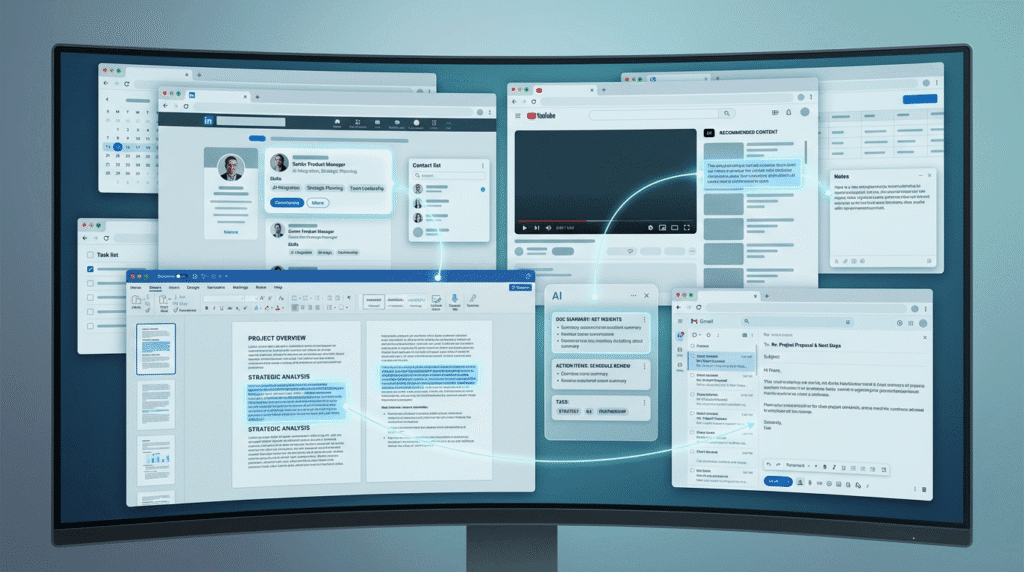
Understanding where AI agents operate is just as important as understanding what they do. The study tracked the specific websites and platforms where these AI agents are deployed, revealing a concentration of activity on staples of the modern enterprise stack.
Google Docs emerged as a primary environment for document and spreadsheet editing, accounting for 11.97 percent of all queries and dominated by educational and professional use. LinkedIn proved to be the dominant platform for career and networking tasks at 9.42 percent, while email services combined for 11.23 percent of activity. YouTube captured 7.03 percent of queries, heavily used for research and learning summaries.
The top 10 environments account for 63 percent of all queries, indicating heavy consolidation on major platforms. For the top five environments in professional networking, the concentration is even more pronounced, representing 96 percent of queries, primarily on LinkedIn.
For Chief Information Security Officers and compliance officers, this presents a new risk profile. AI agents are not just reading data; they are actively manipulating it within core enterprise applications. The study explicitly defines agentic queries as those involving “browser control” or actions on external applications via APIs or the Model Context Protocol. When an employee tasks an agent to “summarize these customer case studies,” the agent is interacting directly with proprietary data.
Personal vs. Professional: The Usage Context Divide
Contrary to the belief that agents are purely enterprise tools, the study found that personal use constitutes 55 percent of queries. Professional use follows at 30 percent, with educational contexts accounting for 16 percent.
However, the type of usage varies significantly by context. Personal queries are heavily skewed toward shopping for goods (15.6 percent of personal queries) and social media interaction. Professional use is dominated by document editing (13.3 percent) and professional networking (12.5 percent). Educational queries are almost entirely focused on courses, which account for 83.9 percent of educational queries.
Among finance professionals, over 47 percent of queries were related to productivity tasks. Around 43 percent of queries from students, on the other hand, were learning and research tasks, according to the Harvard study.
The top 10 tasks, out of a total of 90 identified in the taxonomy, represent 55 percent of all queries. Courses and shopping for goods comprise 22 percent of all agentic queries, while productivity and workflow combined with learning and research account for 57 percent.
Industry-Specific Adoption Patterns
The research revealed distinct adoption patterns across different industries, with implications for how AI agent technology might evolve in sector-specific applications. In healthcare, usage grew 61 percent in early 2025. The legal sector showed that 18 percent of AI-enhanced litigation tools rely on Claude (Anthropic’s competing AI agent), while 24 percent of major banks use AI agents in finance operations.
In retail and e-commerce, 38 percent of chatbots employ AI agent technology, while in real estate, the model powers one out of four listing analysis tools. Manufacturing quality control applications account for about 11 percent of usage.
Among shoppers using AI agents, the most active industries are travel and hospitality (18 percent), retail and consumer packaged goods (16 percent), IT services (14 percent), lifestyle and health (13 percent), food and beverage (13 percent), and home services (12 percent).
The Broader AI Agent Landscape
While the Perplexity study focused on Comet, the broader AI agent market is experiencing explosive growth across multiple platforms. The market for agentic AI is projected to grow from $8 billion in 2025 to $199 billion by 2034, according to industry analysts.
ChatGPT remains the dominant player, with 400 million weekly users in February 2025 and approximately 800 million weekly users by March 2025. An astonishing 92 percent of Fortune 100 companies use ChatGPT, and 79 percent of developers have adopted it. Google’s Gemini boasted about 400 million monthly active users in May 2025, while Microsoft’s Copilot holds approximately 14 percent market share in the US generative AI market.
However, some experts have questioned whether the surge in AI agent adoption has met initial expectations. Andrej Karpathy, a renowned AI researcher, recently commented on a podcast that predictions about 2025 being “the year of agents” may have been premature. “In my mind, this is more accurately described as the decade of agents,” Karpathy stated, suggesting that the technology is still in its early stages of maturation.
Strategic Implications for Enterprise Leaders
The findings from the Perplexity study have immediate implications for how businesses should approach AI agent adoption. The researchers and operational leaders suggest three critical actions:
First, audit productivity and workflow friction points within high-value teams. The data shows this is where agents are naturally finding their foothold. If software engineers and financial analysts are already using these tools to edit documents or manage accounts, formalizing these workflows could standardize efficiency gains across the organization.
Second, prepare for the augmentation reality. The researchers note that while agents have autonomy, users often break tasks into smaller pieces, delegating only subtasks. This suggests that the immediate future of work is collaborative, requiring employees to be upskilled in how to effectively “manage” their AI counterparts rather than simply using them as tools.
Third, address the infrastructure and security layer. With agents operating in “open-world web environments” and interacting with sites like GitHub and corporate email, the perimeter for data loss prevention expands significantly. Policies must distinguish between a chatbot offering advice and an agent executing code or sending messages on behalf of users.
The Road Ahead

The transition to enterprise workflows led by AI agents is clearly underway, driven by the most digitally capable segments of the workforce. The challenge for enterprises is to harness this momentum without losing control of the governance required to scale it safely.
As the researchers acknowledge, the study focuses on a single AI agent platform and therefore may not fully represent the landscape of all available tools. Future work could explore the use of AI agents across different platforms and applications to broaden understanding of their potential.
What is clear from this landmark research is that AI agents have moved beyond the experimental phase. They are currently being used to plan and execute multi-step actions, modifying their environments rather than just exchanging information. The early evidence from Perplexity serves as a bellwether for an industry in transformation, where the most valuable workers are already integrating autonomous AI into their daily cognitive workflows.
The question is no longer whether AI agents will transform knowledge work, but how quickly organizations can adapt their infrastructure, policies, and training programs to support this new paradigm of human-AI collaboration. As one researcher noted, “The era of action” has arrived, and the winners of the next cycle will be those who build agents capable of executing specific, high-value tasks within the environments where knowledge workers spend their day.